7 Electricity Reference
7.1 Learning Objectives
- Apply Ohm’s Law, power formulas, and voltage divider calculations to solve practical IoT circuit problems
- Diagnose common electrical pitfalls including ground loop noise and power supply ripple in sensor circuits
- Calculate battery life for IoT deployments using capacity, current draw, and efficiency factors
- Compare battery-powered and energy-harvesting power strategies for remote IoT sensor nodes
7.2 Why This Chapter Matters
- Beginners often understand a topic once and then lose it when they face a real design, a lab problem, or a debugging session. This chapter exists to keep the core relationships close at hand.
- In real projects, the bottleneck is often not deep theory but forgetting a formula, a rating rule, or a common failure mode at the exact moment you need it.
- This page is meant to shorten that gap between learning and doing.
7.3 How To Use This Chapter
- Do not use this as the first chapter in the electricity sequence. It works best after you have already read the introduction, Ohm’s Law, and pitfalls chapters once.
- Use it as a lookup page when you are checking a calculation, troubleshooting a board, or reviewing for a quiz or lab.
- If a quiz question here feels impossible, go back to the teaching chapter for that topic instead of trying to brute-force the answer from memory.
7.4 Quiz 5: Comprehensive Review
## Visual Reference Gallery {#sens-elec-gallery}
Explore alternative visual representations of electrical fundamentals. These AI-generated figures provide different perspectives on circuits, components, and power concepts.
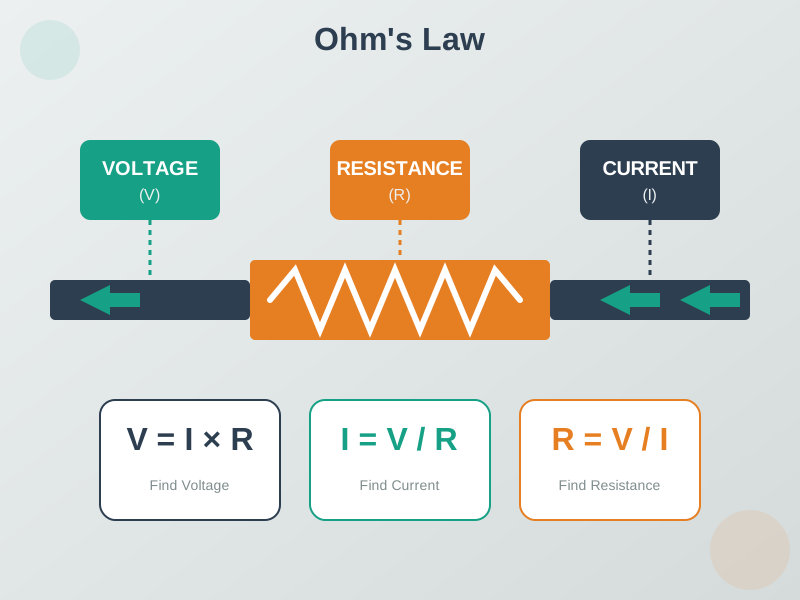
AI-generated modern visualization of the fundamental Ohm’s Law relationship used in all circuit analysis.
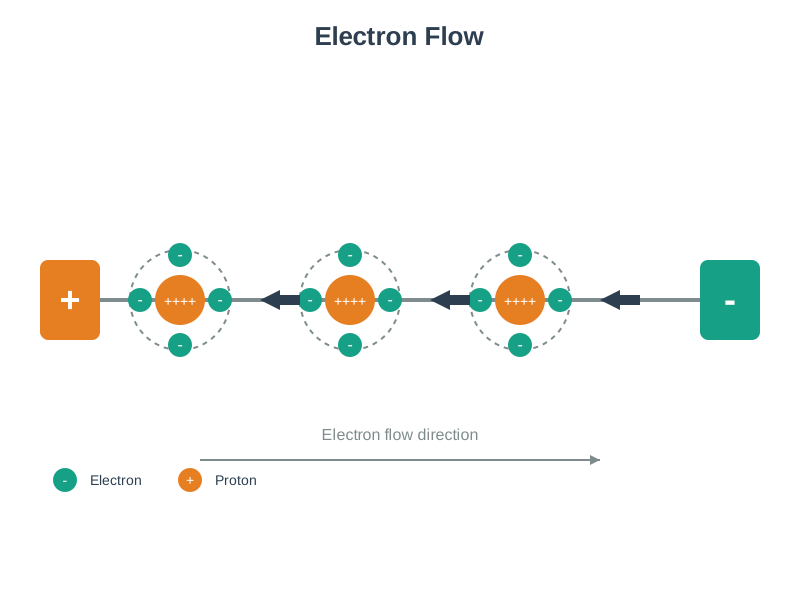
AI-generated geometric visualization explaining the physical basis of electrical current in conductors.
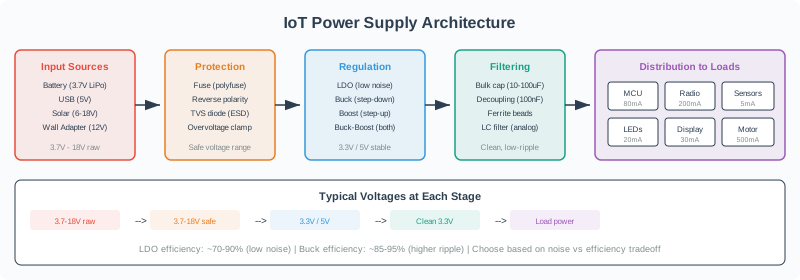
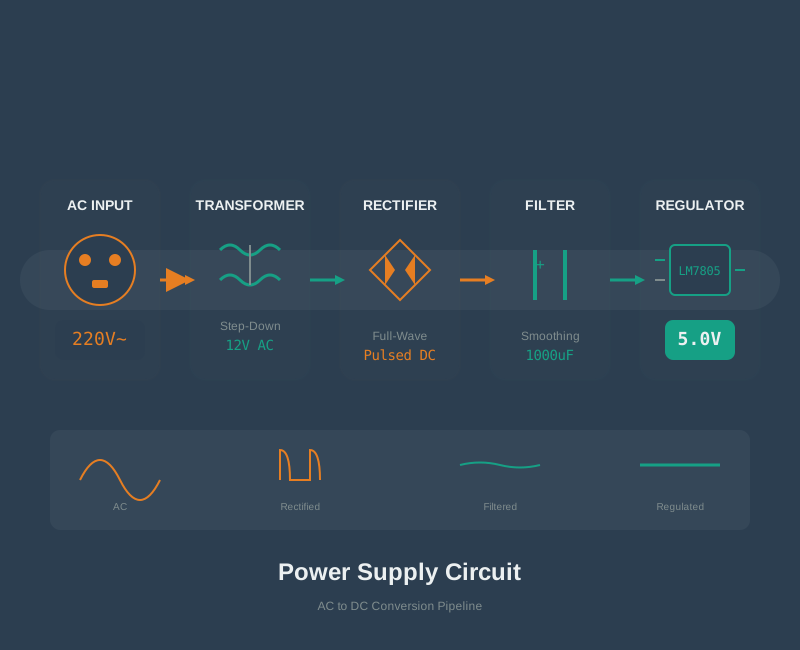
DrawIO template showing the complete power supply architecture for battery-powered IoT devices.
Decision context: When designing a power supply for an IoT device that will operate remotely or in hard-to-reach locations.
| Factor | Battery | Energy Harvesting |
|---|---|---|
| Power | Predictable, consistent output regardless of environment | Variable output depending on light, vibration, or thermal conditions |
| Cost | Lower initial cost ($1-$20 for typical IoT batteries) | Higher initial cost ($20-$100 for solar panels, harvesters, and PMICs) |
| Reliability | Finite lifespan; requires periodic replacement | Potentially infinite lifespan if properly sized for worst-case conditions |
| Maintenance | Scheduled battery replacements (months to years) | Minimal once deployed; monitor harvesting efficiency |
| Size | Scales linearly with capacity needs | Fixed harvester size; requires supercapacitor/battery buffer |
| Environmental | Disposal concerns; temperature sensitivity (-20C to 60C) | Green solution; some harvesters work in extreme temperatures |
Choose Battery when:
- Deployment is accessible for maintenance (monthly/yearly visits feasible)
- Power demand is high or unpredictable (actuators, high-bandwidth radios)
- Environmental conditions are unfavorable for harvesting (indoor, no vibration, stable temps)
- Project budget is limited and upfront cost must be minimized
Choose Energy Harvesting when:
- Device is deployed in inaccessible locations (bridges, wildlife, deep ocean)
- Ultra-long lifetime is required (10+ years maintenance-free)
- Environmental energy is abundant and consistent (outdoor solar, industrial vibration)
- Total cost of ownership matters more than initial cost (thousands of devices at scale)
Default recommendation: Battery power unless the deployment location is inaccessible OR you are deploying at scale (1000+ devices) where battery replacement costs exceed harvesting infrastructure investment.
7.5 Common Pitfalls
The mistake: Connecting multiple circuit boards or sensors using separate ground paths that create loops, introducing 50/60Hz mains interference and unexplained voltage fluctuations into sensitive analog measurements.
Symptoms:
- ADC readings show periodic 50Hz or 60Hz oscillations (depending on mains frequency)
- Sensor values fluctuate even with stable physical conditions
- Noise increases when motors, relays, or AC equipment operates nearby
- Connecting an oscilloscope probe changes the measurement (adds another ground path)
Why it happens: Ground loops form when current flows through unintended ground paths. If sensor ground and MCU ground connect at two different points, the resistance between those points creates a small voltage difference (ground noise). AC equipment induces currents in this loop through magnetic coupling, appearing as 50/60Hz interference.
The fix: Use a star ground topology–connect all ground wires to a single point near the power supply or MCU. For distributed systems, use differential signaling (twisted pairs) or isolated sensors. Add ferrite beads on ground wires to block high-frequency noise.
Prevention: Always plan your ground layout before wiring. Draw your ground connections–if you can trace a loop, break it. For sensitive analog circuits, keep analog ground (AGND) and digital ground (DGND) separate, joining only at the power supply.
The mistake: Powering sensitive analog sensors directly from a switching power supply or USB port without filtering, introducing high-frequency noise that corrupts ADC measurements.
Symptoms:
- ADC readings jump by 10-50 LSBs even with stable sensor input
- Noise frequency matches switching regulator frequency (typically 500kHz-2MHz)
- 12-bit ADC behaves like 8-bit (effective resolution loss of 4 bits)
- Problem worse when Wi-Fi or BLE radio is transmitting (current spikes)
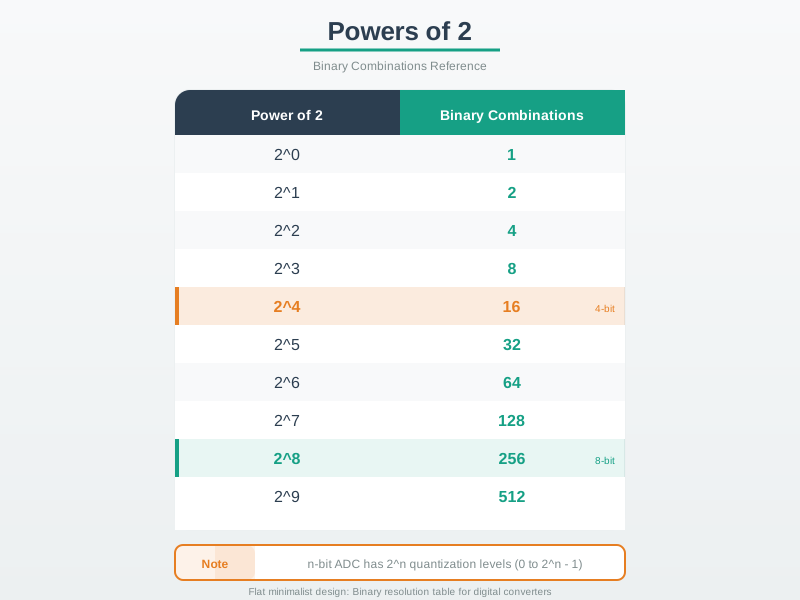
Why it happens: Switch-mode power supplies (including USB) generate ripple at their switching frequency. This ripple couples into the ADC reference and analog inputs. A 10mV ripple on a 3.3V supply with 12-bit ADC (0.8mV/LSB) causes 12 LSB noise. Radio transmit bursts draw 200-400mA spikes, causing supply voltage dips.
The fix: Add a dedicated LDO regulator (like AMS1117-3.3 or MCP1700) for analog sensor power, with 10uF input and 10uF output capacitors. Place a 100nF ceramic capacitor directly at each sensor’s power pins. Use separate power rails for digital (noisy) and analog (quiet) sections.
Prevention: Include analog power filtering in your initial design. Budget for an LDO even when your digital supply voltage matches sensor requirements–the filtering is worth the small efficiency loss. For battery systems, the LDO dropout of 200-300mV is acceptable for the noise improvement gained.
The Error: You build a 2.5V precision voltage reference using a voltage divider with two standard 1kΩ resistors (5% tolerance) from a 5V supply. The reference voltage should be exactly 2.5V for calibrating ADC readings, but measured values vary between 2.375V and 2.625V across production units.
Why This Fails:
Tolerance Stack-Up:
- R1: 1kΩ ± 5% = 950Ω to 1050Ω
- R2: 1kΩ ± 5% = 950Ω to 1050Ω
Worst-Case Scenario:
- Maximum output: (1050Ω / (950Ω + 1050Ω)) × 5V = 2.625V (+5% error)
- Minimum output: (950Ω / (1050Ω + 950Ω)) × 5V = 2.375V (-5% error)
For precision ADC calibration with 12-bit resolution (0.8mV/LSB at 3.3V):
- Acceptable error: ±5 LSB = ±4mV
- Actual error range: ±125mV = ±156 LSB (31× worse than needed!)
Why It Matters in IoT:
- Temperature sensors with 0.1°C precision become ±1°C inaccurate
- Battery voltage monitoring shows wrong SoC (State of Charge)
- Calibration constants change between devices (production nightmare)
- Field failures when “calibrated” sensors drift out of spec
The Fix: Use Precision Components
Option 1: Precision Resistors (1% or 0.1%)
- 1kΩ ± 1% tolerance: 990Ω to 1010Ω
- Worst-case voltage: (1010Ω / (990Ω + 1010Ω)) × 5V = 2.525V
- Error: ±25mV = ±31 LSB (much better, but still not ideal)
Option 2: Matched Resistor Pairs
- Use resistor networks where ratio is guaranteed (e.g., 0.1% ratio matching)
- Example: Bourns 4600X series (0.05% ratio tolerance)
- Output voltage error: ±0.05% = ±1.25mV = ±1.5 LSB ✓
Option 3: Precision Voltage Reference IC (BEST)
- Use dedicated voltage reference chip (e.g., TL431, LM4040, ADR431)
- Accuracy: ±0.5% to ±0.05%
- Temperature coefficient: 10-50 ppm/°C
- Cost: $0.50-$2 (worth it for precision)
Example: TL431 Precision Shunt Regulator
- Output: 2.495V (±0.5%) = 2.482V to 2.507V
- Error: ±13mV = ±16 LSB at 12-bit
- Temperature drift: 30 ppm/°C → ±0.75mV over 0-50°C
- Total error budget: ±14mV (acceptable for ±5 LSB target with margin)
Cost Comparison:
| Solution | Component Cost | Accuracy | When to Use |
|---|---|---|---|
| 5% resistors | $0.02 | ±5% (±125mV) | Non-critical, LED indicators |
| 1% resistors | $0.05 | ±1% (±25mV) | General analog circuits |
| 0.1% matched pair | $0.30 | ±0.1% (±2.5mV) | Precision sensors |
| Voltage reference IC | $0.80 | ±0.5% (±12mV) | ADC calibration, precision DAC |
Real-World Example: Temperature Measurement
Scenario: NTC thermistor voltage divider for temperature sensing - Voltage divider: 5V supply, 10kΩ NTC + 10kΩ fixed resistor - At 25°C: Vout = 2.5V - ADC resolution: 12-bit (0.8mV/LSB) - Target accuracy: ±0.5°C
With 5% resistors:
- ±125mV error = ±156 LSB
- Temperature error: ±3°C (unusable for HVAC control)
With 0.1% matched pair:
- ±2.5mV error = ±3 LSB
- Temperature error: ±0.2°C ✓ (meets spec)
Key Lesson: For precision analog circuits (ADC references, sensor calibration, battery monitoring), always use precision components (1% minimum, 0.1% for production). The extra $0.20-$0.50 per unit prevents field failures worth thousands in returns and reputation damage.
Design Checklist:
- ✓ Use precision voltage reference ICs for ADC Vref
- ✓ Use 0.1% matched resistor pairs for critical dividers
- ✓ Use 1% resistors minimum for analog signal paths
- ✓ Reserve 5% resistors for LED current limiting and pull-ups (non-critical)
- ✓ Calculate worst-case tolerance stack-up for ALL precision circuits
- ✓ Include temperature coefficient in error budget
7.6 Concept Relationships: Electrical Fundamentals
| Concept | Relates To | Relationship |
|---|---|---|
| Ohm’s Law | Circuit Analysis | V = I × R enables calculating any parameter when two are known; foundation for all circuit math |
| Series Circuits | Current Flow | Same current through all components; voltages add (V_total = V1 + V2 + V3) |
| Parallel Circuits | Voltage Distribution | Same voltage across all components; currents add (I_total = I1 + I2 + I3) |
| Power | Battery Life | P = V × I determines energy consumption; higher power → shorter battery runtime |
| Battery Capacity | Runtime | Runtime (hours) = Capacity (mAh) / Current Draw (mA); doubling current halves runtime |
| Ground Loops | Noise | Multiple ground paths create loops where AC currents induce voltage noise (50/60 Hz) |
| Voltage Divider | Sensor Interfacing | V_out = V_in × (R2 / (R1 + R2)); used for level shifting and battery monitoring |
| Tolerance Stack-Up | Precision | 5% resistors in divider: ±10% output error; use 0.1% matched pairs for precision |
7.7 See Also
- Electricity Introduction - Foundational concepts and terminology
- Ohm’s Law - The fundamental relationship between voltage, current, and resistance
- Common Electrical Pitfalls - Avoid common mistakes in circuit design
- Electronics Introduction - Components and circuit analysis
- Circuit Simulators - Practice circuit design with online tools
7.8 Summary
This chapter covered the electrical fundamentals essential for IoT systems:
- Fundamental Concepts: Electricity is the flow of electrons between atoms, with current (I) measuring charge flow in amperes, voltage (V) representing electrical pressure in volts, and resistance (R) opposing current flow in ohms
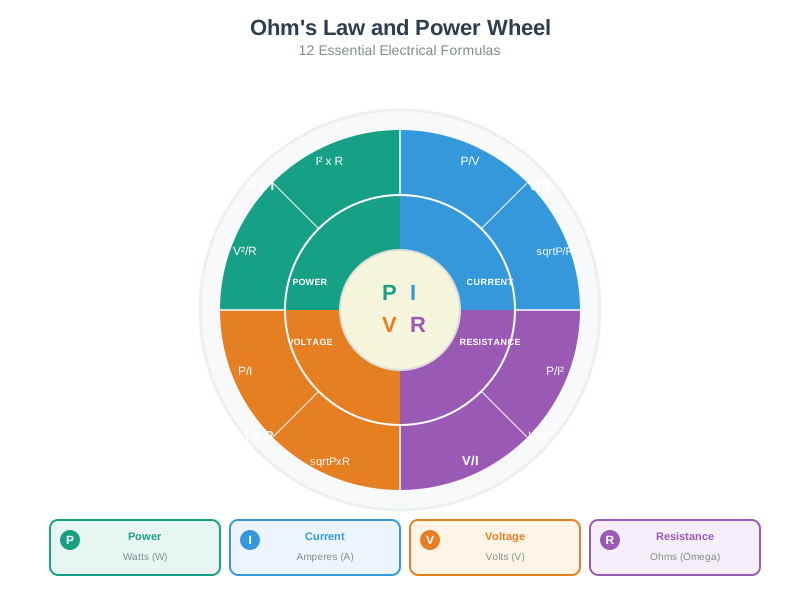
- Ohm’s Law: The relationship V = I × R is fundamental to all circuit analysis, enabling calculation of any electrical parameter when two are known
- Power and Energy: Power (P = V × I) measured in watts determines energy consumption rate, critical for battery life calculations in IoT devices
- Circuit Configurations: Series circuits share the same current with voltages adding up (V_total = V1 + V2), while parallel circuits share the same voltage with currents adding up (I_total = I1 + I2)
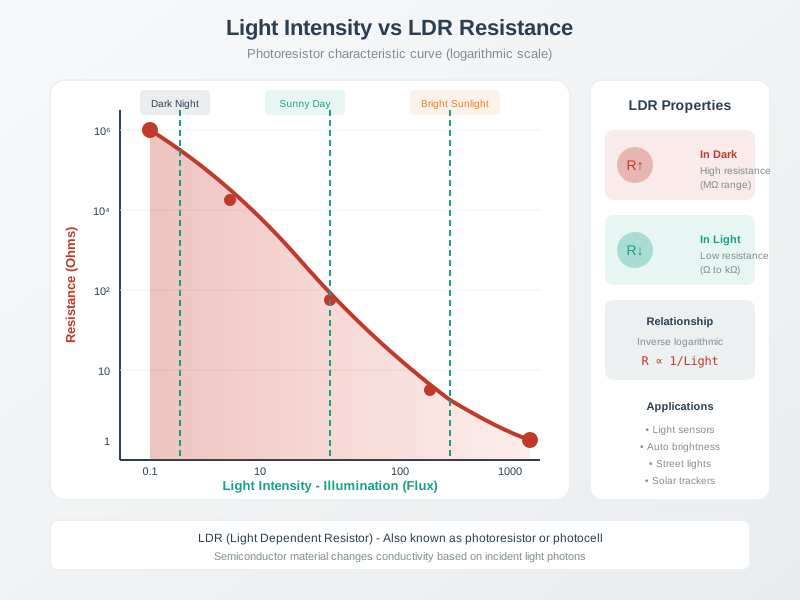
- Resistors: Fixed resistors limit current and divide voltage (color codes indicate values), while variable resistors (potentiometers, thermistors, photoresistors) enable sensor applications
- Capacitors and Inductors: Capacitors store energy in electric fields (used for filtering and timing), while inductors store energy in magnetic fields (used in power supplies and filtering)
- Battery Calculations: Battery life = capacity (mAh) / current draw (mA), essential for determining IoT device deployment duration and sleep mode requirements
Fundamentals:
- Electronics - Semiconductors, transistors, and diodes
- Analog-Digital Electronics - ADC/DAC conversion
Sensing:
- Sensor Fundamentals - Sensor types and power requirements
- Sensor Circuits - Circuit design for sensors
- Sensor Interfacing - Signal conditioning
Actuation:
- Actuators - Motors, relays, and control circuits
Design:
- Energy Management - Power budgeting
- Context-Aware Energy - Battery optimization
- Prototyping Hardware - Arduino, ESP32, Raspberry Pi
Architecture:
- Wireless Sensor Networks - Network power considerations
- Edge Computing - Distributed power systems
Learning:
- Simulations Hub - Circuit simulators
- Sensor Labs - Hands-on electrical labs
7.9 Visual Reference Library
This section contains AI-generated phantom figures designed to illustrate key concepts covered in this chapter. These figures provide visual reference material for understanding sensing and actuation systems.
Note: These are AI-generated educational illustrations meant to complement the technical content.
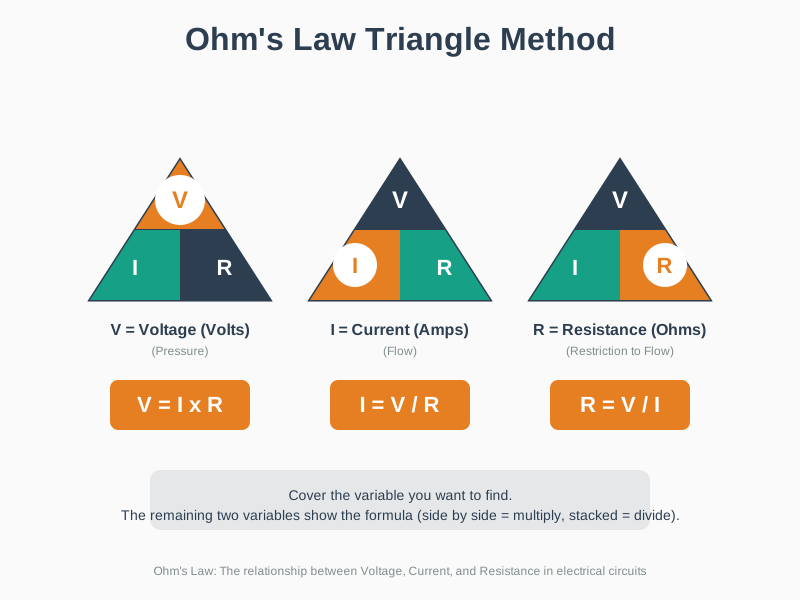
7.9.1 Ohm’s Law and Relationships
7.9.2 Light-Dependent Resistors
7.9.3 Power and Energy
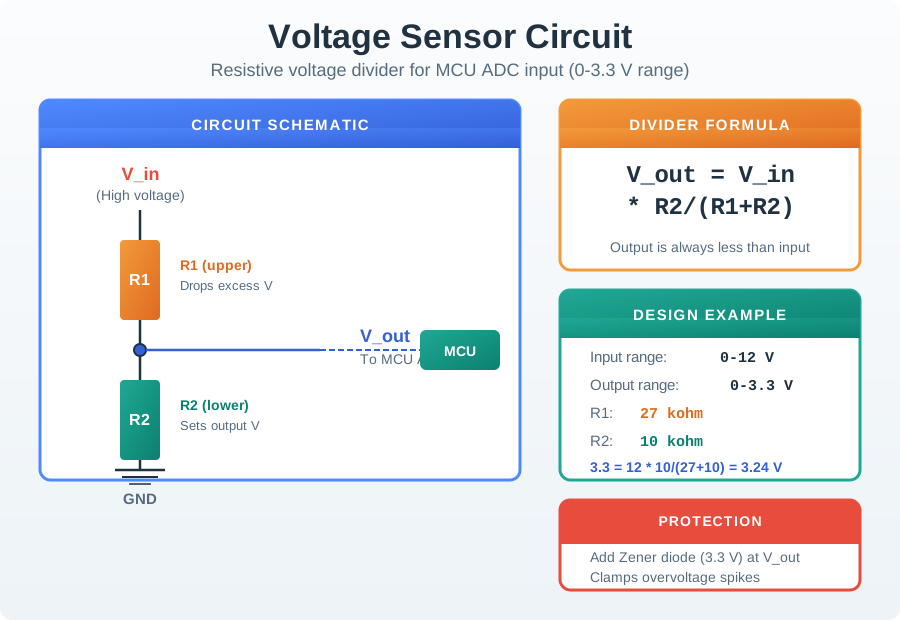
Voltage divider tolerance stack-up determines worst-case output error for precision ADC references.
\[ V_{error} = V_{supply} \times \sqrt{\left(\frac{\Delta R_1}{R_1}\right)^2 + \left(\frac{\Delta R_2}{R_2}\right)^2} \]
Worked example: For 2.5V reference from 5V using two 1kΩ resistors with ±1% tolerance (\(\Delta R = 10\Omega\)):
\[V_{error} = 5 \times \sqrt{\left(\frac{10}{1000}\right)^2 + \left(\frac{10}{1000}\right)^2} = 5 \times \sqrt{0.0002} = 5 \times 0.0141 = 70.7 \text{ mV}\]
This ±70.7 mV error (±2.8%) equals ±88 LSB for 12-bit ADC (0.8 mV/LSB) — far exceeding precision requirements. Using 0.1% resistors reduces error to ±7.07 mV (±9 LSB), meeting high-accuracy sensor calibration needs.
The Sensor Squad reviews everything they learned about electricity!
It was quiz day for the Sensor Squad, and Sammy the Sensor was a little nervous. “Don’t worry,” said Max the Microcontroller. “Let’s review what we know!”
Bella the Battery went first. “I’m like a water pump – I push electricity around the circuit with my voltage! The higher my voltage, the harder I push.” Max nodded. “And I remember that current is like the amount of water flowing through the pipe. More current means more electrons moving!”
Lila the LED chimed in. “And resistance is like a narrow part of the pipe that slows the water down. My friend the resistor uses resistance to protect me from too much current!” Sammy added, “We can figure out any of those three things using Ohm’s Law: V = I times R.”
“But there’s a sneaky problem,” warned Max. “Ground loops! Imagine if the water pipe had two different drains going to two different places – the water would get confused and swirl around, making noise.” Bella nodded wisely. “That’s why we always use a star ground – one single drain point for all the water to flow back to.”
“And don’t forget about noisy power supplies!” said Sammy. “A switching power supply is like a pump that goes THUMP-THUMP-THUMP really fast. Those thumps can mess up my sensor readings. That’s why we add special filter capacitors – they’re like shock absorbers that smooth out the bumps!”
The whole squad felt ready for their quiz. They had learned about voltage, current, resistance, Ohm’s Law, ground loops, and power supply filtering. “We’re electricity experts!” they cheered together.
7.9.4 Key Words for Kids
| Word | What It Means |
|---|---|
| Ground Loop | When electricity has more than one path back to the battery, creating noise |
| Star Ground | Connecting all ground wires to one single point to avoid noise |
| Filter Capacitor | A part that smooths out bumpy electricity, like a shock absorber |
| Power Supply | The part that provides electricity to the whole circuit |
| Ripple | Unwanted bumps in the electricity from a power supply |
Electricity fundamentals – voltage, current, resistance, Ohm’s Law, and power calculations – form the absolute foundation of all IoT hardware. Master these concepts and you can design, build, troubleshoot, and optimize any IoT circuit from simple LED indicators to complex multi-sensor systems.
7.10 Practice: Match and Order
7.11 What’s Next?
| If you want to… | Read this |
|---|---|
| Apply reference knowledge to basic circuit analysis | Electricity Fundamentals: Ohm’s Law |
| Understand how electronic components use these principles | Conductors & Semiconductors |
| Explore sensor electronics that rely on these fundamentals | Sensor Types: Introduction |
| See power management applications of electrical fundamentals | Sensor Power Management |
Now that you understand electrical fundamentals (voltage, current, resistance, power), you’re ready to explore electronics—the world of semiconductors, diodes, and transistors that form the building blocks of active circuits and microcontrollers.
Interactive Learning:
- TinkerCAD Circuits - Free circuit simulator
- PhET Circuit Simulation - Interactive physics simulations
Video Tutorials:
- SparkFun: Voltage, Current, Resistance
- ElectroBOOM: Electricity Explained
Reference:
- All About Circuits - Comprehensive electronics textbook
Electronics Foundation:
- Electronics - Electronic components
- Analog-Digital Electronics - ADC/DAC
Sensing:
- Sensor Circuits - Circuit design
- Sensor Fundamentals - Sensor types
Power & Energy:
- Energy Aware Considerations - Power budgeting
- Context-Aware Energy - Power management
Prototyping:
- Prototyping Hardware - Hardware platforms
Labs:
- Sensor Labs - Hands-on practice