2 How Electricity Works

More
Depth: Practitioner
Progress saves as you read. Mark sections complete as you go; your progress appears in the sidebar.
2.1 Start Simple
This section: Start Simple — Firmware is the software stored inside a device.
Trace the Whole Current Path
Firmware is the software stored inside a device. Picture a small pump that works on a bench but resets its controller when it starts. The control code may be correct while the power path, return wire, or supply limit is wrong.
Draw one complete loop from the source, through the load, and back. Mark voltage, expected current, current limit, and every shared return path. Measure with the load off, starting, and running. Compare those values with the safe limits of each part.
Test a loose wire, reversed connection, short load, weak supply, and sudden stop. Use a current limit and suitable protection before touching the circuit. Check whether the controller resets and whether stored evidence explains why.
Simple voltage and resistance rules describe only part of real behaviour. Heat, start-up current, wire loss, and changing loads matter too. The deeper sections add those effects while keeping every result tied to a safe circuit and a measured state.
Imagine an LED that sometimes turns on and sometimes stays dark. Before blaming the program, check the loop: source, load, return path, current limit, and a voltage you can measure across the part. Start with one safe path that works before adding sensors, radios, or firmware decisions.

2.2 Overview: What Electricity Must Explain
Electricity fundamentals give an IoT designer a way to reason about whether a circuit can power, protect, measure, and communicate safely. The core ideas are voltage, current, resistance, power, grounding, and the closed path that lets charge move through a load and back to its source.
The practical claim is not just "the board turns on." The practical claim is that every load has the right voltage, the expected current path, enough power margin, a shared reference where needed, and measurement evidence that matches the design.
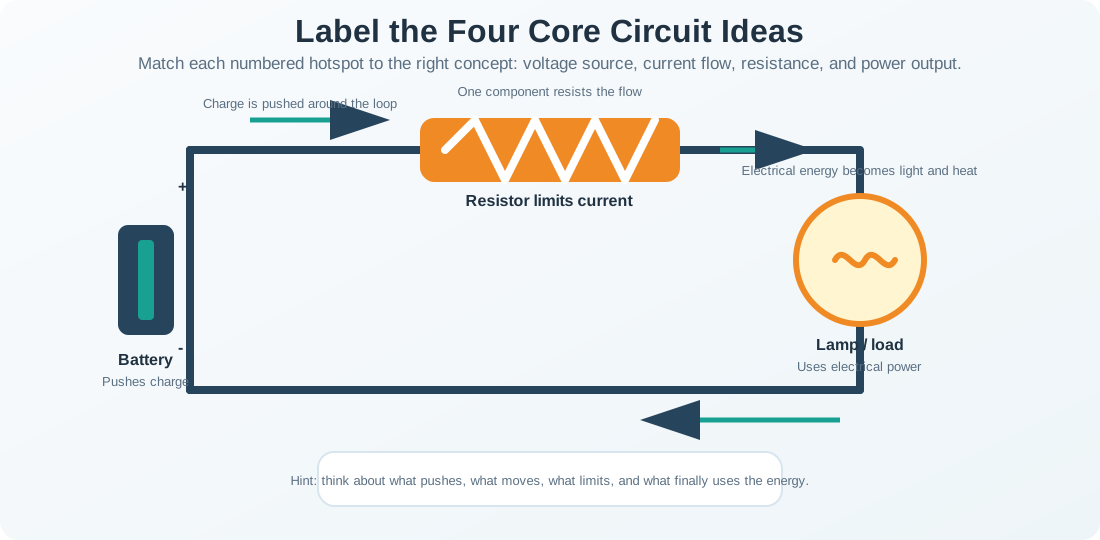
This is the beginner model to keep while debugging. A voltage value is always between two nodes, a current value belongs to a path through a component, a resistance value only explains behavior under the right conditions, and a power value tells you what the battery, regulator, package, or enclosure must survive. Treat those quantities as separate evidence, then connect them with Ohm's Law and measured data.
If you only need the intuition, this layer is enough: voltage pushes, current flows, resistance limits, power heats and drains sources, ground is the reference, and measurement proves the circuit.
2.2.1 The Four Quantities Beginners Must Separate
Voltage
Electrical potential difference between two points. It is measured across components and usually referenced to ground.
Current
Charge flow through a path. It is measured in series with the load and must return to the source.
Resistance
Opposition to current. It is useful for limiting current, setting dividers, sensing conditions, and protecting pins.
Power
Energy use per time. It determines battery drain, heat, regulator load, and component power ratings.
Calculate power only after naming the voltage across a component and the current through it in the same operating state. Follow where electrical energy enters, where useful work occurs, and where voltage drop becomes unwanted heat. A sleeping sensor, transmitting radio, and starting actuator can have very different power paths, so record each relevant state rather than multiplying unrelated maximum values. Compare the result with source capacity, regulator efficiency, package dissipation, enclosure temperature, and the required operating duration. This makes power the outcome of the complete circuit review, not a number detached from its current path.
2.2.2 Beginner Rules Of Thumb
Use the rules in causal order. First prove a complete source-load-return loop and name the two nodes for every voltage. Then check whether the current path crosses a microcontroller pin, driver, regulator, connector, or conductor limit. Apply Ohm’s law only to an approximately resistive part of that path; treat diode drops, motor startup, capacitive inrush, and radio bursts with their appropriate operating models. Convert the resulting voltage and current into power wherever energy becomes heat or battery drain. Finally reproduce the deployed wiring, supply, and firmware state during measurement. This order prevents any one rule from being used as a substitute for the evidence required by the others.
- A circuit needs a complete path from source, through load, and back to the source.
- Voltage is measured between two points, not at a point in isolation.
- Current through a microcontroller pin must stay below the pin and package limits.
- Ohm's Law is for resistive behavior; diodes, motors, capacitors, and radios need additional checks.
- Power ratings matter because excessive current or voltage drop becomes heat.
- Measurement should match the real wiring, firmware state, and supply used in deployment.
2.2.3 Overview Knowledge Check
2.3 Practitioner: Build A Circuit Review Ledger
A practical electronics review should produce a small ledger for the circuit. The ledger does not replace a schematic, but it makes the important assumptions visible: what each rail supplies, which loads draw current, where the return path runs, which limits protect components, and what measurement proves the design.
The safest workflow is to review voltage, current, resistance, power, and reference behavior before connecting a fragile part. In IoT work, that usually means checking sensor supply range, GPIO voltage compatibility, pull-up values, current limits, regulator heat, battery capability, and the exact measurement setup.
2.3.1 Circuit Review Sequence
Begin the record with source and regulated rail ranges, then trace every intended current loop through its load and return. At each boundary, identify limiting or protective parts and confirm their value, rating, and state. Compute current and dissipation for normal, startup, switching, and fault cases that matter to the product. The final step is physical proof: measure voltage across named nodes and current in the relevant branch while the actual firmware drives the real load. Preserve those readings with the wiring and test state. When the source, load, firmware, environment, or connector changes, reopen the sequence from the earliest affected boundary rather than reusing the previous conclusion.
- Name the rails. Record source voltage, regulated rails, allowed range, and what each rail powers.
- Trace current paths. Follow current from source through load and back through ground or return wiring.
- Check limiting parts. Confirm resistors, pull-ups, dividers, fuses, protection parts, and component ratings.
- Compute power. Convert voltage and current into heat, battery drain, regulator load, and safe margins.
- Measure the real circuit. Check voltage across loads and current through loads in the actual firmware state.
- Retest after changes. Repeat the ledger when wiring, firmware state, load, source, or environment changes.
2.3.2 Evidence Ledger
2.3.3 Practitioner Knowledge Check
2.4 Under The Hood: Why Simple Circuits Still Fail
Ohm's Law and the power law are simple, but the real circuit contains handoffs. A battery hands energy to a regulator. The regulator hands a rail to loads. Loads share ground and signal references. Firmware changes the current state. Measurement tools alter or reveal the circuit. A failure at any handoff can make a correct-looking schematic behave badly.
Use formulas as checks, not as decoration. For a resistor, V = I x R links voltage drop, current, and resistance. For a load, P = V x I links electrical behavior to heat and energy use. When voltages differ, compare power or energy instead of adding currents from different rails.
Debug those handoffs in order. Start at the source and measure the rail at the load while the load is active. Then check the return path, the signal reference, the limiting resistor or driver, and the power dissipated in each stressed part. If a reset, noisy reading, or hot package appears only in one firmware state, that state is part of the circuit evidence.
2.4.1 Handoff Points To Debug
Source to rail
Battery, USB, regulator, cable, switch, fuse, and connector behavior decide whether the rail stays in range under load.
Rail to load
Sensors, radios, relays, LEDs, and processors draw different current in startup, active, transmit, idle, and sleep states.
Signal to reference
Logic levels need a compatible voltage range and a shared reference. Missing ground can make readings random.
Model to measurement
Datasheets and calculations guide the design, but the accepted claim needs measured voltage, current, and temperature evidence.
2.4.2 Debugging Questions
Ask the questions against one captured failing state. Measure supply voltage at the active load and current in its actual branch, then verify that every signal is interpreted against a compatible reference. Compare peak demand—not only average demand—with the battery, regulator, wiring, and connector capability. Calculate dissipation where voltage is dropped, and include the package and enclosure’s ability to remove heat. Repeat the observation across startup, radio transmission, actuator motion, sleep transitions, and the relevant fault response. The answer that first differs from the design record identifies the boundary to investigate; it is more useful than replacing components or changing firmware without a measured hypothesis.
- Is the voltage measured at the load while the load is active?
- Is current measured in the path being reviewed, not across a powered component?
- Does every signal have a valid reference and compatible logic level?
- Can the source and regulator handle peak current, not just average current?
- Does any component dissipate more power than its package and environment can handle?
- Did the measurement cover startup, radio transmit, actuator movement, sleep, and fault conditions?
2.4.3 Under-the-Hood Knowledge Check
2.5 Summary
This section: Summary — Read these conclusions as one connected engineering argument: Electricity fundamentals connect voltage, current, resistance, power, ground, and closed current paths to IoT hardware behavior.
Read these conclusions as one connected engineering argument: Electricity fundamentals connect voltage, current, resistance, power, ground, and closed current paths to IoT hardware behavior. A working circuit claim needs measured evidence, not only a schematic or a powered-on board. Ohm’s Law helps review resistive current paths, but components such as LEDs, motors, capacitors, radios, and regulators need additional checks. Power calculations reveal heat, battery drain, regulator load, and component rating problems. Most prototype failures can be traced through source-to-rail, rail-to-load, signal-to-reference, or model-to-measurement handoffs.
Treat every IoT circuit as an evidence path: name the rail, trace the current, check the limits, measure the load, and retest after changes.
2.6 See Also
This section: See Also
Electricity Introduction
Build the beginner model for voltage, current, resistance, ground, and circuit flow.
Ohm's Law
Use voltage, current, resistance, and power equations for practical component decisions.
Electricity Common Pitfalls
Review unit mistakes, GPIO overcurrent, voltage drops, heat, grounding, and unsafe assumptions.
Electronics Fundamentals
Connect basic electricity to components, semiconductors, switching, and circuit validation.
Find help
3 reviewed answers.
Where should I start in a module?
Open the module page from the sidebar to see its chapters in order. Use the module map to return to a topic you need.
Modules and pathsReviewed
What can I try when a project does not work?
Check the symptom, then work through the diagnostic steps. Keep the error message and the smallest example that reproduces it.
When you are stuckReviewed
How do interactive examples work?
Use the interactive guide to check how examples and simulations work before changing your project.
Interactive examples guideReviewed