5 Common Circuit Mistakes
More
Depth: Practitioner
Progress saves as you read. Mark sections complete as you go; your progress appears in the sidebar.
5.1 Start Simple
This section: Start Simple — Picture a board that resets each time a relay turns off.
Measure the Failing State Before Blaming the Code
Picture a board that resets each time a relay turns off. The program ran correctly on the bench, so the team starts rewriting it. A loose return path, supply drop, reversed part, or switching spike can create the same symptom and survive every software change.
Firmware is stored device software. Before changing it, draw the complete current path from source through load and back. Mark polarity, expected voltage at each point, current limit, part rating, shared return, and the place where the measuring tool will connect.
Test with the relay idle, starting, running, and stopping. Add the longest planned wire, warm the load, and repeat at the lowest supply level. Record voltage drop, current, heat, and reset time. Change one thing at a time and stop if a part exceeds its rating.
This check does not replace safe isolation or a full circuit review. The deeper sections show unit conversion, voltage headroom, power loss, inductive loads, grounding, measurement limits, and pre-power evidence for common faults.
Imagine a prototype that works on the bench, then resets when a relay clicks. The useful first move is not a larger rewrite; it is checking polarity, grounds, shorts, current limits, voltage drop, and heat with the board in the failing state. Start with the smallest circuit that fails, prove the electrical path, and only then change the design.
5.2 Overview: Most Pitfalls Are Review Failures Before They Are Circuit Failures
Electricity mistakes in IoT projects usually happen before power is applied. A design mixes units, forgets a voltage drop, ignores current limits, treats a power rating as optional, shares a noisy return path, or uses a formula outside the condition where it applies. The hardware then fails quickly, intermittently, or only after deployment stress.
The practical response is a pre-power evidence habit. Do not rely on a diagram that only shows signal intent. Check the actual loop: source, load, return path, component ratings, polarity, connector orientation, measurement point, and what happens when the firmware, environment, or load changes.
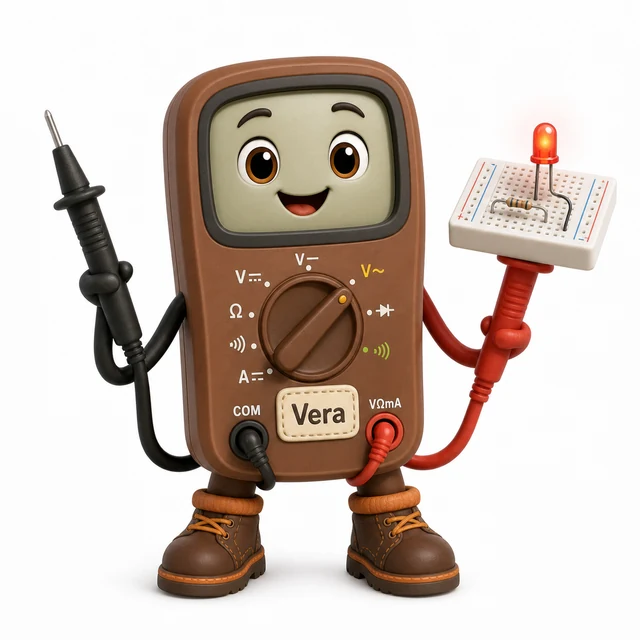
Voltage Vera
“Before you blame the code, follow the current — most ‘bugs’ are a loose ground or a wrong resistor.”
In this chapter Vera probes each pitfall before power is applied, not after a part overheats.
Before applying power, inspect Figure 5.1 as a compact review route through the mistakes that otherwise look like software faults after assembly.
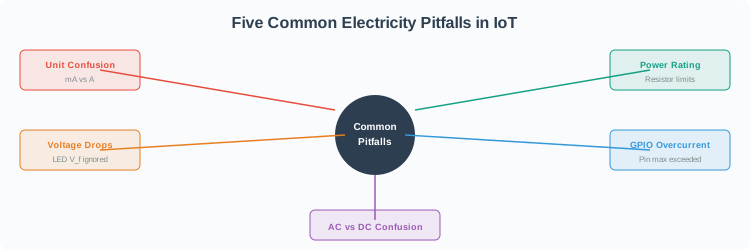
Work around Figure 5.1 in a fixed order. First put every value in the right unit. Then subtract each series voltage drop before choosing a resistor or driver. Name the signal type: DC, pulsed, inductive, capacitive, or AC-like. Find heat from the voltage that is truly across each part. Last, check that a GPIO only controls a rated load path. This review uses basic sums before power is applied. It helps stop hot parts and strange resets while the circuit is still on paper.
If you only need the intuition, use this rule: before powering a circuit, prove the voltage budget, current budget, power budget, polarity, ground path, and measurement plan.
Unit Confusion
Convert prefixes before calculating. A milliamp value used as amps creates errors by orders of magnitude.
Voltage Assumptions
Series components take voltage. LEDs, diodes, transistors, regulators, wires, and connectors can leave less headroom than expected.
Thermal Limits
Resistance alone is not enough. The part also needs a power rating, temperature margin, and mounting condition that match the real circuit.
Pin And Return Limits
GPIO pins are control signals, not general power supplies. Loads, inductive devices, and shared grounds need drivers and return-path review.
Trace load current from its supply through the driver and back to the source without routing it through a GPIO or a sensitive analogue return. Compare the pin's guaranteed logic levels and current limit with the driver's input requirement, then size the external driver for load, startup, and fault current. Measure ground displacement while the load switches because a shared return can make an otherwise valid sensor voltage appear to move. This evidence connects the pin limit to the complete current loop rather than treating the GPIO label as permission to power the load.
Vera’s Probe Points
- Measure: convert every prefix before calculating — “a milliamp value used as amps creates errors by orders of magnitude.”
- Expect: a part needs “a power rating, temperature margin, and mounting condition” that match the real circuit, not resistance alone.
- Wrong?: treating resistance as the whole rating — thermal margin is a separate check.
5.3 Practitioner: Use A Pitfall Ledger
A pitfall ledger is a short review record for every risky interface. It should be used for LEDs, sensors, relays, motors, heaters, long cables, power rails, analog inputs, and any circuit connected near mains-powered equipment. The ledger makes the reviewer ask whether the design has a calculation, a datasheet limit, and a measurement plan.
The key distinction is between a schematic that can be drawn and a circuit that can survive. A GPIO can draw a line to a load in a diagram, but the physical pin still has current, voltage, protection, and thermal limits. A resistor can have the right resistance and still fail because its power rating or temperature condition is wrong.
5.3.1 Pre-Power Record
Circuit section:
Supply range:
Expected load current:
Voltage drops accounted for:
Power dissipation and margin:
Driver or protection device:
Ground/return path:
Short/polarity check:
First measurement point:
Stop condition:
5.4 Under The Hood: Why Small Errors Become Field Failures
Electricity pitfalls chain together. A unit error can choose the wrong resistor. The wrong resistor can raise current. Higher current raises power dissipation. Heat changes component behavior and may stress a driver. A shared ground path then turns load current into sensor error. What looks like one mistake at the bench becomes a reliability problem in the field.
The physics is simple but unforgiving. Current needs a complete loop. Voltage divides across every element in that loop. Power becomes heat. Inductors resist sudden current changes. Capacitors and inductors behave differently with AC than with DC. Semiconductor pins and packages have absolute limits, recommended operating limits, thermal limits, and failure modes that are not reset by power cycling.
This is also why the first measurement point matters. A current-limited supply, a meter on the supply rail, and a written stop condition turn a fault into evidence instead of damage. If the voltage collapses, a part warms, a pin exceeds its expected current, or a sensor reference shifts when a load switches, stop and trace the loop before retrying with higher power.
5.4.1 Failure Chains To Break
Unit Error To Heat
A prefix mistake can increase current or power by a large factor, then a part overheats because only nominal resistance was checked.
Voltage Drop To Brownout
Regulator dropout, diode drops, cable resistance, and load pulses can leave the microcontroller below its reliable operating range.
Return Path To Bad Data
High load current sharing a thin ground path with analog sensors can shift the sensor reference and create false readings.
Inductive Spike To Latent Damage
A relay, motor, or solenoid can generate a turn-off spike that damages the driver immediately or weakens it for later failure.
When current through an inductive load is interrupted, stored magnetic energy still needs a path. Inspect the driver voltage at turn-off, verify the flyback diode or clamp orientation, and compare its voltage, current, and recovery behaviour with the coil energy and switching rate. A device that survives one bench cycle may still accumulate avalanche or thermal stress, so repeat the measurement at the highest supply, hottest enclosure, and fastest commanded switching. The resulting waveform and component limits—not a single successful activation—decide whether the protection is adequate.
Vera’s Probe Points
- Measure: a prefix mistake that raises current or power “by a large factor” while only nominal resistance was checked.
- Expect: a relay, motor, or solenoid turn-off spike “damages the driver immediately or weakens it for later failure.”
- Wrong?: assuming a part is safe because it worked once — failure modes “are not reset by power cycling.”
5.4.2 Retest Triggers
Retest when a change can alter available voltage, current demand, impedance, coupling, or heat. A new battery chemistry or regulator changes source behaviour; a longer cable or different connector changes resistance and interference pickup; a new package or substitute driver changes ratings and thermal paths. Firmware can be an electrical change too when it alters startup ordering, PWM duty, sampling cadence, sleep current, relay timing, or radio bursts. Recreate the most demanding operating state after each trigger, measure at the load and along the return path, and compare against the prior evidence record. If the circuit moves near motors, heaters, or mains equipment, add those noise and load states explicitly instead of assuming the bench result survives.
- The supply, regulator, battery chemistry, cable length, connector, or load current changes.
- A sensor moves from a short bench jumper to a long field cable.
- A firmware update changes sleep state, PWM duty cycle, relay timing, sampling rate, or startup behavior.
- A prototype part is replaced with a different package, tolerance, power rating, or driver device.
- The circuit is placed near mains-powered equipment, motors, heaters, or other noisy loads.

5.5 Summary
This section: Summary — Read these conclusions as one connected engineering argument: Convert units before calculating and carry units through every step.
Read these conclusions as one connected engineering argument: Convert units before calculating and carry units through every step. Account for series voltage drops and available headroom, especially in low-voltage IoT circuits. Check current, power, temperature, and package ratings before powering hardware. Use drivers and protection for loads; microcontroller pins should usually control power paths rather than supply them. Review ground and return paths because load current can create sensor error, brownouts, and intermittent faults. Treat AC, inductive, and capacitive behavior with the right model and isolation requirements.
A safe electricity review proves the loop before power is applied: units, voltage, current, power, polarity, return path, protection, and first measurement point.
5.6 See Also
This section: See Also
Electricity Introduction
Review voltage, current, resistance, power, grounding, and safe measurement basics.
Ohm's Law
Use voltage, current, resistance, and power equations with the correct assumptions.
Electricity Applications
Apply the review habit to sensors, loads, pull-ups, power rails, and protection.
Transistor Selection Guide
Choose driver devices when a microcontroller pin should not carry the load current.
Find help
3 reviewed answers.
Where should I start in a module?
Open the module page from the sidebar to see its chapters in order. Use the module map to return to a topic you need.
Modules and pathsReviewed
What can I try when a project does not work?
Check the symptom, then work through the diagnostic steps. Keep the error message and the smallest example that reproduces it.
When you are stuckReviewed
How do interactive examples work?
Use the interactive guide to check how examples and simulations work before changing your project.
Interactive examples guideReviewed