33 End-to-End Testing: Field Conditions and Evidence
More
Depth: Practitioner
Progress saves as you read. Mark sections complete as you go; your progress appears in the sidebar.
33.1 Start With the Decision
This section: Start With the Decision — A battery device can pass on a bench and fail after a cold radio retry.
A battery device can pass on a bench and fail after a cold radio retry. Field tests must include energy, network, timing, and recovery stress.
33.2 Route Overview
This section: Route Overview — This is part 2 of 2.
This is part 2 of 2. Review End-to-End Testing: Claims and Layers for the preceding evidence.
33.3 Learning Objectives
This section: Learning Objectives
- Design IoT tests for power, radio, timing, and sensor faults.
- Assemble release evidence from injected failures and recovery.
33.4 Chapter Roadmap
This section: Chapter Roadmap
- IoT-Specific Test Conditions
- Phoebe’s Field Notes: Why a Battery-Budget Test Needs More Than mAh × V
- A Green Unit Suite Is Not a Field Result
- Release Gate Evidence
- Plan Tests Before Running Them
- Defects, Waivers, and Follow-Up Runs
- Write Defects as Evidence Gaps
- Build Defect-Closure Record
- Micro-Exercise: Pick the Test Layer
- Metrics Without False Confidence
- Application Snapshots
- Incremental Examples
- Practice Checks
- Match Test Evidence to Purpose
- Order Validation Workflow
- Label Validation Route
- Unit Tests vs Field Claims
- Concept Check: Critical Requirement Gaps
- Common Pitfalls
- 1. Testing Only the Happy Path
- 2. Confusing Coverage With Confidence
- 3. Lab Conditions Are Not Field
- 4. Skipping OTA Failure Tests
- 5. Close Defects With Evidence
- Debate: IoT System Design Trade-off Scenarios
- Summary
- References
- See Also
- What’s Next
- Key Takeaway
33.5 IoT-Specific Test Conditions
This section: IoT-Specific Test Conditions — IoT failures often come from cross-layer interactions.
IoT failures often come from cross-layer interactions. A narrow software test can miss behavior caused by power, radio, enclosure, or cloud assumptions.
State transitions
Check boot, sampling, transmit, receive, sleep, brownout, charger, update, and recovery states on the final power path.
Unreliable links
Exercise packet loss, latency, roaming, reconnect, duplicate messages, replay, clock skew, and backend outage behavior.
Environment and enclosure
Represent temperature, humidity, dust, vibration, mounting orientation, antenna placement, and user installation variation.
Rollback and recovery
Test interrupted updates, low battery, corrupted downloads, version rollback, schema migration, and fleet staged rollout controls.

Unit tests should protect firmware logic, but field behavior depends on the board, radio path, enclosure, installation, power source, cloud service, and update path. Treat each layer as one part of the evidence set.
33.6 Release Gate Evidence
This section: Release Gate Evidence — A release gate must expose what each claim rests on.
A release gate must expose what each claim rests on. In Figure 33.1, traceability maps critical requirements to tests or accepted waivers. Defect status records severity, impact, and a follow-up result; regression checks guard the failure path after a fix. The environment item asks whether test conditions match the release context, while security and update checks cover credentials, OTA, rollback, and response. Operations readiness adds monitoring, a support runbook, staged rollout, and a rollback plan. Those records support an approve, hold, waive, or redesign choice with an owner. A clean lab result cannot replace an open field or recovery check.
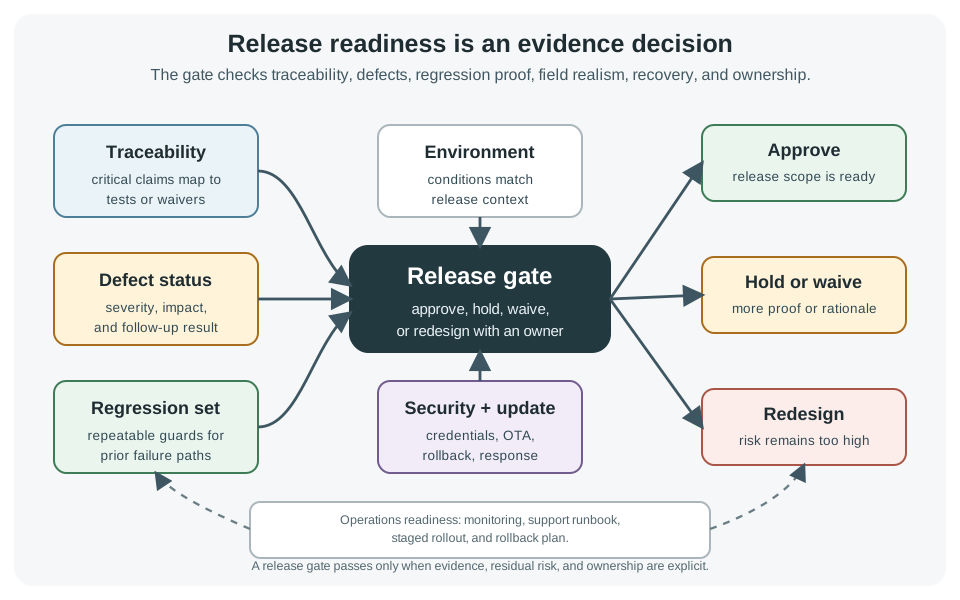
The gate in Figure 33.1 collects test and support proof; check gaps before approve, hold, waive, or redesign.
33.7 Plan Tests Before Running Them
This section: Plan Tests Before Running Them — A test plan does not need to be long.
A test plan does not need to be long. It needs to prevent ambiguity when results arrive.
33.8 Defects, Waivers, and Follow-Up Runs
This section: Defects, Waivers, and Follow-Up Runs — Defect handling is part of validation.
Defect handling is part of validation. A release review should be able to explain what failed, what changed, and why the follow-up check is credible.
Good defect: “REQ-NET-03 failed on board rev B with firmware abc123 when packet loss was 20 percent during reconnect; duplicate cloud messages were observed; logs attached.” Weak defect: “Reconnect sometimes weird.”
33.9 Build Defect-Closure Record
This section: Build Defect-Closure Record — If the note cannot name the original failure evidence and the repeated condition, the defect is not ready to close.
Choose one failed IoT test from a project, lab, or case study and write a five-line defect-closure record before the release review:
| Field | Defect-closure record |
|---|---|
| Original failure | Requirement, symptom, setup, and evidence that showed the failure. |
| Change under test | Firmware, hardware, fixture, cloud, configuration, or procedure change being checked. |
| Repeat condition | The exact failing condition that must be repeated, including load, network, timing, or environment. |
| Regression guard | The automated check, checklist item, trace, or measurement that will catch the failure if it returns. |
| Release decision | Go, hold, waive, or redesign, with owner and next evidence needed. |
If the note cannot name the original failure evidence and the repeated condition, the defect is not ready to close.
33.10 Micro-Exercise: Pick the Test Layer
This section: Micro-Exercise: Pick the Test Layer — First: The MQTT payload parser rejects malformed JSON and unknown units.
For each release claim, choose the first useful test layer and the later evidence that must still be collected:
First: The MQTT payload parser rejects malformed JSON and unknown units.
Next: The gateway recovers after Wi-Fi loss without duplicating queued readings.
Then: The battery node still meets its sleep-current budget after enclosure assembly.
After that: The OTA rollback path works when the download is interrupted at low battery.
33.11 Metrics Without False Confidence
This section: Metrics Without False Confidence — Metrics should guide review, not replace judgment.
Metrics should guide review, not replace judgment. A large number can still be meaningless if the test does not assert the right behavior.
33.12 Application Snapshots
This section: Application Snapshots — Use these as patterns.
Use these as patterns. The exact test mix depends on safety, cost, operating environment, security exposure, and ability to recover devices after deployment.
Power and recovery
Validate sleep transitions, brownout recovery, RF reconnect, queue handling, clock behavior, and current draw on final hardware.
Stress and serviceability
Exercise environmental exposure, EMC assumptions, cabling, installation errors, fault outputs, maintenance procedure, and spare-device swap.
Update and onboarding
Test first-use setup, credential handling, poor Wi-Fi, cloud outage, interrupted update, rollback, privacy notices, and support diagnostics.
Independent review
Use stronger traceability, hazard analysis, negative testing, documented waivers, and clear human override or fail-safe behavior.
33.13 Incremental Examples
This section: Incremental Examples
33.13.1 Protect Parser and State Machine
A first validation pass can protect isolated firmware or service logic. GoogleTest, pytest, or Vitest checks that malformed sensor payloads are rejected, timestamps are ordered, units are normalized, and the alarm state machine moves through normal, warning, alarm, mute, and clear states. The evidence is a CI run with test vectors and expected outputs. It does not prove RF behavior, current draw, enclosure performance, or cloud outage recovery.
33.13.2 Test Gateway Reconnect Layers
A gateway reconnect claim needs integration and system evidence. A Mosquitto or EMQX broker can force disconnects, duplicate deliveries, retained sessions, and delayed acknowledgements while firmware logs, MQTT broker logs, packet captures, and dashboard records are saved together. Wireshark or tcpdump shows packet behavior; OpenTelemetry, CloudWatch, Azure Monitor, or Grafana shows backend timing. If duplicate messages appear only after reconnect, the regression check should repeat that failure path instead of only rerunning happy-path unit tests.
33.13.3 Hold an OTA Release Gate
A field release for OTA firmware needs hardware, cloud, and operations evidence. Zephyr Twister, Renode, QEMU, HIL fixtures, or Robot Framework can cover repeatable update paths, but the release gate should also include bootloader slot behavior, image-signature checks, interrupted-download recovery, low-battery handling, flash-wear limits, staged rollout telemetry, rollback drill results, support runbook readiness, and owners for any accepted waiver. The release decision should say which firmware build, device cohort, monitoring alerts, and rollback trigger are covered.
An OTA decision can be read through the stages in Figure 33.2. The requirement claim names the firmware build, device cohort, update behavior, and fault context to prove. Risk review then asks what interrupted downloads, low battery, signature checks, boot slots, or rollback could invalidate that claim. The test plan chooses the fixture, data, and pass rule before an evidence run saves logs, versions, measurements, and defects. A regression set repeats known failure paths after fixes. The last stage records approve, hold, or redesign with the owner and release scope. Keep any accepted waiver and its remaining risk visible in that decision.
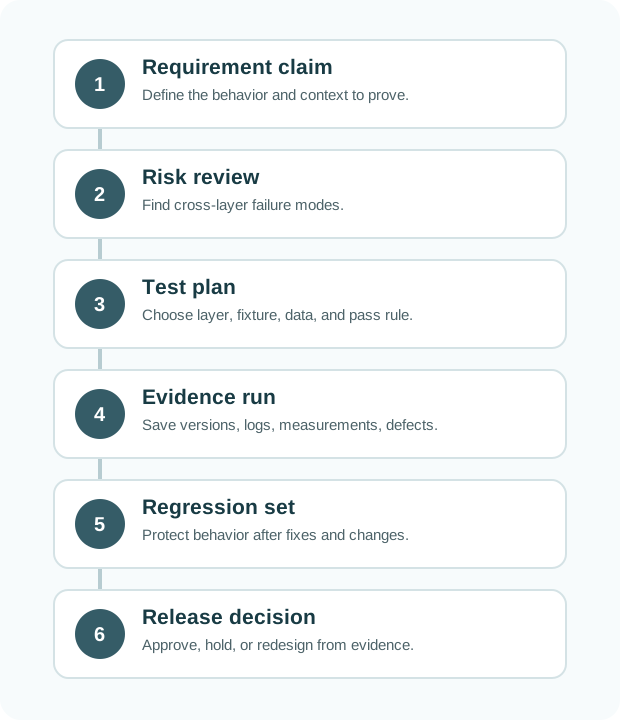
Three labelled stops organise Figure 33.2. Requirement claim uses Requirement claim to state a required condition; moving to Risk review shows where it uses Risk review to expose invalidating risk; ending at Evidence run shows where it uses Evidence run to hold review evidence. Together they explain why The validation route can be checked by asking which evidence belongs at each stage before a release decision matters to Hold an OTA Release Gate.
33.14 Practice Checks
This section: Practice Checks
33.15 Common Pitfalls
This section: Common Pitfalls
Many IoT failures happen during reconnect, sleep transition, update, low battery, sensor fault, invalid data, or backend outage. Include negative and recovery cases.
Coverage can show that code ran, but it does not prove that assertions were meaningful, that edge cases were tested, or that hardware behavior is valid.
A clean bench setup can hide antenna placement, enclosure, mounting, temperature, humidity, user installation, and cloud reliability issues.
Updates can fail because of low battery, poor connectivity, interrupted downloads, incompatible data schemas, or bootloader mistakes. Test rollback before field release.
Do not close a defect only because a fix was committed. Repeat the failing scenario, save the follow-up evidence, and add regression coverage where practical.
33.16 Debate: IoT System Design Trade-off Scenarios
This section: Debate: IoT System Design Trade-off Scenarios — Each scenario below presents a realistic IoT engineering decision with competing constraints.
Each scenario below presents a realistic IoT engineering decision with competing constraints. Work through the discussion questions before checking your reasoning against the trade-offs raised in each one.
33.16.1 Monolithic vs Microservices for IoT
Make One Trade-off Reversible
Picture a small team that chooses a complex platform for future scale, then cannot diagnose a simple field fault. A debate is useful only when its assumptions and exit path are visible.
Firmware means the program stored on a device to control its hardware. A real-time operating system means software that schedules device tasks within known timing rules; it is shortened to RTOS.
Choose one scenario, name the required outcome, compare two options under the same load and failure, and state a rollback trigger. Keep constraints, firmware and RTOS versions where relevant, cost, delay, failure result, owner, and excluded cases.
This exercise supports a bounded decision, not a universal winner. The scenarios below expose architecture, data, support, ethics, power, and compatibility trade-offs.
Scenario: A startup is building a fleet management platform expected to scale from 100 to 100,000 vehicles over 3 years.
Debate: Start with monolith or microservices?
Consider:
First: Team size and expertise
Next: Time to market pressure
Then: Operational complexity
After that: Scaling requirements
33.16.2 Time-Series DB vs Traditional SQL
Scenario: An energy company needs to store and query 10 years of smart meter data (15-minute intervals, 1 million meters).
Question: InfluxDB/TimescaleDB or PostgreSQL with proper indexing?
Discussion Points:
First: Query patterns (recent vs historical)
Next: Compression requirements
Then: Team’s existing expertise
After that: Integration with BI tools
33.16.3 Open Source vs Proprietary Firmware
Scenario: You’re choosing firmware for a new IoT product line. Budget allows either:
First: A) Open-source RTOS with community support
Next: B) Commercial RTOS with vendor support contract
Debate the Trade-offs:
Then: Security vulnerability response time
After that: Long-term maintenance costs
Also inspect: Regulatory compliance evidence
Finally: Talent availability
33.16.4 Data Monetization Ethics
Scenario: A fitness wearable company has anonymized health data from 10 million users. A pharma company offers $50M for access to study medication adherence patterns.
Question: Should they sell the data?
Positions:
First: Yes, with consent: Users agreed to terms of service
Next: Yes, anonymized: No individual harm possible
Then: No, trust violation: Users didn’t expect this use
After that: Conditional: Only for beneficial research
Facilitator Note: This has no “right” answer - explore the reasoning.
33.16.5 Planned Obsolescence in IoT
Scenario: A smart thermostat company must decide end-of-life policy. Hardware works fine but cloud services cost money to maintain.
Options:
First: End cloud support after 5 years (device becomes “dumb”)
Next: Offer paid extended support subscription
Then: Open-source the cloud backend for self-hosting
After that: Design for 10+ year offline operation from start
Debate: What’s the ethical and business-appropriate approach?
33.16.6 Battery vs Functionality
Scenario: You’re designing a cattle health monitor (ear tag). Requirements:
First: 5-year battery life
Next: GPS location (high power)
Then: Temperature sensing (low power)
After that: Heart rate monitoring (medium power)
Budget: Only one CR2032 battery fits the form factor.
Challenge: Which features do you include/exclude? Justify to your team.
Try the trade-off simulator below to turn this same kind of feature-vs-power decision into sliders: allocate a component budget across cost, battery life, latency, reliability, range, and measurement quality and watch where a design goes over budget or underpowered.
Field testing tradeoffs narrated tour
Play silently with captions on provisional storyboard timing; narration audio is pending. Production pacing is not device response time. Choose Reduced motion for a complete still at each beat.
Play the tour to open the workbench. Pause, replay a beat, or read the full transcript below. Some situations cannot be shown by this teaching model; those beats provide captions only.
Full transcript — Field testing tradeoffs (8 beats)
B1 — Tracker allocation
You are designing an internet-connected asset tracker. Its radio must reach far enough to track assets, but each unit also has a cost limit. Your decision is whether reducing computing capability can bring the design within budget while keeping its response delay acceptable.
Model caption: Asset tracker: reduce cost while preserving acceptable response delay. These are custom teaching inputs.
B2 — Acceptance criteria
A tradeoff means improving one part of a design makes another part harder. Start with a measurable requirement and decide what counts as passing before interpreting a result. For the tracker simulator, the budget limit is sixty-two dollars, and the response delay limit is three hundred seconds.
Model caption: Acceptance criteria for the comparison: unit cost at most $62; response delay at most 300 seconds.
B3 — Trial allocation
Use a trial allocation with computing capability at three out of ten. Keep the other investments fixed for the comparison. These settings are teaching inputs, and the outputs are estimates. The first question is narrow: does the estimated unit cost stay within the budget?
Model caption: Initial computing capability: 3/10. All other allocations remain fixed; outputs are teaching estimates.
B4 — Failed budget check
The estimate is sixty-four dollars fifty cents. Against the sixty-two dollar limit, that fails by two dollars fifty cents. The failed check gives a reason to revise the allocation. It also gives a specific result to compare against, rather than a vague feeling that the design costs too much.
Model caption: Model budget check fails: $64.50 exceeds $62 by $2.50. Asset displays $64.5 and $2.5 over.
B5 — Cost revision
Reduce computing capability from three to one out of ten. The model charges one dollar seventy-five cents per capability step, so the reduction saves three dollars fifty cents. Estimated cost becomes sixty-one dollars, leaving one dollar within budget. The revised allocation passes the cost criterion.
Model caption: Computing capability 1/10: $61 estimated cost; $3.50 saved; $1 budget margin. The cost criterion passes.
B6 — Response tradeoff
The saving has a consequence. Estimated response delay rises from about one hundred seventy-nine seconds to about two hundred twelve seconds. Both remain within the three hundred second limit. The revision buys lower cost with a slower response, while preserving the response requirement in the model.
Model caption: Initial: $64.50 and about 179 seconds. Revised: $61 and about 212 seconds. Response limit: 300 seconds. Asset delay readings: 179.10 s and 212.01 s.
B7 — Field evidence boundary
The misconception is that passing the model proves the tracker is ready for the field. The simulator uses teaching estimates. Actual behavior can depend on power, radio, or enclosure conditions that a narrow software test misses. A calculated pass cannot supply the observations from a field test.
Model caption: A model pass is an estimate, not field-test evidence. Field fault injection and observations are not represented by this asset.
B8 — Revision takeaway
For your tracker, the comparison now connects the failed budget check to a specific change and its result: lower estimated cost, with a longer response delay that still meets its limit. Let estimates guide the revision; let field evidence justify the release.
Model caption: Cost failure → computing capability 3/10 to 1/10 → $61 cost and about 212-second delay. Let estimates guide the revision; let field evidence justify the release.
33.16.7 Backward Compatibility
Scenario: Your IoT platform has 50,000 deployed devices using Protocol v1. You’ve designed v2 with major security improvements, but it’s incompatible with v1.
Options:
First: Force upgrade (break v1 devices)
Next: Maintain both indefinitely
Then: Gateway translation layer
After that: Phase out v1 over 2 years
Debate: What’s the responsible path forward?
33.17 Summary
This section: Summary — Testing and validation turns design claims into release evidence.
Testing and validation turns design claims into release evidence. Start with traceable requirements, review cross-layer risks, choose the cheapest credible test layer, run tests with versioned fixtures and saved data, treat defects as evidence gaps, preserve regression coverage, and make release decisions from traceability, defect status, waivers, rollback readiness, and residual risk.
33.18 References
This section: References — First: ISO/IEC/IEEE 29119 Software Testing Series - official overview of the software testing standards series.
First: ISO/IEC/IEEE 29119 Software Testing Series - official overview of the software testing standards series.
Next: NIST SP 800-160 Vol. 1 Rev. 1 - official systems security engineering reference for trustworthy secure systems.
Then: CISA Secure by Design - official secure-by-design guidance for technology manufacturers and buyers.
After that: GoogleTest - official C++ testing and mocking framework repository.
Also inspect: Zephyr Test Runner: Twister - official Zephyr documentation for test automation across platforms and configurations.
33.19 See Also
This section: See Also — First: Simulating Testing and Validation: decide where simulation, HIL, bench, and field evidence belong.
First: Simulating Testing and Validation: decide where simulation, HIL, bench, and field evidence belong.
Next: Accelerometer Datasheet Case Study: see how component evidence becomes release testing conditions.
Then: Network Traffic Analysis: use packet captures and logs when validation fails across device, network, and cloud boundaries.
After that: Design Patterns: move from validated behavior into reusable solution structures.
33.20 What’s Next
This section: What’s Next
| If you want to… | Read this |
|---|---|
| Study detailed IoT testing methods | Testing Fundamentals |
| Automate firmware behavior with fixtures | Hardware-in-the-Loop Testing |
| Practice simulation-based validation | Simulating Testing and Validation |
| Move into reusable solution structures | Design Patterns |
| Previous | Current | Next |
|---|---|---|
| Simulating Testing and Validation | Testing and Validation | Design Patterns |
33.21 Key Takeaway
This section: Key Takeaway — Testing finds defects; validation proves the system meets the intended need.
Testing finds defects; validation proves the system meets the intended need. IoT validation must include hardware, firmware, connectivity, data, security, user workflow, and field conditions.
33.22 Continue Your Route
This section: Continue Your Route — This is the last part of this chapter.
This is the last part of this chapter. Return to End-to-End Testing: Claims and Layers or continue from the design-methodology module index.
Find help
3 reviewed answers.
Where should I start in a module?
Open the module page from the sidebar to see its chapters in order. Use the module map to return to a topic you need.
Modules and pathsReviewed
What can I try when a project does not work?
Check the symptom, then work through the diagnostic steps. Keep the error message and the smallest example that reproduces it.
When you are stuckReviewed
How do interactive examples work?
Use the interactive guide to check how examples and simulations work before changing your project.
Interactive examples guideReviewed