7 IoT Project Planning: Discovery and Scope
More
Depth: Practitioner
Progress saves as you read. Mark sections complete as you go; your progress appears in the sidebar.
7.1 Start With the Decision
This section: Start With the Decision — An IoT project can collect many ideas and still lack one release promise.
An IoT project can collect many ideas and still lack one release promise. Discovery must turn user evidence into a bounded scope.
7.2 Route Overview
This section: Route Overview — This is part 1 of 2.
This is part 1 of 2. Continue with IoT Project Planning: Brief and Viability.
7.3 Part Objectives
This section: Part Objectives
- Convert user needs into a testable IoT release promise.
- Bound project scope with risks, roles, and success measures.
7.4 Start With One Release Promise
This section: Start With One Release Promise — Picture a cold-room pilot with a working sensor, a partly tested app, and no named person for night alerts.
Make “Ready” Mean the Same Thing to Every Owner
Picture a cold-room pilot with a working sensor, a partly tested app, and no named person for night alerts. Hardware, software, operations, and support can each call it ready while the release still has a dangerous gap. The plan needs one bounded promise and one shared evidence gate.
Firmware is stored device software. Write the smallest useful release: which room is covered, which alert is promised, who receives it, how quickly, and what remains out of scope. Give the sensor, firmware, service, app, field setup, and response procedure an owner and an acceptance record.
Test a false reading, lost link, delayed alert, new staff member, repair, and restart. For each case, decide who acts, what evidence is saved, and whether the promise still holds. Open risks should narrow or stop the release rather than disappear behind a completed task list.
This plan does not settle every later feature or supplier choice. The deeper sections connect research, assumptions, work packages, dependencies, risk records, hand-offs, and decision history to the next commitment.
Picture a team saying “the pilot is ready” while hardware, firmware, cloud, app, operations, and support each mean something different by ready. Project planning turns that uncertainty into one release promise: what slice will be built, who owns each decision, which risks are still open, and what evidence must exist before the next commitment.
7.5 Learning Objectives
This section: Learning Objectives
By the end of this chapter, you will be able to:
- Build an IoT project brief that connects the user problem, evidence, scope, and release decision.
- Map stakeholders, assumptions, dependencies, and risks before committing to implementation work.
- Convert design-thinking evidence into work packages, acceptance criteria, and release gates.
- Use decision logs and handoff artifacts to keep a project maintainable as the platform evolves.
Key Concepts
This section: Key Concepts — First: Project brief: A compact planning artifact that states the problem, target users, desired outcome, evidence gaps, constraints, scope boundaries, owners, and next review gate.
First: Project brief: A compact planning artifact that states the problem, target users, desired outcome, evidence gaps, constraints, scope boundaries, owners, and next review gate.
Next: Assumption map: A list of claims the plan depends on, grouped by user desirability, technical feasibility, data trust, operational fit, security, privacy, and support.
Then: Scope boundary: A visible line between what the current release must do, what it may do later, and what it deliberately will not do.
After that: Work package: A planning unit with a clear owner, evidence source, dependency, acceptance condition, and review gate.
Also inspect: Risk register: A living record of uncertainty, impact, trigger, mitigation, owner, and next check.
Finally: Evidence gate: A decision point where the team reviews whether the proof is strong enough to continue, narrow, pivot, or stop.
Finally: Decision log: A short history of important choices, alternatives considered, evidence used, and expected consequences.
7.6 Chapter Roadmap
- Start With One Release Promise
- Key Concepts
- Plans Are Testable Promises
- Convert Scope to Vertical Slice
- Own Interfaces Before Planning
- Checkpoint: Release Promises
- In 60 Seconds
- Prerequisites
- Plan IoT Projects From Evidence
- Incremental Examples
- Checkpoint: Evidence Before Expansion
- Planning Is Evidence Management
- Rule of Thumb
7.7 Plans Are Testable Promises
This section: Plans Are Testable Promises — An IoT project plan is useful when it turns a broad idea into promises the team can test.
An IoT project plan is useful when it turns a broad idea into promises the team can test. The plan should say what user outcome matters, what device behavior is required, what data path is trusted, what support path exists, and what decision will change if the evidence is weak.
Good planning keeps scope small enough for learning. A first release might prove one cold-room sensor path, one alert rule, one dashboard view, and one operator response workflow before expanding to every room, every device type, or every analytics idea. The brief should make that narrowness visible so stakeholders do not treat the pilot as a hidden commitment to a full platform.
Inspect Figure 7.1 and ask which planning artifact would reveal that a proposed feature sits outside the evidence question.
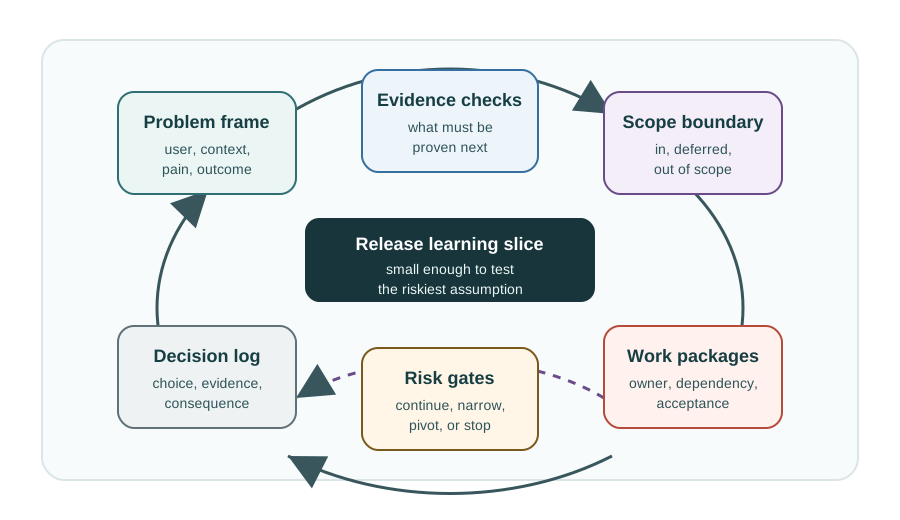
Read Figure 7.1 from the problem frame to evidence checks and the scope boundary. The frame identifies the user outcome, while evidence questions define what the project must learn before the team expands. The boundary then separates a small supported release from attractive work that is explicitly out of scope. Work packages convert that choice into owned deliverables, and risk gates test whether the evidence is sufficient to continue. The decision log records why the team proceeded, narrowed, held, or stopped, then feeds new information back to the original frame. This loop makes the chapter’s planning claim concrete: a schedule is not enough; every delivery decision must remain traceable to a question, an owner, and evidence capable of changing scope.
The planning artifact should connect design-thinking evidence to delivery evidence. For a pharmacy fridge monitor, the problem frame may come from staff interviews and temperature excursion records. The technical plan may name DS18B20 or SHT31 probes, enclosure placement, MQTT topic structure, TLS certificate handling, alert deduplication, and dashboard freshness. The operations plan may name who receives after-hours alerts, who replaces batteries, who reviews compliance exports, and what happens when a device misses heartbeats. If those decisions are scattered across chat threads, tickets, and diagrams, the project becomes hard to review and harder to maintain.
A useful plan is also allowed to say no. It can defer predictive analytics until basic temperature evidence is trustworthy, exclude mobile push notifications until acknowledgement ownership is clear, or hold a multi-site rollout until installation time and support volume are measured. That restraint protects the team from building a large system around untested assumptions.
- User promise: The system helps a named person make a better decision or take a faster action.
- Technical promise: The device, network, cloud service, and interface can produce trustworthy behavior under realistic constraints.
- Operational promise: The installed system can be powered, updated, recovered, secured, and supported after the first demo.
7.8 Convert Scope to Vertical Slice
This section: Convert Scope to Vertical Slice — Start with the smallest slice that crosses the real system boundary.
Start with the smallest slice that crosses the real system boundary. For a cold-room monitor, that could mean one DS18B20 or SHT31 sensor, one ESP32 or Raspberry Pi Pico W node, MQTT publishing over Wi-Fi, a broker or AWS IoT Core endpoint, InfluxDB or TimescaleDB storage, a Grafana panel, and one alert acknowledgement path.
Each work package should carry an acceptance condition that a reviewer can run. Device work may need calibration checks, enclosure placement notes, watchdog behavior, and OTA rollback. Network work may need RSSI readings, broker logs, QoS selection, TLS certificate handling, and outage behavior. Data work may need schema ownership, timestamp quality, retention rules, missing-data display, and permission checks.
Practitioners should write those packages as evidence units, not departmental wish lists. A device package can be accepted when the probe reads within the agreed tolerance at two reference temperatures, survives a door-open test, reports battery voltage, and records firmware version. A connectivity package can be accepted when the node reconnects after access-point restart, queues readings during a short outage, and publishes retained or non-retained messages according to the alert policy. A dashboard package can be accepted when it shows current, stale, alarm, acknowledged, and maintenance states with timestamps that operators can interpret.
The planning cadence should include real gates. A discovery gate asks whether the user problem and simpler alternatives have been checked. A prototype gate asks whether the riskiest assumption changed. A pilot gate asks whether installation, telemetry, support, and privacy behavior are strong enough for a limited field release. A scale gate asks whether costs, support load, update process, and data retention are acceptable before the project expands. Tools such as Jira, GitHub Issues, Linear, Notion, Confluence, or a shared spreadsheet can hold the records, but the important part is that every ticket links back to an assumption, owner, and gate.
- Write the release boundary. State what is in the first slice, what is deferred, and what is explicitly excluded.
- Attach owners to assumptions. Give user, device, network, data, security, and operations risks named owners and review gates.
- Keep a handoff path. Store the brief, risk register, decision log, runbook, and test results where the next maintainer can use them.
7.9 Own Interfaces Before Planning
This section: Own Interfaces Before Planning — Most project plans fail at interfaces between teams or layers.
Most project plans fail at interfaces between teams or layers. Hardware may assume firmware can filter noisy data. Firmware may assume the network is always available. The cloud team may assume payload fields are stable. Operators may assume a failed device is easy to identify. A plan needs to make those assumptions explicit before they become late-stage defects.
Use planning artifacts to expose interface contracts. The device contract covers sensor range, sample interval, calibration, firmware version, power source, and local fault state. The transport contract covers MQTT topic names, QoS, retained-message policy, TLS identity, retry behavior, and payload schema. The service contract covers validation rules, storage retention, alert latency, dashboard freshness, user permissions, and incident ownership.
Those contracts should have version and ownership fields. A payload schema can move from temperature_c and battery_mv to temperature_c, battery_mv, door_open, and fault_code only when the backend, dashboard, tests, and support runbook know how to handle both versions during rollout. A device-shadow or twin record in AWS IoT Core, Azure IoT Hub, LwM2M, or a custom fleet table should distinguish desired configuration, reported configuration, firmware version, last heartbeat, and update state. Without that split, planning documents may say “update firmware” while the system cannot tell which devices actually accepted the update.
Project planning also has security and privacy interfaces. Provisioning needs an owner for certificate issuance, key storage, revocation, and factory reset. Access control needs roles for operators, maintainers, administrators, and auditors. Data governance needs retention windows, export rules, deletion paths, and incident review. If the plan only assigns feature work, these responsibilities appear after launch as urgent operations problems rather than planned design constraints.
The under-the-hood planning test is simple: a new maintainer should be able to trace a field failure from symptom to owner. If a cold-room alert is late, the record should show whether the likely cause is sensor placement, sampling interval, Wi-Fi outage, MQTT retry behavior, broker delay, cloud rule configuration, notification delivery, or operator acknowledgement. That traceability is what turns a plan from a schedule into an operating system for the project.
- Physical interface: Sensor tolerance, mounting, IP rating, cable length, power budget, battery replacement, and maintenance access.
- Digital interface: JSON or CBOR payload fields, schema version, timestamps, topic hierarchy, certificate identity, and API contract.
- Human interface: Alert copy, escalation path, operator acknowledgement, support runbook, training need, and stop condition.
This section:
 Checkpoint: Release Promises
You now know:
- A plan is a testable promise about user value, technical behavior, and operational support.
- The smallest credible slice should cross the device, data path, interface, and support boundary.
- Interface contracts need owners because payloads, device state, access control, and recovery paths can all fail at handoff.
This section:
This section:
This section:
7.10 Prerequisites
This section: Prerequisites
- Design Thinking Introduction: Evidence loops, phases, and assumption framing.
- Empathize and Define: User research, problem statements, and How Might We questions.
- Agile and Risk Management: Risk registers, Definition of Done, Kanban flow, and release controls.
7.11 Plan IoT Projects From Evidence
This section: Plan IoT Projects From Evidence — IoT project planning translates design-thinking evidence into a controlled delivery path.
IoT project planning translates design-thinking evidence into a controlled delivery path. The plan should not pretend that every answer is known. Instead, it should make uncertainty visible, assign ownership, and define the smallest release that can prove or disprove the important assumptions.
Planning works best when the team produces four answers in order:
Inspect Figure 7.2 as a controlled delivery path with explicit return routes. Its first two questions, 1. Why now? and 2. Evidence gaps?, connect users, stakeholders, pain, workaround, and intended outcome to a bounded problem whose untested claims are visibly marked as assumptions.
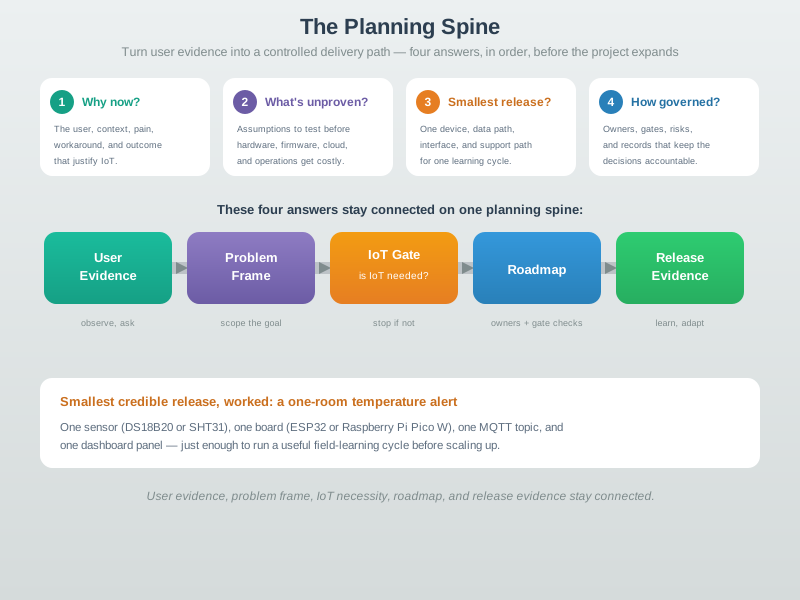
Continue through Figure 7.2 to 3. Smallest release, which turns requirements and limits into a concept or architecture choice, and 4. How governed?, which demands an owner, gate, decision record, and retest-on-change rule. The lower spine expands these questions into user evidence; problem and assumptions; requirements, constraints, and choices; prototype and measured test; decision ownership; and release readiness with accepted risk, a runbook, and revisit triggers. Each forward move therefore requires evidence, while a changed context or failed test returns to the affected stage rather than forcing the roadmap onward. For a one-room IoT release, record who observed the work, why a connected solution is necessary, the non-IoT alternative, device and data boundaries, acceptance limits, prototype failures, recovery behavior, support owner, accepted risk, and the condition for expanding beyond that room. Link every roadmap item to the evidence gap or acceptance limit it closes, not merely to a component delivery. Procurement requires an approved requirement and substitution rule; integration requires interface and failure contracts; pilot entry requires measured device, data, alert, offline, and recovery behavior; expansion requires the named operator, runbook, rollback, and review trigger. A failed gate changes scope or returns to evidence collection, and its decision record remains visible to the next reviewer. This keeps roadmap dates subordinate to evidence and prevents a prototype success from silently becoming fleet approval.
7.12 Incremental Examples
This section: Incremental Examples
7.12.1 One-Room Temperature Alert
Start with a single cold-room monitoring slice. The brief can name one user action, one DS18B20 or SHT31 sensing path, one ESP32 or Raspberry Pi Pico W node, one MQTT topic, one dashboard panel, and one acknowledgement workflow. The planning gate asks whether operators can act on the alert and whether the reading is trustworthy enough for that room before adding more rooms.
7.12.2 Multi-Site Asset Monitoring
For a facilities project, the plan needs more explicit interfaces. Work packages should separate device provisioning, TLS identity, MQTT topic ownership, LTE-M or Wi-Fi connectivity, InfluxDB or TimescaleDB retention, Grafana dashboard freshness, OTA rollback, and support runbook tests. The release boundary should say which sites, devices, alerts, and recovery paths are in the first field-learning cycle.
7.12.3 Regulated Predictive Maintenance
A predictive-maintenance project for industrial equipment needs project planning that can survive audit and operations review. The brief should connect vibration or current sensing, gateway buffering, OPC UA or MQTT Sparkplug integration, maintenance-work-order handoff, model-change ownership, privacy/security review, failure-mode limits, and incident response. The first release should retire one high-risk assumption, not promise fleet-wide automation.
The same artifacts must work for a small room alert, a multi-site field release, and a regulated maintenance workflow.
This section:
Checkpoint: Evidence Before Expansion
You now know:
- The planning spine asks why now, what is unproven, what the smallest release is, and how decisions will be governed.
- A first field-learning cycle should prove user action, data trust, recovery, and governance before wider rollout.
- Strong plans retire the highest-risk assumption before promising broad automation.
7.13 Planning Is Evidence Management
This section: Planning Is Evidence Management — A plan is weak when it lists tasks without explaining why those tasks matter.
A plan is weak when it lists tasks without explaining why those tasks matter. A plan is strong when every task can point to a learning need, a user promise, or a risk that must be reduced.
A project is ready for implementation planning when the team can name the riskiest assumption, the evidence that will test it, the owner responsible for the check, and the decision that will change if the evidence fails.
7.14 Continue to the Next Part
This section: Continue to the Next Part — Carry this evidence into IoT Project Planning: Brief and Viability, which begins with Build the Project Brief.
Carry this evidence into IoT Project Planning: Brief and Viability, which begins with Build the Project Brief.
Find help
3 reviewed answers.
Where should I start in a module?
Open the module page from the sidebar to see its chapters in order. Use the module map to return to a topic you need.
Modules and pathsReviewed
What can I try when a project does not work?
Check the symptom, then work through the diagnostic steps. Keep the error message and the smallest example that reproduces it.
When you are stuckReviewed
How do interactive examples work?
Use the interactive guide to check how examples and simulations work before changing your project.
Interactive examples guideReviewed