5 Implement and Iterate
More
Depth: Practitioner
Progress saves as you read. Mark sections complete as you go; your progress appears in the sidebar.
-

What must the alert do after its first lost message?
5.1 Start With One Thin Slice
This section: Start With One Thin Slice — Picture a cold-room alert that works in a demo but cannot recover after its first lost message.
Release One Safe Thread Before Adding Features
Picture a cold-room alert that works in a demo but cannot recover after its first lost message. The team needs one complete, supportable path before it adds more screens or sensors.
Firmware means the software stored on the device. Telemetry means records a system sends about its readings, state, and health. Define who owns each part before the first release.
Run one alert from sensing through recovery. Interrupt power, delay a message, install the wrong version, and record the device identity, time, state, result, and owner response.
This runway does not prove that the whole product is ready. The deeper sections explain thin slices, release gates, staged rollout, rollback, support, and the evidence needed to iterate safely.
Picture the first release of a connected service as one complete thread, not a pile of unfinished features. A thin slice might sense one condition, publish one message, store one record, show one decision screen, and support one recovery action. Implement-and-iterate work asks whether that thread is safe, observable, useful, and ready to teach the next build decision.
5.2 Learning Objectives
This section: Learning Objectives
By the end of this chapter, you will be able to:
- Convert prototype evidence into a narrow MVP scope and release goal.
- Define an IoT-ready Definition of Done that covers hardware, firmware, cloud, privacy, support, and rollback.
- Organize implementation work into thin slices that produce evidence instead of disconnected component work.
- Plan staged rollouts, telemetry, and field feedback loops for deployed connected products.
- Use release evidence to decide whether to proceed, iterate, hold, or pivot.
5.3 Implementation Is Operating Model
This section: Implementation Is Operating Model — An IoT MVP is not just the first version of the app.
An IoT MVP is not just the first version of the app. It is the smallest supported operating loop that includes device behavior, firmware update, connectivity, cloud processing, user interface, privacy controls, support response, and rollback. If any part of that loop has no owner, the product is not ready for real users.
The implementation stage should protect the validated value while shrinking everything else. A cold-room alert MVP may need one supported sensor node, a defined placement rule, a three-state alert, acknowledgement, device-health telemetry, setup guidance, and a support path. It does not need every dashboard, every integration, or every automation idea from the prototype phase. The release question is narrower: can the team keep a real freezer safe, recover from common faults, and learn whether staff trust the alert?
Inspect Figure 5.1 and ask which field signal would stop expansion of the MVP.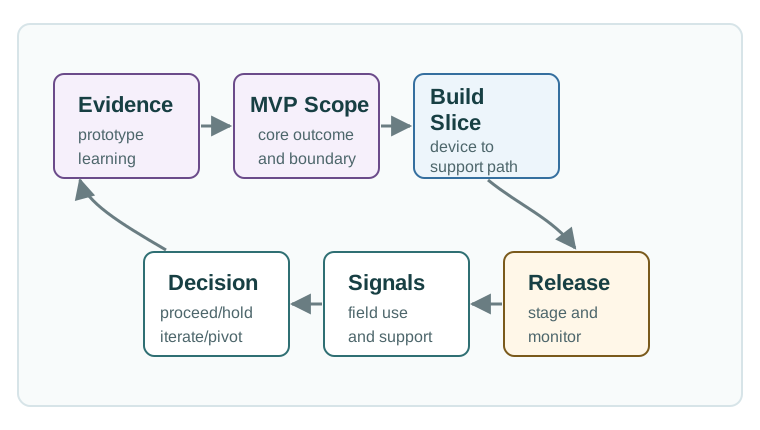
Read Figure 5.1 from trial proof into MVP scope. Keep one sound sensor path, alert and receipt flow, device health view, setup guide, and support owner. Leave out features that do not test the current question. Small build slices should cross the device, link, cloud, user view, and recovery path. A staged release puts those slices in front of a small group. Device data and support notes then become field signals. The last choice may proceed, hold, change, or pivot; it is not always one more sprint. Health gates, rollback rules, and a named response owner must exist before the group grows.
A release-ready slice also includes the unglamorous paths that prototypes often skip. For a smart irrigation controller, the slice might include soil-moisture sampling, pump-control interlock, local manual override, LoRaWAN or Wi-Fi outage behavior, cloud rule evaluation, a phone notification, and a printed installer checklist. For an indoor air-quality monitor, it might include sensor warm-up, calibration notice, battery warning, MQTT retry behavior, dashboard freshness, and a support script for a failed pairing. These are not extra polish items; they are what make the value usable outside the lab.
The team should treat implementation evidence as a decision record. Each release should state what will be learned, which cohort receives it, what telemetry proves basic operation, what support signal stops expansion, and what rollback action is available. That record keeps iteration from becoming endless feature churn. When the evidence says the setup flow fails, the next iteration should improve setup rather than adding a second chart or a new integration.
- Scope boundary: Include only what protects the user outcome, field operation, security, privacy, update path, and learning question.
- Release boundary: Separate code deployed, feature enabled, device updated, cohort expanded, and support team ready.
- Learning boundary: Collect telemetry and feedback only when the team knows what decision each signal supports.
5.4 Build Field-Ready Vertical Slices
This section: Build Field-Ready Vertical Slices — A useful implementation slice crosses the real system path.
A useful implementation slice crosses the real system path. For an alert product, one slice might include sensor sampling, firmware fault state, MQTT publish, cloud rule, app notification, acknowledgement, support runbook, and telemetry dashboard. A slice that only builds the app screen or only brings up the sensor hides integration risk until too late.
Staged rollout is part of product design. Use cohorts, feature flags, compatibility checks, device-health thresholds, support-volume thresholds, and rollback rules before expanding. A canary release should show whether devices update cleanly, recover from weak Wi-Fi or cellular links, preserve local fallback behavior, and produce enough diagnostic context for support. The same release can be enabled for three internal devices, ten friendly customer devices, and one regional cohort without changing the firmware artifact if the enablement boundary is explicit.
Practitioners should write the Definition of Done as a cross-functional checklist rather than a sprint slogan. Hardware may need enclosure labeling, battery-life evidence, regulatory assumptions, and spare-unit handling. Firmware may need watchdog behavior, signed image checks, schema compatibility, and a factory-reset path. Cloud services may need alert deduplication, device-shadow or twin state, retention settings, and operator dashboards. The app or web surface may need offline copy, acknowledgement states, accessible error text, and a clear escalation path. Support needs the same release notes as engineering, translated into questions that can be answered during a real call.
Tooling should serve the rollout, not replace the judgment. Feature-flag services such as LaunchDarkly or open-source alternatives such as Unleash can separate deployment from exposure. OTA systems such as Mender, RAUC, SWUpdate, AWS IoT Jobs, and Azure Device Update can manage cohorts and retries. Prometheus, Grafana, Sentry, CloudWatch, Azure Monitor, Zendesk, Jira Service Management, and simple MQTT capture logs can show whether the release is healthy. The team still has to name the stop rule before the release starts.
- Define done across the loop. Cover firmware tests, hardware configuration, message schema, cloud rule, UI state, privacy text, support workflow, and rollback.
- Instrument the release question. Name events such as setup_completed, alert_acknowledged, firmware_restart, message_retry, offline_queue_flushed, and support_contacted.
- Gate by cohort health. Track activation rate, update success, last heartbeat age, battery drain, crash/restart rate, alert acknowledgement, and support volume.
- Keep rollout reversible. Plan signed OTA updates, previous firmware availability, feature disablement, data-schema compatibility, and support scripts before expansion.
5.5 Release Safety Needs State
This section: Release Safety Needs State — The implementation layer needs versioned contracts.
The implementation layer needs versioned contracts. A device should report hardware revision, firmware version, configuration version, schema version, boot reason, battery state, network type, last heartbeat, and update status. The backend should know desired versus reported state through an AWS IoT Device Shadow, Azure IoT Hub device twin, LwM2M object, or equivalent fleet record.
OTA safety is a state machine, not a button. Queued, downloading, verifying signature, installing, rebooting, healthy, failed, rolled back, and support-needed are separate states. Systems such as Mender, RAUC, SWUpdate, AWS IoT Jobs, Azure Device Update, or a custom bootloader can support this pattern, but only if rollback, power-loss behavior, storage limits, and compatibility checks are tested.
The message contract needs the same discipline. If firmware version 1.4 publishes temperature_c, battery_mv, sequence_number, and fault_code, the cloud rule should tolerate the previous schema during rollout and reject malformed values without hiding them. A gateway that bridges BLE sensors to MQTT should attach gateway firmware, sensor address, receive signal strength, timestamp source, and queue depth so an operations engineer can distinguish a failed sensor from a failed bridge. Schema registries, JSON Schema, Protocol Buffers, Avro, or typed TypeScript contracts can all help, but the release record must say which versions remain supported.
Observability should connect product and operations. Prometheus, Grafana, OpenTelemetry, Sentry, CloudWatch, Azure Monitor, BigQuery, Snowflake, Zendesk, or Jira Service Management can all help, but the release is only learning if events map to decisions: expand, hold, patch, rollback, change onboarding, or simplify the product. A dashboard that shows raw event volume is weaker than one that shows cohort health, time since last heartbeat, failed update reason, alert acknowledgement delay, and open support cases by firmware version.
Iteration also has data-governance mechanics. Field telemetry should keep only the identifiers and time windows needed for reliability, safety, billing, or support. Personal data should be separated from device-health data where possible, and the release owner should know which tables, logs, or buckets must be purged when a customer leaves the pilot. Without retention and ownership rules, the MVP can accidentally become a permanent data collection system that is harder to change than the product itself.
- Device state: Hardware revision, firmware version, config version, battery, connectivity, heartbeat age, boot reason, and update state.
- Rollout state: Cohort, feature flag, compatibility result, update progress, rollback availability, and support readiness.
- Learning state: Release question, event definitions, dashboard owner, review cadence, next action, and signal retirement rule.
5.6 From Prototype to Product
This section: From Prototype to Product — The previous chapter tested assumptions with sketches, Wizard-of-Oz flows, breadboards, and functional prototypes.
The previous chapter tested assumptions with sketches, Wizard-of-Oz flows, breadboards, and functional prototypes. This chapter asks a different question: what is the smallest safe, supportable product that can deliver the validated value in real use?
5.7 Define the MVP Scope
This section: Define the MVP Scope — An MVP is not a demo and not an excuse to ship an unsafe or unsupported device.
An MVP is not a demo and not an excuse to ship an unsafe or unsupported device. It is the narrowest product that can deliver the core user outcome while meeting the minimum operational bar for real deployment.
Core User Job
Name the decision, task, or relief the product must deliver. Everything else is secondary.
Thin Product Slice
Include the minimum device, firmware, connectivity, interface, data flow, and support path needed for that outcome.
Field Readiness
Ship only when setup, failure recovery, privacy, telemetry, updates, and support have a real owner.
Scope Boundary
Move desirable but unproven additions into the next-learning backlog rather than the current release.
If the release plan includes every feature from the prototype wish list, the team has not defined an MVP. The release scope should be narrow enough that each included feature can be defended by prototype evidence, operational need, security need, or a clear learning question.
5.8 Definition of Done for IoT
This section: Definition of Done for IoT — Software teams often use a Definition of Done for code quality, review, and tests.
Software teams often use a Definition of Done for code quality, review, and tests. IoT products need a broader version because the release crosses hardware, firmware, network, cloud, mobile interface, data governance, field support, and update operations.
The board in Figure 5.2 shows a passed user test and failed device test; notice why rollout stops.
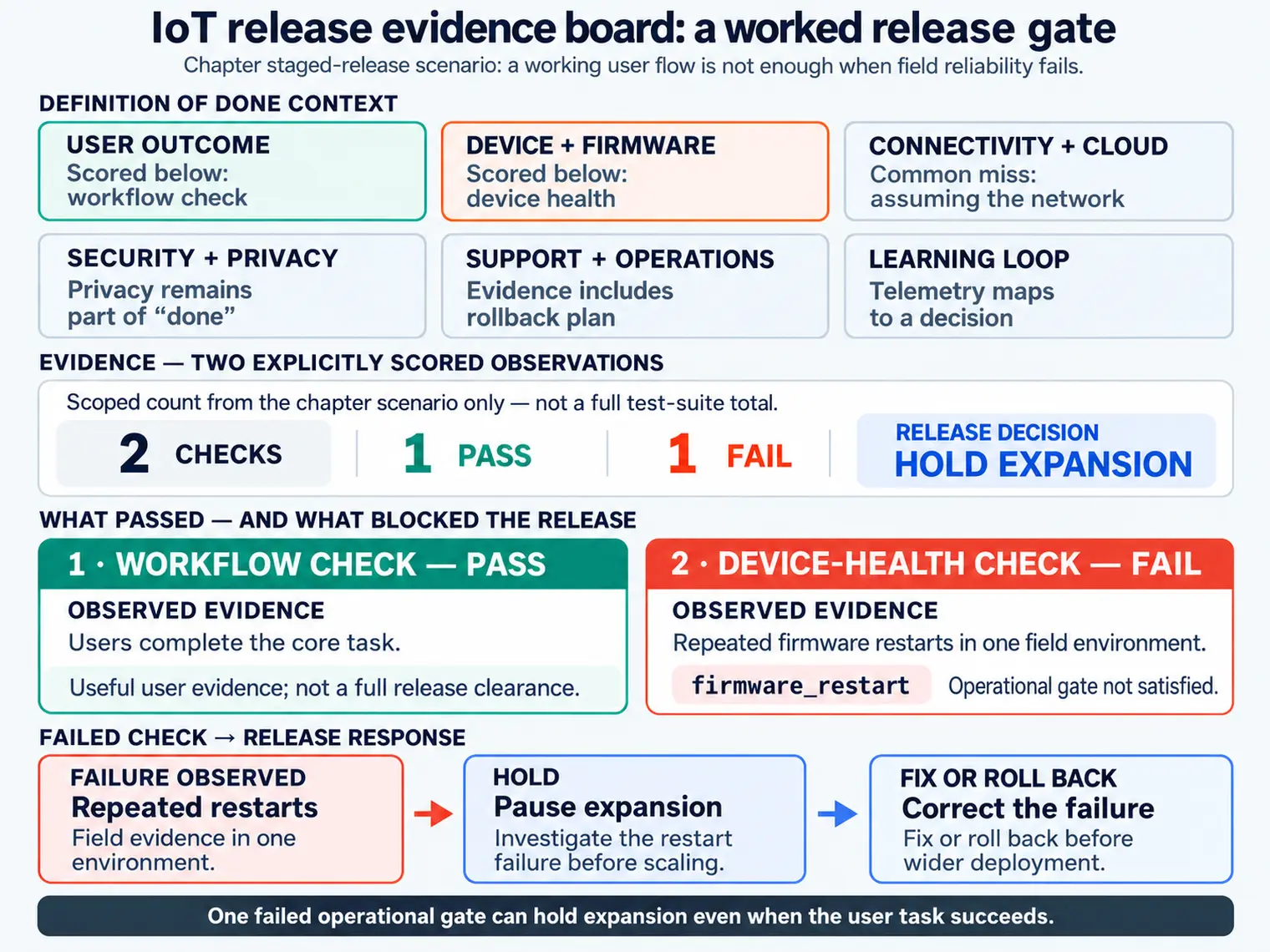
Within Figure 5.2, Evidence is the decision record: one workflow observation succeeds and one device-health observation fails. The Assuming the network and privacy reminders keep the worked gate connected to the wider IoT Definition of Done, while the failed field-reliability check demonstrates why a working user flow alone is not enough to expand deployment.
5.9 Build in Thin Slices
This section: Build in Thin Slices — Implementation quality improves when each slice connects the user outcome to the actual system path.
Implementation quality improves when each slice connects the user outcome to the actual system path. Avoid organizing the first release as isolated workstreams that only integrate at the end.
“Almost done” features are dangerous because they sound cheap while adding testing, support, security, documentation, and rollback work. A feature belongs in the current release only if it protects the release goal or resolves a blocking risk.
5.10 Staged Rollout and Update Safety
This section: Staged Rollout and Update Safety — Connected products need a release plan that assumes some devices will be offline, misconfigured, low on power, behind weak networks, or running older firmware.
Connected products need a release plan that assumes some devices will be offline, misconfigured, low on power, behind weak networks, or running older firmware. Staged rollout is not only for user-interface experiments; it is part of device safety and supportability.
5.11 Telemetry and Feedback
This section: Telemetry and Feedback — Telemetry should be designed around decisions, not curiosity.
Telemetry should be designed around decisions, not curiosity. Each event should answer a release or iteration question.
alert_acknowledged, setup_completed, report_viewedbattery_low, sensor_fault, firmware_restartmessage_retry, offline_queue_flushed, sync_failedpermission_declined, data_export_requested, alert_mutedsupport_contacted, reset_requested, install_failedUseful telemetry has stable names, clear ownership, and a reason to exist. Avoid collecting raw data because it might be useful someday. The stronger pattern is: decision first, signal second, event third.
5.12 Decide: Proceed, Iterate, Hold, or Pivot
This section: Decide: Proceed, Iterate, Hold, or Pivot — Iteration is useful only if evidence changes the plan.
Iteration is useful only if evidence changes the plan. A release review should separate observed field signals from opinions, then choose a specific next action.
5.13 Worked Example: Cold-Room Alert MVP
This section: Worked Example: Cold-Room Alert MVP — If staff acknowledge alerts but frequently contact support before acting, the concept is probably valid but the workflow needs iteration.
Problem frame:
Prototype evidence:
- Staff understood a three-state alert model: normal, watch, and act.
- A clickable alert workflow showed that staff needed the alert reason and the next responsible role, not only a temperature number.
- A breadboard sensor test showed that placement and door-opening behavior affect measurement stability.
- User interviews showed that support and escalation are part of the product, not a separate afterthought.
MVP scope:
Iteration decision example:
If staff acknowledge alerts but frequently contact support before acting, the concept is probably valid but the workflow needs iteration. If devices fail to maintain health reporting in the field, hold rollout and fix the device or connectivity path. If supervisors do not trust the alerts after placement and workflow fixes, return to prototype testing and reconsider the sensing approach.
5.14 Release Evidence Record
This section: Release Evidence Record — Each implementation cycle should leave an evidence record that future teams can understand.
Each implementation cycle should leave an evidence record that future teams can understand.
The pack in Figure 5.3 groups service, update, and support proof; check each area before rollout.
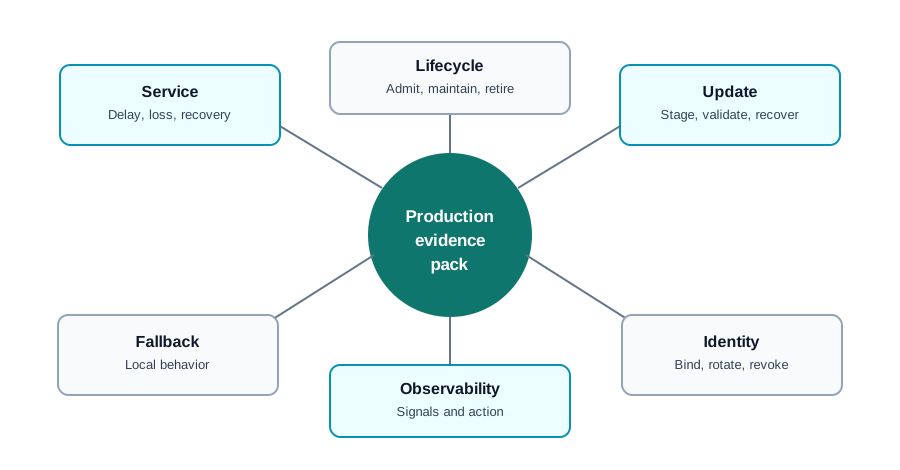
The pack in Figure 5.3 links rollout to its owner; check update, fallback, identity, and logs.
5.15 Knowledge Check
This section: Knowledge Check
5.16 Code Challenge: Release Gate Helper
This section: Code Challenge: Release Gate Helper
5.17 Common Pitfalls
This section: Common Pitfalls
An MVP may be narrow, but it is still a real product release. It needs support, security, privacy, update, rollback, and monitoring paths.
Hardware, firmware, cloud, app, support, and telemetry should meet in thin slices. Late integration hides the most important implementation risks.
Telemetry that is not tied to a release or iteration decision becomes noise. Define the decision before defining the event.
Do not expand a release because the calendar says so. Expand only when the user outcome, operations path, reliability, privacy, support, and rollback evidence are ready.
5.18 References
This section: References — First: Scrum Guide: official guide to Scrum roles, events, artifacts, commitments, and Definition of Done.
First: Scrum Guide: official guide to Scrum roles, events, artifacts, commitments, and Definition of Done.
Next: Agile Manifesto Principles: principles for iterative delivery, working product, and adapting to change.
Then: ISO 9241-210:2019: human-centred design lifecycle principles for interactive systems.
After that: NISTIR 8259A: IoT device cybersecurity capability core baseline.
Also inspect: NIST SP 800-213: IoT device cybersecurity guidance for federal systems that can inform release and security gates.
5.19 See Also
This section: See Also
5.20 What’s Next
This section: What’s Next — Continue to IoT Validation Framework after the MVP scope, release gates, telemetry signals, and iteration decision process are ready for real field learning.
Continue to IoT Validation Framework after the MVP scope, release gates, telemetry signals, and iteration decision process are ready for real field learning.
5.21 Summary
This section: Summary — Implementation and iteration convert prototypes into maintainable systems.
Implementation and iteration convert prototypes into maintainable systems. In IoT, iteration must include firmware, hardware, cloud services, deployment logistics, support workflows, and feedback from real operating conditions.
5.22 Key Takeaway
This section: Key Takeaway — Iteration should be evidence-driven.
Iteration should be evidence-driven. Use telemetry, user feedback, failure reports, and field measurements to decide what to improve rather than adding features blindly.
Find help
3 reviewed answers.
Where should I start in a module?
Open the module page from the sidebar to see its chapters in order. Use the module map to return to a topic you need.
Modules and pathsReviewed
What can I try when a project does not work?
Check the symptom, then work through the diagnostic steps. Keep the error message and the smallest example that reproduces it.
When you are stuckReviewed
How do interactive examples work?
Use the interactive guide to check how examples and simulations work before changing your project.
Interactive examples guideReviewed