14 A Repeatable Design Method
More
Depth: Practitioner
Progress saves as you read. Mark sections complete as you go; your progress appears in the sidebar.
14.1 Start With the Decision Record
This section: Start With the Decision Record — A gateway is a point that joins device links to the next part of the system.
A gateway is a point that joins device links to the next part of the system. Its site, load, power, and owner are part of the design.
Imagine a school planning air sensors in twenty rooms. The real decision is not which tool can draw the best coverage map. It is how many gateways, links, and support steps are needed to meet a clear service goal.
Write the decision first. List each assumption about walls, traffic, range, power, users, and failure. Choose evidence for each question, then plan the test before running a model or buying hardware. Keep raw results, variation, and the rule used to accept or reject the design.
Test more than one room and more than one day. Add busy traffic, a gateway loss, and a changed layout. A model can check its own logic, but it cannot prove that the real building matches its assumptions. One good scenario is not deployment evidence.
Go deeper in two steps. The Practitioner sections match questions to evidence and build the design basis. Under the Hood explains model detail, checking, and the difference between a correct model and a valid real-world claim.
Open the work with one clear choice. For the school case, the choice might be two gateways or three. State the service each plan must support. State the date and the person who will use the result. A choice with no owner or due point is not yet a design question.
Build an assumption list. Put one fact on each row. Include room shape, wall type, device height, send rate, busy time, gateway power, outside link, and support access. Mark each row as known, measured, or guessed. Give every guess a test.
Match the test to the question. Use a site walk for wall and power facts. Use a link test for reach. Use a traffic test for load. Use a current trace for device life. Use a failure drill for repair. A model is useful when it answers a named question with known input.
Plan the test before collecting data. Set the rooms, times, loads, repeats, and pass rules. State which raw data must be kept. State what may stop the test. This prevents a team from moving the goal after it sees a weak result.
Check the tool itself with a small case whose answer is known. Check units. Check signs. Check that a larger loss makes the link worse. Check that more traffic cannot create free capacity. These tests show that the tool follows its own rules.
Then check the model against the school. Compare a few predicted links with real links. Use rooms that are easy and hard. If the gap is too large, fix the input or limit the claim. Do not tune only to the best room.
Run more than one case. Use a normal day, busy day, gateway loss, and changed room plan. Keep the spread in each result. A mean can hide one room that fails every time. The hard service need must pass in each required case.
Write the decision record. Name the chosen plan, rejected plan, main facts, remaining risk, and next check. Attach raw data and the tool version. Add the change that will reopen the choice. The record should let a new team repeat the logic without a private talk.
Picture a future engineer asking why this gateway count, channel plan, retry policy, or simulation result was trusted. A repeatable method keeps the answer visible: the decision being made, the assumptions behind it, the scenarios tested, the evidence accepted, and the review trail that explains what should change when conditions change.

14.2 Learning Objectives
This section: Learning Objectives
By the end of this chapter, you will be able to:
- Build an IoT network methodology around a specific decision, not a generic simulation exercise.
- Translate requirements into scenarios, model assumptions, metrics, and acceptance criteria.
- Select the right evidence level: paper analysis, simulator, packet capture, RF survey, pilot, or operations data.
- Review simulation results for reproducibility, sensitivity, validation, and decision relevance.
- Produce a design basis that makes the network design defensible and maintainable.
14.3 Network Evidence Methodology
This section: Network Evidence Methodology — A network design method prevents the team from treating a diagram, simulation run, or vendor claim as a decision.
A network design method prevents the team from treating a diagram, simulation run, or vendor claim as a decision. The method starts with the decision to be made, defines the system boundary, chooses scenarios that represent real operating conditions, and records what the evidence can and cannot prove. In an IoT project, that discipline matters because the same physical network may carry low-rate telemetry, urgent alarms, commissioning bursts, key rotation, firmware updates, time synchronization, and troubleshooting traffic. A methodology keeps those traffic classes visible instead of allowing one attractive average to stand in for the whole deployment.
The same method can support a LoRaWAN gateway plan, a Thread mesh, a Wi-Fi sensor deployment, an NB-IoT pilot, or an industrial Ethernet segment. The important point is not the tool family. The important point is that requirements, assumptions, scenarios, metrics, validation checks, and residual risks stay connected. A LoRaWAN study might begin with link budget, airtime, duty-cycle, join capacity, and gateway-backhaul questions. A Thread or Zigbee study might begin with powered-router density, parent selection, route repair, multicast behavior, sleepy end devices, and commissioning ownership. A Wi-Fi or Ethernet study might begin with DHCP/DNS reliability, AP placement, roaming, VLAN boundaries, broker reachability, and update traffic.
Inspect Figure 14.1 and ask which stage would expose an unsupported network assumption before a pilot begins.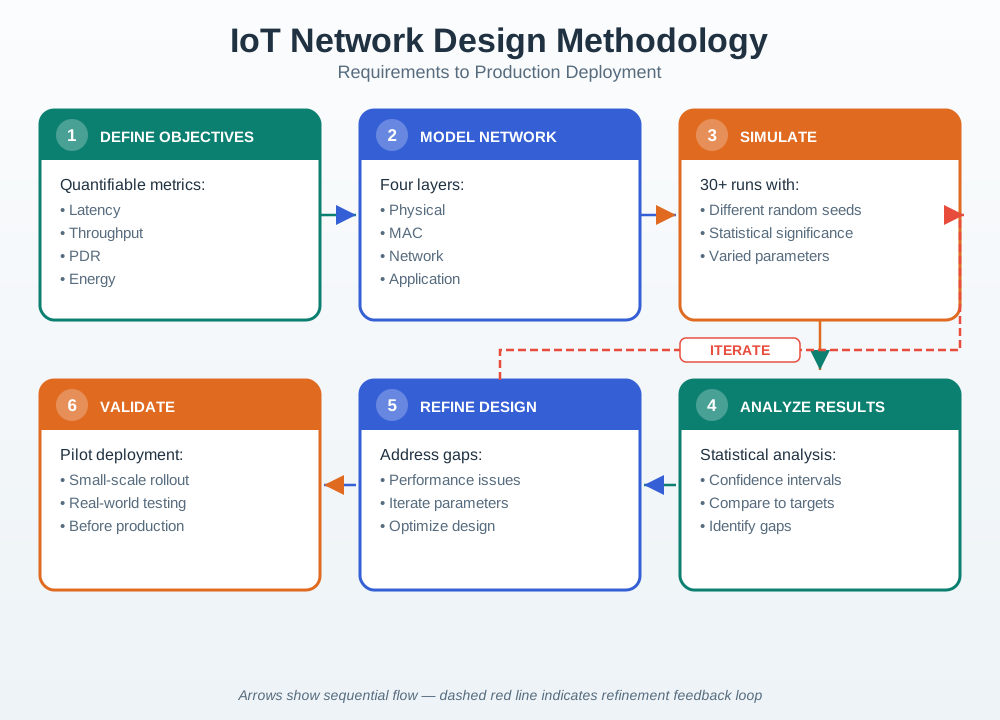
Read Figure 14.1 clockwise from the decision. First bound the nodes, sites, traffic, gateways, backhaul, and power modes. This stops the model from solving a different problem. Next run base, peak, fault, setup, and update cases. The check stage compares each result with a pass limit and records any gap. A failed limit sends the design back for a changed input, case, need, or design choice. One pass may reject a paper gateway count. A later RF survey or pilot may expose weak access, support, battery, SIM, key, or cloud plans. Each loop should narrow the choice or name the proof still missing.
The methodology loop is intentionally repetitive. A first pass may show that a paper gateway count is clearly inadequate. A second pass may use ns-3, OMNeT++/INET, Cooja, Wireshark, tcpdump, iperf3, broker logs, gateway counters, or an RF survey to test the riskiest assumption. A later pilot may show that installation access, support ownership, battery replacement, SIM lifecycle, certificate renewal, or cloud outage behavior dominates the technical result. Each pass should narrow the decision or expose what still needs proof.
- Decision boundary: State whether the study is choosing topology, protocol, gateway count, retry policy, battery budget, segmentation, or pilot readiness.
- Evidence boundary: Separate paper calculations, simulation, packet capture, RF survey, pilot data, gateway telemetry, and production operations data.
- Review boundary: Finish with accepted assumptions, rejected alternatives, unresolved risks, deployment limits, owners, and the next validation action.
14.4 Match Questions to Evidence
This section: Match Questions to Evidence — Use quick calculations before heavy tools.
Use quick calculations before heavy tools. A LoRaWAN study can start with link margin, spreading factor, airtime, duty-cycle, join-accept timing, downlink limits, ADR assumptions, and gateway capacity checks. A Wi-Fi design can start with coverage, channel plan, roaming needs, backhaul limits, DHCP/DNS availability, AP controller behavior, and security posture. A Thread, Zigbee, BLE Mesh, or RPL/6LoWPAN design can start with router placement, hop count, parent choice, route repair, sleepy-node timing, commissioning flow, and failure recovery before a full simulation is useful. A cellular design can start with coverage, SIM/eSIM lifecycle, carrier contract, APN/VPN design, data plan behavior, and expected outage handling.
When simulation is justified, choose the tool for the question. ns-3 can model IP networking, queueing, wireless contention, and transport behavior when the scenario is expressed carefully. OMNeT++/INET can support detailed protocol scenarios and repeatable parameter sweeps. Cooja can help with Contiki-NG and low-power wireless experiments, especially when firmware and MAC behavior are part of the question. A simple MQTT, CoAP, HTTP, or WebSocket test rig may be more useful than a full simulator when the risk is application-layer timing, broker session behavior, retained messages, reconnect storms, or TLS handshakes.
Field checks still matter. Wireshark or tcpdump captures can confirm packet timing, retries, DNS lookup delays, DHCP renewal, TCP reconnects, TLS handshakes, MQTT acknowledgements, CoAP retransmissions, or unexpected broadcasts. Broker logs and cloud IoT platform metrics can show authorization failures, queue depth, retained message behavior, device shadows, and throttling. iperf3 tests, RSSI/SNR samples, gateway counters, join-success rates, route-change logs, and battery-current traces keep the model grounded. The practitioner habit is to ask what each evidence source rules in or rules out, then stop collecting once the decision has enough support.
- Define repeatable scenarios. Include baseline, peak traffic, interference, outage, commissioning, credential rotation, firmware update, and maintenance cases.
- Use distributions. Report latency percentiles, packet delivery variation, retry counts, queue depth, join success, route churn, and battery impact instead of only averages.
- Validate the high-risk claim. Compare the model's most important assumption with an RF survey, packet capture, pilot, gateway metric, support record, or operations trace.
14.5 Model Fidelity Is a Design Choice
This section: Model Fidelity Is a Design Choice — Every network model leaves something out.
Every network model leaves something out. A simulator may approximate radio propagation, traffic timing, duty-cycle behavior, device sleep, queueing, mobility, interference, gateway backhaul, or broker behavior. A packet capture may show the protocol exchange but miss the site geometry. A short pilot may reveal installation problems but not seasonal traffic, firmware rollout load, long-term battery behavior, certificate expiry, or support escalation. Model fidelity is therefore a design choice: spend detail on the mechanism that can change the decision, and state what remains outside the evidence boundary.
The methodology should make those limits explicit. Physical-layer assumptions include path loss, antenna orientation, wall materials, metal shelving, water absorption, weather, noise floor, RSSI/SNR, receiver sensitivity, spreading factor, channel plan, and transmit-power limits. Protocol assumptions include MQTT QoS and session expiry, CoAP confirmable retransmission, TCP congestion behavior, TLS handshake cost, RPL DODAG repair, 802.15.4 MAC retries, Wi-Fi roaming, LoRaWAN ADR, BLE connection intervals, Thread router promotion, Zigbee binding, and cellular attach behavior. Operations assumptions include gateway backhaul, certificate expiry, SIM lifecycle, monitoring coverage, maintenance windows, spare devices, firmware update cadence, and incident escalation.
Under the hood, the design record needs enough provenance that another reviewer can challenge or rerun the work. Store simulator version, configuration files, random-seed policy, topology inputs, traffic traces, packet-capture location, clock synchronization, firmware version, gateway firmware, cloud-region assumptions, and post-processing scripts. If a report shows latency percentiles, say how timestamps were captured and whether gateway, broker, or application clocks were aligned. If a report shows packet delivery, say whether duplicate receptions, retransmissions, retained messages, and application-level de-duplication were counted. If a result depends on a default model, name that default rather than hiding it behind a chart.
- Model state: Topology, traffic distribution, mobility, loss model, queue policy, retry timing, firmware behavior, and sample schedule.
- Measurement state: Capture point, clock alignment, sample size, test duration, site condition, firmware version, and calibration status.
- Decision state: Accepted margin, fallback plan, owner, deployment limit, monitoring requirement, known blind spot, and next review trigger.
This section:
This section:
14.6 Prerequisites
This section: Prerequisites
You should already be comfortable with:
- Network Design Introduction: the overall evidence route.
- Network Design Fundamentals: requirements, topology, gateway placement, and acceptance criteria.
- Networking basics: packets, routing, layers, addressing, and common performance terms.
14.7 What Methodology Adds
This section: What Methodology Adds — The introduction explains the route.
The introduction explains the route. The fundamentals chapter explains the design ingredients. This chapter explains the discipline that keeps a study from becoming a collection of attractive diagrams, arbitrary simulator settings, and unsupported claims.
Decision first
Name the decision the evidence must support: topology choice, gateway count, protocol family, retry policy, battery budget, or deployment gate.
Assumptions visible
Record site, traffic, radio, firmware, energy, security, and operations assumptions before interpreting results.
Scenario based
Use baseline, stress, fault, maintenance, and boundary scenarios instead of one average case.
Design basis
Finish with accepted evidence, rejected alternatives, unresolved risks, and the next validation action.
14.8 The Methodology Loop
This section: The Methodology Loop — The loop is deliberately simple.
The loop is deliberately simple. Each pass should produce evidence that narrows the decision, improves the model, or exposes an assumption that must be tested outside the model.
14.9 Phase 1: Define a Reviewable Decision
This section: Phase 1: Define a Reviewable Decision — Each decision needs acceptance criteria.
A weak study begins with “simulate the network.” A strong study begins with a decision:
- Can this gateway plan cover the required locations with acceptable margin?
- Does a mesh design recover from the expected single-node and gateway faults?
- Which traffic classes need local processing instead of cloud round trips?
- What battery budget is credible under the chosen reporting and retry behavior?
- Which protocol family deserves a pilot at this site?
Each decision needs acceptance criteria. Criteria can include latency class, packet delivery, join behavior, coverage margin, gateway load, backhaul recovery, battery budget, monitoring visibility, and maintenance effort. Keep the criteria tied to the application outcome. “Low latency” is not a criterion; “alarm command acknowledged before the local process becomes unsafe” is closer to one.
A simulator can compare modeled scenarios. It cannot decide whether a hospital alert, warehouse tracking update, classroom lab, or soil-moisture report is operationally acceptable. Requirements come from the system, people, environment, and risk.
14.10 Phase 2: Build the Assumption Register
This section: Phase 2: Build the Assumption Register — Every network model hides assumptions.
Every network model hides assumptions. The register makes them reviewable before they become design folklore.
14.11 Phase 3: Select Evidence by Question
This section: Phase 3: Select Evidence by Question — Do not use the heaviest tool for every question.
Do not use the heaviest tool for every question. A paper check may be enough for an addressing plan; a simulator may be needed for contention and routing behavior; a field pilot may be needed for a propagation claim.
The evidence tool should follow the network decision. In Figure 14.1, the energy marker names operating cost, while the model network stage sets the nodes, places, traffic, gateways, backhaul, and power modes inside the study. That boundary decides what a later result can support. The plan evidence stage then lists paper checks, simulation, captures, RF survey, pilot work, and field metrics. Use a paper check for an addressing plan, a simulation for routing or contention, and a survey or pilot when site behavior is in doubt. The final validation stage compares the important model claims with physical evidence and records any risk left open.
Read Figure 14.1 from • Energy to MODEL NETWORK, then finish at • Network. The • Energy marker uses • Energy to expose operating cost; MODEL NETWORK uses MODEL NETWORK to test technical feasibility; • Network uses • Network to locate a communication boundary. For Phase 3: Select Evidence by Question, that order makes Evidence choices match paper checks, simulation, captures, RF surveys, pilots, and operations telemetry to the design question a traceable decision.
Fast feasibility
Use for addressing, rough traffic budgets, gateway roles, security zones, and obvious topology constraints.
Modeled behavior
Use for routing, contention, queueing, scaling, stress scenarios, failure scenarios, and repeated sensitivity studies.
Measured reality
Use packet captures, spectrum/RF checks, and gateway logs to verify whether assumptions match a real environment.
Deployment rehearsal
Use when operations, installation, firmware, physical access, or environmental uncertainty could dominate the result.
14.12 Phase 4: Plan Experiments First
This section: Phase 4: Plan Experiments First — A network study should have an experiment plan that another reviewer can reproduce or critique.
A network study should have an experiment plan that another reviewer can reproduce or critique.
What is varied?
Node count, placement, gateway location, traffic class, retry policy, channel plan, mobility, interference, or outage case.
What is measured?
Latency distribution, packet delivery, join success, queue depth, gateway load, energy state, route churn, or outage recovery.
What can be rerun?
Record tool version, configuration, seed policy, trace path, scripts, inputs, and output processing steps.
What would change the decision?
Define pass, fail, and investigate bands before looking at the result so interpretation does not move after the fact.
For stochastic models, repeated runs are usually needed. The exact number depends on variability, risk, and the decision. Report the number of observations, the seed or sampling policy, and a distribution or interval. If the interval is wide enough to change the decision, collect more evidence or narrow the question.
Use a report shape like this:
metric = mean, median, tail value, interval, scenario, sample count, seed policy, tool version, trace source, assumptions, validation status
The numeric method matters less than honesty about uncertainty. If the model has not been validated for the site, say that directly in the design basis.
14.13 Phase 5: Analyze for Decisions
This section: Phase 5: Analyze for Decisions — Good analysis links every metric back to the decision.
Good analysis links every metric back to the decision.
14.14 Phase 6: Verify, Validate, and Decide
This section: Phase 6: Verify, Validate, and Decide — Verification asks whether the model was built correctly.
Verification asks whether the model was built correctly. Validation asks whether the model is useful for the real deployment question.
The process in Figure 14.2 tests both model mechanics and field fit; notice where the design changes.
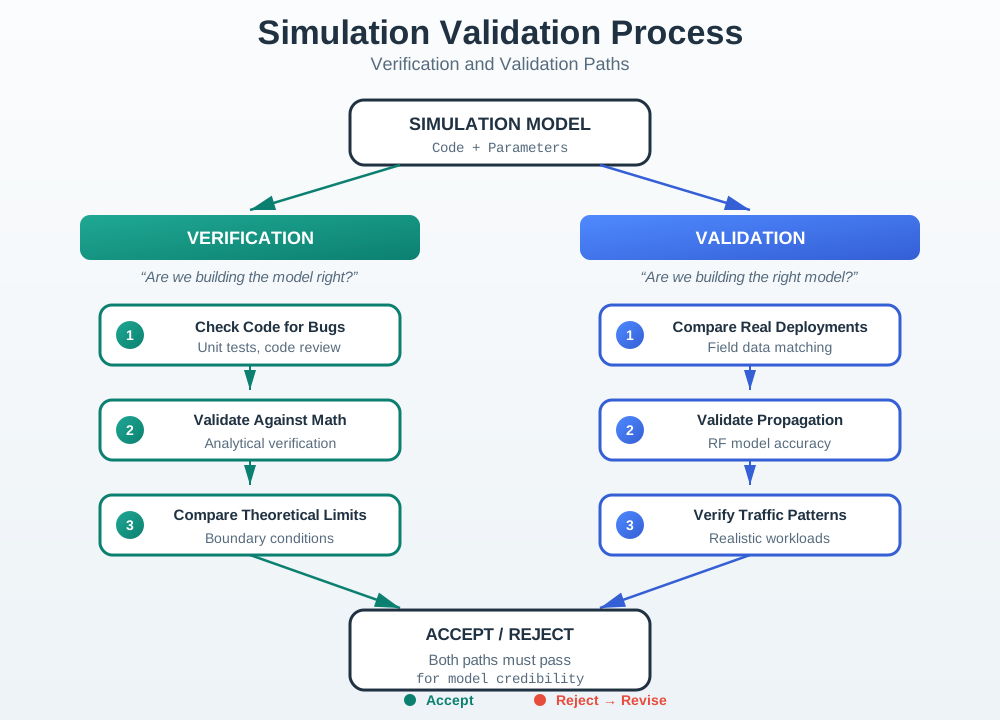
Inspect Figure 14.2 at Simulation Validation Process and note that it uses Simulation Validation Process to hold review evidence. Compare SIMULATION MODEL, which uses SIMULATION MODEL to test technical feasibility, before reading Validate Against Math as the place that highlights Validate Against Math. The comparison turns Verification checks model mechanics; validation checks whether the model matches real deployment evidence before accepting or revising the design into a bounded Phase 6: Verify, Validate, and Decide choice.
Check the model mechanics
Begin by balancing sent, received, dropped, and retried packets. Then inspect whether queue, retry, and route behavior is plausible, confirm that configuration matches the documented scenario, and rerun the trace-processing scripts to reproduce the reported values. These checks establish that the model executed as specified before anyone interprets its result.
Check against reality
Start with packet captures that can confirm protocol behavior, then compare RF survey or pilot data with coverage assumptions. Continue by matching traffic traces to the application workload and operations logs to commissioning and maintenance effects. Together, those observations bound where the model represents deployment and where uncertainty remains.
Record the basis
- Chosen design and rejected alternatives.
- Evidence used and evidence not yet available.
- Known limits, residual risks, and next validation action.
- Owner for monitoring after deployment.
Before approving a network design, write the handoff record so a future reviewer can see exactly what was proven and what still needs watching:
First: The exact decision, acceptance criteria, and deployment boundary that were tested.
Next: The scenario list, including baseline, stress, fault, update, and maintenance cases that protect different requirements.
Then: Evidence status for each important metric: modeled, measured, piloted, operationally observed, or still assumed.
After that: The design limit that follows from the evidence, such as maximum node count, gateway load, retry budget, coverage margin, or update window.
Also inspect: The owner and trigger for the next validation check after deployment.
Use the verify/validate phase as a gate, not a graph review. Network evidence is ready to support a design choice only when it answers four questions:
First: Requirement trace: do the reported metrics map back to the application requirement, not just to a simulator default?
Next: Worst-case visibility: are weak nodes, tail latency, join storms, outage recovery, and maintenance traffic shown separately from the average case?
Then: Model honesty: are tool versions, seeds, assumptions, and unvalidated claims recorded so another reviewer can rerun or challenge them?
After that: Decision outcome: does the review state approve, redesign, pilot, or collect more evidence, with a named next action?
If any answer is missing, the result is still analysis, not validation.
14.15 Building Monitor Methodology
This section: Building Monitor Methodology — A team wants a building-monitor network for temperature, occupancy, and air-quality sensors.
A team wants a building-monitor network for temperature, occupancy, and air-quality sensors. A weak methodology would pick a protocol and draw a topology. A stronger methodology keeps the decision visible:
14.16 Practice Checks
This section: Practice Checks
14.17 Common Pitfalls
This section: Common Pitfalls
Without a decision and acceptance criteria, simulation output becomes decoration. Start with the design question.
Normal telemetry is only one case. Commissioning, alarms, retries, outages, firmware updates, mobility, and interference often create the real constraints.
Average delivery, latency, or energy can hide weak nodes, long tails, and burst failures. Show distributions or scenario-specific evidence where risk matters.
A model can be internally consistent and still wrong for the deployment environment. Verification checks model mechanics; validation checks usefulness against reality.
14.18 Summary
This section: Summary — First: A network design methodology starts with the decision the evidence must support.
First: A network design methodology starts with the decision the evidence must support.
Next: Assumptions about site, traffic, radio behavior, firmware, energy, security, and operations must be visible before results are trusted.
Then: Scenarios should include baseline, stress, fault, commissioning, update, and boundary cases.
After that: Repeated observations, distributions, sensitivity checks, and validation status are stronger than a single average.
Also inspect: A design basis explains the chosen design, rejected alternatives, evidence limits, residual risk, and next validation step.
14.19 References
This section: References — First: ns-3 Project.
First: ns-3 Project. Documentation.
Next: OMNeT++ Project. Simulation Manual.
Then: INET Framework. User’s Guide.
After that: Contiki-NG Project. Running Contiki-NG in Cooja.
Also inspect: Wireshark, User’s Guide, for packet-capture evidence and troubleshooting workflows.
14.20 What’s Next
This section: What’s Next — The next chapter, Choosing Simulation Tools, explains how to select the right simulator, packet capture, classroom workbench, or field evidence for the design question.
The next chapter, Choosing Simulation Tools, explains how to select the right simulator, packet capture, classroom workbench, or field evidence for the design question.
| Previous | Current | Next |
|---|---|---|
| Network Design Fundamentals | Network Design Methodology | Choosing Simulation Tools |
14.21 Key Takeaway
This section: Key Takeaway — A network design methodology should be repeatable: gather requirements, model traffic, choose topology, simulate constraints, prototype critical links, and validate with field measurements.
A network design methodology should be repeatable: gather requirements, model traffic, choose topology, simulate constraints, prototype critical links, and validate with field measurements.
Find help
3 reviewed answers.
Where should I start in a module?
Open the module page from the sidebar to see its chapters in order. Use the module map to return to a topic you need.
Modules and pathsReviewed
What can I try when a project does not work?
Check the symptom, then work through the diagnostic steps. Keep the error message and the smallest example that reproduces it.
When you are stuckReviewed
How do interactive examples work?
Use the interactive guide to check how examples and simulations work before changing your project.
Interactive examples guideReviewed