8 IoT Project Planning: Brief and Viability
More
Depth: Practitioner
Progress saves as you read. Mark sections complete as you go; your progress appears in the sidebar.
8.1 Start With the Decision
This section: Start With the Decision — A project brief links a user problem to the work the team can fund.
A project brief links a user problem to the work the team can fund. It must expose value, cost, assumptions, and delivery evidence.
8.2 Route Overview
This section: Route Overview — This is part 2 of 2.
This is part 2 of 2. Review IoT Project Planning: Discovery and Scope for the preceding evidence.
8.3 Learning Objectives
This section: Learning Objectives
- Write a project brief with measurable acceptance evidence.
- Test commercial viability with a Lean Canvas.
8.4 Chapter Roadmap
This section: Chapter Roadmap
- Build the Project Brief
- Check Commercial Viability with a Lean Canvas
- Worked Example: A Cane Attachment for Independent Navigation
- Align Stakeholders, Hold Scope
- Watch for False Alignment
- Map Assumptions Before Scheduling Work
- Turn Scope Into Work Packages
- Keep the Release Small Enough to Learn
- Checkpoint: From Brief to Work Packages
- Risk Register and Release Gates
- Cold-Room Monitoring Project
- Scenario
- Project Planning Readiness Checklist
- Try It Now
- Micro-Exercise: Find the Missing Owner
- Checkpoint: Ready for Review
- Knowledge Check
- What Makes a Brief Ready?
- Match Artifacts to Plan Decisions
- Order Planning Workflow
- Label the Project Planning Board
- Check Planning Brief Readiness
- Common Pitfalls
- 1. Treating a Feature List as a Plan
- 2. Hiding Assumptions Inside Estimates
- 3. Leaving Scope Boundaries Unwritten
- 4. Skipping the Handoff Artifacts
- Summary
- References
- See Also
- What’s Next
- Key Takeaway
8.5 Build the Project Brief
This section: Build the Project Brief — The project brief is the planning anchor.
The project brief is the planning anchor. Keep it short enough to review, but complete enough that it can survive handoff to another instructor, developer, or content maintainer.
Frame the need
Define who has the problem, where it occurs, how they handle it now, and what better outcome would look like.
Name the proof
Separate observed evidence from assumptions. Do not let a stakeholder request stand in for field evidence.
Draw boundaries
State what is in the first release, what is deferred, and what is explicitly out of scope.
Plan gates
Attach each risky assumption to a gate where the team can continue, narrow, pivot, or stop.
8.5.1 Brief Fields
Before Brief Fields, inspect Figure 8.1. Compare each Evidence source with its Open risk, then use the Validate target to identify the next check.
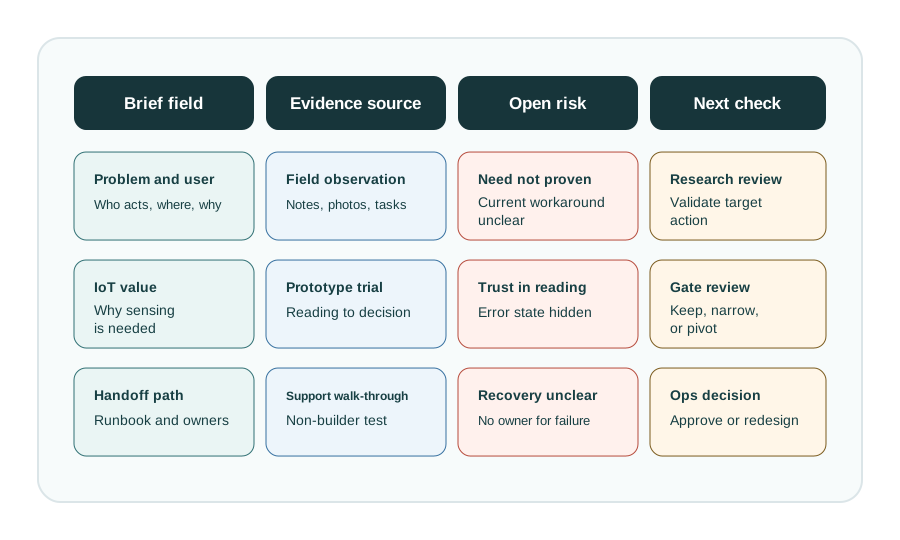
In Figure 8.1, the Evidence source records what is known, the Open risk states what could invalidate the plan, and the Validate target names the next check. Carry all three into the brief.
8.6 Check Commercial Viability with a Lean Canvas
This section: Check Commercial Viability with a Lean Canvas — The project brief records what the team plans to build and which technical and operational assumptions still need evidence.
The project brief records what the team plans to build and which technical and operational assumptions still need evidence. It does not, by itself, prove the release is worth building as a product. Design Thinking Introduction names desirability, feasibility, and viability as three lenses a connected product has to satisfy together. Desirability gets a problem statement. Feasibility gets an assumption map. Viability — can the organization sustain this as a business, not just as a working pilot — has not had its own tool yet. A Lean Canvas is that tool: a one-page way to make the commercial case reviewable alongside the brief.
French startup Handisco built a Bluetooth-connected, GPS-enabled cane attachment called Sherpa so blind and vision-impaired pedestrians could navigate their communities more independently. Where supported, the device can trigger pedestrian crossing signals, and it can give step-by-step directions and bus route and pickup times through a Bluetooth earpiece. The founders won Cisco France’s Le Défi social innovation competition while developing the concept, and by the time of writing it had launched with its first sales in Nancy, France, with the founders hoping to scale up across Europe.
That story fills in some canvas blocks directly: the problem and customer segment (blind and vision-impaired pedestrians losing independence navigating a city) and the solution and value proposition (a cane attachment that can trigger compatible pedestrian signals and speaks directions and transit timing). It does not answer others — the source material never says how Handisco reaches blind associations or medical-equipment retailers, what stops a competitor from building the same device-and-service combination, or what the device costs to run. That gap is not a flaw in the canvas; it is exactly what the assumption map in this chapter’s project brief exists to catch. A canvas block with no evidence behind it is still an assumption, not a fact.
Treat the canvas as a companion artifact filed alongside the brief, not a substitute for it. A canvas answers whether the idea is worth building; the brief’s scope boundary and release gate answer whether the current release proves that responsibly.
8.7 Align Stakeholders, Hold Scope
This section: Align Stakeholders, Hold Scope — IoT projects cross physical devices, software services, data governance, field operations, and support.
IoT projects cross physical devices, software services, data governance, field operations, and support. Stakeholder alignment is therefore more than approval. It is a record of who can clarify needs, remove blockers, accept risk, and maintain the system later.
Stakeholders may agree to a phrase such as “real-time monitoring” while meaning different things. Translate broad phrases into observable user actions, data latency expectations, support responsibilities, and release gates before treating the plan as aligned.
8.8 Map Assumptions Before Scheduling Work
This section: Map Assumptions Before Scheduling Work — Before building a work plan, write down the claims that must be true for the project to succeed.
Before building a work plan, write down the claims that must be true for the project to succeed. This prevents optimistic plans that hide the hardest questions.
User value
Users will act on the information, trust it, and prefer it over the current workaround.
System behavior
The sensors, connectivity, firmware, data model, and interface can meet the required behavior in context.
Field fit
The device can be installed, powered, maintained, replaced, and retired without creating hidden work.
Security and data
Identity, update, privacy, data retention, and access controls are practical for the release.
8.8.1 Assumption Map Template
8.9 Turn Scope Into Work Packages
This section: Turn Scope Into Work Packages — Once the brief and assumption map are clear, split the project into work packages.
Once the brief and assumption map are clear, split the project into work packages. A work package is not just a task. It is a small contract that says what evidence it serves, what dependency it has, and how the team will know it is acceptable.
When the first release contains too many features, failure becomes hard to diagnose. Start with the smallest credible device, data path, user workflow, and support path that can test the riskiest assumption.
At this point the brief, stakeholders, assumptions, and work packages should all point at the same release boundary. Next decide which risks can stop, narrow, or reshape it.
 Checkpoint: From Brief to Work Packages
You now know:
- The project brief anchors problem, users, outcome, evidence gaps, scope boundary, and release gate.
- Stakeholder alignment means naming decision ownership, not only collecting approval.
- Work packages are evidence units with purpose, owner, dependency, acceptance condition, and review gate.
8.10 Risk Register and Release Gates
This section: Risk Register and Release Gates — The risk register connects uncertainty to action.
The risk register connects uncertainty to action. Each risk needs a trigger, mitigation, owner, and gate. Without a gate, the register becomes a list that people read but do not use.
8.10.1 Decision Log Format
Use a decision log when a choice changes scope, architecture, evidence interpretation, or release gates.
8.11 Cold-Room Monitoring Project
This section: Cold-Room Monitoring Project
A food storage team wants an IoT system to help operators notice cold-room temperature problems early enough to protect inventory. The first request is “put sensors in every room and make a dashboard.” A planner should slow this down and turn it into an evidence-gated project.
Project brief
First: Problem frame: Operators need to notice and resolve cold-room temperature excursions before product handling decisions become uncertain.
Next: Target users: Shift operator, facilities technician, food safety lead, and site manager.
Then: Outcome: Operators can identify the affected room, understand confidence in the reading, and follow the correct escalation path.
After that: In scope: Temperature sensing, device identity, alert review, operator acknowledgement, recovery instructions, and data traceability for the first room group.
Also inspect: Out of scope: Predictive maintenance, automated purchasing, energy optimization, and full enterprise reporting.
Finally: Evidence gaps: Sensor placement, alert actionability, support ownership, retention rule, and connectivity behavior in the cold-room environment.
Assumption map
| Assumption | Evidence check | Gate decision |
|---|---|---|
| Operators will act on alerts if the alert includes room, severity, confidence, and next action. | Run a realistic alert walkthrough with shift operators. | Keep alert format, redesign it, or change the target workflow. |
| Sensors can produce trustworthy readings at the planned locations. | Compare candidate readings with trusted room measurements in context. | Use chosen placement, change placement, or select another sensing method. |
| Facilities staff can recover a failed device. | Ask a non-builder to follow the draft recovery runbook. | Accept runbook, simplify device state, or add service tooling. |
| Data retention supports safety review without collecting unnecessary data. | Review data fields against outcome and policy. | Keep, aggregate, shorten, or remove fields. |
Work packages
| Package | Acceptance condition |
|---|---|
| Field workflow review | Operators can explain what they would do for each alert state. |
| Sensor placement check | Readings are stable enough for the release gate and failure states are visible. |
| Data path slice | A sample event is traceable from device to alert to acknowledgement to audit record. |
| Support runbook | A non-builder can identify a device, check state, and recover or escalate. |
| Decision log | Major scope and architecture choices are recorded with evidence and consequences. |
Planning result
The project no longer starts with “install sensors everywhere.” It starts with one credible field-learning slice that tests user action, data trust, device recovery, and governance before expansion.
8.12 Project Planning Readiness Checklist
This section: Project Planning Readiness Checklist — Use this checklist before moving from planning into implementation.
Use this checklist before moving from planning into implementation.
8.13 Try It Now
This section: Try It Now — A stronger answer should name the user action, first deployment slice, data path, alert or dashboard decision, evidence gap, support owner, out-of-scope items, and the release gate that can pause expansion.
Rewrite this weak planning statement into a reviewable project brief:
“Build an IoT dashboard for all cold rooms so managers can see everything in real time.”
A stronger answer should name the user action, first deployment slice, data path, alert or dashboard decision, evidence gap, support owner, out-of-scope items, and the release gate that can pause expansion.
8.14 Micro-Exercise: Find the Missing Owner
This section: Micro-Exercise: Find the Missing Owner — Work from mechanism to observation to accountable decision.
For each planning claim, write the owner role and next evidence check:
Work from mechanism to observation to accountable decision. For recovery, name who owns the reconnect behavior and which outage test proves it. For alert trust, name who owns delivery and which user observation checks it. For retention, name the safety and privacy owners and the record that reconciles their constraints.
First: The device should recover automatically after Wi-Fi loss.
Next: Operators will trust the alert if it appears in the dashboard.
Then: The data retention period is enough for safety review but short enough for privacy needs.
Checkpoint: Ready for Review
You now know:
- A cold-room project brief can replace a vague request to install sensors everywhere with one governed learning slice.
- A readiness checklist should expose problem frame, user action, evidence gaps, scope, risk gates, ownership, handoff, and maintenance path.
- The remaining quizzes ask you to match artifacts, order the workflow, label the planning board, and test brief readiness.
8.15 Knowledge Check
This section: Knowledge Check
Common Pitfalls
This section: Common Pitfalls
A feature list says what someone wants to build. A plan says why it matters, what evidence supports it, what is out of scope, who owns risk, and what gate can stop the work.
Uncertain sensor behavior, user action, data quality, and support capacity should be visible assumptions. If they only appear as optimistic estimates, the project will discover them late.
When deferred and excluded work is not written down, every stakeholder can assume their desired feature is still included. A visible boundary protects learning speed and trust.
IoT systems continue after the first release. The plan must leave behind a decision log, risk register, runbook, and update path so future maintainers can change the system responsibly.
8.16 Summary
This section: Summary — First: IoT project planning is evidence management: the plan should connect user value, assumptions, risk, scope, and release decisions.
First: IoT project planning is evidence management: the plan should connect user value, assumptions, risk, scope, and release decisions.
Next: The project brief is the anchor artifact. It should include problem frame, users, outcome, evidence gaps, constraints, scope boundary, and release gate.
Then: Stakeholder alignment means assigning decision ownership, not collecting vague approval.
After that: Assumption maps and risk registers keep uncertainty visible until evidence is strong enough to continue.
Also inspect: Work packages should include purpose, owner, dependency, evidence source, and acceptance condition.
Finally: Decision logs and handoff artifacts keep the chapter, course, and platform easier to update without editing hub pages every time.
References
This section: References — First: International Organization for Standardization.
First: International Organization for Standardization. ISO 9241-210:2019 Ergonomics of human-system interaction.
Next: GOV.UK Service Manual. Start by learning user needs.
Then: Schwaber, K. and Sutherland, J. The Scrum Guide.
After that: National Institute of Standards and Technology. NISTIR 8259A, IoT Device Cybersecurity Capability Core Baseline.
Also inspect: National Institute of Standards and Technology. SP 800-213, IoT Device Cybersecurity Guidance for the Federal Government.
8.17 See Also
This section: See Also — First: Design Thinking Introduction: place project planning inside the wider evidence loop.
First: Design Thinking Introduction: place project planning inside the wider evidence loop.
Next: Agile and Risk Management: turn planning assumptions into sprint gates and risk owners.
Then: IoT Validation Framework: decide whether the project should continue, narrow, pivot, or stop.
After that: End-to-End Test Strategy: connect work-package acceptance conditions to release evidence.
8.18 What’s Next
This section: What’s Next — Continue to IoT Validation Framework to connect the project plan to stronger validation decisions before scaling the solution.
Continue to IoT Validation Framework to connect the project plan to stronger validation decisions before scaling the solution.
| Previous | Current | Next |
|---|---|---|
| Agile and Risk Management | Project Planning | IoT Validation Framework |
8.19 Key Takeaway
This section: Key Takeaway — IoT project planning must coordinate hardware lead times, firmware work, connectivity, data infrastructure, testing, security review, and deployment support.
IoT project planning must coordinate hardware lead times, firmware work, connectivity, data infrastructure, testing, security review, and deployment support. A schedule that treats IoT like pure software will miss the hard dependencies.
8.20 Continue Your Route
This section: Continue Your Route — This is the last part of this chapter.
This is the last part of this chapter. Return to IoT Project Planning: Discovery and Scope or continue from the design-methodology module index.
Find help
3 reviewed answers.
Where should I start in a module?
Open the module page from the sidebar to see its chapters in order. Use the module map to return to a topic you need.
Modules and pathsReviewed
What can I try when a project does not work?
Check the symptom, then work through the diagnostic steps. Keep the error message and the smallest example that reproduces it.
When you are stuckReviewed
How do interactive examples work?
Use the interactive guide to check how examples and simulations work before changing your project.
Interactive examples guideReviewed