2 LPWAN Fundamentals

More
Depth: Practitioner
Progress saves as you read. Mark sections complete as you go; your progress appears in the sidebar.
2.1 Start Simple
This section: Start Simple — Picture a soil sensor that sleeps most of the day.
Start With a Small, Patient Message
Picture a soil sensor that sleeps most of the day. It wakes, sends a few numbers, and sleeps again. The farm can wait for the next report if one is missed. That shape may suit a low-power wide-area network.
-

A soil sensor sleeps most of the day and sends a few numbers.
-

Long range does not guarantee delivery at the real farm.
-

Test data size, delay, missed reports, site, retries, and power.
-
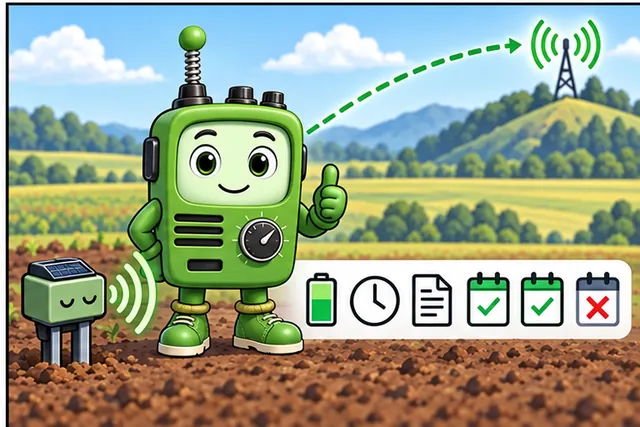
Choose the low-power network only when that patient message fits.
In the illustration, this kind of network trades speed and message size for long reach and low device power. Begin with the work, not the radio name. State how much data the device sends, how often it sends, how long the answer may wait, and how many missed reports the service can accept.
Then test the real site. Check the worst location, antenna position, walls, ground, weather, and busy times. Measure both successful and missed messages. Include the power used while joining, sending, waiting, and trying again.
The simple fit rule has limits. Long reach is not certain reach. Small devices still need a safe retry plan, fair use of shared air, and a way to handle urgent commands.
Use Practitioner to compare network roles and operating plans. Use Under the Hood to examine radio evidence, capacity, power, and failure limits.
Start with one sleepy device that sends a small reading and then disappears to save battery. If the application can wait, tolerate missed reports, and avoid heavy downlink, the device may be LPWAN-shaped. If it needs video, rapid control, or frequent updates, it is not. This chapter keeps that first fit decision visible before any technology name can make the design sound easier than it is.
Overview: LPWAN Is a Workload Fit, Not a Magic Range Claim
Low-power wide-area networking is useful when devices mostly sleep, send compact messages, tolerate delayed delivery, and need coverage across a larger area than short-range links can conveniently provide. It is not a replacement for streaming, tight control loops, frequent downlink, or routine bulk transfer.
The first LPWAN question is therefore not which technology is best. The first question is whether the workload, region, coverage evidence, power model, downlink behavior, ownership model, and operations record make a wide-area low-power link credible.
For example, a municipal waste team might start with 8,000 fill-level sensors, each sending a 16-byte level, battery voltage, and fault flag every six hours. That is only four routine uplinks per bin per day, and a missed reading can wait until the next route-planning cycle. The same city should not put CCTV clips, real-time traffic-light actuation, or daily firmware images on the same LPWAN path, because those workloads change the payload, latency, and reliability assumptions.
A useful fundamentals record therefore splits the fleet before selecting a radio. Street bins, park-soil probes, and water-vault alarms may all be LPWAN-shaped, but they still need separate notes for antenna placement, enclosure loss, reporting cadence, downlink use, battery replacement window, and who investigates a silent device. The chapter's "fit" decision is a filter that keeps strong candidates moving and routes non-fit traffic to other networking chapters.
If a later requirement adds hourly photos, live actuator supervision, or technician tablet sync, the record should create a separate network path instead of silently stretching the LPWAN assumption.
The next choice in the “low power”–“multi-year sleep” decision depends on “small batteries”, a boundary shown in Figure 2.1. Inspect “Low Power”, then set it against “multi-year sleep”, before judging LPWAN is defined by a cluster of characteristics; a workload should match the cluster, not just one attractive property.
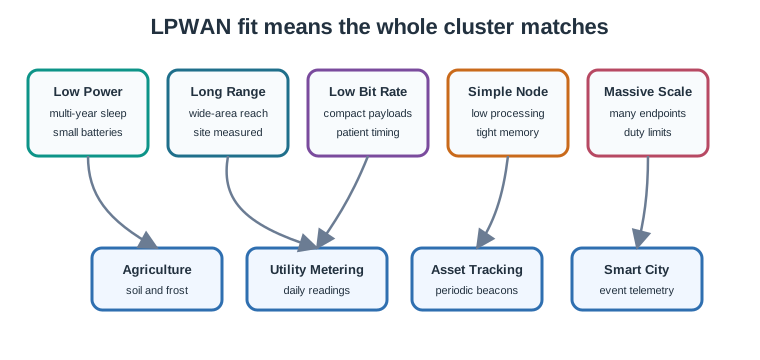
Read Figure 2.1 with “Low Power” as the anchor; treat “multi-year sleep” as the first comparison. Then connect “small batteries” with “Long Range”. Those labels make LPWAN is defined by a cluster of characteristics; a workload should match the cluster, not just one attractive property a traceable part of the “low power”–“multi-year sleep” decision, not an unsupported assertion.
Before carrying LPWAN fundamentals connect workload fit to the evidence needed before deployment claims are accepted into the “Workload” design record, view Figure 2.2. It makes “Workload” and “fit” separate, inspectable parts of the “workload”–“fit” decision.
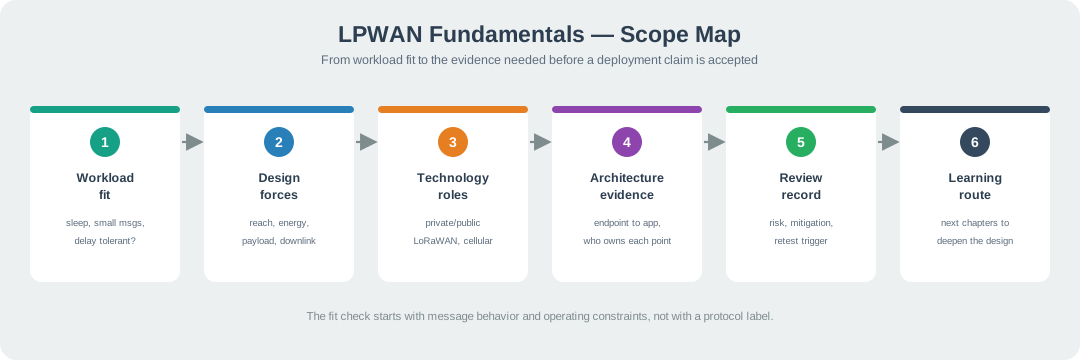
The first useful contrast in Figure 2.2 is “Workload” versus “fit”. After resolving it, move from “sleep, small msgs” to “delay tolerant?”. This is how the visual substantiates LPWAN fundamentals connect workload fit to the evidence needed before deployment claims are accepted and reconnects it to the “workload”–“fit” decision.
Pause before applying the “lpwan”–“fit?” decision, then inspect Figure 2.3. It places “LPWAN” against “fit?”, exposing the evidence behind this claim: The fit check starts with message behavior and operating constraints, not with a protocol label.
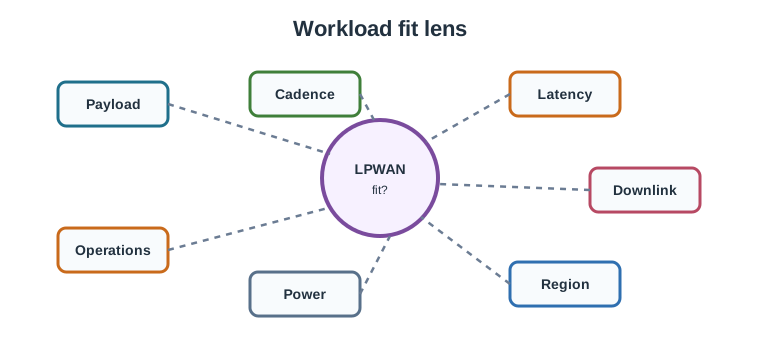
Notice how Figure 2.3 separates “LPWAN” from “fit?”. Now move to “Payload” and finish at “Cadence”; that second step reveals why The fit check starts with message behavior and operating constraints, not with a protocol label. Apply the distinction when “Cadence” closes the record for the “lpwan”–“fit?” decision.
Good Fit
Compact telemetry, infrequent events, sleep-first endpoints, patient downlink, and an owner for operations evidence.
Weak Fit
Continuous streams, large files, tight control loops, frequent commands, or unsupported gateway and service operations.
Evidence Needed
Workload record, regional profile, link budget, antenna plan, power model, downlink rule, and pilot observations.
Review Habit
Reject fixed claims. Ask what condition makes the statement true and what evidence would falsify it.
Practitioner: Compare Design Forces and Operating Models
LPWAN design is a trade-off among reach, energy, payload, latency, downlink, capacity, compliance, security, and ownership. Improving one dimension can weaken another. A recommendation should name the constraint that matters most and the evidence that supports it.
The technology families also have different operating models. Private LoRaWAN, public LoRaWAN, cellular LPWAN, and other managed narrowband services can all support wide-area IoT workloads, but they move gateway ownership, service dependency, certification, monitoring, keys, and replacement duties to different places.
Take a vineyard co-op with 1,200 soil nodes. If each node sends a 12-byte moisture and temperature sample every 30 minutes during irrigation season, the design has 48 routine uplinks per node per day before retries and alarms. A practitioner record should also state whether frost alarms need faster reporting, whether pump-shed metal roofs require external antennas, and whether commands are rare threshold changes or routine closed-loop control. The answer can change the family shortlist even when every candidate is called "LPWAN."
The operating model is just as concrete. A private-gateway plan needs mast locations, backhaul, gateway spares, keys, monitoring, and a field technician owner. A public-network plan needs service availability, account lifecycle, regional roaming assumptions, outage escalation, and an exit path if coverage changes. Comparing the radio without comparing those operating duties hides the actual deployment risk.
Inspect Figure 2.4 to see how one vineyard workload exposes the evidence needed for site, power, capacity, downlink, and ownership choices.
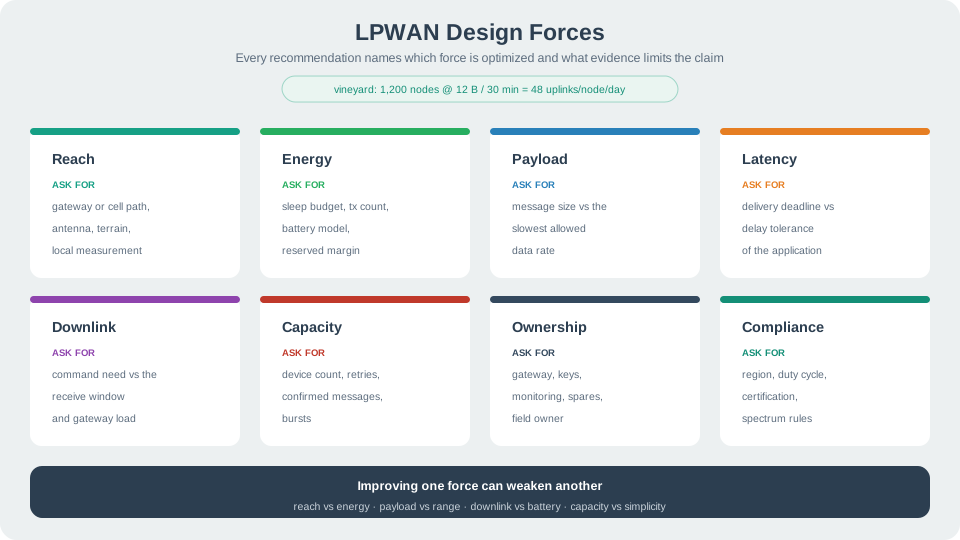
In Figure 2.4, start with 1,200 soil nodes sending a 12-byte sample every 30 minutes. One day contains 24 h × 60 min/h / 30 min = 48 uplinks per node before retries or alarms. That routine count makes capacity a workload question, not just a coverage question. Move to site and power evidence: the worst antenna location, metal roof, joining current, retries, and sleep budget shape reach and lifetime together. Then compare rare threshold changes with routine closed-loop commands, because downlink demand changes the network fit. Finish at the operating model, where backhaul, spares, keys, monitoring, certification, and a field owner decide who keeps the service working.
The next choice in the “long range”–“2–15 km urban, up to 40+ km rural” decision depends on “Low Power”, a boundary shown in Figure 2.5. Inspect “Long Range”, then set it against “2–15 km urban, up to 40+ km rural”, before judging LPWAN Technology Overview.
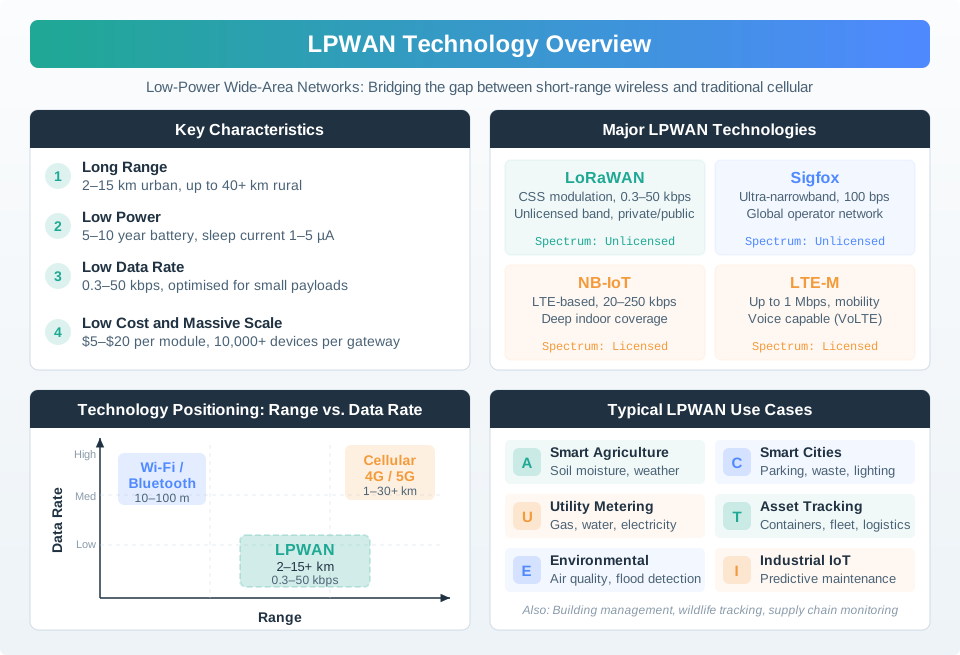
Begin Figure 2.5 at “Long Range”, but do not stop there. Compare “2–15 km urban, up to 40+ km rural”, then follow “Low Power” until “5–10 year battery, sleep current 1–5 µA”. The resulting chain supports LPWAN Technology Overview; it also gives the “long range”–“2–15 km urban, up to 40+ km rural” decision a specific retest boundary.
Before deciding the “endpoint”–“sensor profile” decision, inspect “Endpoint” in Figure 2.6 and compare it with “sensor profile”. That contrast matters because The architecture review follows the device-to-application path and asks who owns each evidence point.
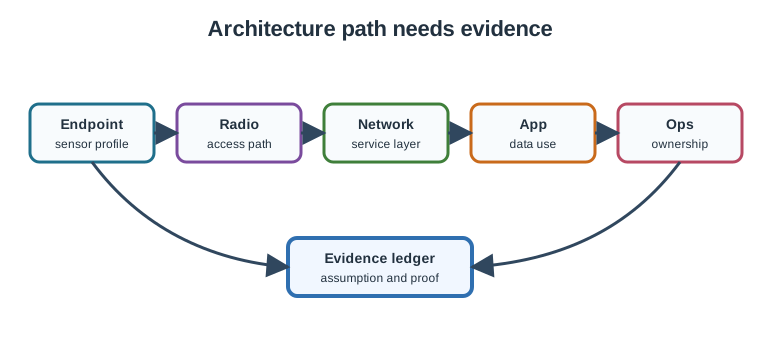
Trace the review path across Figure 2.6 from “Endpoint” to “sensor profile”. From “Radio”, it arrives at “access path”. That path is evidence for The architecture review follows the device-to-application path and asks who owns each evidence point; retain it when revisiting the “endpoint”–“sensor profile” decision.
Under the Hood: Non-Fit Signals and Review Records
LPWAN review is strongest when it can say no. High-volume media, tight safety control, repeated large downloads, frequent cloud commands, unsupported operations, and unclear service ownership should route away from the LPWAN path or trigger a redesign.
The final output should be a review record. That record names the workload, region, technology-family candidate, evidence used, weak assumptions, mitigation, owner, and retest trigger. A technology name without that record is not enough for release.
A cold-chain pallet tag shows why the non-fit check matters. A five-minute temperature heartbeat is usually LPWAN-shaped if the payload is compact and delayed arrival is acceptable. The same product becomes a poor fit if it must upload a 250 kB calibration package through the low-rate radio every week. Even before protocol overhead, that download would require thousands of small payload fragments, long receive time, more battery energy, retry handling, and an operational plan for interrupted transfers.
The review record should make that boundary explicit: "temperature telemetry over LPWAN; calibration package over depot Wi-Fi or wired cradle." It should also name the owner for stale gateways, battery model drift, service subscription changes, enclosure revisions, antenna relocation, and region moves. Those triggers stop a valid pilot from becoming an unreviewed production assumption six months later.
A release-ready record also keeps arithmetic close to the decision. If a device normally sends 12 bytes every 15 minutes, the reviewer should record the daily message count, the alarm burst assumption, and the retry budget used in the pilot. If an enclosure swap reduces antenna clearance or a customer asks for ten times more samples, the old pass is no longer valid; the route returns to link budget, capacity, or another access technology before deployment expands.
Inspect Figure 2.7 with one question from the “streaming”–“media or waveform” decision: how does “Streaming” constrain “media or waveform”? The answer supports Non-fit signals are design feedback, not failures of the technology.
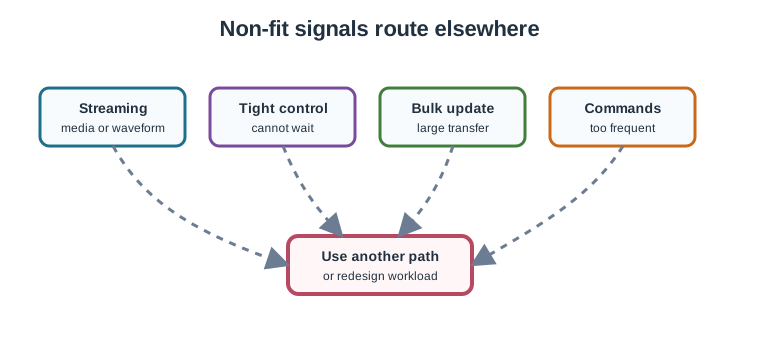
The first useful contrast in Figure 2.7 is “Streaming” versus “media or waveform”. After resolving it, move from “Tight control” to “cannot wait”. This is how the visual substantiates Non-fit signals are design feedback, not failures of the technology and reconnects it to the “streaming”–“media or waveform” decision.
Before deciding the “claim”–“what is true?” decision, inspect “Claim” in Figure 2.8 and compare it with “what is true?”. That contrast matters because A review record keeps LPWAN claims bounded and makes weak assumptions actionable.
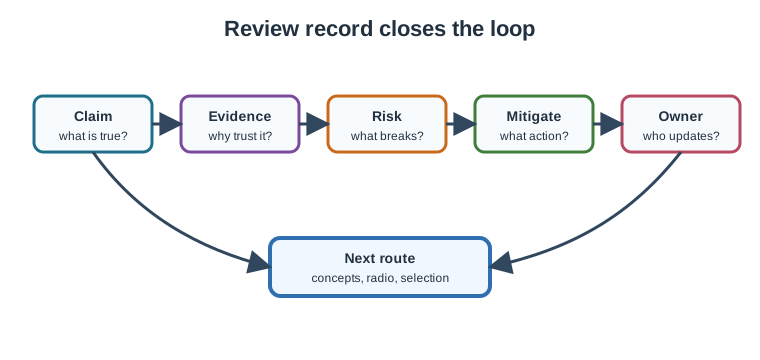
On Figure 2.8, inspect “Claim” before “what is true?”. The subsequent hand-off from “Evidence” to “why trust it?” explains A review record keeps LPWAN claims bounded and makes weak assumptions actionable. Carry that sequence into the “claim”–“what is true?” decision so “Claim” evidence, “what is true?” decision, and “why trust it?” recheck remain distinguishable.
Record the Claim
State the workload, region, candidate family, path, and design question being answered.
Name the Evidence
Attach measurements, power model, antenna assumptions, downlink rule, service dependency, and owner.
Route the Weakness
Send range claims to link budget, family choice to selection, architecture gaps to ownership review, and operations gaps to readiness checks.
Set the Retest Trigger
Reopen the decision when payload, cadence, region, antenna, endpoint, gateway, service, policy, or operations ownership changes.
2.2 Summary
This section: Summary — Inspect Figure 2.9 to place one remote tank and one maintenance tablet inside their different rate, energy, range, and workload envelopes.
Inspect Figure 2.9 to place one remote tank and one maintenance tablet inside their different rate, energy, range, and workload envelopes.

Read Figure 2.9 from Wi-Fi for the tablet’s nearby bulk traffic to LPWAN / LoRa for the tank’s tens-of-bytes telemetry over kilometres. Select by the envelope then requires payload, cadence, latency, link margin, regulation, terrain, gateways, and retry energy rather than treating the plotted regions as guarantees.
LPWAN fundamentals are about workload fit and evidence. A good LPWAN design starts from compact, delay-tolerant messages; checks regional, radio, power, downlink, ownership, security, and operations assumptions; and records what would change the recommendation. The fundamentals route prepares you for link-budget, architecture, selection, and LoRaWAN-specific chapters without drifting into unsupported range or battery claims.
2.3 Key Takeaway
This section: Key Takeaway
Use LPWAN when the workload is small, patient, and evidence-backed; reject or reroute claims that lack radio, power, downlink, ownership, and operations proof.
2.4 See Also
This section: See Also
LPWAN Link Budget and Range
LPWAN Link Budget and Range turns range claims into bounded radio evidence.
LPWAN Architectures
LPWAN Architectures reviews gateway, network-server, service, and ownership paths.
LPWAN Technology Selection
LPWAN Technology Selection compares candidate families and decision evidence.
LoRaWAN Introduction
LoRaWAN Introduction connects LPWAN fundamentals to LoRa and LoRaWAN-specific behavior.
Open printable teacher run sheet
Find help
3 reviewed answers.
Where should I start in a module?
Open the module page from the sidebar to see its chapters in order. Use the module map to return to a topic you need.
Modules and pathsReviewed
What can I try when a project does not work?
Check the symptom, then work through the diagnostic steps. Keep the error message and the smallest example that reproduces it.
When you are stuckReviewed
How do interactive examples work?
Use the interactive guide to check how examples and simulations work before changing your project.
Interactive examples guideReviewed