17 LoRaWAN Assessment: Fundamentals and Diagnostics

More
Depth: Practitioner
Progress saves as you read. Mark sections complete as you go; your progress appears in the sidebar.
17.1 Start With the Decision
This section: Start With the Decision — Use four short checks.
Use four short checks. Did the device send?
17.2 Route Overview
This section: Route Overview — This is part 1 of 2.
This is part 1 of 2. Continue with LoRaWAN Assessment: Regional Reference and Trade-Offs.
17.3 Part Objectives
This section: Part Objectives
- Test how this assessment works with a concrete scenario and pass criteria.
- Validate using adr as a slogan with a concrete scenario and pass criteria.
17.4 Chapter Roadmap
This section: Chapter Roadmap
- Start Simple
- In 60 Seconds
- How This Assessment Works
- Quick Check: LoRaWAN Assessment
- Fundamentals Map
- Minimum Review Knowledge
- Quiz Questions
- Activation And Security Questions
- Energy Optimization Questions
- Network Scalability Questions
- Regional Deployment Questions
- Question 1: Layer Boundary
- Question 2: Gateway Role
- Boundary Stack
- Question 3: Device Class
- Question 4: ADR Evidence
- Troubleshooting Surfaces
- Match The Fundamentals
- Order The Fundamentals Review
- Readiness Record
- Label The Readiness Record
- Common Pitfalls
- Merging LoRa and LoRaWAN
- Treating gateways as smart protocol endpoints
- Choosing class behavior late
- Using ADR as a slogan
17.5 Start Simple
This section: Start Simple
17.5.1 Name the Layer Before Choosing
-

A soil sensor sends a dry reading but gets no reply.
-

Check send, radio hearing, network acceptance, and service use in order.
-

Fix the first failed layer instead of blaming every part.
LoRaWAN means Long Range Wide Area Network. It is a set of network rules for low-power devices that use LoRa radio links. A protocol is an agreed set of rules for an exchange. A gateway is a bridge that hears radio traffic and forwards it; it does not decide what the reading means.
Picture a farm sensor that reports dry soil but receives no reply. The grower needs to know whether the radio failed, the network rejected the device, the reply window was missed, or the service ignored a valid reading. One vague answer can send the repair team to the wrong place.
For each quiz item, name the actor, the layer, and the evidence. Ask what was sent, what was heard, what was accepted, and what action followed. Reject an answer that makes one part of the system responsible for every result. Then test the answer against delay, lost power, a duplicate message, or a replaced device.
Use four short checks. Did the device send? Did a radio hear it? Did the network accept it? Did the service use it? A yes at one step is not a yes at the next. This simple chain keeps each answer tied to the record that can prove it.
This method does not replace the detailed rules for joining, device classes, security, or radio range. It gives you a safe route into them. The deeper sections show which record can support each claim and where the claim must stop.
Treat the quiz as a check on shortcuts. Before choosing an answer, ask whether the question is about LoRa radio behavior, LoRaWAN network behavior, gateway forwarding, device-class timing, ADR evidence, or deployment proof. Most wrong answers collapse two layers into one. The quickest path to the right answer is to name the layer and then ask what evidence belongs there.
17.6 How This Assessment Works
This section: How This Assessment Works
- Read each question as a review scenario.
- Choose the answer that preserves protocol boundaries.
- Ask for evidence before accepting a performance or architecture claim.
- Use missed questions to revisit the overview, architecture, topology, device-class, or ADR chapters.
17.7 Learning Objectives
This section: Learning Objectives
By the end of this assessment, you will be able to:
- Separate LoRa physical-layer behavior from LoRaWAN network behavior.
- Explain what gateways do and do not own.
- Match Class A, B, and C behavior to downlink timing promises.
- Identify when ADR evidence should be requested.
- Choose a troubleshooting path from symptom and evidence rather than intuition.
17.8 Quick Check: LoRaWAN Assessment
This section: Quick Check: LoRaWAN Assessment
17.9 Fundamentals Map
This section: Fundamentals Map — The fundamentals are a set of boundaries.
The fundamentals are a set of boundaries. Most wrong answers mix boundaries together.
Pause before applying the “radio”–“lorawan” decision, then inspect Figure 17.1. It places “radio” against “LoRaWAN”, exposing the evidence behind this claim: LoRaWAN fundamentals quiz map showing LoRa radio, LoRaWAN MAC, gateway forwarding, network server control, device class, ADR evidence, and review record.
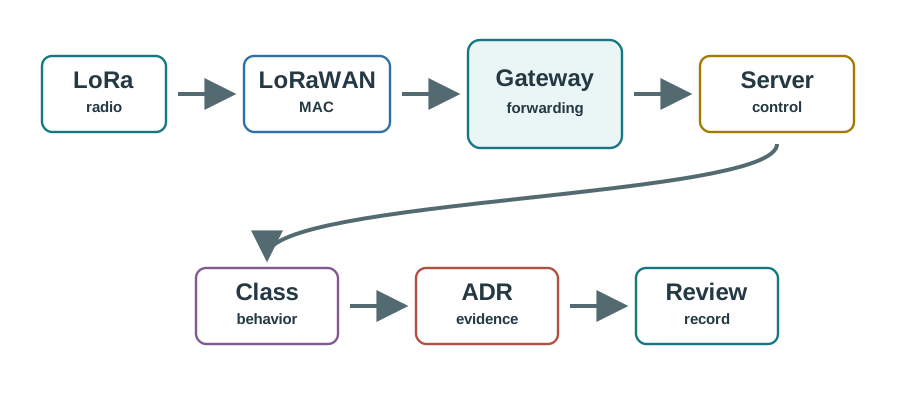
The first useful contrast in Figure 17.1 is “radio” versus “LoRaWAN”. After resolving it, move from “MAC” to “Gateway”. This is how the visual substantiates LoRaWAN fundamentals quiz map showing LoRa radio, LoRaWAN MAC, gateway forwarding, network server control, device class, ADR evidence, and review record and reconnects it to the “radio”–“lorawan” decision.
Use the map this way:
- LoRa radio: modulation and radio settings.
- LoRaWAN MAC: device behavior, activation, frame handling, and class behavior.
- Gateway forwarding: receives radio frames and forwards metadata; it is not the session authority.
- Network server control: deduplication, MAC behavior, ADR commands, and routing.
- Review record: evidence that proves the chosen behavior.
17.10 Minimum Review Knowledge
This section: Minimum Review Knowledge
LoRa versus LoRaWAN
LoRa describes the radio layer. LoRaWAN adds network behavior, joining, class behavior, and server responsibilities.
Forwarding role
A gateway forwards frames and metadata. The network server owns deduplication, MAC control, and route decisions.
Downlink timing
Class behavior must match the application response promise and the energy source.
Evidence policy
ADR is a policy decision based on representative uplink evidence, not a magic performance switch.
17.11 Quiz Questions
This section: Quiz Questions
17.12 Activation And Security Questions
This section: Activation And Security Questions — The activation/security quiz is now part of this assessment.
The activation/security quiz is now part of this assessment. A good answer:
- prefers OTAA unless the release packet explains why ABP is necessary;
- treats frame-counter rollback as a security review, not a nuisance to disable;
- keeps key custody, invalid MIC diagnosis, and application payload ownership separate;
- records reset recovery, owner response, and retest triggers.
17.13 Energy Optimization Questions
This section: Energy Optimization Questions — The battery/energy quiz is now part of this assessment.
The battery/energy quiz is now part of this assessment. A good answer:
- counts receive windows, retries, wake time, and measurement evidence, not only transmit current;
- matches device class to the application response promise and energy source;
- treats ADR as an evidence policy that can reduce airtime only when link margin remains acceptable;
- requires measured or representative current evidence before claiming lifetime.
17.14 Network Scalability Questions
This section: Network Scalability Questions — The scalability quiz is now part of this assessment.
The scalability quiz is now part of this assessment. A good answer:
- checks airtime pressure, spreading-factor distribution, payload cadence, gateway diversity, and application tolerance;
- distinguishes link weakness from channel occupancy;
- does not treat gateway overlap as a cure for every collision or airtime issue;
- records exception devices and retest triggers before scale.
17.15 Regional Deployment Questions
This section: Regional Deployment Questions — The regional deployment quiz is now part of this assessment.
The regional deployment quiz is now part of this assessment. A good answer:
- checks regional profile, channel plan, data-rate limits, payload size, device firmware, gateway support, and server profile together;
- rejects copied settings from another region until target-region evidence exists;
- names owners for field validation, configuration drift, and application acceptance;
- records what profile or site change reopens the release decision.
17.16 Question 1: Layer Boundary
This section: Question 1: Layer Boundary
17.17 Question 2: Gateway Role
This section: Question 2: Gateway Role
17.18 Boundary Stack
This section: Boundary Stack — Use this stack to keep the review from merging unrelated responsibilities.
Use this stack to keep the review from merging unrelated responsibilities.
Do not accept LoRaWAN protocol stack: an end node’s application and LoRa MAC drive the SX127x radio over the wireless link to a gateway packet forwarder and IP backhaul as “END NODE” prose alone. Look at Figure 17.2 before the “end node”–“sensors” decision, where “END NODE” is explicitly distinguished from “Sensors”.
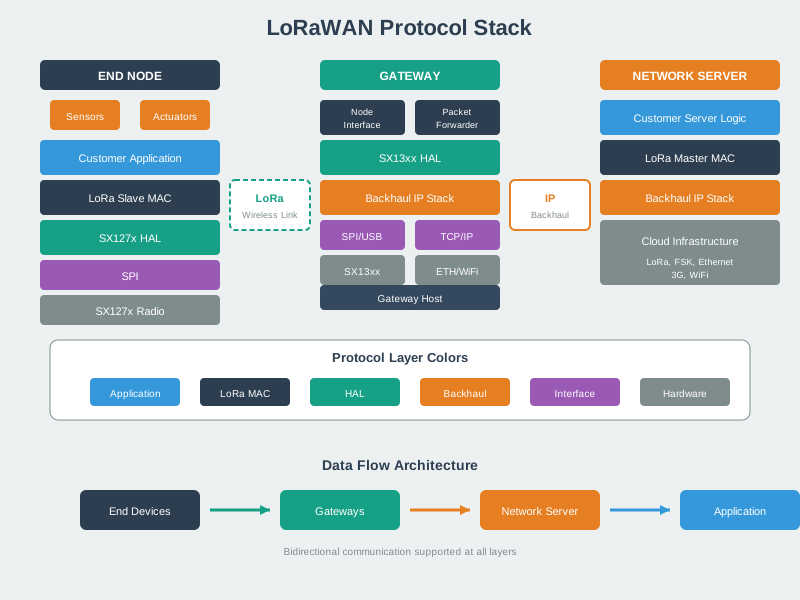
Figure 17.2 traces the end node’s application and LoRa MAC through the SX127x radio and wireless link to the gateway packet forwarder and IP backhaul.
Ask:
- Which layer owns the claim?
- Which component can observe the evidence?
- Which component can change the behavior?
- Which chapter should the learner revisit?
17.19 Question 3: Device Class
This section: Question 3: Device Class
17.20 Question 4: ADR Evidence
This section: Question 4: ADR Evidence
17.21 Troubleshooting Surfaces
This section: Troubleshooting Surfaces — Good troubleshooting starts by naming the surface being tested.
Good troubleshooting starts by naming the surface being tested.
A release decision about the “symptom”–“what changed?” decision needs “missing uplink”, not a slogan. Inspect Figure 17.3 through “Symptom” and “what changed?” to check this claim: LoRaWAN troubleshooting surfaces: one symptom is checked in parallel across radio, topology, class-behavior, ADR, and security evidence, then a review decision records the boundary, evidence, and next chapter.
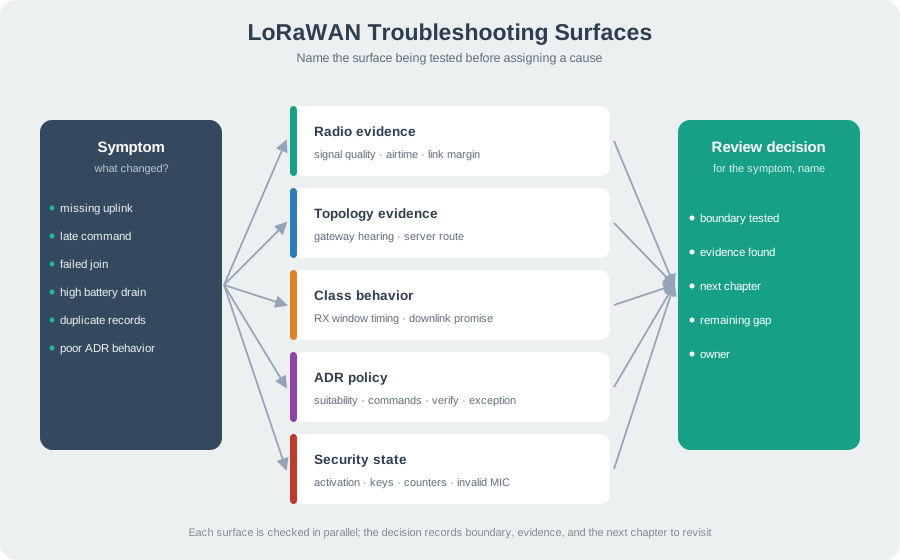
Rather than scanning Figure 17.3, use “Symptom” as the start. Relate it to “what changed?”, then carry “missing uplink” toward “late command”. The labelled route demonstrates LoRaWAN troubleshooting surfaces: one symptom is checked in parallel across radio, topology, class-behavior, ADR, and security evidence, then a review decision records the boundary, evidence, and next chapter and returns the result to the “symptom”–“what changed?” decision.
Review surfaces:
- Radio evidence: signal quality and airtime evidence.
- Topology evidence: gateway hearing and server route.
- Class behavior: receive-window timing and downlink promise.
- ADR policy: suitability, commands, verification, and exception rule.
- Security state: activation, keys, counters, and invalid-MIC events.
17.22 Match The Fundamentals
This section: Match The Fundamentals
17.23 Order The Fundamentals Review
This section: Order The Fundamentals Review
17.24 Readiness Record
This section: Readiness Record — The fundamentals quiz is complete when the learner can name the boundary, evidence, and next chapter for each symptom.
The fundamentals quiz is complete when the learner can name the boundary, evidence, and next chapter for each symptom.
Use Figure 17.4 to test a dry-soil uplink that gets no reply.
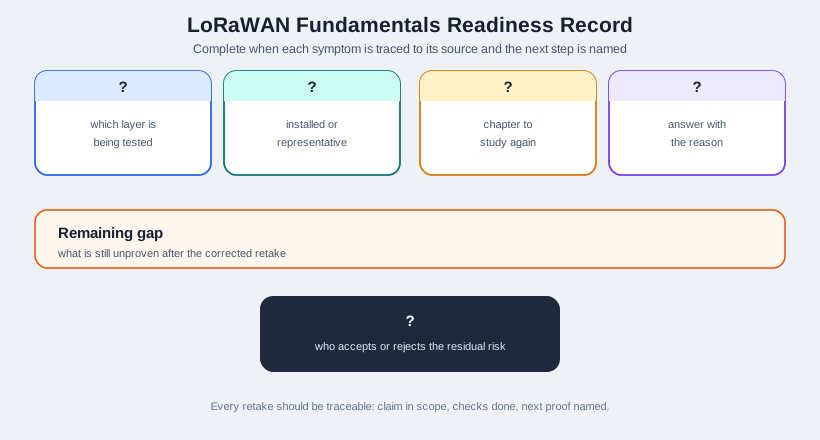
The four checks ask whether the device sent, a radio heard, the network accepted, and the service used the reading. The first is given; the other three need evidence. A second panel tests the promise of an immediate downlink to a Class A device. Its receive windows follow uplinks, so gateway proximity cannot make a command arrive at any time. The last panel asks for energy, airtime and ADR, and scale records before approval. Those checks matter because a correct quiz answer is not yet a working deployment. Name the failed boundary, the record that would prove it, and the next chapter to revisit; the release owner then judges readiness.
17.25 Label The Readiness Record
This section: Label The Readiness Record
17.26 Common Pitfalls
This section: Common Pitfalls
Radio settings and network behavior are connected, but they are not the same review surface. Name the layer before choosing the evidence.
Gateways forward frames and metadata. Do not assign server, key, or application responsibilities to them without evidence.
Device class affects downlink timing and energy assumptions. It belongs in the early design review, not final polish.
ADR needs representative evidence, follow-up uplinks, and an exception path. It is not a universal fix or a feature to ignore.
Overview: Assessment Proves Boundaries
A LoRaWAN assessment is useful when every answer names the boundary being tested. LoRa radio behavior, LoRaWAN MAC behavior, gateway forwarding, network-server control, join/security custody, device class, ADR policy, regional settings, and application ownership each need different evidence.
The quiz is therefore not a memory check about labels. It is a review exercise: can the learner explain which claim is in scope, which component can observe it, and which record would prove or reopen the decision?
For example, a learner who answers "add another gateway" to every reliability problem has not passed the boundary check. The same missing uplink symptom could come from weak radio margin, channel occupancy, a regional profile mismatch, activation failure, a blocked route, or an application expectation that the network never promised. The assessment should push the learner to ask which surface is being tested before choosing a remedy.
A strong answer also keeps evidence proportional to the claim. "LoRaWAN reaches far" is not enough to approve a campus, farm, or warehouse deployment. The answer should ask for representative gateway metadata, payload cadence, spreading-factor mix, downlink timing needs, class behavior, activation status, and the owner who can accept or reject the remaining risk. The point of the quiz is to turn a quick multiple-choice response into a small release-review habit.
In practice, that means every corrected answer should be traceable. The learner should be able to say, "I changed my answer because the claim was about class timing, the gateway evidence did not prove listening time, and the next proof is a receive-window test." If that sentence cannot be formed, the score is hiding an evidence gap.
- Layer boundary: separate radio settings from MAC, server, and application responsibilities.
- Evidence boundary: require installed or representative observations before approving range, class timing, ADR, or security claims.
- Decision boundary: record what answer is approved, what remains unproven, and what change triggers a retest.
Practitioner: Mark The Missed Evidence
When a learner misses a question, classify the miss before assigning review work. A layer miss sends them back to boundary diagrams. A timing miss sends them to device classes and downlink windows. A security miss sends them to activation, counters, MIC checks, and key custody. An ADR miss sends them to link evidence and exception handling.
Use a short assessment record for each missed surface: question, selected answer, boundary confused, evidence missing, chapter to revisit, and owner for the release decision. That turns the quiz into a readiness tool rather than a score alone.
Start the evidence review for the “attempt”–“weak surface” decision: inspect Figure 17.5. Two labels deserve attention—“attempt” and “Weak surface”—because they bound Quiz readiness loop: identify the weak surface, revisit the right chapter, fix the evidence gap, retake with focus, then record the owner action.
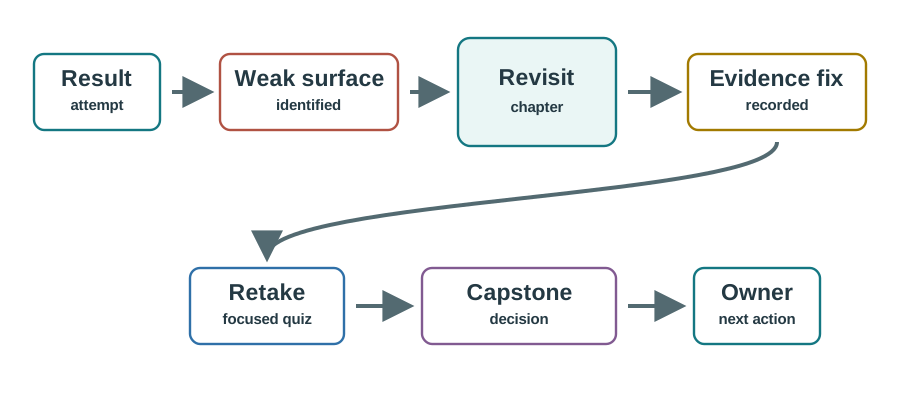
In Figure 17.5, notice how “attempt” establishes the initial state; “Weak surface” supplies the next check. The move through “identified” reaches “Revisit”, making Quiz readiness loop: identify the weak surface, revisit the right chapter, fix the evidence gap, retake with focus, then record the owner action observable. Return to the “attempt”–“weak surface” decision with “Revisit”, and keep “attempt” in the release record.
<p>Suppose a learner chooses "Class A devices can receive whenever the gateway is nearby" for a downlink question. The feedback should not only say the answer is wrong. The record should say the learner confused gateway reachability with device listening behavior, point them to device classes, and ask for an example receive-window timeline before the retake. If the same learner later answers an ADR question by saying "enable ADR everywhere," the record should add link-evidence and mobility suitability as the weak surface.</p>
<p>That lightweight record is useful for teams too. It shows whether the assessment uncovered one isolated gap or a pattern that could affect release work. A repeated security miss means the reviewer should not approve activation exceptions yet. A repeated regional-profile miss means copied settings need a field-validation owner. A repeated architecture miss means gateway, server, and application responsibilities should be reviewed before the learner moves to deployment scenarios.</p>
<ul>
  <li><strong>Boundary miss</strong>: LoRa, LoRaWAN MAC, gateway, server, and application roles were mixed together.</li>
  <li><strong>Evidence miss</strong>: a range, energy, ADR, or class claim was accepted without representative observations.</li>
  <li><strong>Ownership miss</strong>: the answer did not name who can change, verify, or reopen the behavior.</li>
</ul>
Under The Hood: Wrong Answers Collapse Layers
Most wrong LoRaWAN assessment answers collapse two layers into one shortcut. A nearby gateway is treated as proof of application success. A long-range radio is treated as proof of network readiness. ADR is treated as a universal optimizer. Device class is treated as an application preference instead of a radio-listening and energy contract.
The safer mental model is a chain of claims. The radio can be heard, the gateway can forward, the network server can accept and control MAC behavior, the application can interpret the payload, and the operator can respond to failures. A good assessment answer says which link is being tested and what evidence proves that link.
The chain matters because one successful observation does not prove the next one. A gateway log can show that a frame was heard, but it does not prove the message joined with valid session state, passed frame-counter checks, survived deduplication, reached the correct application route, or matched the application command timing. A dashboard value can prove ingestion, but it does not prove that a future downlink can be scheduled for a sleeping Class A device.
This is also why answer feedback should stay specific. If the wrong answer was "move the parser" for an ADR problem, the correction should name ADR as MAC/network behavior and point back to link evidence. If the wrong answer was "disable frame counters" for a reset problem, the correction should name security state and recovery evidence. If the wrong answer was "copy the EU profile" into another region, the correction should name regional configuration and field validation. The underlying skill is not trivia; it is controlled handoff between layers.
- Radio proof does not prove join success, payload acceptance, or downlink timing.
- Server proof does not prove application handling, owner response, or field power budget.
- Quiz proof expires when firmware, region profile, payload cadence, gateway placement, or class behavior changes.
17.27 Continue to the Next Part
This section: Continue to the Next Part — Carry this evidence into LoRaWAN Assessment: Regional Reference and Trade-Offs, which begins with Reference: LoRaWAN Quick Reference Card.
Carry this evidence into LoRaWAN Assessment: Regional Reference and Trade-Offs, which begins with Reference: LoRaWAN Quick Reference Card.
Open printable teacher run sheet
Find help
3 reviewed answers.
Where should I start in a module?
Open the module page from the sidebar to see its chapters in order. Use the module map to return to a topic you need.
Modules and pathsReviewed
What can I try when a project does not work?
Check the symptom, then work through the diagnostic steps. Keep the error message and the smallest example that reproduces it.
When you are stuckReviewed
How do interactive examples work?
Use the interactive guide to check how examples and simulations work before changing your project.
Interactive examples guideReviewed