2 Interoperability Beyond Connection
Transport, Syntax, Shared Meaning, Stream Contracts, and Review Evidence
IoT interoperability fundamentals, protocol integration interoperability, event contract, semantic alignment, IoT data exchange
2.1 Start With Two Systems Reading the Same Event
Imagine a freezer alarm that leaves a sensor gateway, reaches a broker, and appears in two dashboards. One dashboard treats the value as cabinet temperature; the other treats it as room temperature. The connection worked, the JSON parsed, and the alert still became unsafe because the receiving systems did not share the same meaning.
That is the story behind interoperability. Start with one event, follow it across the boundary, and ask whether the producer, contract, consumer, and action all agree on what the event means before the downstream system acts.
2.2 Overview: Interoperability Is Shared Use, Not Just Connection
Interoperability means that independent systems can exchange information and use it correctly for the intended decision. In IoT, that claim is broader than a network connection. A stream can arrive over the expected protocol and still be unsafe to use if the receiver cannot parse the payload, understand the measurement, align the event time, or trust the contract that describes the stream.
The useful review question is simple: can the producer, boundary, and consumer agree on what each event means and what the consumer is allowed to do with it?
Consider a gateway that forwards room readings from one vendor and supply-duct readings from another. Both feeds may authenticate, reach the broker, and use valid JSON. The integration still fails if the dashboard treats those values as the same measurement, ignores stale quality states, or averages event-time readings with gateway-receipt timestamps. Interoperability review keeps those differences visible before a consumer acts on the stream.
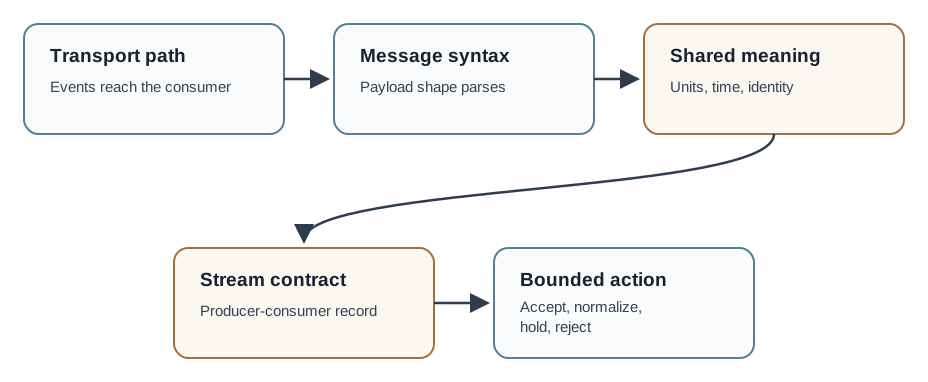
If you only need the intuition, this layer is enough: check interoperability in four steps. First prove the event can travel. Then prove the payload can be parsed. Then prove the values mean the same thing to producer and consumer. Finally prove the stream is governed well enough for the downstream workflow.
Technical
The expected path works: network reachability, authentication context, topic or endpoint naming, and delivery to the intended ingestion point.
Syntactic
The receiver can parse the representation: envelope, keys, types, version, required fields, and malformed-message handling.
Semantic
The receiver understands the same meaning: unit, identifier, timestamp basis, location or asset context, quality state, and status values.
Operational
The stream can support the consumer decision: ownership, change process, validation sample, bounded action, and retest trigger are recorded.
Those layers are ordered. A parseable message does not prove a meaningful message. A meaningful sample does not prove that the producer can change safely. A standards name helps only when the implemented profile, mapping, and validation evidence are clear for this stream and this consumer.
2.3 Practitioner: Build the Stream Contract Record
A stream contract should show the producer fields, consumer expectation, translation rule, semantic version, rejected-sample behavior, and change that would reopen the integration decision. It does not need to be a large specification; it needs enough detail for a maintainer to replay the boundary decision.
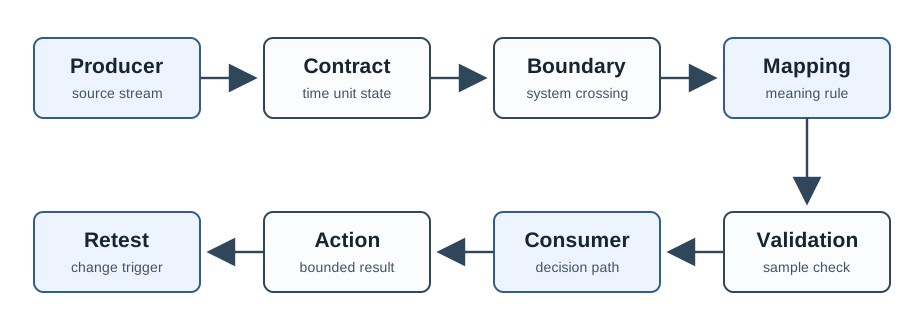
Work from the consumer decision backward. A dashboard that shows current status needs a different contract from a processor that builds windowed averages or a control rule that suppresses alarms. The same event can be adequate for one consumer and insufficient for another.
Accept
Use the stream when transport, syntax, meaning, owner, validation, and retest evidence match the consumer decision.
Normalize
Translate a known boundary while preserving source identity, event time, quality state, and mapping confidence.
Hold
Pause only the affected stream path while missing unit, timestamp, identity, or quality-state evidence is clarified.
Reject
Reject the affected path when the stream cannot support the consumer decision without unsupported assumptions.
For example, a building gateway may publish temperature readings from two device families through the same broker. The broker connection can work and the messages can parse, but the stream is not interoperable until the contract states which field is the measurement, whether the unit is Celsius or Fahrenheit, which timestamp is event time, whether stale readings are marked, and which consumer is allowed to use the merged output.
2.4 Under the Hood: Boundaries, Standards, and Meaning Drift
Most interoperability failures are boundary failures. A boundary can be a protocol bridge, gateway, cloud service, team interface, data model, standard profile, or adapter. The boundary is useful when it makes a translation explicit. It is dangerous when it hides source identity, quality state, timestamp basis, or mapping confidence.
Under the hood, interoperability is a controlled chain of claims: this producer emitted this event, this boundary transformed it in this way, this consumer interpreted these fields with this meaning, and this evidence shows the path still supports the intended decision.
Representation standard
Helps encode and validate the payload shape. It does not by itself prove that a field has the right physical meaning for a consumer.
Semantic context
Helps align observed properties, units, identifiers, status values, and vocabulary so producer and consumer refer to the same thing.
Interface description
Helps describe properties, actions, events, operations, forms, and subscriptions, but still needs local validation against the consumer decision.
Service boundary
Helps long-lived cross-team integration when ownership, versioning, rejection behavior, replay evidence, and retest triggers are explicit.
Standards reduce translation work when teams implement the same profile and preserve the same evidence. They do not remove the need to review the implemented path. A receiver still needs to know which profile version applies, which fields are required, how missing or stale data is represented, how extensions are handled, and what should happen when validation fails.
Meaning drift is the slow failure mode. A producer changes a unit, a gateway remaps a location, a schema gains an optional field, a dashboard changes its aggregation, or a rule starts treating a quality flag as authoritative. None of those changes has to break transport or syntax. That is why the retest trigger is part of the contract rather than a project-management afterthought.
The fail-closed action should stay bounded. Rejecting one ambiguous stream should not stop unrelated streams. Normalizing one known unit conversion should not silently rewrite every source from that producer. Holding a stream for clarification should name the missing evidence and the consumer that is affected.
2.5 Summary
Interoperability fundamentals are about usable meaning across a boundary. A working connection and a parseable payload are necessary, but they do not prove that a receiver can combine, display, alert on, or automate from the event safely.
The practical artifact is a stream contract. It records source identity, event time, message shape, measurement meaning, schema version, consumer expectation, validation evidence, bounded action, and retest trigger. When that evidence is missing, constrain the response to the affected stream path: accept, normalize, hold, or reject based on the consumer decision.
Interoperability is a chain of evidence: transport gets the event there, syntax makes it readable, semantics make it meaningful, and the contract proves the consumer can use it safely.
2.6 See Also
Modbus Protocol
See how register maps, RTU and TCP paths, and integration boundaries shape interoperability for a widely used industrial protocol.
OPC UA Fundamentals
Review how information models, services, and trust records carry shared meaning across the integration boundary.
IoT Protocol Selection Guide
Connect interoperability evidence to protocol selection gates, candidate comparison, and decision records.
Industrial Protocols Overview
Carry the same boundary-evidence discipline into OT, gateway, and industrial connectivity reviews.