41 IIoT Operational Decision Contracts
41.1 Start With the Story
Begin with an industrial decision that must be made by a person, PLC, MES, or enterprise system at the right level. This contract chapter defines the operational boundary so IIoT evidence supports the right action without moving control into the wrong layer.
41.2 Learning Objectives
After this page, you should be able to:
- Explain why IIoT value depends on operational decisions, not sensor installation alone.
- Map industrial signals to asset, outcome, timing, and integration boundaries.
- Place control, supervision, production, and business decisions at the correct ISA-95 layer.
- Trace an IIoT data item from machine source to historian, CMMS, MES, ERP, dashboard, or alert workflow.
- Specify semantic, reliability, security, and safety contracts for industrial telemetry.
41.3 After Industry 4.0 Basics
Industry 4.0 Fundamentals introduces cyber-physical systems, digital twins, industrial analytics, ISA-95 levels, and brownfield deployment tradeoffs. This page isolates the decision contract underneath those ideas: a plant signal becomes valuable only when its timing, context, owner, and safe action path are explicit.
Use it when a project proposes sensors, gateways, dashboards, or predictive models without naming the machine, production state, decision owner, integration system, latency budget, safety boundary, and fallback behavior.
41.4 IIoT Operational Decisions
Industrial IoT is different from consumer IoT because the connected system sits inside production, safety, maintenance, quality, and compliance workflows. A sensor reading matters when it changes a maintenance work order, production schedule, safety response, quality hold, or engineering decision. The technical stack still senses, communicates, analyzes, and acts, but the cost of a wrong or late action is much higher than a missed convenience notification.
Industry 4.0 is therefore more than a sensor retrofit. It combines cyber-physical systems, digital twins, AI or statistical analytics, vertical integration across plant systems, and horizontal integration across suppliers and customers. A bearing vibration sensor may start as a monitoring project, but it becomes an IIoT system when its signal is tied to asset identity, operating state, historian records, spare-parts planning, maintenance procedures, and a decision owner who can safely act on the result.
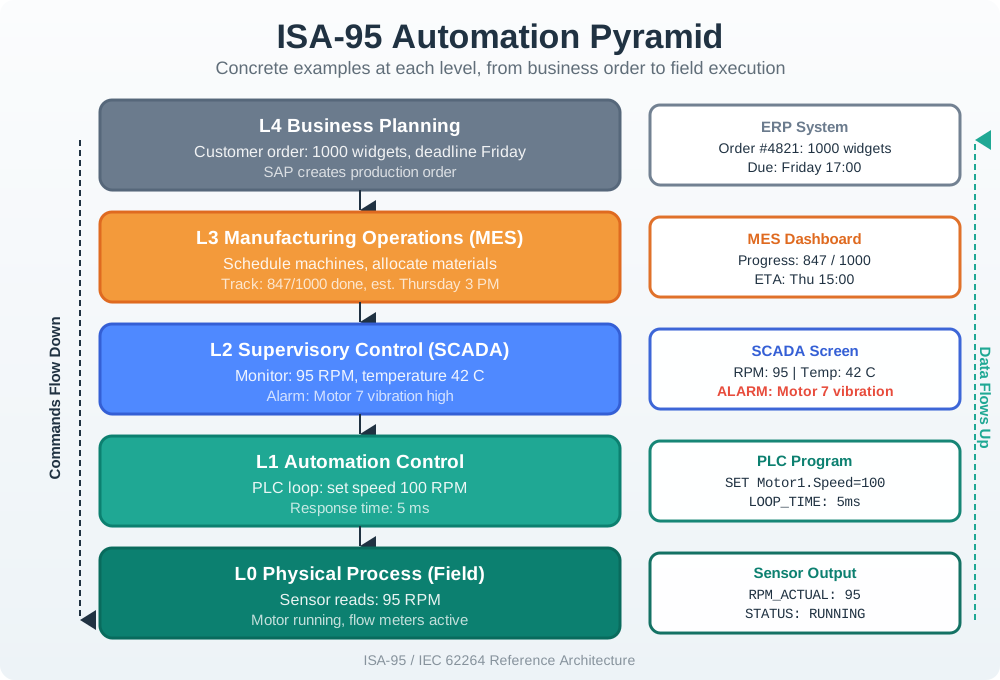
The ISA-95 layers are a useful way to avoid vague architecture diagrams. Sensors, actuators, and PLC control loops sit close to the physical process. SCADA supervises equipment and alarms. MES coordinates production execution, quality, and scheduling. ERP handles business planning, orders, inventory, and finance. A design that sends a millisecond control decision through a cloud dashboard is usually wrong, while a design that traps production context inside a PLC is also incomplete.
- Asset boundary: Name the machine, line, cell, process, or utility system being monitored or controlled, including the tags and operating states that define it.
- Outcome boundary: Name the operating decision: prevent downtime, improve quality, reduce scrap, save energy, protect workers, or prove traceability.
- Timing boundary: Decide whether the action needs a PLC-cycle response, a SCADA alarm response, an MES production response, or a business-planning response.
- Integration boundary: Name the system of record that receives the signal, such as SCADA, MES, CMMS, historian, dashboard, ERP, or alerting workflow.
This is why brownfield context matters. Machines may run for decades, shutdown windows may be short, vendor equipment may be closed, and safety interlocks may already be certified. Good IIoT work respects that reality: it starts with an operational decision, places compute where the timing requires it, and adds integration without weakening existing control or safety behavior.
41.5 Start With Constraint Layer
A useful IIoT design starts by locating the constraint before choosing a platform. A sub-second machine-control loop may belong near the PLC and should not wait for a cloud round trip. A maintenance trend may be safe to aggregate through an edge gateway. A production KPI may belong in MES or ERP after the signal has been cleaned, timestamped, and contextualized. The same sensor can support all three, but each consumer needs a different latency budget, failure behavior, and owner.
Begin with an OT inventory and a decision trace. List the machines, PLCs, drives, sensors, safety systems, network segments, cabinets, available ports, historian tags, maintenance windows, and vendor support constraints. Then trace one proposed data item from the physical source to the human or automated action. For example, a vibration alert may start at an accelerometer, pass through an IO module or edge computer, publish to a broker, land in a historian, trigger a CMMS work order, and reach a technician with enough evidence to decide whether production can continue.
Protocol choices follow that boundary. Modbus TCP, PROFINET, EtherNet/IP, EtherCAT, IO-Link, and vendor fieldbus networks often appear near industrial equipment and automation systems. OPC UA can expose structured equipment data to SCADA, MES, historians, or integration gateways. MQTT Sparkplug B can carry contextualized edge data toward brokers and applications. REST APIs, Kafka, time-series databases, data lakes, and enterprise warehouses may support analytics and reporting after the control boundary is protected.
- Separate monitor from control. Decide whether the project observes a machine, recommends action, or directly changes equipment behavior. Monitoring can often be added through read-only paths; control changes require formal engineering review.
- Place the decision. Decide whether logic belongs in a PLC, edge computer, gateway, SCADA layer, MES, cloud service, or human workflow. Put the fastest and most safety-sensitive logic closest to the process.
- Protect production. Plan brownfield wiring, cabinet space, network segmentation, maintenance windows, rollback steps, and operator handoff before adding sensors or gateways.
- Commission with evidence. Record tag mappings, sample rates, alarm thresholds, units, calibration status, and acceptance tests so maintenance and operations teams know what the new signal means.
- Prove the action loop. A dashboard is not enough. Show who receives the alert, what they can inspect, what system they update, and what happens when the alert is false, late, duplicated, or missing.
41.6 Industrial Data Context and Trust
Industrial telemetry is useful only when the consumer knows what the signal means. A vibration RMS value needs asset identity, sensor mounting point, sampling window, engineering unit, timestamp, machine state, speed, load, and quality flag. A temperature reading needs probe location, calibration status, alarm thresholds, measurement range, and whether the equipment was idle, ramping, cleaning, or producing. Without that context, analytics may learn maintenance schedules, product recipes, or operator behavior instead of the physical failure mode.
Modern IIoT stacks therefore spend a large amount of engineering effort on semantics. OPC UA information models can describe objects, methods, variables, namespaces, and data quality. MQTT Sparkplug B birth certificates can advertise edge nodes, devices, metrics, units, and online state to a broker. Historians and time-series databases preserve high-resolution process data, while MES, CMMS, ERP, and quality systems attach production order, work order, product, batch, and maintenance context. The hard part is keeping these meanings aligned as equipment, recipes, and software versions change.
Security and reliability also differ from office IT defaults. Plants often use Purdue-style zones, firewalls, jump hosts, DMZ brokers, read-only data taps, least-privilege service accounts, certificate rotation, and change-control records to keep monitoring projects from weakening control systems. IEC 62443 practices may guide segmentation, identity, remote access, patching, and supplier responsibilities. Store-and-forward gateways, local alarms, monotonic clocks, sequence numbers, duplicate handling, and stale-data rules keep the plant usable when analytics, cloud links, dashboards, or enterprise networks are unavailable.
- Semantics: Attach asset model, tag name, engineering unit, quality flag, namespace owner, and operating context to each signal before using it for optimization or maintenance decisions.
- Reliability: Define buffering, replay behavior, duplicate handling, clock behavior, quality codes, and stale-data rules before analytics consume the stream.
- Security: Treat gateways, brokers, remote access, credentials, certificates, and vendor support paths as part of the industrial risk model, not as afterthoughts.
- Safety boundary: Keep advisory analytics separate from certified control and safety functions unless the whole system is engineered, validated, and maintained for that role.