12 IoT Enablers: Records and Convergence
More
Depth: Practitioner
Progress saves as you read. Mark sections complete as you go; your progress appears in the sidebar.
12.1 Start With the Decision
This section: Start With the Decision — A readiness claim fades when its assumptions stay in a meeting.
A readiness claim fades when its assumptions stay in a meeting. Records make each dependency, limit, and owner open to review.
12.2 Route Overview
This section: Route Overview — This is part 2 of 2.
This is part 2 of 2. Review IoT Enablers: Compute and Readiness for the preceding evidence.
12.3 Learning Objectives
This section: Learning Objectives
- Create auditable readiness records for enabling technology.
- Explain how IoT enablers converge in a deployed system.
12.4 Chapter Roadmap
This section: Chapter Roadmap
- Records Make Readiness Auditable
- IoT Enabling Technologies Converge
- Summary
- Key Takeaway
- See Also
12.5 Records Make Readiness Auditable
This section: Records Make Readiness Auditable — Under the hood, an enabler review is a traceability system.
Under the hood, an enabler review is a traceability system. It connects an architecture claim to observed evidence, owner decisions, unresolved risks, and the event that should reopen the review.
That record matters because IoT systems change after installation. Devices move, firmware changes, batteries age, signal paths shift, support teams change, and data consumers begin to rely on readings in new ways.
The reason to inspect records make readiness auditable is concrete. Figure 12.1 depicts: Readiness grows as evidence moves from idea to operated fleet learning. Distinguish Concept from Release.
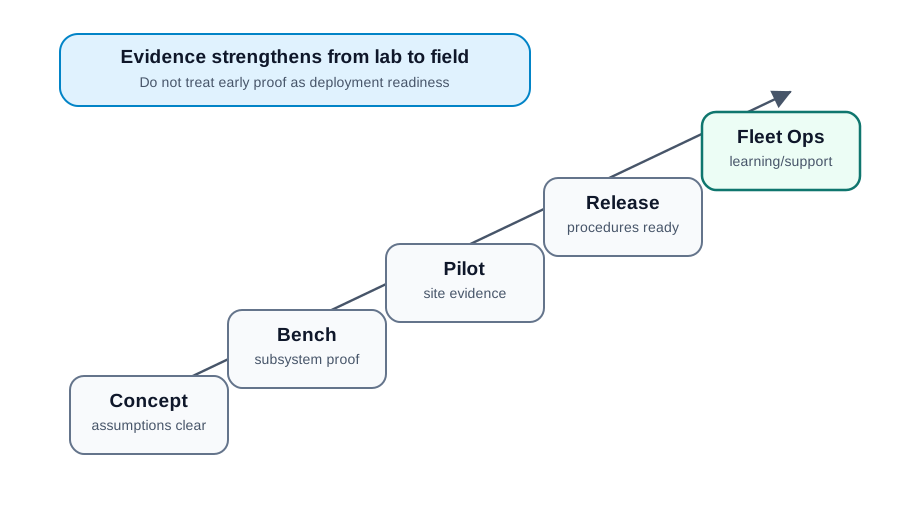
Figure 12.1 follows readiness from concept through release to operated fleet learning and warns against treating early proof as deployment readiness.
Evidence Maturity
Readiness Record Fields
Build the readiness record from purpose to ownership. First state the physical event or action, then capture signal and device limits, responsibility placement, enclosure and power behavior, communications and data evidence, and the security and management lifecycle. Finish with adoption ownership, known risks, and the trigger that reopens review. The fields below form one connected system argument rather than independent component checks.
Test the couplings as well as each field. Enclosure material can alter radio evidence, retry behavior can alter the power ledger, a payload change can alter storage and support workflows, and a credential change can alter provisioning and recovery. Recording those dependencies helps the next reviewer find the affected owner and proof when deployment assumptions move.
For every accepted field, keep one artifact and one failure probe. Measurements, drawings, traces, configuration records, inventories, and workflow tickets should show the normal state; outage, low energy, invalid input, lost connectivity, expired identity, failed update, or operator escalation should show the bounded response. That pairing distinguishes production readiness from a catalogue of intended features.
- Purpose: physical event, decision, or action supported.
- Signal: expected range, validity limits, calibration, and failure behavior.
- Device capability: local compute, storage, timing, buffering, firmware constraints, and safe defaults.
- Responsibility placement: where each capability executes, which system boundary it crosses, who owns the handoff, what fallback applies, and what evidence makes the placement reviewable.
- Physical fit: enclosure, mounting, antenna, connector access, environment, and service access.
- Power behavior: sleep pattern, transmit windows, replacement workflow, warning threshold, and outage behavior.
- Communication evidence: payload, timing, topology, coverage, capacity, retries, and diagnostics.
- Data quality: units, timestamps, identity, location, missing data, duplicates, retention, and quality flags.
- Security boundary: identity, credentials, authorization, update trust, logs, and diagnostic access.
- Management workflow: provisioning, inventory, monitoring, update, rollback, replacement, and retirement.
- Adoption owner: installer, operator, support team, escalation route, and outcome review.
- Risks and trigger: known limits, unresolved assumptions, and the event that requires a new review.
Common Failure Patterns
Component Equals Enabler
A sensor, radio, or service is treated as the capability, even though the deployed evidence around it is missing.
Bench Success Equals Rollout
Controlled tests are accepted without representative site evidence, fault behavior, monitoring, updates, or support ownership.
Data Meaning Is Deferred
Readings are stored without identity, units, timestamps, calibration state, location, quality flags, or missing-data policy.
People Are Outside the Architecture
Installers, operators, support staff, and decision owners are not represented, so alerts and failed devices have no clear action path.
12.6 IoT Enabling Technologies Converge
This section: IoT Enabling Technologies Converge
12.6.1 Start With the Pressure to Change
Picture one store room with a wired heat sensor. At first, a local alarm is enough. The owner then asks for phone alerts, longer battery life, remote updates, and proof that every site is healthy. Each request changes more than one part of the design.
Begin with the new need, not a list of new tools. Write down what must now happen, who must act, how soon they must act, and what record will prove success. Then trace one reading from the sensor to the final action. Check what happens when the link fails, the battery is weak, or an update goes wrong.
An enabler is something that makes a useful change possible, such as a better sensor, radio, power source, or support process. No enabler proves the whole system on its own. A faster radio can use more power. A cloud service can still receive bad data. A good pilot can still fail when the fleet grows.
Go deeper in two steps. The Practitioner section builds an Enabler Readiness Record for real design work. Under the Hood follows the proof loop across each handoff and shows where meaning can be lost.
IoT architectures evolve because some pressure becomes too strong for the first design: more devices, tighter latency, new privacy rules, harder maintenance, longer battery life, or a platform handoff that the prototype never considered.
Use that pressure as the story. The evolution path should explain what changed, which architectural enabler absorbs the change, and what evidence shows the system improved instead of merely becoming more complicated.
12.6.2 IoT Emerges from Enablers
IoT did not become practical because one component improved in isolation. It became practical when small processors, useful sensors, low-power design, reliable communication, device management, data pipelines, security controls, and field adoption started fitting together as a system.
A connected product can send or receive messages. An IoT system goes further: it connects a physical event to a supportable decision, action, or workflow. The useful question is not whether a device has a radio. The useful question is whether the device, network, data, decision logic, and operating process leave evidence that another team can trust.
A practical way to see the convergence is to follow a simple asset monitor over time. Early designs might use a wired sensor and local microcontroller. As MEMS sensors, ARM Cortex-M class devices, ESP32 or nRF52-style SoCs, lithium-ion packs, and low-power modes improve, the same monitor can sleep for long periods and wake only for useful events. BLE, Zigbee, LoRaWAN, LTE-M, NB-IoT, Wi-Fi, MQTT, HTTP APIs, and managed device registries then turn the device from a local instrument into a serviceable fleet member. The IoT claim becomes credible only when those pieces are tested together.
If you only need the intuition, this layer is enough: IoT is managed physical-system feedback. The device senses or acts, the network carries meaning, software turns that meaning into a decision, and operations can install, update, diagnose, and improve the system over time.
Read Figure 12.2 to see how several technology tracks converged before large, supportable IoT deployments became practical.
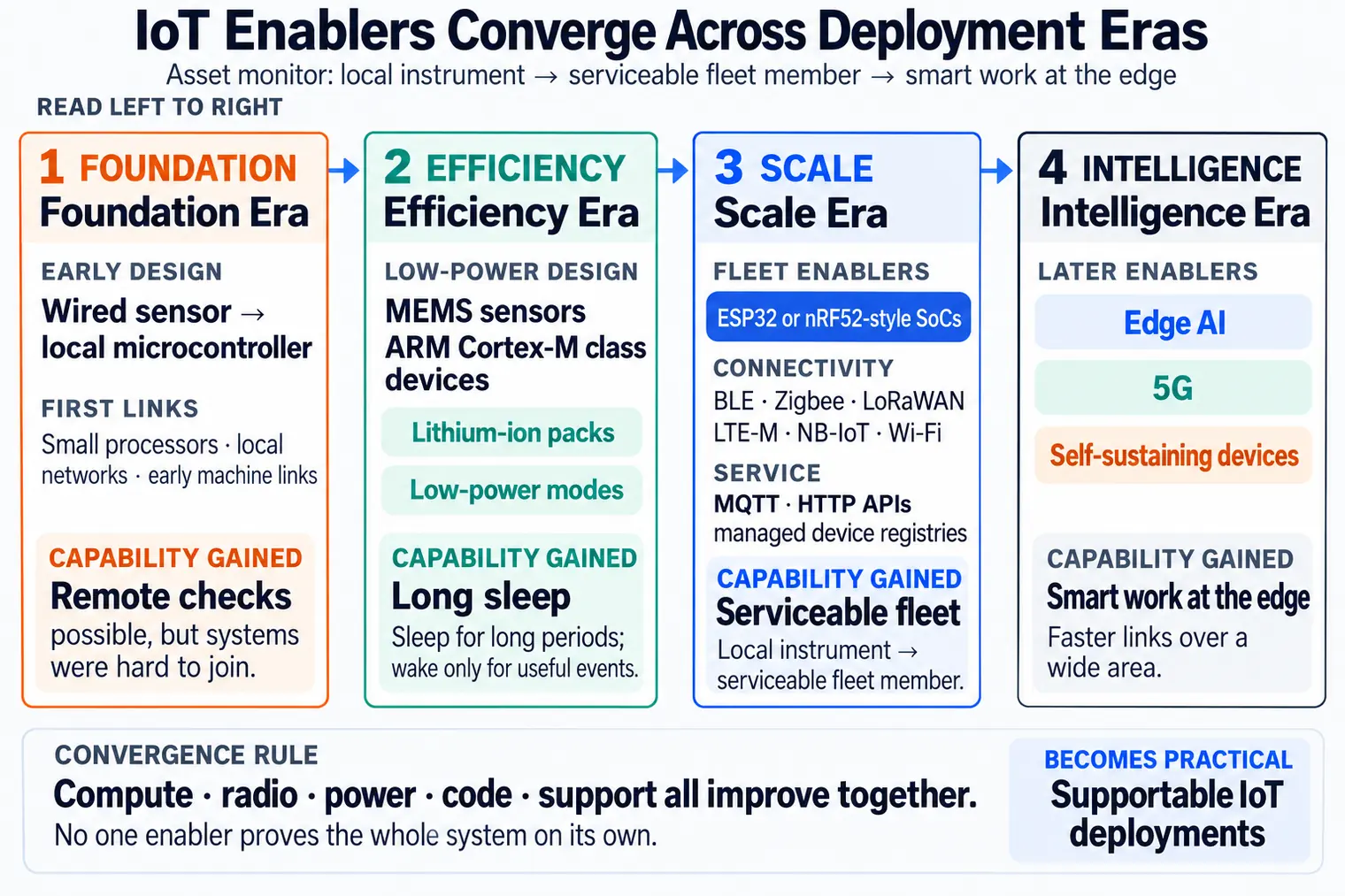
Start in the first era. Small processors, local networks, and early machine links made remote checks possible, but systems were hard to join. The next eras add low-power radios, better cells, cloud services, and chips such as the ESP32 and nRF52. The last track adds smart work at the edge and faster links over a wide area. No one part caused this shift. The time line shows that field systems become useful when compute, radio, power, code, and support all improve together.
Embedded Product
Local logic responds to local inputs. Proof focuses on firmware behavior, local safety, and maintenance access.
Connected Product
A network link adds remote status, commands, configuration, or notifications. Proof now includes basic identity and communication behavior.
IoT System
Physical data supports a decision or action through data quality, lifecycle management, security, analytics, and operational ownership.
12.6.3 Enabler Readiness Record
In a design review, treat enablers as coupled responsibilities. A power decision changes reporting frequency. Reporting frequency changes network load. Network behavior changes battery life, data latency, and support procedures. A readiness record keeps those dependencies visible before a pilot becomes a deployment dependency.
Use Figure 12.3 to find the dependencies that a readiness review would miss by approving each enabler separately.
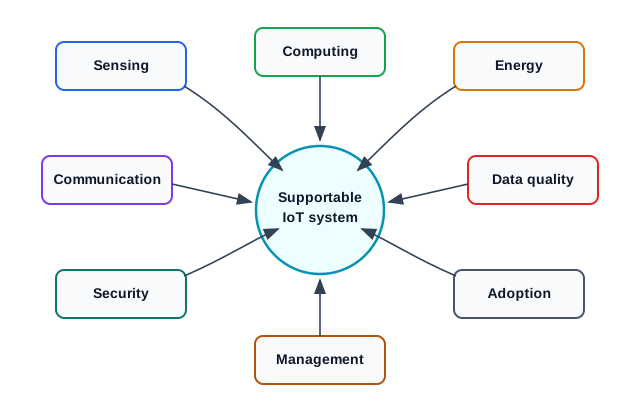
Read out from the supportable system at the centre. Sensors and small processors set what the device can learn on site. The power plan sets how often it can do that work and send a result. Data paths, security, and device care decide whether those results stay sound after launch. Data study may find a useful fact, but the work plan must still name who will act on it. The map joins these duties. A change to one path should cause new checks on the nearby paths that depend on it.
Applied to Figure 12.3, a warehouse condition-monitoring readiness record should connect measurement placement, battery replacement access, link tests around doors and racks, timestamp and calibration policy, alert routing, update ownership, and a review of whether interventions reduced product risk. A sensor list alone cannot answer those questions.
Make the record concrete enough for another team to repeat the review. Name the sensor part or capability class, firmware version, radio profile, gateway model, broker topic, data-retention rule, alert threshold, escalation path, and maintenance interval used in the pilot. If the warehouse later adds freezer rooms, metal racks, a second shift, or a new gateway image, the team can see which assumptions must be retested before scale-out.
Change One Enabler
If reporting frequency increases, recheck power life, network airtime, storage cost, alert volume, and support expectations.
Close The Loop
Every enabler decision should name the observable behavior, the owner, the proof artifact, and the trigger for review.
12.6.4 Proof Loops in IoT Evolution
At architecture level, Figure 12.4 expresses IoT evolution as a proof loop. A physical event becomes a measured signal. The device attaches state, timing, identity, and local context. The communication path preserves the meaning well enough for a data pipeline to validate it. Decision logic turns it into an action, alert, optimization, or record. Operations then confirm whether the action helped and whether the system remains supportable.
The loop is fragile because each boundary can silently change meaning. A missing timestamp can make a reading unusable. A weak identity process can make device history ambiguous. A radio retry policy can stretch latency. A dashboard can hide missing-data flags. Under-the-hood review looks for those meaning changes.
The hidden engineering issue is that every enabler exports a contract to the next one. Firmware exports units, sampling time, battery state, and fault flags. The network exports delivery behavior, ordering, retry limits, and identity. The data pipeline exports schema version, validation results, and missing-data semantics. If any contract is undocumented, the architecture can appear to work while quietly making the wrong operational decision.
The store-room route in Figure 12.4 follows a heat reading to a phone alert; check who owns it.
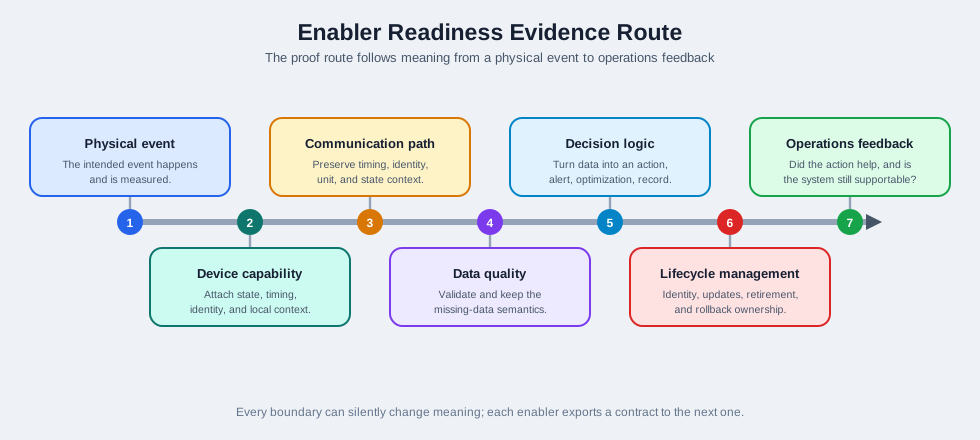
The worked path in Figure 12.4 tracks one store-room heat reading through its meaning, not only its delivery. The sensor value needs placement and calibration evidence. Device firmware adds units, sample time, identity, battery, and fault state before the network carries it through retries. The data stage checks schema and missing-data meaning; decision logic can then trigger a phone alert. Operations owns routing, escalation, and the question of whether action helped. Each handoff has a record and a condition that reopens review, such as sensor replacement, weak coverage, missed events, or a new site. A delivered number without context is not enough.
Inspect Figure 12.5 before judging proof loops in iot evolution; it depicts: A compact decision record makes the proof loop reviewable after the architecture choice is made. Focus first on Enabler Decision Record, then on Data quality.
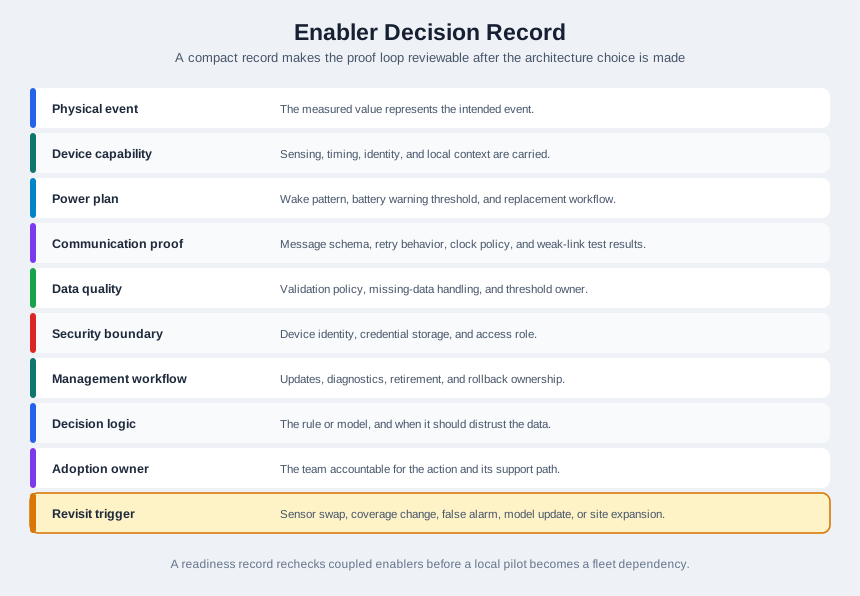
The fields in Figure 12.5 turn the proof loop into a decision another team can inspect. It begins with the physical event and the device’s unit, calibration, time, power, and fault context. Communication proof covers payload, weak spots, retries, and outage behavior. Data quality must preserve missing readings before a threshold owner can approve the alert rule. Management and adoption fields name update, support, and response ownership. The figure also marks missing pilot values as open evidence rather than filling them with guesses. A sensor, site, radio profile, or alert rule change becomes a revisit trigger because it can break the meaning carried between stages.
12.6.5 Summary
IoT becomes practical when enabling technologies converge into a managed physical-system feedback loop. Sensing, compact computing, energy design, communication, data quality, security, device management, analytics, and adoption workflow all constrain one another. The architecture task is to prove that those enablers preserve meaning from physical event to device behavior, network transport, data pipeline, decision logic, and operations feedback.
12.6.6 Key Takeaway
Technology evolution matters when it changes supportable capability, not labels; judge an IoT system by the evidence that its enablers work together in the field.
12.6.7 See Also
Choosing IoT Communication Technologies
Use this next when the communication enabler needs a coverage, capacity, topology, and operations proof record.
Connectivity and Energy Trade-offs
Connect reporting frequency, radio choice, sleep behavior, and maintenance access to the energy plan.
IoT Reference Models as Responsibility Maps
Translate enabler proof into layered architecture responsibilities that can be reviewed and owned.
12.7 Summary
This section: Summary — Architectural enablers should now read as a connected readiness argument.
Architectural enablers should now read as a connected readiness argument. Begin with the system purpose, inspect each enabling dimension with deployed evidence, then test the couplings where power, communication, data, security, operations, and adoption constrain one another. The summary points below close that argument by showing why a bench-successful component is weaker than an owned, traceable system record with explicit review triggers.
Readiness therefore changes when the deployment changes. A new enclosure, gateway, update service, operator workflow, energy source, or data obligation can invalidate evidence even if the component part numbers remain fixed. Preserve assumptions and owners beside measurements so later reviewers know which enabler record to reopen instead of repeating the entire architecture discussion.
- Architectural enablers are evidence-based review dimensions, not just component categories.
- Component availability and bench success are weaker than deployed system readiness.
- The foundation set covers sensing, computing, physical fit, power, communication, data, security, management, and adoption workflow.
- Enablers constrain one another, so review should test couplings as well as individual readiness.
- A readiness record keeps purpose, evidence, risks, owners, and review triggers auditable over time.
12.8 Key Takeaway
This section: Key Takeaway
Enabler fundamentals help teams explain why hardware, connectivity, energy, data, lifecycle, and human workflow constrain the whole IoT architecture. A design becomes credible when those constraints have evidence and owners.
12.9 See Also
This section: See Also
IoT Evolution and Enablers Overview
Shows how connected systems became managed physical-system feedback loops.
IoT Communications Technology
Connects payloads, coverage, topology, and communication evidence to architecture choices.
Technology Selection and Energy
Focuses on power-aware tradeoffs and energy review for IoT designs.
Applying Reference Architectures
Places enabler evidence into reusable architecture decisions and application contexts.
12.10 Continue Your Route
This section: Continue Your Route — This is the last part of this chapter.
This is the last part of this chapter. Return to IoT Enablers: Compute and Readiness or continue from the reference-architectures module index.
Find help
3 reviewed answers.
Where should I start in a module?
Open the module page from the sidebar to see its chapters in order. Use the module map to return to a topic you need.
Modules and pathsReviewed
What can I try when a project does not work?
Check the symptom, then work through the diagnostic steps. Keep the error message and the smallest example that reproduces it.
When you are stuckReviewed
How do interactive examples work?
Use the interactive guide to check how examples and simulations work before changing your project.
Interactive examples guideReviewed