21 IoT Development Workflow: Debug and Release
More
Depth: Practitioner
Progress saves as you read. Mark sections complete as you go; your progress appears in the sidebar.
21.1 Start With the Situation
This section: Start With the Situation — Firmware is the program stored on a device.
Firmware is the program stored on a device. A local build checks that the program can be made, but it is not yet a release. Debug evidence records the fault and how it was reproduced. Release gates are checks that must pass before delivery. Stage the update in steps, watch device health, and keep rollback, the way to restore the earlier version, ready.
21.2 Overview
This section: Overview — This route follows a fault through debugging, CI, release, staged OTA, and fleet evidence.
This route follows a fault through debugging, CI, release, staged OTA, and fleet evidence.
This is part 2 of 2. Review IoT Development Workflow: Toolchain Boundaries when you need the first route.
21.3 Learning Objectives
This section: Learning Objectives
By the end of this chapter, you will be able to:
- apply a structured debugging record
- define embedded CI release gates
- plan staged OTA rollout and rollback
21.4 Chapter Roadmap
This section: Chapter Roadmap — The workflow moves from debugging records to CI release gates, OTA rollout, and rollback.
The workflow moves from debugging records to CI release gates, OTA rollout, and rollback.
21.5 Debugging Record Path
This section: Debugging Record Path — Embedded failures often disappear when extra logging changes timing.
Embedded failures often disappear when extra logging changes timing. The workflow should support multiple diagnostic paths instead of relying on one print log.
For debugging record path, inspect Figure 21.1 at Debugging evidence path. Its visible premise is: A debugging record path moves from symptom capture to reproduction, trace, breakpoint, memory findings, fix, regression test, and release note. Then compare halt on fault.
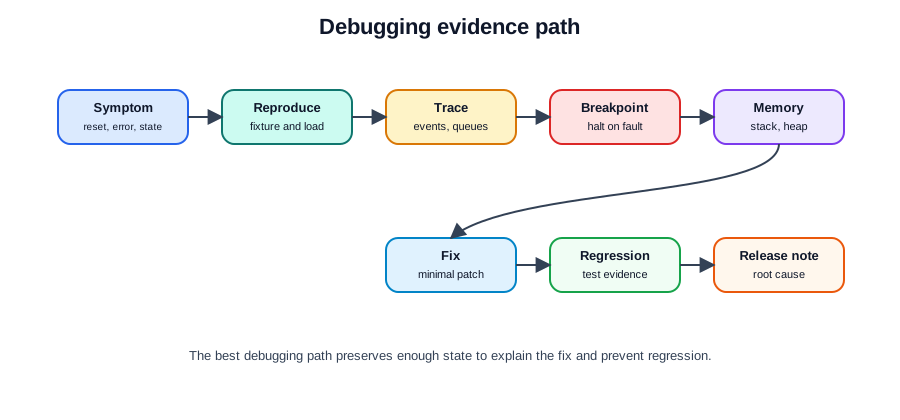
The path in Figure 21.1 starts with a symptom record, such as reset cause, last state, and firmware version. A repeatable fixture and load then make the failure observable. Event or queue traces may explain timing without changing it; a breakpoint can halt on the fault when stack or register state is needed. Memory checks look for bounds, lifetime, heap, or stack evidence before a minimal fix is chosen. The regression test repeats the failing case, and the release note records root cause and reviewer signoff. Keep these artifacts linked so extra logging does not become the only explanation for a timing-sensitive defect.
Use the least invasive diagnostic record that can answer the question:
- Symptom capture: boot reason, reset cause, error code, last state, version, device identity, and time window.
- Reproduction: test fixture, hardware revision, configuration, radio conditions, sensor input, and load pattern.
- Trace: structured logs, event counters, state transitions, queue depth, task state, and watchdog markers.
- Breakpoint and watchpoint: halt on exception, inspect stack, registers, heap, buffers, and invalid writes.
- Memory findings: stack high-water mark, heap fragmentation, allocation lifetime, buffer bounds, and leak checks.
- Fix record: root cause, minimal patch, regression test, release note, and reviewer signoff.
Do not treat “more logs” as the only debugging strategy. Logging can change timing, fill storage, drain power, or hide the race condition. Use logs with trace levels and retention limits, then switch to breakpoints, watchpoints, crash dumps, or hardware capture when the symptom requires it.
21.6 CI Release Gates
This section: CI Release Gates — CI is useful when it rejects changes that would be unsafe, unreproducible, or unreviewable in the fleet.
CI is useful when it rejects changes that would be unsafe, unreproducible, or unreviewable in the fleet.
Read Figure 21.2 to see where a signed firmware build can be stopped before it reaches the whole fleet.
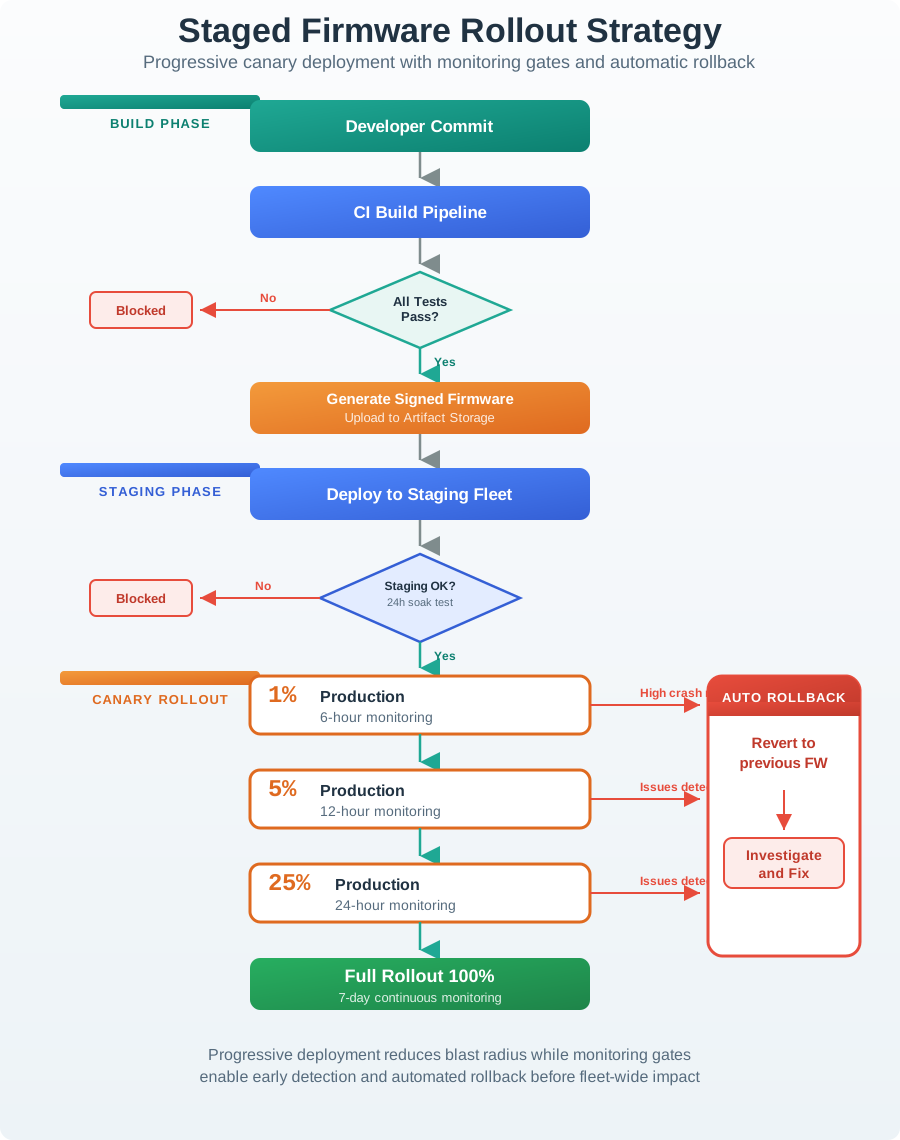
Begin with the signed build from CI, then inspect the staging and soak gates that test installation, startup, and steady operation before customer devices are involved. The canary rollout exposes only a bounded group and watches explicit health signals. A stop rule must lead to pause, diagnosis, or automatic rollback rather than continued expansion. Broader waves occur only after the evidence gate passes. The final release record links the deployed version, observed metrics, exceptions, and rollback result so a later incident can reconstruct why the fleet was allowed to advance.
Useful gates include:
- Build reproducibility: the release artifact is built from a tagged source state, target definition, and locked dependencies.
- Configuration guard: debug logging, test endpoints, unsafe credentials, development flags, and local URLs are rejected from release builds.
- Test pass: host tests, integration tests, hardware-in-the-loop checks, protocol checks, and boot checks pass for the target class.
- Artifact inspection: firmware size, partition fit, manifest fields, version string, and compatibility markers are checked.
- Signing and manifest: artifact hash, signature, target hardware, minimum compatible version, and rollback information are recorded.
- Record storage: build logs, test reports, static analysis results, artifact hash, and release notes remain linked to the release.
The workflow should fail closed. If a required gate cannot run, the release should wait for review rather than silently publishing an unverified artifact.
21.7 OTA Rollout Safety
This section: OTA Rollout Safety — OTA is not only a transport mechanism.
OTA is not only a transport mechanism. It is a controlled release process for devices that may be remote, battery constrained, intermittently connected, or physically hard to recover.
Review the rollout from eligibility to recovery. First identify every device and constrain the target cohort, then expand only when measured health signals pass. Keep rollback and operator pause authority active throughout the sequence. This turns the checklist below into a release state machine: inventory and targeting define who may enter, staging and health gates decide who advances, and rollback or pause provides the bounded exit when field evidence deteriorates.
Safe rollout needs:
- Fleet inventory: each device reports stable identity, hardware revision, installed version, boot state, and last contact.
- Targeting: release rules select only compatible hardware, region, cohort, and dependency state.
- Staging: a small monitored group updates first, then later cohorts expand only after health gates pass.
- Health gates: boot confirmation, crash rate, watchdog resets, battery impact, connectivity, command success, and support signals.
- Rollback: dual image or equivalent recovery path, boot confirmation marker, rollback reason, and blocked-version record.
- Pause control: an owner can stop rollout when health signals degrade or support evidence changes.
OTA rollout rule: A rollout plan must explain which devices are eligible, what health signal opens the next cohort, what signal pauses the rollout, and how a device returns to the previous working image.
21.8 Cold-Room Firmware Change
This section: Cold-Room Firmware Change — A team maintains cold-room sensor gateways.
A team maintains cold-room sensor gateways. A recent field report shows occasional missing compressor-state events after a reconnect. The team needs to change the firmware without breaking local alarms or losing event evidence.
21.8.1 Workflow Route
Read this route as one incident-to-release narrative. The field report fixes the affected scope and supplies a reproducible failure sequence; local development turns that sequence into a fixture with visible identity, queue, and reconnect state; release gates then prove the same behavior from a tagged build. The grouped actions below are not independent chores. Each stage consumes the evidence left by the previous one so a reconnect fix cannot reach devices without regression, artifact, and rollback proof.
Preserve negative evidence as the route advances. The fixture should show the original fault, the corrected result, and the behavior when interruption recurs; CI should reject a build that loses those cases; staging should watch the same counters in a small cohort. That continuity ties the source change to field health instead of relying on separate teams to reinterpret the incident.
Close the route only after the artifact, deployment cohort, and rollback target can be traced back to the same source and configuration. Record who can pause expansion, which signal invokes that authority, and how affected devices return to a known state. Those final links turn a local fix into controlled operational change.
Change intake
- Link the change to the field report and affected firmware families.
- Capture version, hardware revision, reconnect timing, network state, and event sequence.
- Define success as preserved local alarm behavior and no duplicate or missing compressor-state transitions after reconnect.
Local development
- Add a reproducible reconnect test using a gateway fixture and a simulated network interruption.
- Keep device identity, retained event queue, and command freshness rules visible in logs.
- Use trace counters for reconnect attempts, replayed events, duplicate suppression, and final state.
Release Gates
- Add regression tests for event ordering, duplicate handling, and reconnect replay.
- Build release and debug configurations from the same source tag.
- Reject release if debug trace is left at a verbose level or if the replay buffer configuration is missing.
Rollout
- Release only to compatible hardware revisions.
- Start with a monitored cohort, then expand after boot health, reconnect success, alarm delivery, and event replay evidence remain acceptable.
- Keep rollback available until the fleet reports stable health across normal reconnect cycles.
21.9 Development Workflow Release Record
This section: Development Workflow Release Record — The workflow should end with a release record that can be used during audits, incident analysis, and future changes.
The workflow should end with a release record that can be used during audits, incident analysis, and future changes.
Treat development workflow release record as a system decision around Development workflow review record. The visual in Figure 21.3 places Release gate within this relationship: A development workflow release record captures change intent, branch, target, tests, debug findings, release gate, artifact, rollout, fleet health, owner, and next checkpoint.
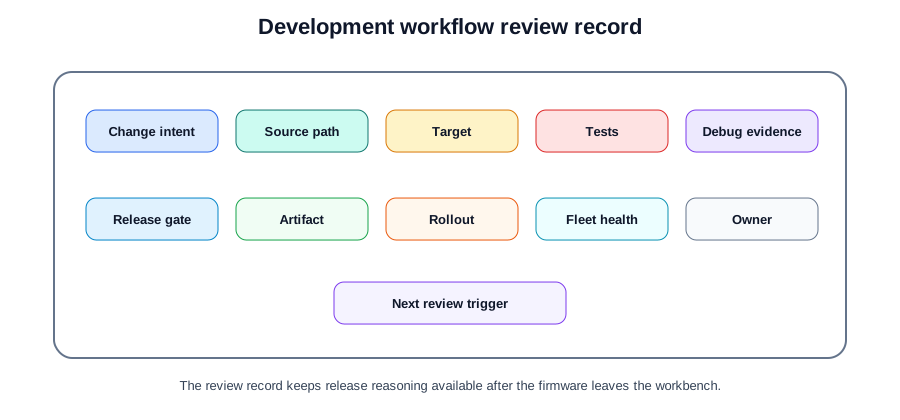
Begin the diagram Figure 21.3 with Development workflow review record. Continue through Release gate before checking Next review trigger. This path preserves the chapter’s development workflow release record argument: A development workflow release record captures change intent, branch, target, tests, debug findings, release gate, artifact, rollout, fleet health, owner, and next checkpoint.
Record:
- Change intent: requirement, defect, support issue, risk, or maintenance need.
- Source path: branch, review, tag, reviewer, and unresolved decision notes.
- Target definition: board class, hardware revision, partition layout, dependencies, and configuration.
- Test records: host tests, hardware tests, protocol tests, power tests, and recovery tests.
- Debug records: crash record, trace, breakpoint finding, memory finding, and root cause.
- Release artifact: version, manifest, hash, signature, compatibility rule, and rollback data.
- Rollout record: cohort rule, health gate, pause owner, rollback trigger, and final fleet state.
- Next checkpoint: date or trigger for revisiting tooling, release gates, update safety, or fleet records.
21.10 Interaction: Workflow Release Decision
This section: Interaction: Workflow Release Decision
21.11 Interaction: Match The Workflow Record
This section: Interaction: Match The Workflow Record
21.12 Order a Safe Firmware Release
This section: Order a Safe Firmware Release
21.13 Common Pitfalls
This section: Common Pitfalls
If the release artifact depends on a developer laptop, local cache, or uncommitted setting, the team cannot reproduce the binary after an incident. Release builds should come from a reviewed source state and recorded environment.
Debug builds often include extra logs, assertions, test endpoints, and different timing. Release gates should verify the actual artifact that can reach devices.
OTA targeting is unsafe when the team cannot identify hardware revision, installed version, boot state, and last contact. Inventory is part of the release system, not an administrative side list.
A rollback design is incomplete until the team has tested boot confirmation, failed boot recovery, rollback reporting, and blocked-version handling.
21.14 Overview: Keep The Record Chain Intact
This section: Overview: Keep The Record Chain Intact — The workflow map in Part 1 ties a cold-room gateway fix to a full release record.
If you only need the selection shortcut, this layer is enough: a development workflow is ready when a firmware change can be rebuilt, tested, signed, rolled out, paused, rolled back, and explained from the same record chain.
The workflow map in Part 1 ties a cold-room gateway fix to a full release record. A requirement or field defect leads to a reviewed branch, target build, host and device tests, and debug traces. The release gate can block or approve the hashed, signed artifact before OTA reaches selected cohorts. Fleet health then reports boot and crash behavior, closing the loop when reconnect results become evidence for the next change. This order keeps the build command, dependency lock, trace, rollout owner, and rollback rule with the same firmware change. A local green test cannot stand in for later fleet behavior.
The IoT development workflow label opens the diagram the linked figure in Part 1. Debug evidence marks a different decision point, while boot and crash prevents an early stop in overview: keep the record chain intact. Together IoT development workflow and boot and crash connect to the claim: The depth layer uses the same record-chain map as the chapter: every release step should leave evidence that can be checked later.
For the cold-room gateway fix, the record chain starts with the field report and ends only when the affected fleet reports stable reconnect behavior. Git history, a reviewed commit SHA, the dependency lock, the target board definition, and the build command prove what was built. Hardware fixture logs, serial traces, boot records, and reconnect regression results prove what was tested. The signed firmware manifest, rollout cohort, health gate, pause owner, and rollback rule prove how the change reached devices.
The important detail is that no link should depend on memory. A teammate should be able to rebuild the same image from the tagged source, run the same PlatformIO, ESP-IDF, Zephyr, CMake, or Ninja build path, find the artifact hash, inspect the release gate, and explain which gateways were eligible. That is what turns a toolchain into engineering evidence.
Use that record chain during routine changes, not only emergencies. Small edits to reconnect timing, logging level, queue length, watchdog timeout, or certificate handling can change fleet behavior after devices sleep, lose network, or reboot under load. Treat each small edit as a future incident clue.
Build proof
Record source tag, target board, dependency lock, compiler settings, configuration guard, artifact hash, and release manifest.
Test proof
Keep host tests, hardware-in-the-loop checks, boot evidence, protocol behavior, power impact, and recovery tests with the change.
Fleet proof
Connect rollout cohort, health gate, pause owner, rollback trigger, installed version, boot state, crash rate, and support signal.
21.15 Prove Cold-Room Firmware Fix
This section: Prove Cold-Room Firmware Fix — For the reconnect replay fix, the workflow should prove more than one local pass.
For the reconnect replay fix, the workflow should prove more than one local pass. It should show that the team can reproduce the missing event, build the intended gateway image, gate it on representative hardware, and expand rollout only while fleet evidence remains healthy.
Make one release packet before the OTA job opens. The packet should include the issue link, reviewed branch, SDK/toolchain version, lock file, target hardware revision, release configuration, artifact hash, signature identity, manifest, and compatible-version rule. A CI system such as GitHub Actions, GitLab CI, Jenkins, or Buildkite can assemble much of this, but the workflow still needs owners for fixture availability, failed gate triage, signing-key access, and release approval.
The packet also needs debugging evidence. For this reconnect bug, keep the network-interruption fixture, retained queue state, replay counter, duplicate-suppression log, boot reason, watchdog marker, and final compressor-state sequence. If the team uses OpenOCD, J-Link, pyOCD, Segger SystemView, or vendor crash dumps, link the trace or crash record to the same change. Debug findings become useful only when they are tied to the artifact that actually ships.
When a required fixture is offline, write the exception as an owned release risk rather than hiding it in CI output. The owner should name the missing proof, compatible devices, rollout limit, monitoring window, and rollback condition before any cohort expands. This keeps temporary lab failure from becoming permanent fleet ambiguity.
Reproduction record
Capture affected version, hardware revision, reconnect timing, network interruption, retained queue state, duplicate suppression, and expected compressor event order.
Release gate record
Require reviewed source, locked dependencies, debug/release configuration checks, hardware boot test, replay regression test, size budget, signature, and artifact hash.
Rollout record
Start with compatible gateways, watch reconnect success, local alarm behavior, update success, crash rate, battery or power impact, and rollback readiness.
21.16 Why Tooling Workflows Lose Proof
This section: Why Tooling Workflows Lose Proof — The weak point is usually not the editor or test framework.
The weak point is usually not the editor or test framework. The weak point is a gap between the local change, the artifact that shipped, and the fleet state after rollout.
Tooling gaps appear when each system records a different truth. The ticket says the bug is fixed, Git says a branch was merged, CI says a build passed, the OTA service says devices updated, and support says alarms still look wrong. The release record has to join those systems with stable identifiers: issue id, commit SHA, build id, artifact hash, firmware version, hardware revision, cohort id, device id, and health-window timestamp. Without those identifiers, the team cannot connect a crash report to the exact build and rollout decision that caused it.
Release gates should also distinguish transport success from product success. Mender, RAUC, SWUpdate, AWS IoT Jobs, Azure Device Update, or another OTA service can report download and install state, but the workflow still needs boot confirmation, application heartbeat, reconnect success, alarm delivery, rollback reason, and blocked-version handling. The tooling is working only when a missing hardware fixture, unsigned artifact, wrong target, failed boot check, or unhealthy cohort stops the rollout instead of becoming a note after the fact.
The practical test is simple: choose any device id and ask which source commit, binary hash, manifest, cohort, and health evidence explain its current firmware state.
- Local drift: uncommitted settings, cached dependencies, board-specific flags, or laptop-only tools produce an artifact that cannot be rebuilt later.
- Gate drift: CI builds the wrong target, skips a fixture, accepts verbose debug configuration, or stores logs without the artifact hash.
- Rollback drift: the device can download an image, but boot confirmation, failed-boot recovery, blocked-version handling, or rollback reporting was never tested.
- Fleet drift: rollout proceeds without compatible inventory, stable health signals, pause ownership, or support evidence tied back to the release.
21.17 Summary
This section: Summary — Development workflow and tooling turn firmware change into traceable records.
Development workflow and tooling turn firmware change into traceable records. Keep toolchain responsibilities explicit, build from source control, debug from preserved state, run release gates automatically, sign and record artifacts, and treat OTA as a staged release with inventory, health signals, pause control, and rollback.
21.18 Key Takeaway
This section: Key Takeaway — Development workflow should make builds, flashing, tests, debugging, reviews, and handoff repeatable so prototype evidence can survive team and device changes.
Development workflow should make builds, flashing, tests, debugging, reviews, and handoff repeatable so prototype evidence can survive team and device changes.
21.19 What’s Next
This section: What’s Next — Continue according to the next unresolved boundary in your record.
Continue with:
Continue according to the next unresolved boundary in your record. Use hardware selection when board resources or interfaces constrain the workflow, serial protocols when bus timing or device communication is the missing evidence, and the broader development route when the change spans several tooling responsibilities. These links extend the same proof chain rather than beginning unrelated topics.
- Hardware Platform Selection for matching tooling to board, memory, power, and interface constraints.
- Serial Communication Protocols for debugging I2C, SPI, UART, and interface timing.
- Development and Tools for the broader tooling route across this part.
Find help
3 reviewed answers.
Where should I start in a module?
Open the module page from the sidebar to see its chapters in order. Use the module map to return to a topic you need.
Modules and pathsReviewed
What can I try when a project does not work?
Check the symptom, then work through the diagnostic steps. Keep the error message and the smallest example that reproduces it.
When you are stuckReviewed
How do interactive examples work?
Use the interactive guide to check how examples and simulations work before changing your project.
Interactive examples guideReviewed