24 Knowledge Categories & Refreshers
Key Concepts
- Knowledge Domain: Major thematic area of IoT expertise (Networking, Protocols, Wireless, Sensing, Security, Architecture, Human Factors) organizing related skills
- Layered Knowledge Architecture: Model where foundational domains (networking, protocols) must be mastered before dependent domains (architecture, applications)
- Skill Refresher: Targeted review material for a specific knowledge area, designed to restore competence in previously learned but forgotten concepts
- Domain Prerequisites: List of knowledge concepts that must be understood before a specific IoT domain can be studied effectively
- Gap Severity: Assessment of how much a missing knowledge domain affects a learner’s ability to progress in their primary IoT learning goal
- Cross-Domain Dependency: Relationship where a concept in one domain (security) requires understanding of a concept in another domain (networking)
- Knowledge Taxonomy: Hierarchical classification system organizing IoT concepts from fundamental to advanced within and across domains
- Self-Assessment Calibration: Process of accurately identifying one’s own knowledge gaps, which requires sufficient domain familiarity to know what one doesn’t know
Chapter Scope (Avoiding Duplicate Hubs)
This chapter focuses on where your gap sits in the IoT knowledge stack.
- Use Gap Closure Process for step-by-step remediation execution.
- Use Progress Tracking & Assessment for scoring, trend tracking, and prioritized next actions.
- Use this chapter when you need domain-specific refreshers and prerequisite sequencing.
24.1 Learning Objectives
By the end of this chapter, you will be able to:
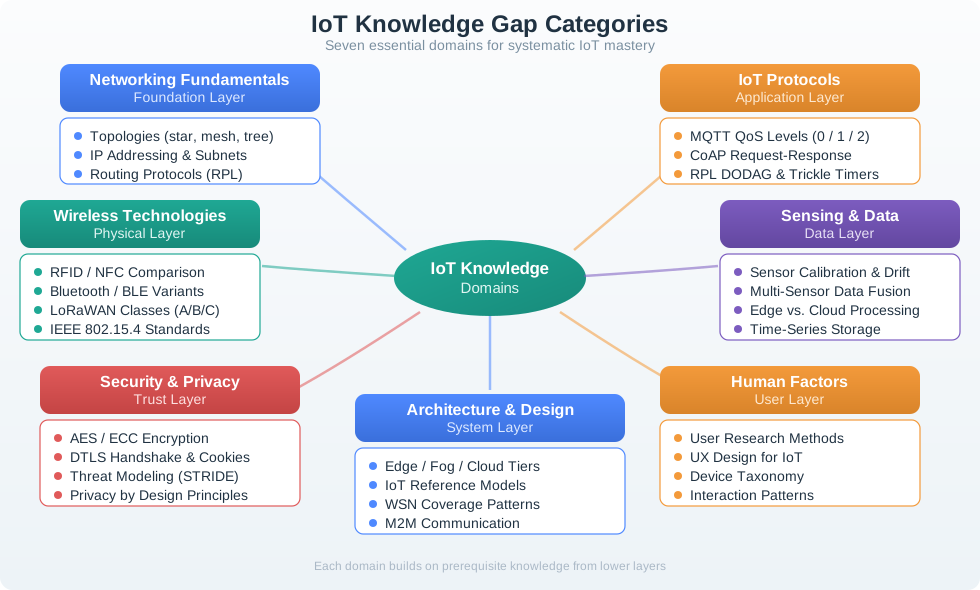
- Identify the seven major IoT knowledge categories and their relationships
- Locate targeted refreshers for specific knowledge gaps in each domain
- Explain topic prerequisites through the layered architecture view
- Navigate to appropriate quizzes and practice resources for each topic
For Beginners: Knowledge Categories
IoT knowledge is organized into seven major areas – from networking and protocols to security and architecture. Understanding these categories helps you see the big picture of what IoT involves and figure out which areas you need to study next. It is like looking at a map of a city’s neighborhoods before deciding which ones to visit: you can plan a logical route instead of wandering randomly.
No-One-Left-Behind Category Loop
- Locate the lowest missing prerequisite in the stack.
- Refresh one domain with one theory source plus one practice source.
- Verify with a focused quiz attempt for that domain.
- Reinforce with one cross-domain challenge before advancing upward.
24.2 Knowledge Categories
Seven major categories of IoT knowledge gaps to track:
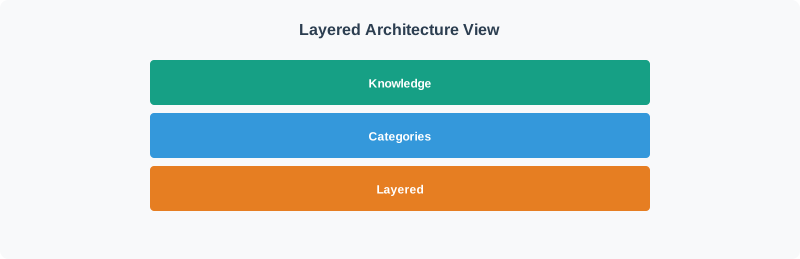
24.3 Layered Architecture View
Understanding how knowledge domains build upon each other helps you prioritize your study:
Putting Numbers to It
Prerequisite gaps compound. A simple way to estimate readiness for an upper-layer topic is to multiply mastery across required lower layers:
\[ R_{\text{upper}} = \prod_{i=1}^{k} R_i \]
where each \(R_i\) is your mastery fraction (0 to 1) in a prerequisite domain.
Worked example: If your current mastery is Networking \(R_1=0.85\), Wireless \(R_2=0.80\), and Protocols \(R_3=0.70\), then readiness for advanced security architecture is:
\[ R_{\text{upper}} = 0.85 \times 0.80 \times 0.70 = 0.476 \]
So only about 47.6% effective readiness is available at the top layer, even though each individual score seems acceptable. Raising the weakest prerequisite (Protocols) from 0.70 to 0.85 increases readiness to \(0.578\) (57.8%), which is a large gain from one targeted improvement.
Interactive Calculator: Adjust the sliders below to see how your mastery in different domains affects your overall readiness for advanced topics.
24.4 Quick Reference Summary
| Category | Key Topics |
|---|---|
| Networking | Topologies, IP Addressing, Routing Protocols |
| IoT Protocols | MQTT (QoS), CoAP, RPL |
| Wireless | RFID/NFC, Bluetooth/BLE, LPWAN |
| Sensing & Data | Calibration, Data Fusion, Edge vs Cloud |
| Security | Encryption, DTLS, Threat Modeling |
| Architecture | Edge/Fog/Cloud, Reference Models, WSN Coverage |
| Human Factors | User Research, UX Design, Interaction Patterns |
24.5 Spotlight Refreshers
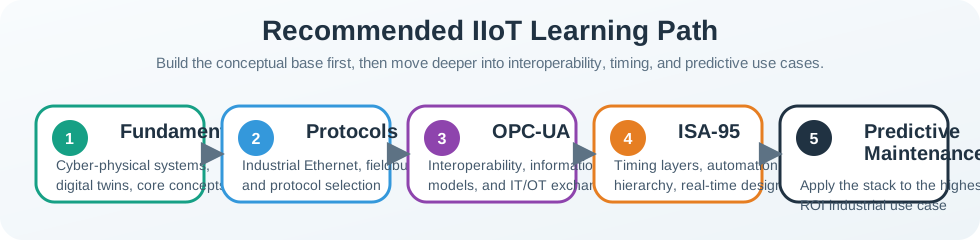
24.5.1 Networking Concepts
Difficulty: Intermediate
Foundational networking knowledge. Allow 10 minutes per topic.
| Topic | Overview | Refresh | Practice |
|---|---|---|---|
| Network Topologies | Star, mesh, tree trade-offs | Topologies Fundamentals | Quiz |
| IP Addressing | Subnets, CIDR, NAT basics | Network Mechanisms | Quiz |
| Routing Protocols | RPL, distance vector, link state | Routing Fundamentals | Quiz |
24.5.2 IoT Protocols
Difficulty: Intermediate
These topics require understanding of networking fundamentals. Allow 10-15 minutes per topic.
| Topic | Overview | Refresh | Practice |
|---|---|---|---|
| MQTT QoS Levels | Compare 0/1/2 trade-offs | MQTT QoS Section | Quiz |
| CoAP vs HTTP | Request-response for constrained devices | CoAP Fundamentals | Quiz |
| RPL DODAG | Graph construction, Trickle timers | RPL Construction | Quiz |
24.5.3 Wireless Technologies
Difficulty: Intermediate
These topics focus on comparison and selection. Allow 10 minutes per topic.
| Topic | Overview | Refresh | Practice |
|---|---|---|---|
| RFID vs NFC | Range, power, use cases | RFID Fundamentals | Quiz |
| BLE vs Classic Bluetooth | Low energy modes, GATT profiles | Bluetooth Fundamentals | Quiz |
| LoRaWAN Classes | A/B/C power and latency trade-offs | LoRaWAN Overview | Quiz |
24.5.4 Sensing & Data
Difficulty: Intermediate
Data-focused topics combining theory and practice. Allow 12-15 minutes per topic.
MVU: Sensor Data Understanding
Core Concept: Sensor data has inherent characteristics - accuracy (how close to true value), precision (repeatability), resolution (smallest detectable change), and drift (change over time) - that determine what decisions you can reliably make. Why It Matters: A temperature sensor with 0.01 degree resolution but only 2 degree accuracy gives false precision - understanding these limits prevents bad decisions based on misleading data. Key Takeaway: Always check both accuracy AND resolution in datasheets; calibrate sensors at deployment and periodically thereafter; aggregate noisy readings to improve signal quality.
| Topic | Overview | Refresh | Practice |
|---|---|---|---|
| Sensor Calibration | Drift, noise, and calibration routines | Sensor Interfacing | Quiz |
| Data Fusion | Statistical combination patterns | Multi-Sensor Data Fusion | Simulator |
| Edge vs Cloud | Where to process data | Edge Compute Patterns | Quiz |
| Time-Series Databases | Optimized storage for IoT data | Data Storage | Quiz |
| Lambda Architecture | Batch and stream processing layers | Big Data Overview | Quiz |
24.5.5 Security
Difficulty: Advanced
Security topics require strong foundational knowledge. Allow 15-20 minutes per topic.
MVU: IoT Security Fundamentals
Core Concept: IoT security rests on three pillars - confidentiality (only authorized parties read data), integrity (data is not tampered with), and availability (systems remain operational) - known as the CIA triad. Why It Matters: IoT devices often operate unattended in physical environments where attackers can access hardware, intercept wireless signals, or exploit weak default credentials at scale. Key Takeaway: Never trust, always verify - use TLS/DTLS for transport, unique credentials per device, and assume every network request could be malicious.
| Topic | Overview | Refresh | Practice |
|---|---|---|---|
| DTLS Handshake | Securing UDP communication | DTLS Security | Quiz |
| Threat Modeling | STRIDE, attack trees | Threat Modeling | Quiz |
| IoT Encryption | AES, ECC for constrained devices | Encryption Principles | Quiz |
| Privacy by Design | Embedding privacy in system design | Privacy by Design | Quiz |
| CIA Triad | Confidentiality, Integrity, Availability | Security Overview | Quiz |
24.5.6 Architecture & Design
Difficulty: Intermediate
System-level thinking topics. Allow 10-12 minutes per topic.
| Topic | Overview | Refresh | Practice |
|---|---|---|---|
| Edge/Fog/Cloud | Three-tier IoT architecture | Edge-Fog Computing | Videos |
| IoT Reference Models | Standardized architecture frameworks | Reference Models | Chapter |
| WSN Coverage | Optimal sensor placement strategies | WSN Coverage | Quiz |
| M2M vs IoT | Machine-to-machine communication evolution | M2M Fundamentals | Review |
24.5.7 Human Factors
Difficulty: Intermediate
User-centered design topics. Allow 8-10 minutes per topic.
| Topic | Overview | Refresh | Practice |
|---|---|---|---|
| User Research | Understanding user needs and context | Understanding Users | Quiz |
| UX Design | User experience evaluation framework | UX Design | Quiz |
| Device Taxonomy | Connected device categories | Connected Devices | Quiz |
| Interaction Patterns | UI/UX patterns for IoT | Interface Design | Quiz |
24.6 Summary
The seven major IoT knowledge categories form the foundation for systematic learning:
- Networking Fundamentals - The foundation layer covering topologies, addressing, and routing
- IoT Protocols - Application-layer protocols like MQTT, CoAP, and RPL
- Wireless Technologies - Physical and link layer technologies from RFID to LoRaWAN
- Sensing & Data - Data acquisition, processing, and storage patterns
- Security & Privacy - Protection mechanisms and compliance frameworks
- Architecture & Design - System-level patterns and reference models
- Human Factors - User-centered design and interaction patterns
Use the spotlight refresher tables to find targeted content for your specific gaps. Each entry provides: - Overview - Quick description of the topic - Refresh - Link to the detailed chapter content - Practice - Quiz or simulation for hands-on reinforcement
Common Mistake: Skipping Lower Layers to “Get to the Interesting Stuff”
The Mistake: A student scored poorly on IoT Security quizzes despite studying DTLS and encryption chapters thoroughly for 6 hours. They were frustrated: “I understand AES and certificates, why am I failing?”
Root Cause: Gaps in lower layers prevented understanding security concepts. Here’s what actually happened:
Security Quiz Question: “Why does DTLS use cookies during handshake?”
Student’s answer: “To encrypt the connection” (incorrect)
Correct answer: “To prevent DoS amplification attacks where attacker spoofs victim’s IP, causing server to send large handshake responses to victim”
Why the student struggled:
- Never studied UDP vs TCP differences (Networking layer)
- Didn’t understand stateless vs stateful protocols (Transport layer)
- Hadn’t learned about DoS attack vectors (Security threats fundamentals)
- Jumped directly to DTLS (Security implementation) without prerequisites
The Layer Gap Cascade:
Layer 4: Security Implementation (DTLS cookies)
   ↑ requires understanding
Layer 3: Security Threats (DoS amplification)
   ↑ requires understanding
Layer 2: Transport Protocols (UDP stateless nature)
   ↑ requires understanding
Layer 1: Networking Fundamentals (IP spoofing, packet flow)
What worked: Student backtracked: 1. Spent 45 min on Transport Protocols UDP section 2. Read Threat Modeling DoS section (30 min) 3. Returned to DTLS with new context (20 min review) 4. Retook quiz: 4/10 → 9/10
Total time: 95 minutes of targeted lower-layer study fixed weeks of frustration.
How to avoid:
- Check prerequisites: Each chapter lists prerequisite knowledge - read those FIRST
- Use the layered diagram: Start at Physical layer, work upward
- If you score <70% on a quiz: Check if you have gaps in lower layers before re-studying the topic
- Time investment: Better to spend 2 hours on fundamentals once than 10 hours struggling with advanced topics
Quiz diagnostic: When you miss a question, ask “Do I not understand THIS topic, or do I not understand a prerequisite concept it builds on?” Often it’s the prerequisite.
Key Takeaway
IoT knowledge builds in layers across seven major categories: master networking and wireless fundamentals before tackling protocols, then data and sensing, followed by security, architecture, and human factors. Gaps in lower layers cascade upward and undermine advanced topic comprehension.
For Kids: Meet the Sensor Squad!
The Knowledge Tower Adventure
Sammy the Sensor, Lila the LED, Max the Microcontroller, and Bella the Battery were building a tall tower out of blocks.
“I want to put the SECURITY block on top!” said Max excitedly. But when he placed it, the tower wobbled and fell!
“Wait,” said Sammy wisely. “We need to build the bottom first. Networking blocks go on the ground floor, then Wireless blocks, then Protocol blocks, and THEN we can add Security at the top!”
Bella nodded, “It is like learning IoT – you cannot understand how to protect a system if you do not first understand how the system talks and listens!”
Lila added, “And if you find a wobbly block in the middle, fix it before stacking more on top. That is what the Knowledge Gaps Tracker helps you do!”
What would happen if you tried to build a sandcastle starting from the top? Why do foundations matter?
Concept Relationships: Knowledge Categories
- 7 Knowledge Categories -> IoT System Architecture: Maps to OSI-like layers: Hardware -> Connectivity -> Protocols -> Data -> Architecture -> Applications -> Security.
- Dependency Ordering -> Learning Paths: Some categories are prerequisites for others, such as Networking before Protocols and Protocols before Architecture.
- Beginner/Intermediate/Advanced -> Progressive Mastery: Learners advance through levels within each category before moving to dependent categories.
- Knowledge Gaps -> Self-Assessment: Gaps appear when learners skip prerequisite categories or rush through levels too quickly.
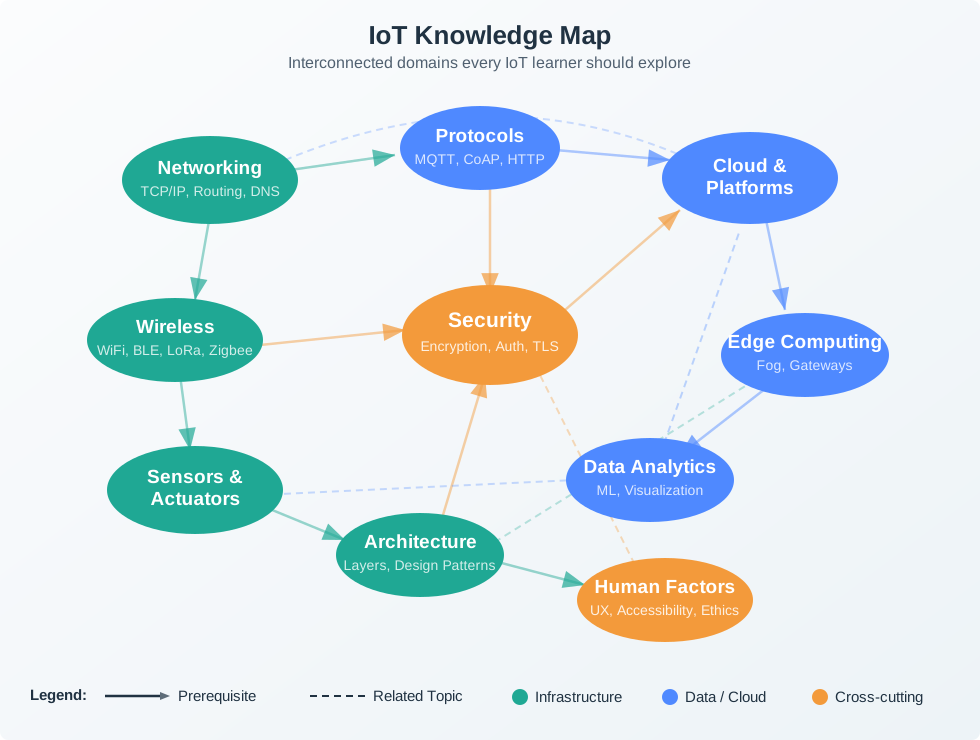
Cross-module connection: Knowledge categories align with the 9-module structure. See Visual Concept Map for interactive prerequisite visualization.
Common Pitfalls
1. Declaring a Domain “Complete” After One Study Session
Reading a category overview creates familiarity, not mastery. Mastery requires applying knowledge (solving problems, designing systems, explaining to others) and encountering edge cases. Mark domains as complete only after demonstrating applied knowledge through lab work or successfully explaining key trade-offs to someone else.
2. Studying Domains in Isolation Without Integrating Across Boundaries
IoT deployments require simultaneous competence in multiple domains. An engineer who deeply understands wireless protocols but ignores security will deploy unencrypted MQTT to production. Study each domain fully, but regularly revisit how domains interact in complete system designs.
3. Skipping Human Factors Domain as Non-Technical
Human factors (UX design, deployment ergonomics, maintenance workflows) determine whether technically correct IoT systems succeed in practice. Systems with excellent technical specifications frequently fail because configuration is too complex, alerts are not actionable, or maintenance requires specialized skills unavailable on-site. Take the human factors domain seriously.
24.7 What’s Next
- Use the Progress Tracking tools to assess your current level in each category
- Follow the Gap Closure Process methodology for systematic improvement
- Return to the Knowledge Gaps Hub for the complete overview
- Reinforce refreshed domains with challenge rounds in the IoT Games Hub
| Previous | Current | Next |
|---|---|---|
| Gap Closure Process | Knowledge Categories | Progress Tracking |