A systematic five-phase methodology for closing knowledge gaps: Assessment (15 min), Diagnosis (10 min), Study (30-45 min), Practice (20-30 min), and Validation (15 min). Total time per gap: 90-115 minutes. Includes a real case study showing a student improving from 4/10 to 9/10 on MQTT QoS in 2 hours using the structured read-watch-practice-test approach.
Key Concepts
Gap Closure Cycle: Structured five-phase process (assess, diagnose, study, practice, validate) for systematically resolving identified IoT knowledge deficiencies
Spaced Repetition: Learning technique reviewing material at increasing intervals (1 day, 3 days, 1 week, 2 weeks) to maximize long-term retention
Active Recall: Learning method requiring retrieval of information from memory rather than passive re-reading, proven more effective for knowledge consolidation
Elaborative Interrogation: Study technique of asking “why?” for each concept, forcing construction of explanations that deepen understanding beyond surface facts
Practice Testing: Using quiz questions and exercises to identify remaining gaps after studying, more effective than additional re-reading for measuring mastery
Study Session Time-Boxing: Allocating fixed time periods (25-minute Pomodoro blocks) to gap closure to prevent open-ended study that loses focus
Validation Criterion: Specific, measurable standard used to confirm a knowledge gap has been closed (e.g., “correctly explain MQTT QoS levels and when to use each”)
Study Queue: Prioritized list of knowledge gaps ordered by impact on current learning goals and prerequisite chain requirements
Chapter Scope (Avoiding Duplicate Hubs)
This chapter focuses on how to close a known gap efficiently.
Use this chapter when executing the remediation workflow itself.
23.1 Learning Objectives
By the end of this chapter, you will be able to:
Apply the gap closure workflow to systematically address knowledge weaknesses
Budget study time effectively using the timeline framework (90-115 minutes per gap)
Explain skill development milestones and target appropriate proficiency levels
Execute a recovery plan when quiz scores fall below expectations
For Beginners: Gap Closure Process
Closing a knowledge gap means going from “I do not understand this topic” to “I can explain it and use it.” This chapter gives you a repeatable five-step method that takes about 90 minutes per topic: assess what you know, diagnose what is missing, study the material, practice with exercises, and validate with a quiz. It is a structured approach that works much better than randomly re-reading chapters and hoping things stick.
No-One-Left-Behind Closure Loop
Start with one precise weakness, not a broad topic.
Apply a timed remediation cycle with concrete outputs.
Validate with a quiz or applied task and record the result.
Reinforce with one simulation or game before moving on.
23.2 Gap Closure Process
Time: ~10 min | Level: Intermediate | Unit: P01.C04.U03
MVU: Skill Development Milestones
Core Concept: IoT competency develops through four stages - awareness (recognize terms), understanding (explain concepts), application (build working systems), and mastery (debug complex failures and mentor others). Why It Matters: Self-assessment at wrong stages wastes time - studying advanced topics at awareness level causes frustration; staying at understanding level when ready for application delays practical skills. Key Takeaway: Target 70% quiz score before advancing topics; aim for “application” level (can build a working prototype) within 4-6 weeks per major domain; mastery requires 6+ months of project experience.
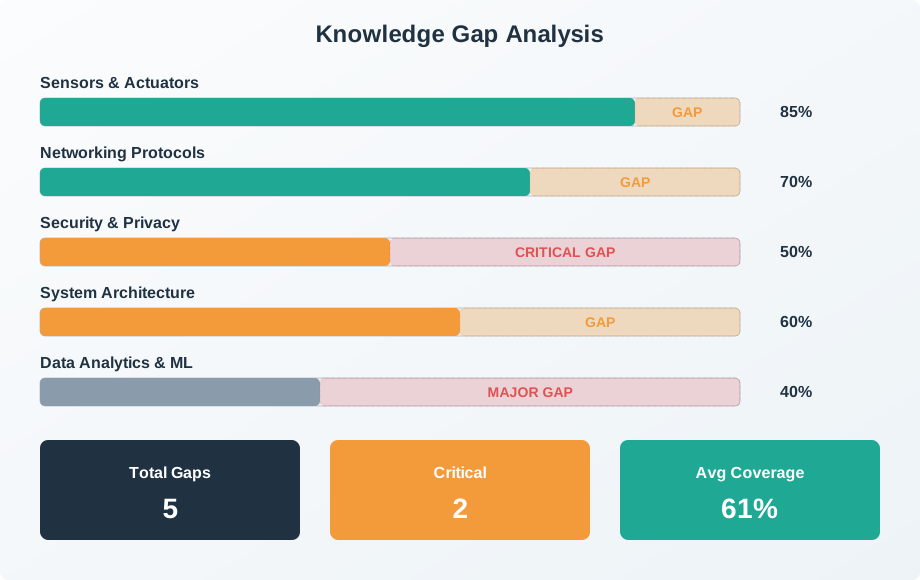
Knowledge Gap Analysis Process
Figure 23.1: The knowledge gap analysis process begins with honest self-assessment and progresses through systematic identification, prioritization, and remediation. This structured approach ensures no gaps are overlooked and learning efforts are optimally directed.
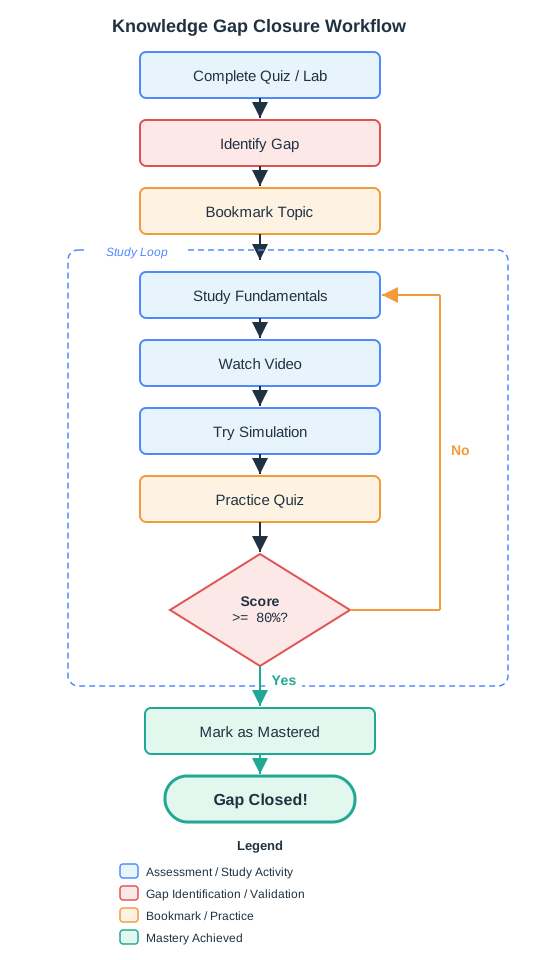
Understanding how to systematically address knowledge gaps is essential for effective learning:
Figure 23.2: Knowledge Gap Closure Workflow: systematic study, practice, and validation to achieve mastery
23.3 Study Timeline Framework
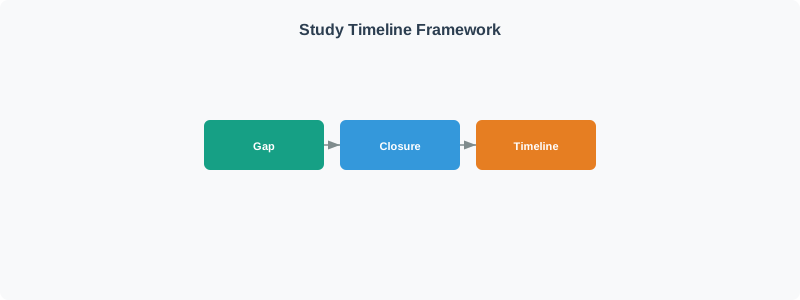
Effective gap closure requires structured time allocation. The following timeline shows how to budget a focused study session:
23.3.1 Interactive Study Session Planner
Customize your study session timeline based on your available time and priorities:
Figure 23.3: Alternative View: Timeline Perspective - This Gantt chart shows the same gap closure process as a time-budgeted study session. Total estimated time: 90-115 minutes. The timeline view helps students plan realistic study sessions and understand that effective learning requires dedicated time blocks for each phase. If the validation quiz score falls below 80%, return to the Study phase and repeat.
23.4 Study Strategy Tradeoffs
Choosing the right study approach depends on your goals and available time:
Tradeoff: Single Deep Gap Closure vs Multi-Topic Surface Review
Option A (Single Deep): Focus 90-120 minutes on one knowledge gap until achieving 80%+ mastery. Example: Master MQTT QoS levels completely (read chapter, watch 2 videos, run simulator, retake quiz). Outcome: Permanent understanding with strong recall. Option B (Multi-Topic Surface): Spend 20-30 minutes each on 4-5 topics to raise awareness across broader coverage. Example: Quick review of MQTT, CoAP, BLE, Zigbee, and LoRaWAN basics. Outcome: Improved vocabulary and recognition, but shallow application skills. Decision Factors: Choose single deep when preparing for project implementation or technical interviews requiring problem-solving. Choose multi-topic surface when preparing for multiple-choice exams, broadening awareness before specialization, or triaging which topics need deep investment.
Tradeoff: Self-Paced Gap Closure vs Structured Study Groups
Option A (Self-Paced): Work through gaps individually using hub resources. Flexible scheduling - study anytime. Progress at your natural speed (some topics faster, some slower). Best metrics: 70-85% knowledge retention after 30 days. Option B (Study Groups): Form 3-5 person groups meeting 2x weekly to discuss gaps and quiz each other. Fixed schedule but social accountability. Explaining concepts to peers deepens understanding. Best metrics: 80-95% retention after 30 days, but requires 25% more calendar time. Decision Factors: Choose self-paced if you have irregular schedules, prefer independent learning, or are significantly ahead/behind classmates. Choose study groups if you struggle with motivation, benefit from discussion-based learning, or have complex topics where multiple perspectives help.
23.5 Case Study: Closing a Knowledge Gap in 2 Hours
Student Profile: Sarah, studying for IoT networking exam
Gap Discovered: Scored 4/10 on MQTT quiz, particularly struggled with QoS levels
Used QoS 1 for temperature updates (balance of reliability/efficiency)
Result: Gap closed in one focused study session. Now confident explaining QoS levels to peers.
Key Lesson: Structured approach (read → watch → practice → test) is faster than random studying.
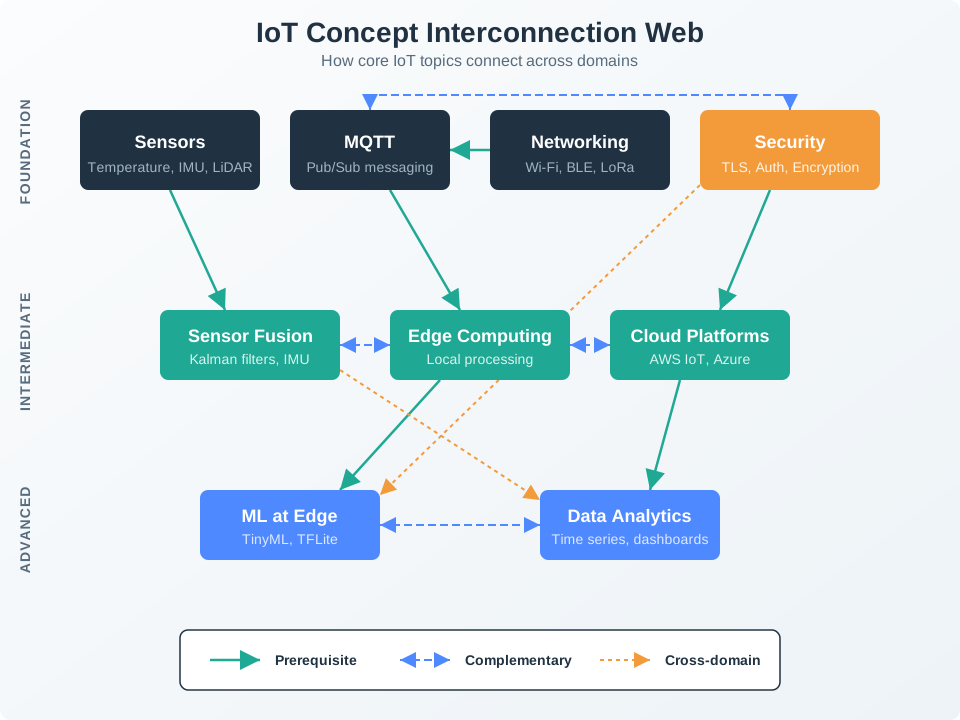
Concept Connection Network
Figure 23.4: Understanding how concepts interconnect across domains helps you build comprehensive IoT knowledge. A gap in one area often affects understanding in related areas, making systematic gap closure essential.
23.6 Cross-Hub Learning Integration
Cross-Hub Connections: Integrated Learning
Knowledge gaps don’t exist in isolation. Use all four learning hubs together for maximum effectiveness:
Diagnosis → Quizzes Hub - Take quizzes to discover what you don’t know - Quiz results reveal specific knowledge gaps - Example: “Failed MQTT quiz questions 3, 5, 7 about QoS levels”
Quick Review → Videos Hub - Watch 5-15 minute videos for rapid refreshers - Visual explanations for complex concepts - Example: “Watch MQTT QoS video for protocol state diagrams”
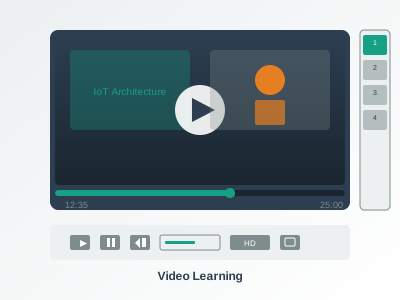
Video Learning Approach
Figure 23.5: Video content provides visual demonstrations of concepts that are difficult to grasp through text alone. Protocol state machines, hardware interactions, and real-world deployments come alive through video tutorials.
Hands-On Practice → Simulations Hub - Interactive tools reinforce learning - Simulate scenarios you struggled with in quizzes - Example: “Use MQTT simulator to experiment with QoS settings”
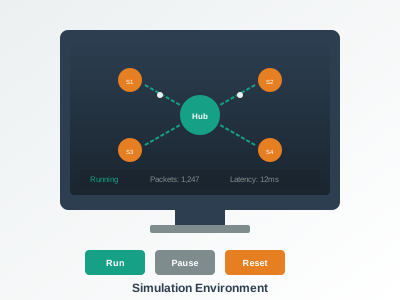
Simulation Environment
Figure 23.6: Simulation environments provide safe spaces to experiment with IoT configurations. You can test protocol settings, observe network behavior, and make mistakes without consequences - accelerating learning through active experimentation.
Deep Dive → Knowledge Gaps Hub (you are here) - Systematic gap closure with study plans - Track progress across multiple domains - Example: “Follow 2-hour study plan to master MQTT QoS”
Workflow Example:
Quiz reveals gap in Routing Protocols (3/10 score)
Knowledge Gaps Hub provides structured study plan
Videos Hub offers RPL DODAG formation tutorial
Simulations Hub lets you build a DODAG network
Retake quiz to validate understanding (8/10 score)
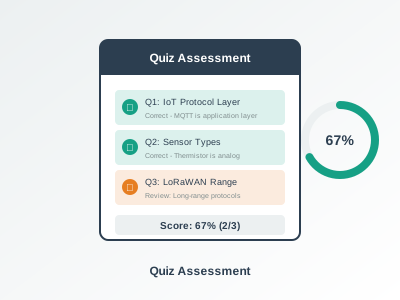
Quiz Assessment Process
Figure 23.7: Regular quiz assessment provides objective measurement of your knowledge. Rather than guessing what you know, quizzes reveal specific topics requiring attention, enabling targeted study efforts.
23.7 Low Quiz Score Recovery Plan
Learning Scenario: Low Quiz Score Recovery Plan
Scenario: You scored 3/10 on the Routing Protocols quiz. Here’s your 90-minute recovery plan:
[0-15 min] Identify specific gaps
Review quiz results: which 7 questions did you miss?
Common weak spots: RPL DODAG construction, Trickle timer, distance-vector vs link-state
Focused on the 7 missed topics, not reviewing what you already know
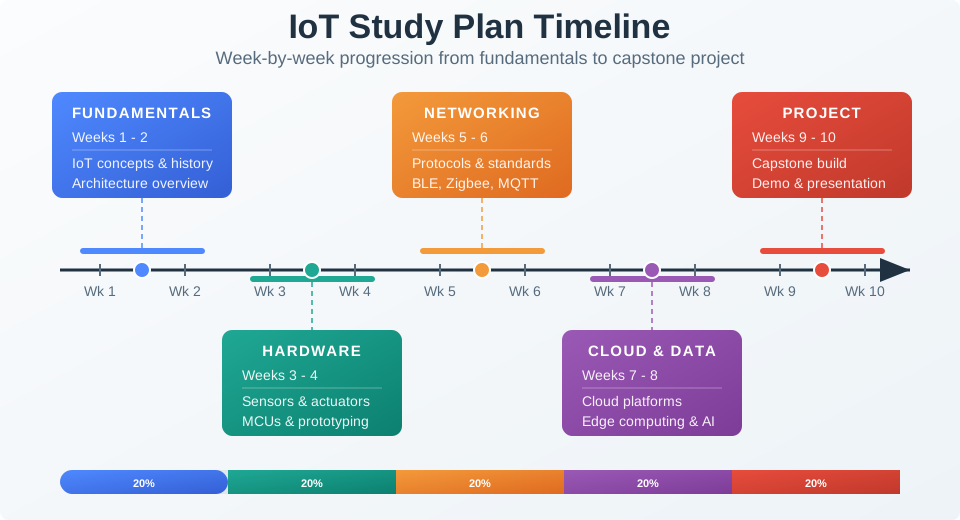
Study Plan Timeline
Figure 23.8: Effective study plans allocate specific time blocks to different learning activities. This timeline approach prevents aimless studying and ensures all learning modes (read, watch, practice, test) receive appropriate attention.
Practice Environment
Figure 23.9: Practice environments bridge theory and application. Whether using simulators, development boards, or cloud platforms, hands-on practice solidifies understanding and reveals practical challenges not apparent in textbooks.
23.8 Interactive Learning Efficiency Calculator
Calculate your own learning efficiency to understand the power of structured study:
Show code
viewof initial_score = Inputs.range([0,10], {value:4,step:1,label:"Initial quiz score (out of 10)"})viewof final_score = Inputs.range([0,10], {value:9,step:1,label:"Final quiz score (out of 10)"})viewof study_hours = Inputs.range([0.5,8], {value:2,step:0.5,label:"Study time (hours)"})viewof comparison_hours = Inputs.range([0.5,12], {value:4,step:0.5,label:"Comparison: previous unstructured time (hours)"})viewof comparison_score = Inputs.range([0,10], {value:5,step:1,label:"Comparison: score after unstructured study (out of 10)"})
Worked example: From the case study, Sarah improved from 4/10 to 9/10 on MQTT in 2 hours using structured approach. Previous unstructured study: 4 hours → 5/10.
A 90-minute focused session beats 6+ hours of random review.
Try the interactive calculator above to explore your own learning efficiency scenarios.
The gap closure process provides a structured approach to learning:
Workflow: Complete quiz → Identify gaps → Study → Practice → Validate → Close
Timeline: Budget 90-115 minutes per knowledge gap for effective closure
Integration: Use all four learning hubs together (Quizzes, Videos, Simulations, Knowledge Gaps)
Recovery: Follow the specific recovery plan structure for low quiz scores
Validation: Always retake quizzes to confirm understanding (target 80%+)
Decision Framework: When to Move On vs Keep Studying
After completing the gap closure process and retaking a quiz, use this decision table:
Quiz Score
Your Understanding Level
Recommended Action
Time Investment
90-100%
Mastery
Move on immediately
0 min (you are done!)
80-89%
Strong understanding
Move on, but bookmark topic for review before exams
0 min now, 15 min later
70-79%
Passing but shaky
Review missed questions (10 min), then move on
10 min targeted
60-69%
Weak spots remain
Repeat ONE study cycle (45 min), focus on 3-4 missed topics only
45 min focused
50-59%
Significant gaps
Check for missing prerequisites - go one layer down
60-90 min (lower layer)
<50%
Fundamental misunderstanding
STOP. This topic is too advanced. Study prerequisites FIRST
Back up 2 chapters
Key Decision Points:
Scenario 1: “I scored 75%. Should I keep studying or move on?”
If exam is >2 weeks away → Move on (80% target, you are at 75%)
If exam is <2 weeks away → Quick 10-min review of 2-3 missed questions
If this is for project work → Move on IF you can build working prototype. Otherwise, repeat practice phase.
Scenario 2: “I studied 2 hours and only improved from 4/10 to 6/10”
Diagnosis: You are studying the wrong layer. Example: Studying MQTT QoS without understanding TCP/UDP.
Fix: Stop. Go to Knowledge Categories, find the prerequisite layer, study that first.
Time saved: 4 hours of continued struggling vs 90 min on prerequisites → net 2.5 hour savings
Scenario 3: “I got 95% but do not feel confident”
Reality check: You ARE confident (95% proves it). This is imposter syndrome.
Action: Move on. Confidence builds through application (projects), not more studying.
Red Flags (signs you should STOP current topic): - Studying for 3+ hours with <10 percentage point improvement - Reading same chapter 4+ times without understanding - Can recite definitions but cannot explain “why” or “when to use” - Scored high on quiz but cannot build a working example
Green Flags (signs you are ready to move on): - Can explain topic to a peer without referencing notes - Scored 70%+ AND can identify why you missed those questions - Can apply concept to a hypothetical project scenario - Confident enough to Google for edge cases (not fundamentals)
Time Management Rule: If you hit 2× the estimated time budget (180 min instead of 90 min) without reaching 70%, you are studying inefficiently. STOP, reassess prerequisites, and seek help (study group, instructor, Discord).
Key Takeaway
Structured gap closure (read, watch, practice, test) is dramatically faster than random studying. Budget 90-115 minutes per knowledge gap, always validate with a quiz targeting 80%+, and use multiple learning modes (text, video, simulation) for lasting retention.
For Kids: Meet the Sensor Squad!
Sammy’s Study Secret
Sammy the Sensor got a low score on his “How Wireless Signals Work” quiz. He was sad at first, but Max the Microcontroller cheered him up.
“A low score is not bad, Sammy – it is like a treasure map! It shows you EXACTLY what to study next!”
So Sammy made a plan: 1. First, he READ about radio waves for 10 minutes 2. Then, he WATCHED a fun video about how signals bounce off walls 3. Next, he PRACTICED with a signal simulator game 4. Finally, he took the quiz AGAIN – and scored much better!
“The secret,” said Bella the Battery, “is doing all four steps in order. Just reading is not enough. Just watching is not enough. You need to read, watch, practice, AND test!”
Lila the LED glowed bright green: “And now Sammy knows wireless signals better than anyone!”
Next time you learn something new, try Sammy’s four-step plan: Read, Watch, Practice, Test!
Concept Relationships: Knowledge Gap Closure Process
4-Step Remediation -> Learning Science: Read -> Watch -> Practice -> Test follows spaced repetition and active recall principles.
Diagnostic Testing -> Knowledge Gaps: Pre-chapter quizzes identify specific weak concepts rather than entire topic areas.
Microlearning -> Time Management: Focused 15-30 minute sessions outperform 3-hour marathon study for retention.
Validation Quiz -> Mastery Learning: Post-remediation testing confirms gap closure before advancing to dependent topics.
Cross-module connection: This process applies to all modules. See Quiz Navigator for diagnostic tests and Learning Path Generator for sequencing. Add IoT Games Hub as a short retention pass after each closure cycle.
Common Pitfalls
1. Starting Gap Closure Without a Specific Validation Criterion
Studying “until you feel confident” produces indefinitely open study sessions that consume time without clear completion. Before starting any gap closure session, define exactly how you will verify the gap is closed: a quiz score target, the ability to explain a concept without notes, or successfully completing a specific lab task.
2. Using Passive Re-Reading as the Primary Study Method
Re-reading the same material three times produces familiarity, not mastery. After reading a concept once, switch to active methods: write a summary without looking at notes, solve practice problems, explain the concept aloud, or teach it to someone else. These active methods expose remaining gaps that passive reading masks.
3. Closing Gaps Individually Without Integration Practice
Closing individual gaps in isolation (MQTT, then TLS, then broker architecture) does not ensure you can integrate them into a coherent mental model. After closing 3-5 related gaps, practice integrating them by designing a complete system that requires all of them simultaneously.