Edge-Fog Latency
Build response budgets before assigning fast decisions to a tier.
Progress saves as you read. Mark sections complete as you go; your progress appears in the sidebar.
This section: Start With the Decision — A site may need a millisecond local stop and a monthly cloud report from the same data.
A site may need a millisecond local stop and a monthly cloud report from the same data. A placement decision must assign each deadline and failure mode to the right tier.
This section: Route Overview — This is part 3 of 3.
This is part 3 of 3. Review Edge-Fog Use Cases: Bandwidth Optimization for the preceding evidence.
This section: Learning Objectives
This section: Chapter Roadmap
This section: Choosing Edge, Fog, or Cloud — A site may need a local stop within milliseconds and a monthly cloud report from the same data.
A site may need a local stop within milliseconds and a monthly cloud report from the same data. Placement means choosing where each job runs. Give each job a deadline, the time it must finish by, and a failure mode, what happens when its path fails. Then choose the edge, fog, or cloud tier that can meet those needs.
Picture one workload, such as opening a valve, classifying a sound, or reconciling a batch of site readings. The core question is where that workload can be correct, timely, private, and supportable. Everyday IoT placement is not a vote for edge, fog, or cloud in general; it is a record for this one job. Start with one decision record that names the owner, the evidence, the rejected tiers, the degraded mode, and the condition that forces a retest.
Edge Eddie
“Send the decision, not the raw feed — the edge earns its keep in milliseconds and megabytes saved.”
Here Eddie checks each workload claim against its record: who owns it, what evidence backs it, and what happens when the tier degrades.
By the end of this chapter, you will be able to:
Start by naming one action: sample, filter, infer, actuate, alert, aggregate, translate, buffer, display, train, audit, or update. Then decide which tier owns that action. Do not label the whole system as edge-first or cloud-first and force every function into that label.
Inspect Figure 6.1 before continuing. Calling an architecture edge-first hides the fact that different actions can have different owners. Figure 6.1 helps decompose one workload before the placement record is written.
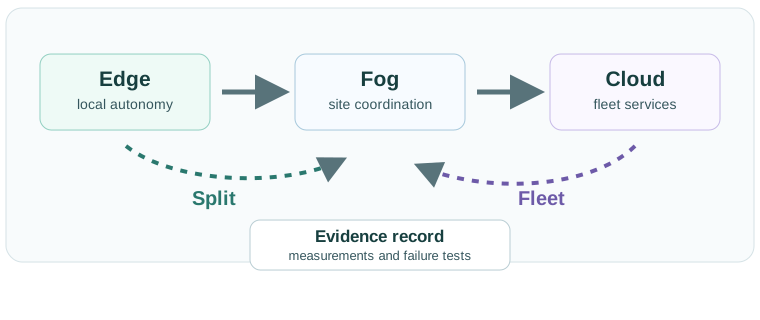
In the diagram Figure 6.1, Edge is paired with local autonomy, Fog with site coordination, and Cloud with fleet services. The Split path connects those roles instead of forcing the whole workload into one tier, and the Evidence record captures measurements and failure tests for the chosen division. The map therefore turns verbs such as infer, buffer, aggregate, and train into separate ownership claims that can be checked when requirements change.
Use edge ownership when a device must validate, decide, warn, actuate, or hold a safe local state without waiting for an upstream service.
Use fog ownership when a gateway or local server needs a group view, protocol boundary, buffer, site policy, or local operator context.
Use cloud ownership when value comes from history, dashboards, analytics, model training, rollout policy, audit, or cross-site comparison.
Use split ownership only when telemetry, commands, updates, fallback, replay, reconciliation, and evidence paths have named owners.
For example, an irrigation controller may keep pump shutoff at the edge because the field device must react during connectivity loss. A fog gateway may compare nearby pumps, soil sensors, and weather readings to detect site anomalies. Long-term water-use reporting can still live in the cloud. That is not one tier label; it is a set of workload claims with different evidence and owners.
Eddie’s Edge Ledger
A placement record turns architecture preference into reviewable evidence. Keep it short enough to maintain, but specific enough that another engineer can replay the reasoning after requirements, devices, links, policies, or cloud services change.
Inspect Figure 6.2 before continuing. A placement record needs a reproducible route from measurements to ownership. Figure 6.2 provides a first-pass branching model that the team can annotate with its own observed values.
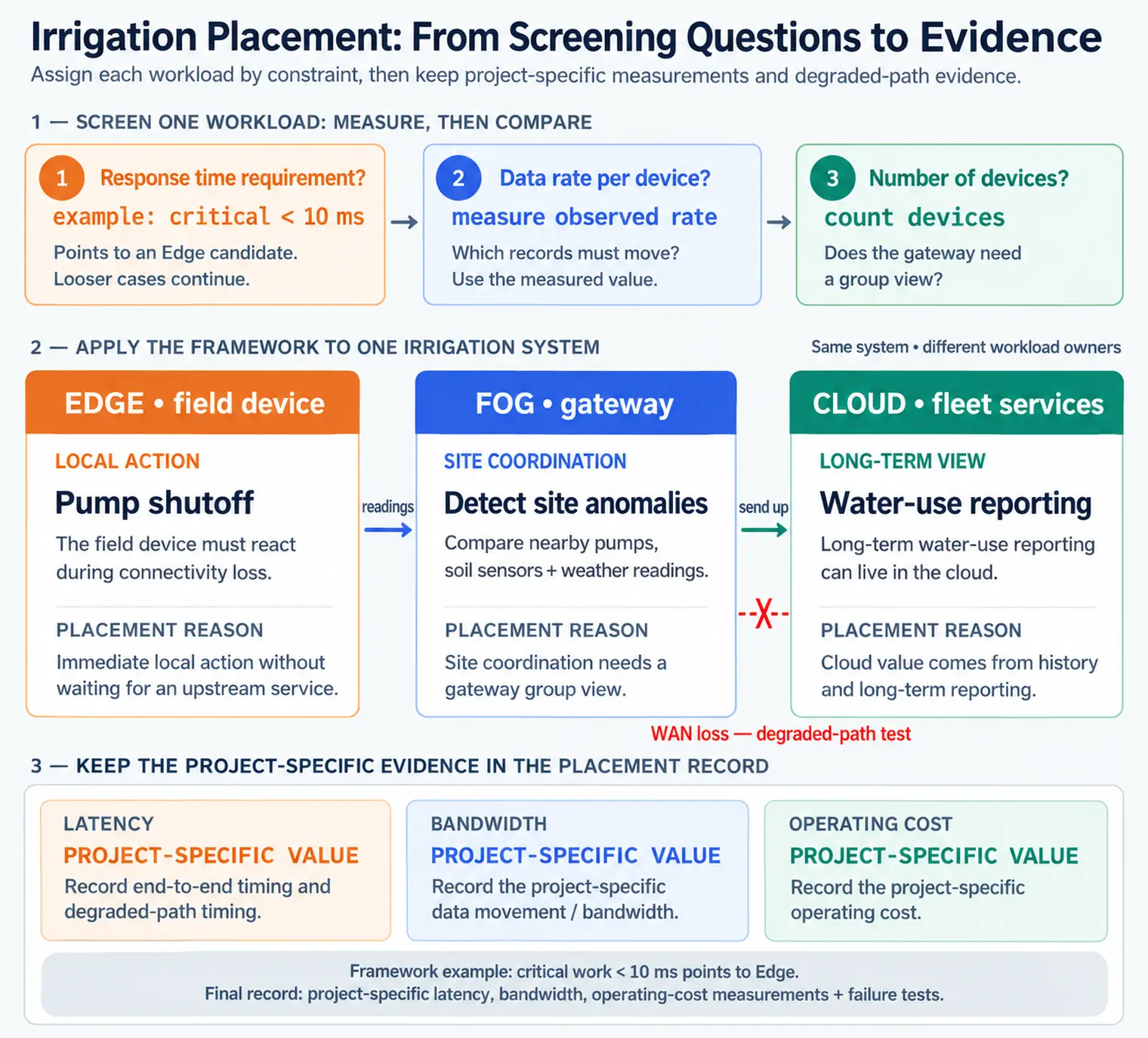
In the diagram Figure 6.2, the IoT Processing Decision first branches on Latency Requirement?: critical work under 10 ms points to Edge, while looser cases continue. The next tests use Data Rate per Device? and Number of Devices? to distinguish lightweight edge filtering, fog aggregation, direct cloud, or cloud processing. The lower cost-and-performance comparison is context, not proof; its role is to prompt project-specific latency, bandwidth, and operating-cost measurements in the final record.
Record these fields before rollout:
Placement record:
- Workload:
- Tier owner:
- Rejected alternatives:
- Response evidence:
- Data and evidence boundary:
- Trust and command boundary:
- Normal path:
- Degraded path:
- Update and rollback owner:
- Retest trigger:
The same workload may point to different tiers as the constraints change. Use the table as a review prompt, not as a formula.
| Constraint | Review Question | Evidence to Keep | Common Mistake |
|---|---|---|---|
| Response | How quickly must the physical process or user receive a useful response? | End-to-end timing, percentile behavior, queue delay, and degraded-path timing. | Measuring only API latency while ignoring sampling, buffering, command delivery, and actuation. |
| Data | Which raw records, summaries, events, and diagnostics must move or remain local? | Freshness needs, retention rules, replay behavior, audit records, and loss handling. | Dropping detailed evidence before diagnostics, compliance, or model improvement needs are known. |
| Trust | Which tier may see, change, store, command, or delete data and device state? | Identity, authorization, encryption, retention, command approval, and audit ownership. | Treating gateway access as harmless because it is local. |
| Operations | Who updates, monitors, rolls back, repairs, and retires each tier? | Health signals, update records, rollback plan, support owner, and retest trigger. | Choosing a clever placement that the field team cannot observe or recover. |
The hard part of placement is not choosing a tier name. The hard part is proving the boundaries between tiers. A workload can fail because data arrives too late, the wrong tier owns authority, a gateway cannot recover state, an update breaks local behavior, or the cloud record cannot explain what happened during a disconnected period.
Measure the full path under normal load, queue pressure, link degradation, restart, and recovery. A single successful path test is not a latency budget.
Name which state is authoritative at the device, gateway, and cloud. Include conflict handling when a local decision happens before upstream reconciliation.
Track configuration, firmware, model files, certificates, health checks, logs, and rollback signals as first-class traffic.
Define what continues, what stops safely, what queues, what drops, and what evidence is retained when WAN, LAN, broker, gateway, or cloud services fail.
| Boundary Test | What to Vary | Pass Evidence | Retest Trigger |
|---|---|---|---|
| Disconnected operation | WAN loss, broker restart, gateway reboot, local storage pressure. | Named local behavior, queued or summarized records, safe stop rule, and replay result. | New gateway software, storage policy, broker path, or response requirement. |
| Command authority | Allowed commands, stale commands, duplicate commands, denied identities. | Command validation logs, rejection evidence, local override behavior, and audit trail. | New actuator, role model, identity provider, or firmware version. |
| Evidence retention | Filtering level, compression, sampling window, privacy rule, retention window. | Review can still explain alerts, misses, outages, model decisions, and operator action. | New analytics goal, compliance rule, support process, or privacy boundary. |
| Lifecycle change | Update, rollback, replacement device, certificate rotation, model replacement. | Known owner, rollback proof, version record, compatibility check, and health signal. | New hardware revision, model runtime, gateway image, or cloud API contract. |
A useful failure drill is concrete. Disconnect the WAN, restart the gateway, rotate a certificate, and send a stale command while the device is still sampling. The expected result should say which tier has authority, which records queue locally, which commands are rejected, what the operator sees, and how cloud state reconciles afterward.
Eddie’s Edge Ledger
First, Edge-fog placement is a workload-level decision, not a whole-system label. Next, Edge usually owns immediate local action; fog usually owns site coordination; cloud usually owns fleet memory and governance. Then, Split designs are valid only when paths, owners, evidence, fallback, replay, and reconciliation are explicit. After that, A decision record should state the chosen tier, rejected alternatives, normal path, degraded path, proof, owner, and retest trigger. Finally, Boundary tests make the placement decision maintainable after devices, links, policies, software, and support responsibilities change.
Do not choose edge, fog, or cloud by architecture preference alone. Choose a workload owner, prove the boundary with evidence, and reopen the decision when measurements, devices, links, policies, or operating responsibilities change.
Build response budgets before assigning fast decisions to a tier.
Review data movement, buffering, filtering, replay, and evidence retention.
Map tier responsibilities and the paths that connect them.
Connect placement decisions to device, gateway, and cloud contracts.
This section: Summary — Edge and fog use cases are strongest when they are reviewed as constraint-driven placement decisions.
Edge and fog use cases are strongest when they are reviewed as constraint-driven placement decisions. Industrial maintenance, autonomous systems, privacy-sensitive sensing, smart infrastructure, field operations, and energy systems can all use the same architecture discipline: immediate local action at the edge, site or regional coordination at the fog tier, and long-term history in the cloud.
The best use-case record names the workload, quantifies constraints, assigns tier ownership, defines degraded behavior, and records evidence. Without that record, edge and fog become slogans. With it, they become testable architecture choices.
This section: Concept Relationships
A domain example becomes useful only when it names the constraint that drives placement.
Edge placement is strongest when local context, safety, outage behavior, or raw data rate makes remote processing unsuitable.
Fog placement is strongest when several edge devices need shared policy, aggregation, buffering, or site-level context.
Cloud placement is strongest when the work needs cross-site history, model training, governance, reporting, or slow analytics.
This section: What’s Next — First, Edge-Fog Pitfalls: Review failure modes that appear when edge and fog use cases move toward production.
First, Edge-Fog Pitfalls: Review failure modes that appear when edge and fog use cases move toward production. Next, Edge-Fog Labs: Practice measuring latency, buffering, and placement behavior in small lab scenarios. Then, Edge-Fog Simulator: Use simulation to compare placement assumptions before hardware decisions. After that, Fog Applications: Continue into fog-specific application patterns and architecture choices.
This section: Key Takeaway — Edge and fog are strongest in use cases with local control, privacy pressure, constrained links, intermittent connectivity, location-aware coordination, or expensive raw data movement.
Edge and fog are strongest in use cases with local control, privacy pressure, constrained links, intermittent connectivity, location-aware coordination, or expensive raw data movement.
This section: Continue Your Route — Use the placement tradeoffs in Choosing Edge, Fog, or Cloud to test the Key Takeaway against latency and ownership.
Use the placement tradeoffs in Choosing Edge, Fog, or Cloud to test the Key Takeaway against latency and ownership. Return to Edge-Fog Use Cases: Bandwidth Optimization or continue from the edge-fog module index.
3 reviewed answers.
Open the module page from the sidebar to see its chapters in order. Use the module map to return to a topic you need.
Modules and pathsReviewed
Check the symptom, then work through the diagnostic steps. Keep the error message and the smallest example that reproduces it.
When you are stuckReviewed
Use the interactive guide to check how examples and simulations work before changing your project.
Interactive examples guideReviewed