Edge Reduces Noise
Validate readings, reject impossible values, mark missing or stale inputs, and keep local context before sending routine telemetry upstream.
Progress saves as you read. Mark sections complete as you go; your progress appears in the sidebar.
This section: Start With the Decision — A camera can fill an uplink long before its gateway runs out of compute.
A camera can fill an uplink long before its gateway runs out of compute. The placement guard must reject unsafe choices and show what edge reduction saves.
This section: Route Overview — This is part 2 of 3.
This is part 2 of 3. Review Edge-Fog Use Cases: Placement Patterns for the preceding evidence.
This section: Learning Objectives
This section: Chapter Roadmap
This section: Common Mistakes — A camera can fill an uplink, the path that sends data away from the site, before its gateway, the device joining networks, runs out of compute capacity, or room to process data.
A camera can fill an uplink, the path that sends data away from the site, before its gateway, the device joining networks, runs out of compute capacity, or room to process data. The placement guard must reject unsafe choices. It must also show what edge reduction, or sending only selected or compressed results after processing near the camera, saves.
Saying “factory means edge” or “city means cloud” skips the actual placement work. Split the domain into workloads and constraints.
Remote analytics can advise, but immediate safety, protection, and actuation need a local behavior that survives upstream delay or outage.
A single fog node can become a bottleneck or single point of failure. Capacity, zoning, redundancy, and failover must be explicit.
Encrypting raw sensitive data before cloud upload still leaves the cloud processing sensitive data. Minimize and transform data before transmission where the use case allows.
Over-filtering can destroy the evidence needed for audits, incident review, or model improvement. Decide what raw windows or samples are retained.
Cost, data reduction, latency, and model accuracy claims should be treated as hypotheses until measured in the intended environment.
This section: Bandwidth Optimization at the Edge
Imagine a farm gateway that hears thousands of sensor readings but has only a narrow uplink. Keep noisy raw traffic local unless it needs to travel for an alert, trend, audit, or model improvement. Everyday IoT bandwidth design separates urgent facts from useful history and disposable chatter. Start one record with four questions. What is sent now? What is summarized? What is stored for later? What can be dropped safely?

Edge Eddie
“Send the decision, not the raw feed — the edge earns its keep in milliseconds and megabytes saved.”
Here Eddie audits the narrow uplink byte by byte: what the gateway decides locally, what truly needs to travel, and what each saving must still prove.
After this chapter, you should be able to:
Do not begin by asking, “How much can we drop?” First ask what information each tier needs for its decisions. Then set how fresh that information must be and which evidence must remain. Finally, decide what happens when the link slows or disappears.
For example, a cold-chain gateway might sample temperature every few seconds but upload a five-minute summary during normal operation. That is acceptable only if the gateway still sends threshold violations immediately, keeps enough local detail to explain a spoiled-load incident, records missing or stale sensor periods, and marks delayed uploads after an outage. The bandwidth saving is not the decision by itself. The accepted design is the evidence boundary: routine summaries can support fleet dashboards, while alarms, audit trails, and recovery records need stronger freshness and retention guarantees.
Eddie’s Edge Ledger
Inspect Figure 5.1 before continuing. Bandwidth savings are defensible only when the design states what information is removed and what evidence is retained. Figure 5.1 follows one observation through that reduction contract.
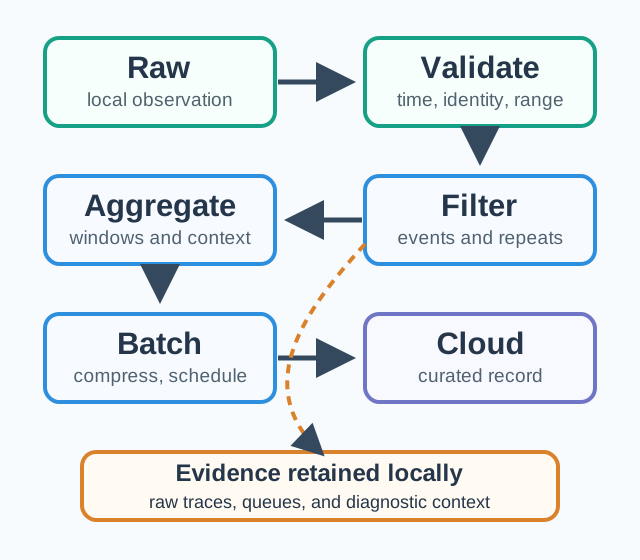
In the diagram Figure 5.1, Raw begins as a local observation; Validate adds time, identity, and range checks before Filter removes repeats or isolates events. Aggregate builds windows and context, then Batch compresses and schedules the curated record sent to Cloud. Beneath that path, Evidence retained locally preserves raw traces, queues, and diagnostic context. The two outputs matter together: the upstream record limits bandwidth, while the local evidence keeps anomaly and failure claims auditable.
If you only need the intuition, this layer is enough: reduce traffic only after naming the decision, freshness need, retained evidence, priority rule, backpressure behavior, owner, known limit, and retest trigger.
Validate readings, reject impossible values, mark missing or stale inputs, and keep local context before sending routine telemetry upstream.
Aggregate nearby devices, prioritize events, batch routine records, and buffer evidence when the upstream path is weak or unavailable.
Receive the records needed for dashboards, long-term history, model improvement, compliance, rollout policy, and cross-site comparison.
Filtering, compression, batching, and summarization can hide rare events, local extremes, fault context, or forensic detail if approved blindly.
A bandwidth decision record shows which data is reduced, where the reduction happens, what evidence remains available, how urgent traffic is protected, and which change reopens the review. It turns optimization from a hidden implementation detail into an owned architecture decision.
Separate routine traffic from urgent traffic. Telemetry summaries, diagnostics, model traces, firmware downloads, command acknowledgements, and incident records may all share one link. The design should state which traffic wins when capacity is tight and what lower-priority evidence is retained locally.
Use the flow as a release checklist: urgent traffic should bypass routine batches, routine records should carry freshness and sequence metadata, and every delayed or lost path should leave evidence operators can read later.
Eddie’s Edge Ledger
Bandwidth problems rarely appear as one simple shortage. They appear when a reduction boundary changes the meaning, timing, order, custody, or priority of the data. A summary may erase the exception. A queue may replay stale records as fresh. A compression step may drop diagnostic detail. A fog buffer may protect telemetry while starving commands.
Filtering and aggregation should state what detail is lost, which exceptions bypass the reduction, and which decisions remain valid.
Batching, retry, backoff, and replay should mark freshness, expiry, and ordering so late records are not mistaken for current state.
Local retention should preserve source, timestamp, sequence, quality flags, owner, loss markers, and cloud acceptance state.
Alerts, commands, acknowledgements, updates, diagnostics, and routine telemetry need an explicit order when the uplink is constrained.
Backpressure is the key under-the-hood behavior. When upload capacity is lower than production rate, the system must decide whether to slow sampling, summarize, drop low-priority records, retain locally, escalate an alarm, or narrow the accepted claim. Silent queues are dangerous because they can turn a bandwidth issue into stale or misleading evidence.
The rule is to make every reduction reversible in review even when it is not reversible in data. If the raw detail is gone, the record should still show what was reduced, why it was acceptable, what exception path exists, and what field change forces a retest.
Consider a vibration gateway on an intermittent cellular link. Normal windows can be compressed and uploaded later, but high-severity anomalies should bypass the routine queue, carry sequence and freshness metadata, and leave a local record if the upload fails. If storage fills, the gateway should apply the declared policy, such as keeping the newest routine summaries while retaining incident evidence and marking the loss boundary. Without that visible policy, the cloud may treat a delayed replay as current plant state or miss that lower-priority records were discarded.
First, Bandwidth optimization is an evidence budget across edge, fog, and cloud tiers. Next, Reduce traffic only after naming the decision, freshness need, retained evidence, priority rule, recovery behavior, owner, and retest trigger. Then, Filtering, aggregation, compression, batching, local inference, retention, and replay solve different problems and can introduce different evidence losses. After that, Backpressure behavior should state what happens when data production exceeds upload capacity. Finally, A changed sensor, sampling rate, threshold, feature, model, gateway, queue, protocol, backhaul, privacy rule, dashboard, or application claim should reopen the bandwidth review.
Optimize bandwidth by preserving the right evidence, not by blindly dropping data. The accepted record should tie reduction rules, priority, retention, replay, owner, known limit, and retest trigger to the decision being supported.
Pair bandwidth decisions with response budgets, jitter, queueing, and tier ownership for time-sensitive paths.
Use placement evidence to decide which tier owns filtering, aggregation, inference, retention, and recovery.
Map bandwidth responsibilities to owned telemetry, command, management, recovery, and fleet-memory paths.
Compare how industrial, health, city, vehicle, and remote-site cases change bandwidth and evidence priorities.
This section: Continue to the Next Part — Carry this evidence into Edge-Fog Use Cases: Decision Framework, which begins with Choosing Edge, Fog, or Cloud.
Carry this evidence into Edge-Fog Use Cases: Decision Framework, which begins with Choosing Edge, Fog, or Cloud.
3 reviewed answers.
Open the module page from the sidebar to see its chapters in order. Use the module map to return to a topic you need.
Modules and pathsReviewed
Check the symptom, then work through the diagnostic steps. Keep the error message and the smallest example that reproduces it.
When you are stuckReviewed
Use the interactive guide to check how examples and simulations work before changing your project.
Interactive examples guideReviewed