15 Edge AI: Deployment Validation and Runtime Design
More
Depth: Practitioner
Progress saves as you read. Mark sections complete as you go; your progress appears in the sidebar.
15.1 Start With the Decision
This section: Start With the Decision — A model that scores well in a notebook may fail on the target device.
A model that scores well in a notebook may fail on the target device. The deployment loop must test data, runtime, power, and updates.
15.2 Route Overview
This section: Route Overview — This is part 2 of 2.
This is part 2 of 2. Review Edge AI: Application Fit and Constraints for the preceding evidence.
15.3 Learning Objectives
This section: Learning Objectives
- Build an edge-model deployment and validation pipeline.
- Verify runtime, memory, energy, and update behaviour.
15.4 Chapter Roadmap
This section: Chapter Roadmap
- Deployment Pipeline
- Interactive: Trace the Edge AI Pipeline
- Knowledge Check: Pipeline Order
- Target-Device Validation
- Notebook Accuracy Is Not Enough
- Checkpoint: Deployment Loop
- Runtime Architecture
- Monitoring and Drift
- Knowledge Check: Drift Monitoring
- Checkpoint: Operations Evidence
- Common Pitfalls
- Label the Diagram
- Code Challenge
- Deep Dive: Operating the Edge AI Lifecycle
- Knowledge Check: Drift Response
- Summary
- Knowledge Check
- Quiz: Edge AI Applications
- Interactive Quiz: Match Concepts
- Interactive Quiz: Sequence the Steps
- Try It Yourself: Edge AI Application Record
- References
- What’s Next
- Navigation
- Key Takeaway
15.5 Deployment Pipeline
This section: Deployment Pipeline — Edge AI deployment is a loop, not a one-time model export.
Edge AI deployment is a loop, not a one-time model export.
Inspect Figure 15.1 before continuing. An edge-AI release is one turn of an operating loop, not the delivery of a model file. Figure 15.1 connects the local decision to the data, target-device proof, staged rollout, and monitoring that make later releases possible.
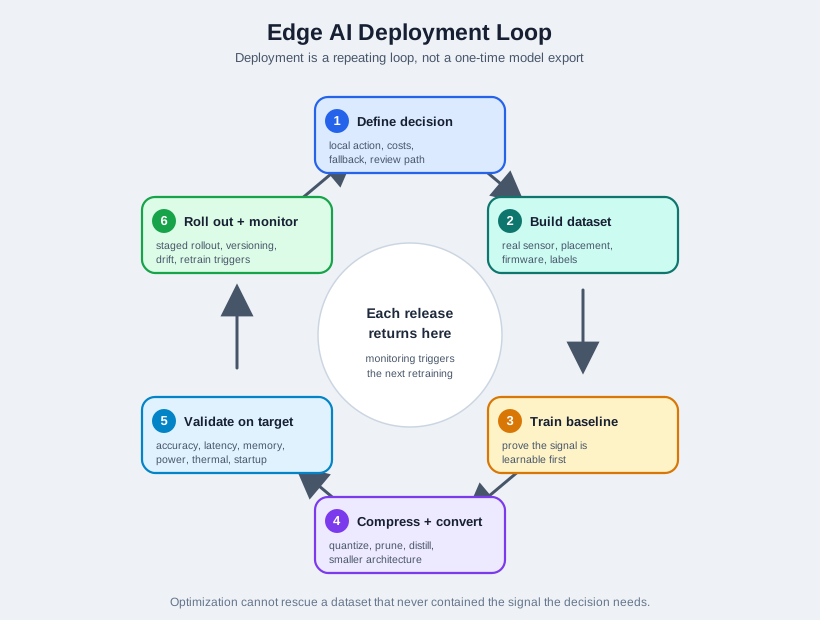
In the diagram Figure 15.1, the ring moves from Define decision and its fallback to Build dataset with real sensor placement and labels. Train baseline first proves the signal, after which Compress + convert may quantize, prune, or distil. Validate on target covers accuracy, latency, memory, power, thermal state, and startup; Roll out + monitor adds versions, drift, and retraining triggers. Because monitoring returns to the next decision, a dataset or field failure can revise the entire pipeline rather than being hidden by another optimization pass.
1. Define the decision State the local action, user impact, false-positive cost, missed-detection cost, fallback behavior, and human review path.
2. Build the dataset Collect data from the real sensor, placement, firmware, environment, and operating modes. Track labels and uncertain examples.
3. Train a baseline Create a model that proves the signal is learnable before optimizing for the target.
4. Compress and convert Quantize, prune, distill, or choose a smaller architecture only after the baseline is meaningful.
5. Validate on target Measure accuracy, latency, memory, power, thermal behavior, startup time, and failure handling on representative hardware.
6. Roll out and monitor Use staged deployment, versioning, rollback, drift monitoring, alert review, and retraining triggers.
15.6 Interactive: Trace the Edge AI Pipeline
This section: Interactive: Trace the Edge AI Pipeline — Use the animation to walk a sensor sample through buffering, preprocessing, inference, thresholding, local action, and cloud evidence before treating the deployment loop as release-ready.
Use the animation to walk a sensor sample through buffering, preprocessing, inference, thresholding, local action, and cloud evidence before treating the deployment loop as release-ready.
This section:
This section:
15.7 Target-Device Validation
This section: Target-Device Validation — An edge AI project is not production-ready until it passes target-device tests.
An edge AI project is not production-ready until it passes target-device tests.
Model footprint: Flash, RAM, tensor arena, activation buffers, runtime libraries, and model metadata fit with headroom.
Latency path: Sensor acquisition, preprocessing, inference, postprocessing, action, and logging meet the workflow deadline.
Power and thermal behavior: The inference schedule is compatible with battery, heat, enclosure, duty cycle, and site conditions.
Input robustness: Lighting, vibration, noise, temperature, placement, calibration, and sensor aging are represented in validation.
Fallback behavior: The device has an explicit behavior when confidence is low, the model is missing, memory is exhausted, or the runtime fails.
Update safety: Model versions are signed or controlled, staged, observable, and rollback-capable.
15.8 Notebook Accuracy Is Not Enough
A model can look good in a notebook and fail on the device because preprocessing differs, quantization changes scores, memory pressure changes timing, or live sensor data differs from training data.
 Checkpoint: Deployment Loop
You now know:
- The deployment loop has six stages: define the decision, build the dataset, train a baseline, compress and convert, validate on target, and roll out and monitor.
- Target-device validation must measure model footprint, latency path, power and thermal behavior, input robustness, fallback behavior, and update safety.
- Optimization is a release step, not a substitute for representative data, baseline validation, and target-device measurements.
After the release loop is explicit, define the runtime boundary so the local device, cloud control plane, and review workflow each own the right evidence.
15.9 Runtime Architecture
This section: Runtime Architecture — Edge AI systems usually combine local inference with cloud operations.
Edge AI systems usually combine local inference with cloud operations.
15.9.1 Device or Gateway Runtime
Owns sensor acquisition, preprocessing, model execution, postprocessing, local action, local buffering, and watchdog behavior.
15.9.2 Fleet Control Plane
Owns model version inventory, deployment rings, device eligibility, rollback, evidence upload policy, and audit history.
15.9.3 Monitoring and Review
Tracks confidence, class distribution, alert volume, rejected samples, latency, memory, power, and examples for human review.
15.9.4 Training and Retraining
Uses reviewed evidence, representative datasets, test suites, and deployment metadata to improve future model versions.
def handle_sensor_window(window, model, policy, device):
    features = device.preprocess(window)
    result = model.predict(features)

    if result.confidence < policy.minimum_confidence:
        device.store_evidence(window, reason="low_confidence")
        return device.safe_fallback("needs_review")

    if result.label in policy.local_action_labels:
        device.act(result.label)
        device.report_event(result.summary())
        return "acted_locally"

    device.report_event(result.summary())
return "observed"15.10 Monitoring and Drift
This section: Monitoring and Drift — Edge models drift when the world changes.
Edge models drift when the world changes. The model is local, but the monitoring plan must still be fleet-wide.
15.10.1 Model Health
Track confidence distribution, class mix, unknown rate, low-confidence rate, model version, and runtime errors.
15.10.2 Device Health
Track latency, memory, reset reason, thermal state, battery or power budget, sensor quality, and local storage pressure.
15.10.3 Data Drift
Watch for changes in lighting, soundscape, vibration baseline, materials, site layout, firmware, or user behavior.
15.10.4 Review Signals
Review signals should explain both model behavior and operational response. Start with false positives and missed events, then compare operator overrides with discarded or low-confidence detections. Preserve only policy-approved uncertain examples, labelled with model version and relevant sensing context, for later review or retraining. A change in one counter is a prompt to inspect lighting, placement, process, thresholds, or labels before retraining automatically. This connects field monitoring to the chapter’s evidence loop: diagnose the changed boundary, choose a bounded correction, and validate the replacement on the target.
This section:
Checkpoint: Operations Evidence
You now know:
- Runtime architecture separates device or gateway inference, fleet control, monitoring and review, and training or retraining.
- Monitoring must watch model health, device health, data drift, and review signals even when inference stays local.
- A production record should name the model version, preprocessing version, confidence policy, fallback path, evidence upload rule, rollback trigger, and retraining trigger.
Use those operational signals to spot the common ways edge AI projects fail after the first demo.
15.11 Common Pitfalls
This section: Common Pitfalls
15.11.1 Starting With Hardware
Buying an accelerator before defining the local decision often leads to mismatched cost, power, memory, and update requirements.
15.11.2 Reusing Business Claims
Borrowed payback periods and savings estimates hide the real economics of false alarms, installation, review, maintenance, and retraining.
15.11.3 Ignoring Preprocessing
Training and deployment must use the same preprocessing. Small image, audio, or feature differences can dominate model behavior.
15.11.4 No Fallback Path
The device must define what happens when confidence is low, the model fails to load, the sensor is unhealthy, or storage is full.
15.11.5 No Evidence Loop
Edge inference without sampled evidence and operator feedback becomes hard to improve after release.
15.11.6 One-Shot Deployment
Production edge AI needs versioning, staged rollout, rollback, monitoring, and retraining triggers.
15.12 Deep Dive: Operating the Edge AI Lifecycle
This section: Deep Dive: Operating the Edge AI Lifecycle — An edge AI application is more than a trained network.
An edge AI application is more than a trained network. In the field it is a running pipeline: capture, preprocess, infer, act or report, monitor, and update. The model is one controlled artifact inside that pipeline, alongside the preprocessing version, confidence policy, local action, evidence rules, fleet inventory, rollback path, and review workflow.
Inspect Figure 15.2 before continuing. Operating an edge model requires visibility into the complete sensor-to-action path, not just accelerator throughput. Figure 15.2 shows the stages and device metrics that a release record should preserve.
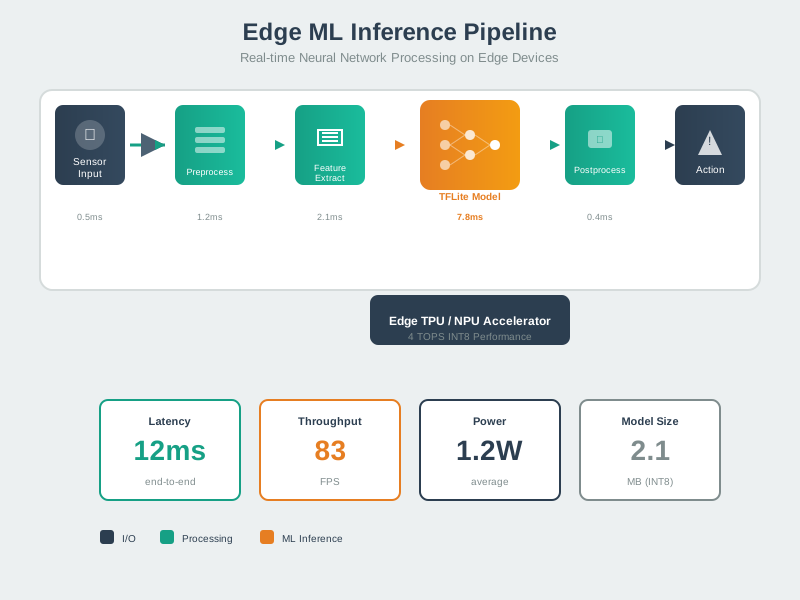
In the diagram Figure 15.2, the path begins at Sensor Input, then passes through Preprocess and Feature Extract before the TFLite Model; Postprocess turns scores into an Action. The example reports 12 ms end-to-end latency, 83 FPS throughput, 1.2 W average power, and a 2.1 MB INT8 model alongside a 4 TOPS Edge TPU or NPU label. Those numbers describe this pictured configuration only, but the arrangement makes the general lesson clear: monitor input, transformation, inference, decision, and device cost as one versioned pipeline.
15.12.1 Pipeline Evidence
For example, a packing line may start with a defect classifier that works well in the lab. In production, the application also needs camera exposure control, a preprocessing version, a confidence threshold, a reject-lane action, a hold-for-review path, and evidence upload rules. If the model sees a low-confidence image, the safe behavior may be to hold the item and store the frame, not to force a reject. If alert volume jumps after a lens is cleaned or a light is replaced, monitoring should surface that drift before operators lose trust.
A small latency budget makes the operating boundary concrete. Suppose a camera line runs at 30 frames per second, so each frame arrives about every 33 ms. If capture takes 4 ms, preprocessing 6 ms, inference 12 ms, postprocessing 3 ms, reject-lane signaling 3 ms, and local evidence logging 2 ms, the edge path is 30 ms end to end and still has 3 ms of margin. Adding an 80 ms cloud round trip would miss the physical action window even if model accuracy were identical.
15.12.2 Release Evidence and Rollback
Treat a model version like firmware. A release record should name the training dataset, model hash, quantization settings, preprocessing version, minimum confidence, fallback policy, rollback trigger, and operator who can pause or resume the rollout.
| Stage | What Happens | Evidence To Keep |
|---|---|---|
| Train in cloud | Train and validate the full-precision model on representative data. | Dataset version, metrics, and exact model artifact. |
| Convert and optimize | Export to TensorFlow Lite/LiteRT or ONNX and quantize for the target. | On-target accuracy after conversion, not only server accuracy. |
| Deploy over the air | Roll a versioned model to a canary group first. | Device-to-model inventory, rollout ring, and rollback result. |
| Monitor | Track confidence, input statistics, alerts, sampled hard cases, and device health. | Drift signals and field cases for retraining. |
A practical rollout might start with ten devices on one production cell. During the canary, operators compare reject rate, low-confidence rate, latency, memory headroom, and sampled false-positive reviews against the previous model. If the reject rate doubles without a process change, the rollout pauses and the fleet control plane keeps the older model everywhere else. If signals stay inside limits, the release widens by site or region.
15.12.3 Drift Feedback Loop
Two kinds of drift erode a deployed model. Data drift is a change in the input distribution, such as new lighting, a replaced sensor, a new season, or a changed product mix. Concept drift is a change in the relationship itself, so the mapping the model learned is no longer correct. Both can appear as a quiet accuracy decline because the model still returns confident answers; they are just increasingly wrong.
The fix is a loop, not a patch. Sample hard cases from the field, send them to the cloud, relabel representative examples, retrain, re-optimize the candidate, test it against both the old validation set and the new field slice, and roll it out in stages. Without that evidence loop, drift becomes an unexplained local complaint instead of a measurable lifecycle event.
15.13 Summary
This section: Summary
- Edge AI applications should be selected from measurable latency, privacy, bandwidth, autonomy, and operational-value evidence.
- Visual inspection, predictive maintenance, audio/event detection, and privacy-preserving sensing are common but different application families.
- The deployment loop includes use-case definition, data collection, baseline modeling, optimization, target-device validation, staged rollout, monitoring, and retraining.
- Target-device validation must measure the whole path, including preprocessing, inference, action, memory, power, thermal behavior, and fallback.
- Production systems need model versioning, rollback, cloud monitoring, evidence collection, and drift review.
15.14 Knowledge Check
This section: Knowledge Check
15.15 Try It Yourself: Edge AI Application Record
This section: Try It Yourself: Edge AI Application Record — Choose one application and complete a design record before choosing hardware.
Choose one application and complete a design record before choosing hardware.
application: visual-inspection-station
local_decision: detect missing label before package leaves station
why_edge:
  - local action must happen before item moves downstream
  - raw images should not be stored by default
sensor_context:
  sensor: fixed camera
  environment_risks: [lighting_change, motion_blur, label_variants]
model_plan:
  baseline: train cloud model first
  target_runtime: validate converted model on device class
  optimization: quantize only after baseline is acceptable
validation:
  measure: [accuracy, latency, memory, thermal, false_rejects, missed_defects]
fallback:
  low_confidence: hold for human review
  model_missing: route to manual inspection
monitoring:
  collect: [confidence_distribution, class_mix, low_confidence_samples, model_version]
rollout:
  strategy: staged deployment with rollback
Review the record with operations, privacy, and maintenance owners. A good edge AI application plan is a deployment and review plan, not just a model architecture.
15.16 References
This section: References
15.17 What’s Next
This section: What’s Next
15.17.1 Edge AI Fundamentals
Review the core reasons edge inference is useful and when cloud-only inference remains appropriate.
15.17.2 Edge AI Hardware
Compare microcontrollers, gateways, accelerators, memory budgets, and power constraints.
15.17.3 Edge AI Optimization
Learn how quantization, pruning, distillation, and conversion affect deployability.
15.17.4 Edge AI Lab
Practice a small end-to-end deployment workflow with target-device thinking.
15.19 Key Takeaway
This section: Key Takeaway — Edge ML is most valuable when local inference changes the outcome: lower latency, lower bandwidth, better privacy, or continued operation during cloud loss.
Edge ML is most valuable when local inference changes the outcome: lower latency, lower bandwidth, better privacy, or continued operation during cloud loss. A smaller monitored model at the right tier often beats a larger model that cannot run reliably in the field.
15.20 Continue Your Route
This section: Continue Your Route — This is the last part of this chapter.
This is the last part of this chapter. Return to Edge AI: Application Fit and Constraints or continue from the edge-fog module index.
Find help
3 reviewed answers.
Where should I start in a module?
Open the module page from the sidebar to see its chapters in order. Use the module map to return to a topic you need.
Modules and pathsReviewed
What can I try when a project does not work?
Check the symptom, then work through the diagnostic steps. Keep the error message and the smallest example that reproduces it.
When you are stuckReviewed
How do interactive examples work?
Use the interactive guide to check how examples and simulations work before changing your project.
Interactive examples guideReviewed