3 Bluetooth: BLE Profiles and Operations
More
Depth: Practitioner
Progress saves as you read. Mark sections complete as you go; your progress appears in the sidebar.
3.1 Start With the Decision
This section: Start With the Decision — BLE is the low-power form of Bluetooth.
BLE is the low-power form of Bluetooth. A role states what each device does in a connection. GATT is the way a connected BLE device organises its data. A sensor that sends one short value should not hold an audio link open. BLE roles and GATT shape its power and data path.
3.2 Route Overview
This section: Route Overview — This is part 1 of 2.
This is part 1 of 2. Continue with Bluetooth: Radio, Channels, and Piconets.
3.3 Part Objectives
This section: Part Objectives
- Choose Classic or BLE from rate, delay, and power needs.
- Map advertising, connection, and GATT operations.
3.4 Chapter Roadmap
This section: Chapter Roadmap
- Start With the Story
- Phoebe’s Field Notes: Why 79 Channels Share One Antenna Length
- Bluetooth Fundamentals for IoT
- Build the Bluetooth Fundamentals Record
- Radio, Link, GATT, and Operations Boundaries
- BLE Advertising & Scanning Game
3.5 Start With the Story
This section: Start With the Story — A small wireless device can stream sound, send a brief signal and return to sleep, or hold a data connection open.
A small wireless device can stream sound, send a brief signal and return to sleep, or hold a data connection open. These choices change battery life and speed. Latency means the delay between an action and its result. A gateway is a device that passes data between a local Bluetooth device and another network.
Bluetooth Low Energy (BLE) is the low-power form of Bluetooth. The Generic Attribute Profile (GATT) is the way a connected BLE device organises and exchanges data. This chapter breaks Bluetooth into visible steps: announcing a device, finding it, choosing roles, connecting, and exchanging data. You can then explain a design as a trade-off instead of merely ticking a Bluetooth box.
3.6 Bluetooth Fundamentals for IoT
This section: Bluetooth Fundamentals for IoT — Start with the behaviour, not the logo.
Start with the behaviour, not the logo. Classic Bluetooth usually carries steady streams such as audio and supports older, well-known device profiles. BLE usually carries short exchanges such as sensor reports, beacons, phone setup, and small control messages. A duty cycle is the share of time for which the radio is active. Short duty cycles let a BLE device sleep for longer. Bluetooth Mesh is a managed way for many devices to pass control messages. It is not simply one phone connection made larger.
The key idea is that “Bluetooth works” is not one claim. Discovery means that another device can find it. Pairing establishes keys and may authenticate the peer, depending on the method. Connection setup opens a data path. GATT services describe the data available on that path. Timing, power use, privacy, phone support, and recovery after failure each need their own test.
Radio Remi
“Range, power, and data-rate is a triangle — pick two honestly, then measure the third in the real room.”
Through this chapter, Remi tags each Bluetooth behavior with its band, its trade, and the room measurement that proves it.
Inspect Figure 3.1. It shows that Classic and BLE share basic controller and radio functions. Their higher-level rules are different. The figure turns the vague phrase “Bluetooth support” into a set of parts that can be tested.
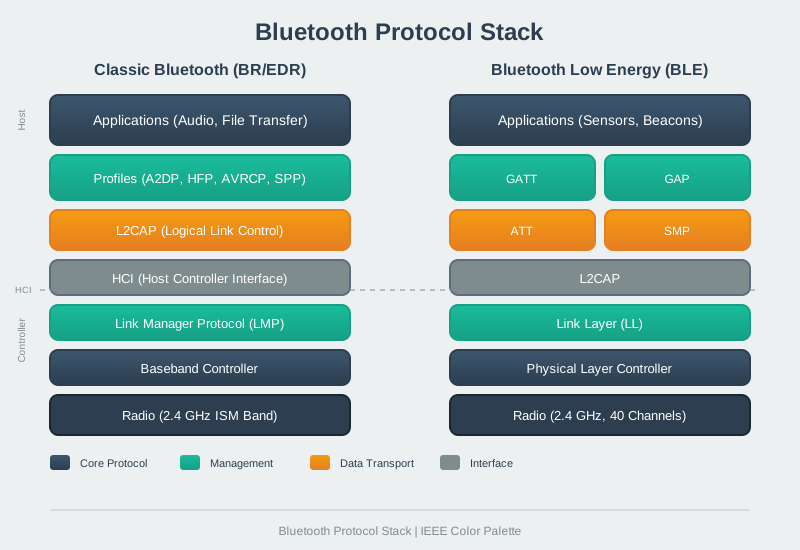
Read Figure 3.1 from the 2.4 GHz radio at the bottom upward. The controller runs the radio. A host interface connects that controller to the main software. On the BLE side, L2CAP carries the rules used by ATT/GATT and SMP. GAP defines how devices are found and which role each device takes. Classic Bluetooth uses different higher-level rules for steady streams. This explains a practical choice. A shipping logger can send short announcements and offer brief GATT reads, so BLE fits. A headset sends steady audio, so it needs different evidence for its profile, timing, compatibility, and power use.
One product may use several of these behaviours. During warehouse setup, a phone may act as the central device and write settings. During transport, gateways may only listen for announcements. During service, a technician may connect and read fault details. Calling all three cases “BLE support” hides important differences. Record the behaviour being approved, the other device involved, the data that moves, and the change that would require another test.
If you only need the intuition, this layer is enough: use Classic Bluetooth for sustained compatibility streams, BLE for small local IoT exchanges that can sleep between radio events, and mesh only when the provisioning, relay, security, and operations model are explicitly reviewed.
3.6.1 The Fundamental Choice
Review continuous connection behavior, audio or legacy profile fit, controller support, and whether the product can tolerate the active-link power model.
Review advertising, scanning, connection intervals, GATT services, characteristics, notifications, writes, and sleep behavior for the real device.
Profiles, services, permissions, characteristic properties, and app or gateway mapping define what the bytes mean.
Approve only the tested phones, firmware, enclosure, radio environment, security flow, battery target, and recovery behavior.
3.6.2 Common Beginner Distinctions
- Advertising proves visibility; it does not prove connected data exchange.
- A connection proves link setup; it does not prove the correct service, characteristic, permission, or application value.
- A BLE label suggests low-power design potential; it does not prove the actual duty cycle or battery life.
- A phone demo is useful evidence, but it should stay bounded to the tested phone, operating system, app permissions, firmware, and recovery path.
3.6.3 Overview Knowledge Check
3.7 Build the Bluetooth Fundamentals Record
This section: Build the Bluetooth Fundamentals Record — A practical Bluetooth fundamentals record explains why the chosen Bluetooth behavior fits the IoT job.
A practical Bluetooth fundamentals record explains why the chosen Bluetooth behavior fits the IoT job. It should show the device role, traffic pattern, receiver population, service model, timing, security ceremony, power expectation, and retest trigger. This keeps design review from sliding between Classic, BLE, advertising, connection, GATT, mesh, and gateway claims.
Use this record early. Before writing firmware, it catches mismatches such as selecting BLE for sustained high-rate traffic, using a beacon when the app needs acknowledged commands, or assuming a phone setup flow works across every phone and permission state.
3.7.1 Worked Review: BLE Sensor Reporting
A battery sensor sends a small reading to a phone app. The record should approve only the tested reporting workflow: the device is a BLE peripheral, the phone acts as central, the service and characteristic are known, the value format is documented, notification or read behavior is tested, pairing or authorization is defined, and reconnection after phone absence is observed.
Power approval needs its own evidence. The review should record the advertising schedule, connection behavior, payload size, sleep state, failed-connection recovery, and the device conditions that require retest.
3.7.2 Worked Review: Setup-Only BLE
A product may use BLE only for commissioning before it joins Wi-Fi, Thread, cellular, or another network. That is a setup workflow, not proof that BLE is the product data network. Review who can discover the setup mode, how the product proves ownership, how credentials are protected, what timeout ends setup mode, and how the device recovers from a failed or interrupted setup.
3.7.3 Practitioner Knowledge Check
3.8 Radio, Link, GATT, and Operations Boundaries
This section: Radio, Link, GATT, and Operations Boundaries — Bluetooth behavior moves through several evidence boundaries.
Bluetooth behavior moves through several evidence boundaries. A device may be visible during advertising, connect as the expected role, expose services through GATT, exchange an application value, and then recover after disconnection. Each boundary can pass or fail independently.
That separation matters because the fix changes by boundary. A scan problem may involve advertising interval, phone permissions, or RF placement. A read problem may involve pairing, service discovery, characteristic properties, or app mapping. A power problem may involve connection interval, retry behavior, sleep state, or a failed reconnection loop.
3.8.1 Diagnosis Pattern
- Keep the symptom narrow. Decide whether the failure is discovery, connection, pairing, GATT access, notification timing, application meaning, power, or recovery.
- Preserve known-good lower evidence. If the phone can discover the device, do not erase that evidence while debugging GATT access.
- Change one boundary at a time. Phone OS, app permission, firmware, enclosure, antenna, connection schedule, and service schema changes should be tested separately.
- Record what remains unproven. A lab phone and one firmware build do not prove all phones, all sites, all batteries, or all ownership transitions.
3.9 BLE Advertising & Scanning Game
This section: BLE Advertising & Scanning Game
3.10 Continue to the Next Part
This section: Continue to the Next Part — Carry this evidence into Bluetooth: Radio, Channels, and Piconets, which begins with How Bluetooth Works: Radio, Channels, and Piconets.
Carry this evidence into Bluetooth: Radio, Channels, and Piconets, which begins with How Bluetooth Works: Radio, Channels, and Piconets.
Find help
3 reviewed answers.
Where should I start in a module?
Open the module page from the sidebar to see its chapters in order. Use the module map to return to a topic you need.
Modules and pathsReviewed
What can I try when a project does not work?
Check the symptom, then work through the diagnostic steps. Keep the error message and the smallest example that reproduces it.
When you are stuckReviewed
How do interactive examples work?
Use the interactive guide to check how examples and simulations work before changing your project.
Interactive examples guideReviewed