2 The Bluetooth Landscape
More
Depth: Practitioner
Progress saves as you read. Mark sections complete as you go; your progress appears in the sidebar.
-

What must happen after the phone finds the sensor?
2.1 Start With the Story
This section: Start With the Story — Picture a fitness sensor beside a phone.
Picture a fitness sensor beside a phone. The phone can see that something is nearby. That first sighting does not prove the product will work. The sensor must share useful data, protect it, save power, and recover when the person walks away.
Bluetooth is a family of short-range wireless choices. One branch suits steady audio and older uses. Another branch suits small devices that send short updates and sleep often. A mesh option lets many powered devices pass local messages. Choose by the job, not by the common name.
Start with distance and data. Ask how often the device sends. Set the battery goal. Decide whether a phone must be present. Name who begins the connection. Define what happens after a break. Then test the final device in a busy place.
Finding, joining, and using data are separate steps. A device may announce that it exists. A client may connect. The two sides may then discover named services and values. Permission still controls which actions are allowed. Each step needs its own evidence.
This first view uses one sensor and one phone. Real products face many phones, shared air, and changing software. The Practitioner layer builds the design and power record. Under the Hood explains roles, data layers, timing, and the failure boundaries hidden by a successful first scan.
Imagine a wearable sensor beside a phone. A successful scan proves only that a radio was nearby; it does not yet prove the product has the right power budget, data contract, security boundary, or failure behavior.
Read this overview from that first observation outward. Separate Classic Bluetooth, BLE, profiles, roles, and mesh by the evidence each one can provide, then choose the path that matches the IoT job instead of the familiar brand name.
2.2 What Bluetooth Is Good For
This section: What Bluetooth Is Good For — Bluetooth is a short-range wireless family for devices that need local connectivity rather than direct Internet reach.
Bluetooth is a short-range wireless family for devices that need local connectivity rather than direct Internet reach. The name covers several design choices: Classic Bluetooth for sustained streams, Bluetooth Low Energy for small duty-cycled data, and Bluetooth Mesh for managed many-to-many lighting and building-control use cases.
The first review question is not “does it support Bluetooth?” Inspect Figure 2.1 to ask which Bluetooth behavior is being approved: audio streaming, a connected BLE sensor, a connectionless beacon, a phone-based commissioning path, or a mesh control network. The timeline helps prevent a later feature label from being mistaken for evidence that every device supports the same power, topology, security, or interoperability behavior.
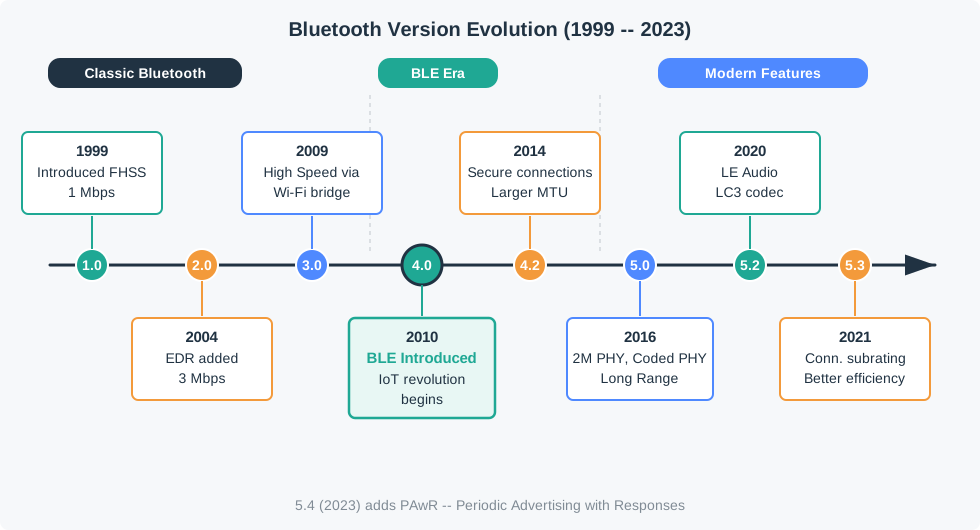
Read Figure 2.1 from the Classic stream family to BLE’s low-energy introduction, then across later additions such as extended range, richer advertising, and LE Audio. The order shows feature evolution, not automatic support in every controller, phone, or profile. That distinction connects directly to the review record: name the required behavior and verify both endpoints rather than approving the word “Bluetooth.” A smart door sensor, for example, may need separate evidence for advertising, a short GATT configuration connection, and bonded owner-only settings.
The same discipline prevents over-choosing technology. If the sensor only reports to a nearby gateway every few minutes, BLE collection may be enough. If the product streams audio, Classic Bluetooth or an audio profile is the relevant review boundary. If mains-powered lights must relay group commands through rooms, Bluetooth Mesh becomes a separate architecture decision with provisioner, relay, friend, low-power, key, and support responsibilities. A good overview record names the behavior first, then narrows the evidence to range, power, security, application meaning, and the change that reopens the review.
If you only need the intuition, this layer is enough: choose Bluetooth when the product needs short-range local interaction, phone access, low-power sensor exchange, or a standard profile. Do not treat the word "Bluetooth" as proof of range, battery life, security, or application compatibility.
2.2.1 The Core Bluetooth Choices
Best suited to sustained streams and established profiles such as audio, headsets, input devices, and serial-style links where continuous connection behavior is expected.
Best suited to sensors, wearables, beacons, locks, labels, commissioning, and phone-adjacent IoT devices that can sleep between short radio events.
Application meaning comes from profiles, services, characteristics, permissions, notifications, indications, and writes, not from the radio label alone.
Pairing, bonding, key custody, privacy behavior, firmware changes, phone-OS changes, and retest triggers define whether a deployment remains reviewable.
2.2.2 Beginner Examples
- A heart-rate wearable is usually a BLE problem because it sends small measurements and spends much of its time sleeping.
- A speaker playing phone audio is usually a Classic Bluetooth or Bluetooth audio-profile problem because the stream is continuous.
- A beacon that only announces an identifier may never need a connection, but it still needs advertising interval, privacy, battery, and receiver evidence.
- A phone setup flow proves a commissioning path only for the tested phones, OS versions, permissions, and recovery behavior.
2.2.3 Overview Knowledge Check
2.3 Build the Bluetooth Design Record
This section: Build the Bluetooth Design Record — A practical Bluetooth design record should let another engineer repeat the choice.
A practical Bluetooth design record should let another engineer repeat the choice. It states the use case, traffic pattern, radio mode, role, profile or service model, security ceremony, power budget, coexistence assumption, receiver population, and the change that reopens the decision.
Early design may record assumptions. A release review should replace assumptions with observations from representative devices, enclosures, phones, firmware, site conditions, and failure cases. Keep the approval narrow when evidence is narrow.
2.3.1 Worked Review: Battery Sensor to Phone
A battery sensor reports temperature to a phone app every few minutes. The safe design record names BLE peripheral behavior, the central phone population, the GATT service and characteristic, notification or read behavior, advertising interval, connection interval, reconnection path, pairing rule, sleep current assumption, and the phone or firmware changes that require retest.
The approval should not claim general Bluetooth compatibility. It should say that this sensor, app, firmware, phone set, and power budget support the reviewed reporting workflow under the tested conditions.
2.3.2 Worked Review: Local Commissioning Path
A device uses BLE only for setup before it joins another network. That is a commissioning claim, not a permanent data-network claim. Review device discovery, ownership transfer, authentication, timeout, recovery after failed setup, privacy behavior, and what happens when the phone app is absent or permissions change.
The safe approval statement is narrow: BLE is acceptable for the reviewed setup workflow if the device can recover from partial provisioning and if the security record prevents unauthorized reconfiguration.
2.3.3 Practitioner Knowledge Check
2.4 Layer Handoffs and Failure Boundaries
This section: Layer Handoffs and Failure Boundaries — Bluetooth failures are often misdiagnosed because several layers are visible at once.
Bluetooth failures are often misdiagnosed because several layers are visible at once. A phone may discover a device but fail to pair. A link may be encrypted but still expose the wrong characteristic permission. A notification may arrive correctly but drain the battery because the connection schedule is too aggressive. A beacon may be visible in a lab and unreliable in a crowded RF site.
The review should preserve the handoff from radio behavior to role behavior to application meaning to security custody to operations. That does not require packet-level proof for every lesson. It does require enough separation that a later engineer can tell where the claim stopped being proven.
2.4.1 Diagnosis Pattern
- Name the failing layer. Separate discovery, connection, pairing, service discovery, data exchange, power, and application interpretation before changing design assumptions.
- Check the closest proof below the symptom. If notifications stop, confirm link and subscription state before rewriting application parsing. If battery drains, inspect intervals and wake behavior before blaming the cell.
- Retest with one variable changed. Phone model, OS version, app permissions, enclosure, antenna position, firmware, and RF environment can each change the observed Bluetooth behavior.
- Write the unsupported claim. If only one phone, one room, one firmware, or one service was tested, keep the approval limited to that boundary.
2.4.2 Under-the-Hood Knowledge Check
2.5 Summary
This section: Summary
- Bluetooth design starts with a bounded behavior claim, not with the protocol label.
- Classic Bluetooth, BLE connections, BLE advertising, Bluetooth Mesh, profiles, and services support different IoT jobs.
- A review record should preserve use case, mode, role, profile or service model, security, power, receiver population, and retest triggers.
- Discovery evidence does not prove connection, pairing, GATT behavior, application meaning, or long-term battery life.
- Power claims require duty-cycle and wake-behavior evidence from the actual device, not just a BLE label.
- Operational readiness depends on ownership, recovery, lost-device handling, app or phone changes, and firmware retest boundaries.
2.6 Key Takeaway
This section: Key Takeaway
Approve Bluetooth only when the reviewed behavior is tied to mode, role, application model, security custody, power evidence, receiver population, owner, and retest boundary.
2.7 See Also
This section: See Also
Compare sustained Classic behavior with duty-cycled BLE behavior for IoT traffic, latency, and battery trade-offs.
Trace radio, link, L2CAP, ATT, GATT, profiles, and service evidence through a Bluetooth design.
Review discovery, advertising, scanning, pairing, bonding, parameters, and reconnection behavior.
Review pairing methods, encryption, authorization, privacy behavior, ownership transfer, and retest boundaries.
Find help
3 reviewed answers.
Where should I start in a module?
Open the module page from the sidebar to see its chapters in order. Use the module map to return to a topic you need.
Modules and pathsReviewed
What can I try when a project does not work?
Check the symptom, then work through the diagnostic steps. Keep the error message and the smallest example that reproduces it.
When you are stuckReviewed
How do interactive examples work?
Use the interactive guide to check how examples and simulations work before changing your project.
Interactive examples guideReviewed