4 AMQP Core Architecture: Brokers and Routing
More
Depth: Practitioner
Progress saves as you read. Mark sections complete as you go; your progress appears in the sidebar.
Start with the story: AMQP is easiest to understand as a sorting office for messages. Producers hand a message to an exchange, bindings describe the sorting rules, queues hold the matched copies, and consumers collect only the queues they own.
4.1 Start With the Decision
This section: Start With the Decision — AMQP 0-9-1 is a messaging protocol for clients and brokers.
AMQP 0-9-1 is a messaging protocol for clients and brokers. A publisher sends a message to an exchange, which routes it to zero or more queues using bindings. A queue holds messages for consumers. A binding connects an exchange to a queue; some exchange types compare a message’s routing key with a binding rule. Consumers receive messages from queues.
4.2 Route Overview
This section: Route Overview — This is part 1 of 2.
This is part 1 of 2. Continue with AMQP Core Architecture: Exchange Types.
4.3 Part Objectives
This section: Part Objectives
- Trace a message from publisher to exchange, binding, queue, and consumer, including what happens when routing fails.
- Trace amqp 0-9-1 model: exchanges, queues, and bindings across its components and failure boundaries.
- In 60 Seconds
- Key Concepts
- Prerequisites
- Related Chapters
- For Beginners: AMQP Architecture
- The Message Sorting Office
- Common Misconception: “Publishing to Queues Directly”
- How It Works: AMQP Message Routing
- Interactive Calculator: AMQP Message Routing Performance
- Checkpoint: Message Routing Flow
- AMQP Architecture Overview
- Interactive Calculator: Channel Multiplexing Savings
- Checkpoint: Broker and Channel Basics
- AMQP 0-9-1 Model: Exchanges, Queues, and Bindings
This chapter has several moving pieces, so use this path:
- First follow one message from producer to exchange, binding, queue, and consumer.
- Then compare core architecture choices: broker responsibilities, channel multiplexing, and the AMQP 0-9-1 exchange-queue-binding model.
- Next choose among direct, fanout, topic, and headers exchanges using the routing examples and calculators.
- Finally debug real designs through the industrial case study, pitfalls, concept checks, and hands-on exercises.
Checkpoints summarize what you can safely carry forward. Deep-dive and interactive panels are there when you want to test the numbers or routing rules yourself.
4.4 Learning Objectives
This section: Learning Objectives
By the end of this chapter, you will be able to:
- Describe AMQP Architecture: Explain the roles of producers, brokers, exchanges, queues, and consumers in the AMQP messaging model
- Configure Exchange Types: Set up direct, fanout, topic, and headers exchanges for different message routing patterns
- Implement Message Routing: Design binding rules that route messages from exchanges to queues based on routing keys
- Demonstrate Channel Multiplexing: Explain how multiple logical channels share a single TCP connection and calculate the resource savings of multiplexing over separate connections
Key Concepts
This section: Key Concepts
First: AMQP Broker: Central server receiving, routing, and storing messages between producers and consumers
Next: Exchange: AMQP routing component that applies rules to determine which queues receive each message
Then: Queue: Message buffer storing messages until consumed; configurable as durable (survives restart) or transient
After that: Binding: Rule connecting an exchange to a queue with an optional routing key pattern
Also inspect: Channel: Lightweight virtual connection multiplexed over a single TCP connection — reduces connection overhead
Finally: Virtual Host (vhost): Isolated AMQP namespace providing multi-tenancy on a single broker instance
Finally: Routing Key: Message attribute used by direct and topic exchanges to match binding patterns for queue selection
4.5 Prerequisites
This section: Prerequisites
Before diving into this chapter, you should be familiar with:
- AMQP Fundamentals: This chapter builds directly on AMQP basics - you must understand the protocol’s purpose, history (AMQP 0-9-1 vs 1.0), and core message-oriented middleware concepts
- Layered Network Models: AMQP operates at the application layer (Layer 7), so understanding how it sits atop TCP/IP helps grasp its role in the protocol stack
- Networking Basics: Knowledge of TCP connections, ports, and client-server communication patterns provides context for understanding AMQP’s connection model
Deep Dives:
- AMQP Messages and Delivery - Message structure and delivery guarantees
- AMQP Frames and Reliability - Advanced features and protocol frames
- AMQP vs MQTT - Protocol comparison and trade-offs
- AMQP Implementations and Labs - Hands-on broker setup
Related Protocols:
- MQTT Architecture - Lightweight pub/sub for IoT
- CoAP Fundamentals - REST-based messaging
- Application Protocols Overview - Protocol landscape
Imagine an enterprise system where hundreds of applications need to communicate: banking transactions, inventory updates, customer notifications, audit logs. Direct application-to-application connections would be a nightmare - each app would need code to talk to dozens of others. AMQP (Advanced Message Queuing Protocol) solves this with a message broker - a central post office that routes messages.
The Key Components:
- Producers (publishers) send messages to the broker
- Exchanges receive messages and route them based on rules
- Queues store messages until consumers are ready
- Consumers (subscribers) receive and process messages
What makes AMQP powerful? Flexible routing. An exchange can route one message to many queues (fanout), route based on exact routing keys (direct), or use pattern matching (topic). For example, a topic exchange with routing key “sensor.temperature.warehouse” can deliver to queues subscribing to “sensor.”, “.temperature.*”, or “sensor.temperature.warehouse”.
| Term | Simple Explanation |
|---|---|
| Message Broker | Central server routing messages between applications |
| Producer | Application that sends messages (publisher) |
| Consumer | Application that receives messages (subscriber) |
| Exchange | Routing component - determines which queues receive messages |
| Queue | Buffer storing messages until consumer reads them |
| Binding | Rule connecting exchange to queue with routing criteria |
“I have a temperature reading to report!” announced Temperature Terry, holding up a tiny data packet. “But there are so many different systems that need my data — the dashboard, the alarm system, the energy manager. How do I send it to all of them?”
the microcontroller grinned. “You don’t have to figure that out yourself, Sammy. That’s what the AMQP broker does! Think of it like a really smart post office. You just drop your message at the front desk — that’s the exchange — and label it with a topic like ‘temperature.kitchen.high’. The exchange checks its routing rules and puts copies into different queues — one for the alarm team, one for the dashboard team, one for the energy team.”
“So I only send one message, but it reaches everyone who needs it?” Sammy asked. “Exactly!” said the LED, blinking excitedly. “And the best part is, if the alarm system is busy, the message waits safely in its queue until the alarm is ready to read it. Nobody loses any data!”
the battery nodded approvingly. “And since Sammy only talks to one exchange instead of three different systems, he uses way less power. One delivery instead of three — my kind of efficiency!”
Misconception: “I should publish messages directly to queues for better performance, bypassing exchanges.”
Reality: Publishing with a queue name uses the default direct exchange; it does not bypass an exchange. That convenient route couples the publisher to a queue name. A named exchange can keep producer code stable as bindings change.
Why exchanges are essential:
Anti-pattern (direct queue publishing):
# Producer tightly coupled to queue name
channel.basic_publish(
    exchange='',  # Default exchange
    routing_key='temperature_queue',  # Direct queue name
    body='22.5C'
)
# Limitation: Producer must know this queue name; a new destination needs another publish
Correct pattern (exchange routing):
# Producer decoupled from consumer topology
channel.basic_publish(
    exchange='sensor_exchange',
    routing_key='sensor.temperature.zone1',
    body='22.5C'
)
# Exchange routes to multiple queues automatically:
# - temperature_monitoring_queue (pattern: sensor.temperature.#)
# - zone1_dashboard_queue (pattern: sensor.*.zone1)
# - archive_queue (pattern: sensor.#)
Real-world consequences:
| Scenario | Direct Queue | Exchange Routing | Impact |
|---|---|---|---|
| Adding a new destination queue | Modify producer routing when publishing by queue name | Add a new binding | No producer code change with the named exchange |
| Fan-out to 3 consumers | Publish 3 times | Publish once | 3x network traffic |
| Change routing logic | Redeploy producers | Update bindings | Code change vs config change |
Key principle: AMQP exchanges enable location transparency - producers don’t know (or care) who consumes messages. This is fundamental to scalable, evolvable architectures.
4.6 How It Works: AMQP Message Routing
This section: How It Works: AMQP Message Routing — Start with the smallest complete path: one producer publishes one message, and the broker decides which queue copies should exist.
Start with the smallest complete path: one producer publishes one message, and the broker decides which queue copies should exist.
Understanding AMQP’s message routing flow is essential for designing reliable messaging systems. The process involves three coordinated steps:
Step 1: Producer Publishes to Exchange
When a producer sends a message, it targets an exchange (not a queue directly). The message includes:
First: Routing key: A label like sensor.temperature.zone1 that the exchange uses for routing decisions
Next: Message body: The actual data payload (JSON, binary, etc.)
Then: Properties: Metadata like delivery mode, priority, content type
Step 2: Exchange Evaluates Bindings
The exchange examines its bindings (routing rules) to determine which queues should receive the message:
After that: Direct exchange: Compares routing key to binding keys for exact matches
Also inspect: Topic exchange: Matches routing key against wildcard patterns (* for one word, # for zero or more)
Finally: Fanout exchange: Ignores routing key and copies message to all bound queues
Finally: Headers exchange: Matches message header attributes instead of routing key
Step 3: Queue Storage and Consumer Delivery
Once routed, the message:
Finally: Enters a matching queue; storage and restart behavior depend on queue type, delivery mode, and broker version
Finally: Waits for a basic.get request or is pushed to a subscribed consumer
Finally: Acknowledges after consumer confirms successful processing (manual ack) or immediately (auto ack)
Illustrative timeline (assumed millisecond marks, not broker measurements):
Finally: T = 0 ms: Producer publishes to exchange
Finally: T = 1 ms: Exchange evaluates 100 bindings using pattern matching
Finally: T = 2 ms: Message is copied to 3 matching queues
Finally: T = 3 ms: Queue 1 delivers to consumer A
Finally: T = 15 ms: Consumer A finishes processing and sends an acknowledgement
Finally: T = 16 ms: Queue 1 removes the acknowledged message
 Checkpoint: Message Routing Flow
You now know:
- Producers publish to exchanges, not directly to application-owned queues.
- The broker evaluates bindings, then copies the message only into matching queues.
- The default example shows a 100-binding exchange, 3 matching queues, a 200-byte payload, and 4,800 messages per second, so routing cost is a design input rather than a hidden detail.
Why This Design Matters:
The exchange-queue separation enables location transparency - producers don’t know which consumers exist. You can:
- Add new consumers by creating queues and bindings (zero code changes to producers)
- Scale consumers independently (competing consumers pattern)
- Implement fan-out routing (one message to many queues) without producer logic
4.7 AMQP Architecture Overview
This section: AMQP Architecture Overview — Now widen the view from a single route to the broker architecture that makes those routes reusable.
Now widen the view from a single route to the broker architecture that makes those routes reusable.
AMQP’s architecture consists of three main components that work together to enable reliable, flexible message routing.
4.7.1 Core Components
First: Producer: Publishes a message with a routing key such as sensor.temperature.zone1.
Sends data once and does not know which consumers exist.
Next: Broker: Accepts the publish, evaluates routing rules, and stores matching copies in queues.
Core broker primitives: Exchange, Binding, and Queue.
Then: Consumer: Reads from a queue, processes the message, and sends an acknowledgement when complete.
Subscribes to queues and processes asynchronously.
AMQP core components: the producer publishes once, the broker routes through exchanges and queues, and the consumer receives and acknowledges the message.
1. Producer (Publisher):
After that: Application that sends messages
Also inspect: Publishes to exchanges (or directly to queues via the default exchange)
Finally: Does not need to know about consumers
Finally: Can publish to any exchange with appropriate credentials
2. Message Broker:
Finally: Central message routing and queuing system
Finally: Receives messages from producers
Finally: Routes to appropriate queues based on exchange rules and bindings
Finally: Delivers to consumers on demand or via push
Finally: Manages persistence, acknowledgments, and flow control
3. Consumer (Subscriber):
Finally: Application that receives messages
Finally: Subscribes to queues (not exchanges)
Finally: Processes messages asynchronously
Finally: Sends acknowledgments to confirm successful processing
4.7.2 Channel Multiplexing
AMQP supports multiple lightweight channels over a single TCP connection. This reduces connection overhead while allowing concurrent message streams.
Benefits of channel multiplexing:
First: Resource efficiency: One TCP connection can handle many message streams
Next: Isolation: Errors on one channel don’t affect others
Then: Parallelism: Multiple threads can use different channels concurrently
After that: Reduced overhead: Avoids TCP connection setup costs for each stream
This section:
Checkpoint: Broker and Channel Basics
You now know:
- Producer, broker, and consumer are separate roles; the producer sends once and does not need to know which consumers exist.
- The broker owns exchanges, bindings, queues, persistence, acknowledgments, and flow control.
- Channel multiplexing lets one TCP connection carry many logical streams while channel errors remain isolated from other channels.
4.8 AMQP 0-9-1 Model: Exchanges, Queues, and Bindings
This section: AMQP 0-9-1 Model: Exchanges, Queues, and Bindings — With the broker roles in place, the next question is how AMQP 0-9-1 represents routing rules inside that broker.
With the broker roles in place, the next question is how AMQP 0-9-1 represents routing rules inside that broker.
The AMQP 0-9-1 model (used by RabbitMQ) introduces powerful routing capabilities through a three-tier architecture.
Inspect Figure 4.1 to separate the three broker objects before reasoning about delivery guarantees.
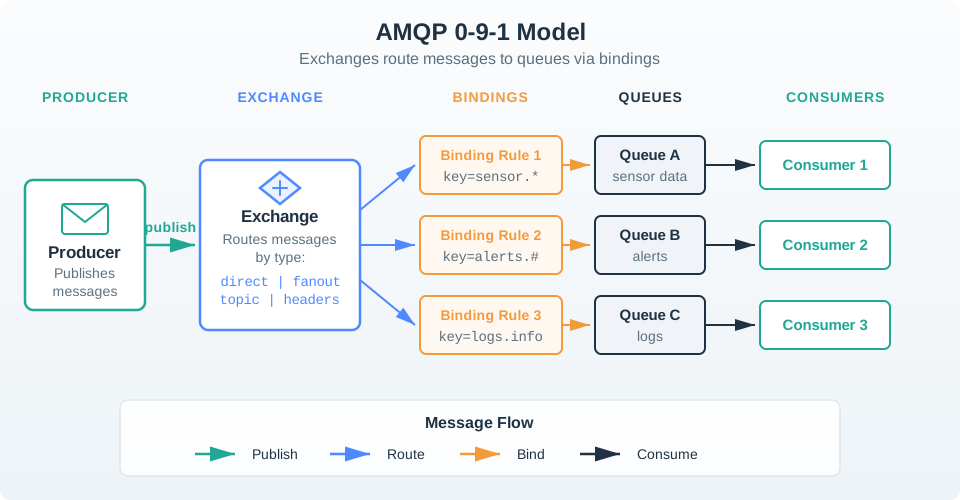
Trace Figure 4.1 from publisher to exchange, across bindings, and into queues consumed downstream. Exchanges match; bindings express the match rules; queues store independently consumable copies. That division explains why broker acceptance, successful routing, durable storage, and consumer completion require different checks.
4.8.1 Exchanges
Exchanges are the routing layer of AMQP. They receive messages from producers and route them to queues based on rules.
Key characteristics:
First: Receives messages from producers
Next: Routes messages to queues based on rules
Then: Does NOT store messages (queues do)
After that: Multiple exchange types (direct, fanout, topic, headers)
Also inspect: Named entities declared by clients
4.8.2 Queues
Queues are message buffers that store messages until consumed.
Key characteristics:
First: Message buffer (FIFO — First In, First Out); priorities, requeues and competing consumers can change the order consumers see
Next: Stores messages until consumed
Then: Can be durable (survives broker restart)
After that: Can be exclusive (accessible only to its declaring connection and deleted when that connection closes)
Also inspect: Can be auto-delete (deleted when last consumer disconnects)
4.8.3 Bindings
Bindings are rules that connect exchanges to queues, defining the routing logic.
Key characteristics:
First: Rules connecting exchanges to queues
Next: Defines routing logic (e.g., “route messages with key ‘sensor.temperature’ to queue ‘temp-data’”)
Then: Can include additional arguments for headers exchanges
After that: Multiple bindings can connect the same exchange to multiple queues
4.9 Continue to the Next Part
This section: Continue to the Next Part — Carry this evidence into AMQP Core Architecture: Exchange Types, which begins with Exchange Types.
Carry this evidence into AMQP Core Architecture: Exchange Types, which begins with Exchange Types.
Find help
3 reviewed answers.
Where should I start in a module?
Open the module page from the sidebar to see its chapters in order. Use the module map to return to a topic you need.
Modules and pathsReviewed
What can I try when a project does not work?
Check the symptom, then work through the diagnostic steps. Keep the error message and the smallest example that reproduces it.
When you are stuckReviewed
How do interactive examples work?
Use the interactive guide to check how examples and simulations work before changing your project.
Interactive examples guideReviewed