16 AMQP Operations: Capacity Tools and Diagnostics
More
Depth: Practitioner
Progress saves as you read. Mark sections complete as you go; your progress appears in the sidebar.
Start with the story: In production, AMQP carries work through a broker. An exchange accepts and routes each message. A queue stores messages that wait; a consumer is the program that handles them. Operators watch that backlog and its delay before it becomes data loss.
16.1 Start With the Decision
This section: Start With the Decision — A queue-depth chart is useful only when its rate and capacity assumptions are clear.
A queue-depth chart is useful only when its rate and capacity assumptions are clear. Tools should turn those values into an operating decision.
16.2 Route Overview
This section: Route Overview — This is part 2 of 2.
This is part 2 of 2. Review AMQP Operations: Deployment and Broker Health for the preceding evidence.
16.3 Learning Objectives
This section: Learning Objectives
- Use AMQP calculators to test load and capacity.
- Read routing and protocol views during fault diagnosis.
16.4 Chapter Roadmap
This section: Chapter Roadmap
- Interactive Calculators
- Checkpoint: capacity sizing
- Visual Reference Gallery
- Visual: AMQP Routing Topology
- Visual: AMQP Protocol Overview
- Practical Implementation Resources
- Official Libraries and Documentation
- Knowledge Check
- Label the Diagram
- Code Challenge
- Routing Pattern Production Drill
- Design Contract: Production Availability and Confirms
- Availability and Confirms
- Summary
- What’s Next
- Key Takeaway
16.5 Interactive Calculators
This section: Interactive Calculators
16.5.1 AMQP Queue Capacity Calculator
Calculate memory requirements, queue depth limits, and backlog tolerance for production AMQP deployments.
16.5.2 AMQP Throughput & Scaling Calculator
Determine consumer count requirements and identify throughput bottlenecks.
16.5.3 AMQP Prefetch Optimizer
Explore the tradeoff between throughput (higher prefetch) and latency (lower prefetch) for optimal consumer performance.
Key Insights:
First: Prefetch count controls the tradeoff between throughput and latency. Low prefetch (1-10) minimizes per-message latency but adds network overhead. High prefetch (100+) maximizes throughput but delays fair work distribution across consumers.
Next: Backlog payload scales with message count and size. A 10-second backlog at 500 msg/sec is 5,000 messages; at 1 kB of payload each, that is 5 MB of payload before queue metadata, disk/index overhead, and replication. It is not a 5 MB RAM requirement.
Then: Consumer service capacity is approximately consumers × (1000 / processing_time_ms) messages/sec for sequential, fully busy workers with no other bottleneck. At 10 ms per message, one worker could process about 100 msg/sec. Little’s Law separately relates average work in progress to arrival rate and time in system.
This section:
 Checkpoint: capacity sizing
You now know:
- A 10-second backlog at 500 msg/sec creates 5,000 queued messages before metadata overhead.
- A 10 ms processing time gives one consumer about 100 msg/sec, so consumer count follows the target publish rate.
- Prefetch of about 100–300 typically gives the best throughput (it hides delivery latency), but a large prefetch reserves work on slow consumers and delays redistribution after failure.
16.6 Visual Reference Gallery
This section: Visual Reference Gallery
Inspect Figure 16.1 to relate a production routing rule to the broker objects that enforce it.
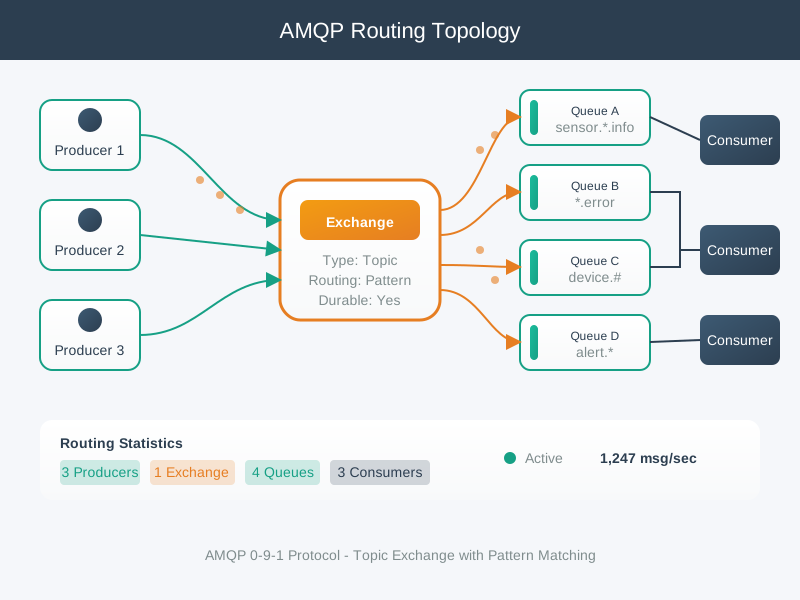
Read Figure 16.1 from each exchange through its labelled bindings into destination queues, then follow the consumers attached to those queues. The view shows where routing flexibility lives and where backlog can accumulate. It connects topology design to binding tests, queue monitoring, and unroutable-message policy.
This diagram shows how AMQP’s exchange-binding-queue model supports routing patterns distinct from MQTT topic subscriptions.
16.7 Visual: AMQP Protocol Overview
Inspect Figure 16.2 to orient the complete broker-mediated path before selecting production client settings.
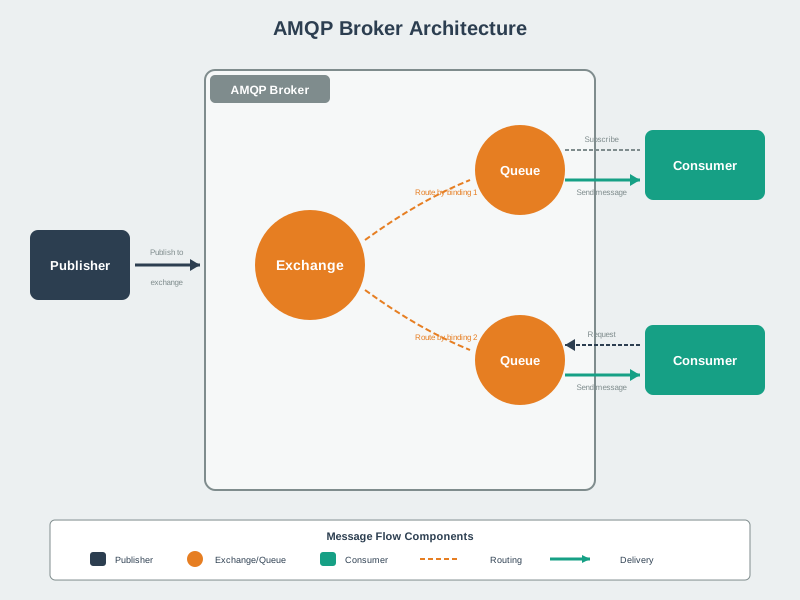
Trace Figure 16.2 from producer into the broker, through exchange and queue responsibilities, and out to consumers. Notice that routing and buffering occur between the endpoints. This placement explains why availability, confirmation, persistence, acknowledgment, and monitoring must cover separate parts of the same path.
AMQP’s broker-mediated architecture provides the reliable, transactional messaging capabilities required for enterprise IoT backend integration scenarios.
16.8 Practical Implementation Resources
This section: Practical Implementation Resources
Official Libraries:
First: Python: pika library (https://pika.readthedocs.io)
Next: Java: RabbitMQ Java Client (https://www.rabbitmq.com/java-client.html)
Then: Node.js: amqplib (https://amqp-node.github.io/amqplib)
Practical Examples:
After that: RabbitMQ Tutorials: https://www.rabbitmq.com/getstarted.html
Also inspect: AMQP 0-9-1 Reference: https://www.rabbitmq.com/amqp-0-9-1-reference.html
16.9 Knowledge Check
This section: Knowledge Check
16.10 Routing Pattern Production Drill
This section: Routing Pattern Production Drill — Use the exchange topology as an operations decision, not just a publisher setting.
Use the exchange topology as an operations decision, not just a publisher setting. A production routing review should answer these checks before the queue names are frozen:
| Check | Evidence to collect | Production risk if skipped |
|---|---|---|
| Topic hierarchy | Example keys such as factory.line1.temperature and binding patterns using * or # | Consumers receive too much data and reimplement filtering in application code |
| Offline consumer buffering | Durable queue, persistent messages, and a measured backlog drain rate | Maintenance windows silently drop telemetry or create an unbounded queue |
| Failure routing | Dead-letter exchange, rejection policy, retry owner, and poison-message sample | Bad payloads loop forever or block healthy messages |
| Fan-out requirement | Explicit reason for a fanout exchange or separate topic bindings | Audit, analytics, and alert consumers interfere with one another |
For an offline analytics consumer, record the expected backlog in messages and bytes. For example, 10 msg/s over a 30 minute maintenance window creates 18,000 queued messages; at 200 bytes each, the broker needs roughly 3.6 MB of payload storage before metadata and index overhead. That calculation belongs beside the durable queue declaration, not in a post-incident note.
16.11 Design Contract: Production Availability and Confirms
This section: Design Contract: Production Availability and Confirms — Production AMQP code is not complete until broker node failure and publisher-confirm throughput are bounded deliberately.
Production AMQP code is not complete until broker node failure and publisher-confirm throughput are bounded deliberately. The deeper treatment now lives in AMQP Production Availability and Confirm Contracts, covering quorum queues, connection hygiene, asynchronous publisher confirms, confirm windows, mandatory returns, and the operational thresholds that show when a queue is already violating its service promise.
16.12 Availability and Confirms
This section: Availability and Confirms — Start with the story: A broker setup that is correct in a lab can still fail in production if one node, one confirm loop, or one growing queue becomes the hidden weak point.
Start with the story: A broker setup that is correct in a lab can still fail in production if one node, one confirm loop, or one growing queue becomes the hidden weak point. This page turns those weak points into explicit availability and monitoring contracts.
16.12.1 Learning Objectives
Keep a Critical Message Safe When One Queue Host Fails
Imagine a factory alert reaching one queue host just before that host stops. A durable disk file is not enough if no live member can keep serving the message.
A protocol is an agreed set of rules for an exchange. Advanced Message Queuing Protocol, or AMQP, is a protocol for exchanging messages. A broker is the service that receives, routes, and holds those messages. For a critical queue, name how many members hold it, which loss it can survive, and what the sender learns about each accepted message.
Turn off one member during a measured send. Delay confirmations, refuse one message, and return one that has no valid route. Track each message until it is confirmed, retried, rejected, or left unknown.
This small test does not prove every high-load case. Practitioner sets up the queue and connection plan. Under the Hood tracks confirmation state at speed and explains the remaining loss windows.
After this page, you should be able to:
- Explain why a durable single-node queue is still a production availability risk.
- Choose quorum queues for critical RabbitMQ workloads and describe majority-failure behavior.
- Separate publishing and consuming connections while reusing channels deliberately.
- Track asynchronous publisher confirms with delivery tags, multiple acknowledgments, nacks, and mandatory returns.
- Tie confirm-window, queue-depth, unacked-message, and dead-letter metrics to alert thresholds.
16.12.2 Why This Follows AMQP Production Operations
AMQP Production Operations teaches durable declarations, client-library implementations, dead-letter queues, monitoring, and capacity calculators. This page tightens the production availability contract underneath that code: a queue must tolerate broker node loss, a publisher must sustain throughput without losing confirm state, and operators must know before backlog age violates the product SLA.
Use it when a RabbitMQ deployment is moving from pilot to production, when publishers block on synchronous confirms, when a single broker node is still a failure domain, or when a runbook needs concrete alert thresholds for publish pressure, queue backlog, consumer health, and dead-letter flow.
16.12.3 Overview: Production Adds Availability and Scale
Everything so far makes a single broker correct. Production adds two harder requirements: the queue must survive a broker node failing, and the publisher must sustain thousands of messages per second without blocking on each confirm. The two answers are replicated queues and asynchronous publisher confirms. A durable queue on one node is still a single point of failure; a synchronous "publish, wait for confirm, repeat" loop is safe but slow.
Inspect Figure 16.3 to locate where publish rate, routing fan-out, queued backlog, and consumer drain rate become separate production signals.
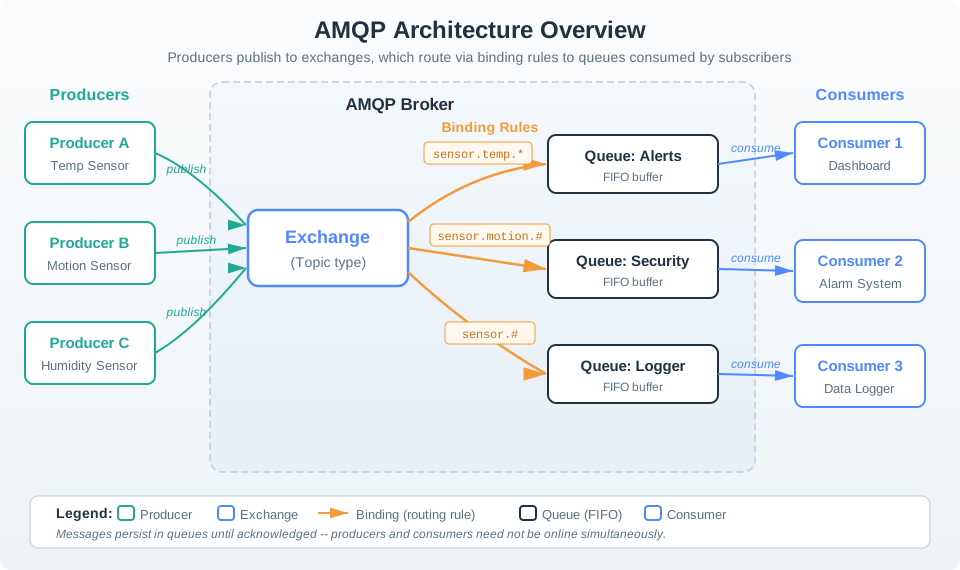
Read Figure 16.3 from producers to consumers as four separate signals. The three factories create 1,200 messages/s of ingress; exchange bindings determine how much of that rate reaches each queue, and every queue holds its own backlog. At the alert queue, 5% of 1,200 messages/s is 60 messages/s of ingress. Two consumers at 40 messages/s each drain 80 messages/s, so 60 − 80 = −20 messages/s: the backlog shrinks. If a new binding doubles alert traffic, the same consumers fall behind. Watch queue depth and oldest-message age beside active consumers and unconfirmed publishes, because available disk does not prove that delivery still meets the service deadline.
16.12.4 Practitioner: Quorum Queues and Connection Hygiene
For data-safety-critical queues, RabbitMQ recommends the quorum queue. It replicates contents with Raft across an odd number of nodes and keeps working while a majority is available; a publisher confirm means a quorum has accepted the message. RabbitMQ 4.0 removed classic mirrored queues.
| Property | Classic queue | Quorum queue |
|---|---|---|
| Replication | Single node by default | Raft across an odd set of nodes |
| Survives a node loss | No (queue unavailable) | Yes, while a majority survives |
| Best for | Transient, high-churn, non-critical | Orders, commands, anything you cannot lose |
Two connection habits help isolate load. First, use separate connections for publishing and consuming where possible: the broker sends connection.blocked and pauses publishing connections, while consumers may still drain work, and TCP back-pressure on a shared socket can affect both roles. Second, reuse connections and channels rather than opening one per message; per-message channel churn wastes broker resources.
Turn those settings into a deployment rule. A three-node quorum queue can tolerate one broker node failing; if two nodes are unavailable, writes stop because no majority can confirm them. For critical commands, set the producer timeout lower than the operator escalation time: if confirms stop for 10 seconds, the publisher should fail fast, surface the queue name and last delivery tag, and switch the device gateway into a degraded mode instead of buffering indefinitely in RAM.
Connection hygiene has the same measurable shape. If 500 edge gateways each open one publishing connection and reuse channels per stream, the broker handles hundreds of stable sockets. If each gateway opens a connection per message at 2 msg/s, the broker sees 1,000 TCP handshakes per second before it processes payloads. That is wasted capacity and a common reason a "small" pilot collapses when it becomes a production fleet.
16.12.5 Under the Hood: Asynchronous Confirms at Throughput
Synchronous confirms (publish one, block for its ack) are simple but cap you at one message per round trip. The production pattern is asynchronous confirms: call confirm.select once to put the channel in confirm mode, then keep publishing while tracking each message's delivery tag (a monotonically increasing sequence number) in an outstanding map. The broker acks tags asynchronously and out of band:
basic.ackwith a delivery tag clears that message; withmultiple=trueit clears every tag up to and including it, so acks arrive in efficient ranges.basic.nacksignals the broker could not take responsibility for the message — the publisher should resend it.- a
basic.return(only if you publishedmandatory) arrives first for an unroutable message, because a confirm alone would ack it as handled.
So a robust publisher keeps a map of unconfirmed tags, removes them as acks arrive, resends on nack or unknown outcome with duplicate-safe IDs, and treats a returned message as a routing failure. With a quorum queue and successful confirms, this protects broker acceptance while allowing high throughput; the publisher need not block on each ack.
The throughput difference is large. With a 25 ms broker round trip, synchronous confirms cap one channel near 1000 / 25 = 40 msg/s. If the same channel keeps a window of 1,000 outstanding confirms, the theoretical pipe becomes roughly 1000 / 0.025 = 40,000 msg/s before broker, disk, and network limits. The outstanding map is the safety valve: cap it, expose its size as a metric, and pause publishing when it approaches the window instead of letting memory grow without bound.
Pair that publisher metric with queue and consumer signals. Alert when queue depth grows for more than one drain interval, when unacknowledged messages stay near consumers × prefetch_count for a sustained period, or when dead-letter rate rises above the expected poison-message baseline. Prefetch is applied per consumer in RabbitMQ; a sustained near-limit count can show saturated workers. Confirms protect accepted writes, queues reveal backlog, ACKs reveal consumer progress, and DLQs reveal work the normal path could not process.
16.13 Summary
This section: Summary
This chapter covered production AMQP implementation patterns:
First: Production Configuration: Durable exchanges, persistent messages, manual acknowledgment, and dead letter queues
Next: Client Libraries: Complete Python (Pika), Java (RabbitMQ Client), and Node.js (amqplib) implementations with reliability features
Then: Publisher Confirms: Ensuring the broker acknowledges message receipt before considering it sent
After that: Consumer Reliability: Manual acknowledgment with proper error handling and requeue/dead-letter strategies
Also inspect: Monitoring: Key metrics (queue depth, consumer count, message rates) and alerting thresholds
Finally: Dead Letter Queues: Capturing failed messages for investigation and recovery
16.14 What’s Next
This section: What’s Next — Choose the next chapter from the unresolved engineering question.
Choose the next chapter from the unresolved engineering question. Use AMQP Routing Patterns to practise exchange topology and capacity calculations with direct, topic, and headers routing. Use AMQP and MQTT Tradeoffs when the open decision is whether AMQP’s reliability and routing machinery justifies its cost in a particular IoT deployment.
If the device edge is the concern, compare this backend design with MQTT Fundamentals for lightweight publish-subscribe or CoAP Fundamentals for RESTful constrained-node communication. Return to the AMQP Comprehensive Review when framing, channels, or protocol foundations need reinforcement; the same module overview also shows how this production chapter fits the complete implementation path.
16.15 Key Takeaway
This section: Key Takeaway — A production AMQP deployment is a managed system, not only a broker endpoint.
A production AMQP deployment is a managed system, not only a broker endpoint. Capacity planning, monitoring, retry policy, queue limits, and operational runbooks are as important as the producer and consumer code.
16.16 Continue Your Route
This section: Continue Your Route — This is the last part of this chapter.
This is the last part of this chapter. Return to AMQP Operations: Deployment and Broker Health or continue from the AMQP Module Guide.
Find help
3 reviewed answers.
Where should I start in a module?
Open the module page from the sidebar to see its chapters in order. Use the module map to return to a topic you need.
Modules and pathsReviewed
What can I try when a project does not work?
Check the symptom, then work through the diagnostic steps. Keep the error message and the smallest example that reproduces it.
When you are stuckReviewed
How do interactive examples work?
Use the interactive guide to check how examples and simulations work before changing your project.
Interactive examples guideReviewed