2 AMQP Core: Routing and Message Lifecycle
More
Depth: Practitioner
Progress saves as you read. Mark sections complete as you go; your progress appears in the sidebar.
Start with the story: AMQP adds a smart sorting desk between senders and receivers. Instead of every device knowing every consumer, the exchange uses its type and bindings (and a routing key where applicable) to route message copies to matching queues.
2.1 Start With the Decision
This section: Start With the Decision — A warehouse alert must reach the right worker and leave proof when done.
A warehouse alert must reach the right worker and leave proof when done. An exchange chooses where an AMQP message goes. A queue holds it until it can be handled; a consumer takes it from the queue. Completion proof shows that the worker finished the job, beyond merely receiving the alert.
2.2 Route Overview
This section: Route Overview — This is part 1 of 2.
This is part 1 of 2. Continue with AMQP Core: Consumers and Topology Contracts.
2.3 Part Objectives
This section: Part Objectives
- Trace an AMQP message from publish to acknowledgement.
- Compare direct, fanout, topic, and headers exchanges.
2.4 In 60 Seconds
This section: In 60 Seconds — A protocol is a set of rules for exchanging data.
Trace One Message From Send to Done
A protocol is a set of rules for exchanging data. Telemetry is a time-linked record from a device. Advanced Message Queuing Protocol (AMQP) is a method for routing work through a message service. A broker is the service that receives and routes messages. Message Queuing Telemetry Transport (MQTT) is a lighter publish-and-subscribe method.
Picture a warehouse alert that must reach either the cold-store team or the loading team. The sender names the event. A routing rule chooses a waiting line. A worker takes the item and later reports whether the job finished.
Draw those steps before setting names. Test an exact match, a broadcast, a broad pattern, and a rule based on message details. Then restart the service, send the same alert twice, and make one worker fail. Check which record proves receipt and which proves the real task was completed.
A message waiting safely is not the same as work finished safely. The deeper sections separate matching, storage, delivery, and completion so each boundary gets its own evidence.
2.5 Learning Objectives
This section: Learning Objectives
By the end of this chapter, you will be able to:
- Explain AMQP’s architecture and message model, distinguishing it from simpler pub/sub protocols
- Construct exchange-to-queue binding configurations using exchanges, queues, and bindings
- Compare AMQP with MQTT for IoT applications and justify which to select for a given scenario
- Analyze the four AMQP exchange types and evaluate their routing patterns for different use cases
- Apply the post office analogy to demonstrate how message routing decisions flow through an AMQP broker
2.6 Introduction
This section: Introduction — Read this chapter as one routing argument.
Read this chapter as one routing argument. First identify which broker object owns matching, buffering, and consumption; then compare exchange rules; finally trace reliability evidence from publisher acceptance to consumer completion. The sequence prevents protocol features from becoming an unconnected checklist.
- In 60 Seconds
- Introduction
- Key Concepts
- Key Takeaway
- Getting Started (For Beginners)
- Alternative View: Exchange Types Comparison
- Message Lifecycle Timeline
- Reliability Guarantees
- The Three Delivery Promises
- AMQP vs MQTT Comparison
- Tradeoff: MQTT Simple Topics vs AMQP Exchange Routing
- Interactive Calculator: AMQP Message Routing Efficiency
- Checkpoint: AMQP vs MQTT Routing
- The Four Exchange Types
- Checkpoint: Exchange Types
- Knowledge Check: Exchange Types
- Interactive Calculator: Topic Exchange Pattern Matching
- Consumer Patterns
- Tradeoff: Competing Consumers vs Fan-Out Distribution for AMQP Queues
Key Concepts
This section: Key Concepts — Advanced Message Queuing Protocol (AMQP) is an open standard application layer protocol designed for message-oriented middleware.
First: AMQP: Advanced Message Queuing Protocol — open standard for enterprise message routing with delivery guarantees
Next: Exchange Types: Direct (exact key), Topic (wildcard), Fanout (broadcast), Headers (metadata) — four routing strategies
Then: Queue: Message buffer between exchange and consumer — durable queues survive broker restarts
After that: Binding: Connection between exchange and queue specifying routing key pattern for message matching
Also inspect: Delivery Guarantee: At-most-once (auto-ack), at-least-once (manual-ack + persistence), duplicate-safe processing (application deduplication)
Finally: Publisher Confirms: Asynchronous broker acknowledgment to producers confirming message persistence in the queue
Finally: Dead Letter Exchange: Secondary exchange receiving rejected, expired, or overflowed messages for error handling
Advanced Message Queuing Protocol (AMQP) is an open standard application layer protocol designed for message-oriented middleware. Unlike MQTT (designed specifically for IoT), AMQP was created for enterprise messaging but has found applications in IoT due to its reliability, interoperability, and rich feature set. AMQP enables robust, scalable communication between distributed systems and business processes.
2.7 Key Takeaway
This section: Key Takeaway
In one sentence: AMQP provides enterprise-grade message routing through exchanges that intelligently distribute messages to queues based on routing patterns, offering more sophisticated routing than MQTT’s simple topic-based pub/sub.
Remember this: Use topic exchange with # wildcards (sensor.temperature.#) for flexible subscription patterns; always configure queue limits and dead-letter exchanges because AMQP silently discards unroutable messages by default.
2.8 Getting Started (For Beginners)
This section: Getting Started (For Beginners)
Analogy: Think of AMQP like a sophisticated post office with smart sorting rooms.
Imagine a post office where:
First: Publishers (senders) drop off letters at the counter
Next: Exchanges (sorting rooms) read the address and decide which mailbox gets each letter
Then: Queues (mailboxes) hold letters until the recipient picks them up
After that: Consumers (recipients) retrieve their letters when ready
2.9 Alternative View: Exchange Types Comparison
This section: Alternative View: Exchange Types Comparison
Figure 2.1 distinguishes exchange types by the message fields and bindings each uses for routing.
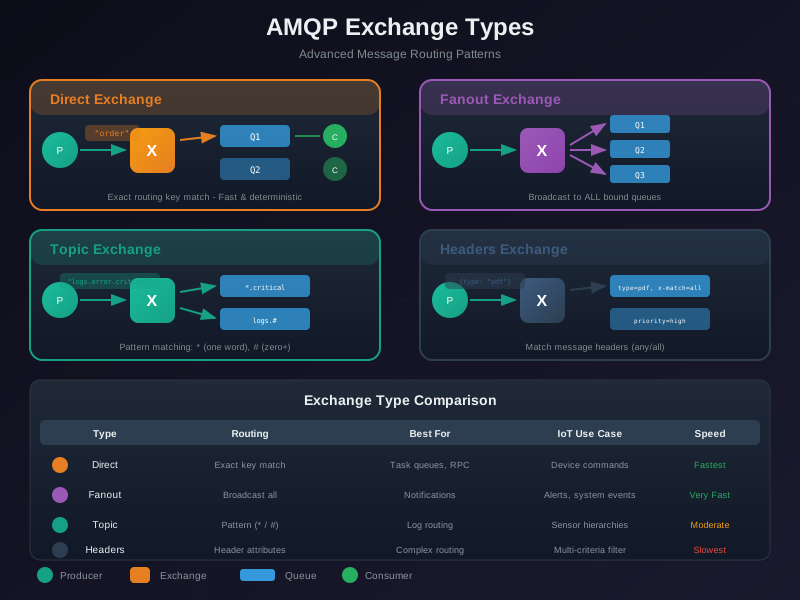
Read Figure 2.1 across direct exact keys, topic wildcards, fanout broadcast, and header attributes. For each column, identify what the broker compares and what produces a non-match. The comparison prepares the lifecycle discussion by showing how one accepted publish may become zero, one, or many queued copies.
This diagram compares AMQP exchange types: Direct (exact key match), Topic (pattern matching), and Fanout (broadcast to all bound queues).
2.10 Message Lifecycle Timeline
This section: Message Lifecycle Timeline — Inspect Figure 2.2 to identify where setup, routing, storage, processing, and cleanup hand responsibility to one another.
AMQP message lifecycle proceeds through four phases: connection setup (TCP open, channel open), message publishing (publish to exchange, evaluate bindings, route to queue, store), message consumption (consumer subscribes, receives delivery, sends acknowledgment, queue removes message), and cleanup (close channels).
Inspect Figure 2.2 to identify where setup, routing, storage, processing, and cleanup hand responsibility to one another.
Trace Figure 2.2 from TCP and channel setup through publish, exchange matching, queue storage, consumer delivery, and acknowledgment before following cleanup. Each transition leaves different evidence. The ordered view connects basic components to the reliability controls applied later at publish and consumption boundaries.
2.11 Reliability Guarantees
This section: Reliability Guarantees — Figure 2.3 shows which failures each delivery mode tolerates for an IoT message.
Figure 2.3 shows which failures each delivery mode tolerates for an IoT message.
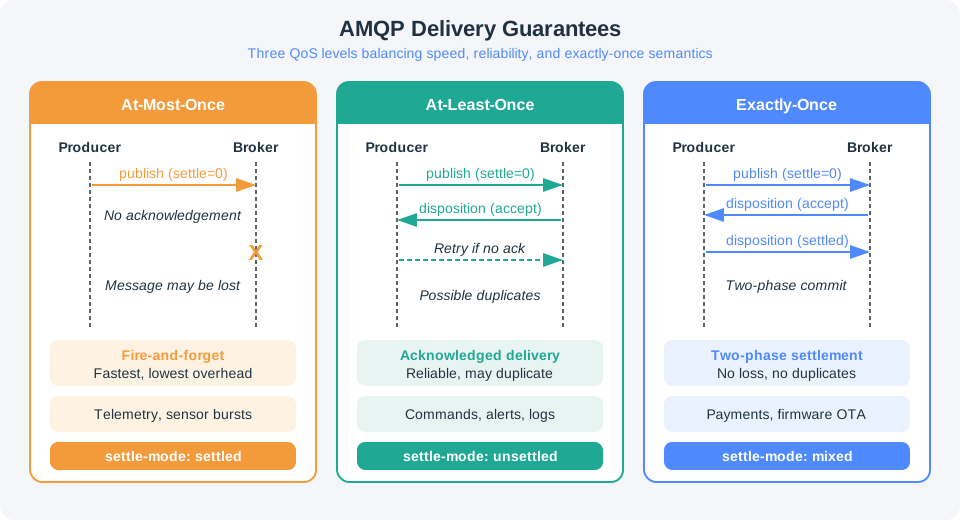
Read Figure 2.3 from the fast no-ack path to acknowledged retry and then coordinated or deduplicated processing. The diagram trades loss risk for duplicate risk and additional overhead. It connects protocol mechanics to the application decision: telemetry, commands, and financial effects do not justify the same guarantee.
2.12 The Three Delivery Promises
This section: The Three Delivery Promises
“I just sent a temperature alert, but how do I know the cloud actually got it?” Temperature Terry asked nervously.
the microcontroller held up three fingers. “There are three choices, Sammy! At-most-once is like tossing a paper airplane — fast but it might not arrive. At-least-once is like sending a letter with tracking — retries can make it arrive twice. And if repeating something would be bad, like paying twice, the receiver keeps a list of message numbers it has already handled and skips repeats.”
“I always want the strongest path then!” said the LED. “Choose from the consequence of loss,” cautioned the battery. “Each extra check costs energy. For my light readings every 5 minutes, occasional loss is acceptable. For Sammy’s fire alarm, ask for a receipt, try again if needed, and check that someone acted on the alert.”
“If a message can’t be delivered, the broker can park it in a dead letter queue, like the post office’s return-to-sender pile, so someone can look at it,” Max added.
2.13 AMQP vs MQTT Comparison
This section: AMQP vs MQTT Comparison — Simple rule: Use MQTT for simple IoT.
| Feature | MQTT | AMQP |
|---|---|---|
| Complexity | Simple (pub/sub only) | Rich (exchanges, routing) |
| Message routing | Topic-based only | Multiple patterns (direct, topic, fanout, headers) |
| Message size | Any size | Any size |
| Reliability | 3 QoS levels | Delivery guarantees + transactions |
| Best for | IoT sensors, mobile | Enterprise, complex routing |
Simple rule: Use MQTT for simple IoT. Use AMQP when you need smart message routing.
2.14 Tradeoff: MQTT Simple Topics vs AMQP Exchange Routing
This section: Tradeoff: MQTT Simple Topics vs AMQP Exchange Routing
Option A: Use MQTT with topic-based pub/sub - subscribers filter by topic patterns, broker handles matching
Option B: Use AMQP with exchange routing - messages route through exchanges using binding rules before reaching queues
Decision Factors:
First: Routing complexity
MQTT Topics: Simple (topic wildcards: +, #)
AMQP Exchanges: Rich (direct, topic, fanout, headers)
Next: Message filtering
MQTT Topics: Broker routes publishes to matching subscriptions AMQP Exchanges: Server-side (exchange evaluates bindings)
Then: Delivery guarantee
MQTT Topics: 3 QoS levels (0, 1, 2) AMQP Exchanges: At-most/at-least-once; transactions for publishes/ACKs, with application deduplication for exactly-once processing
After that: Message persistence
MQTT Topics: Optional (retained messages) AMQP Exchanges: Configurable per queue (durable/transient)
Also inspect: Dead letter handling
MQTT Topics: None (application must implement) AMQP Exchanges: Built-in (dead-letter exchanges)
Finally: Protocol overhead
MQTT Topics: 2-byte header minimum AMQP Exchanges: 8-byte frame header
Finally: Broker complexity
MQTT Topics: Simple (pub/sub matching) AMQP Exchanges: Complex (exchange to binding to queue chain)
Finally: Client library size
MQTT Topics: 10-50 kB AMQP Exchanges: 100-500 kB
Choose MQTT when:
Finally: Simple fan-out messaging (one topic to many subscribers)
Finally: Resource-constrained devices (<64KB RAM) that cannot afford AMQP client overhead
Finally: Mobile/cellular networks where connection overhead matters
Finally: Standard telemetry use cases (sensor to dashboard)
Finally: Example: 1000 temperature sensors publishing to sensors/+/temperature topic
Choose AMQP when:
Finally: Complex routing rules (route by message headers, priority, content-type)
Finally: Work queue distribution (competing consumers processing tasks)
Finally: Message transformation pipelines (exchange chains)
Finally: At-least-once delivery with application deduplication for critical work
Finally: Enterprise integration requiring dead-letter queues and message TTL
Finally: Example: Order processing where orders.us.priority-high routes to US fulfillment queue with priority handling
Real-world example: An e-commerce platform processing orders:
Finally: MQTT approach: Subscribe to orders/#, filter in application code - 10 ms latency, but all subscribers receive all orders (100K msg/sec to each)
Finally: AMQP approach: Topic exchange with bindings orders.us.* to US queue, orders.eu.* to EU queue - 5 ms routing, each queue gets only relevant orders (10K msg/sec each)
Finally: Result in this example: AMQP reduces per-subscriber message volume by 90% for the assumed geographically partitioned workload.
2.15 Interactive Calculator: AMQP Message Routing Efficiency
This section: Interactive Calculator: AMQP Message Routing Efficiency
This section:
 Checkpoint: AMQP vs MQTT Routing
You now know:
- MQTT gives simple topic-based pub/sub, while AMQP adds exchanges, bindings, queues, and server-side routing rules.
- The protocol choice is not only syntax: MQTT has smaller client libraries, while AMQP carries richer routing, delivery guarantees, and built-in dead-letter handling.
- AMQP helps when each subscriber should receive only relevant messages instead of filtering every broadcast locally.
This section: — With that tradeoff in place, the next question is how an AMQP exchange decides where each message goes.
With that tradeoff in place, the next question is how an AMQP exchange decides where each message goes.
2.16 The Four Exchange Types
This section: The Four Exchange Types
AMQP provides four exchange types, each with different routing strategies:
2.16.1 Direct Exchange
Direct exchange routing with exact match - publisher sends message with routing key error which matches exactly to Error Log Queue binding, while Info Log Queue receives no message.
Inspect Figure 2.4 to check an exact-match routing decision before comparing it with wildcard or broadcast behavior.
Trace Figure 2.4 from the error routing key into the direct exchange, compare it with both binding keys, and follow only the exact match to the error queue. The non-matching info queue is equally important: direct routing is predictable because unmatched bindings receive no copy.
Use case: One routing key to one queue (exact match required)
2.16.2 Topic Exchange
Topic exchange with wildcard pattern matching - message with routing key sensor.temp.line1 matches two patterns: sensor.temp.# routes to Temp Dashboard and sensor.# routes to Data Lake, but does not match Vibration Queue.
Inspect Figure 2.5 to evaluate wildcard matches one binding at a time rather than assuming a topic has a single destination.
Trace Figure 2.5 from sensor.temp.line1 to each pattern. It matches the temperature and data-lake bindings, producing two queue copies, but not the vibration binding. This independent evaluation is the basis for flexible fan-out and also the reason wildcard depth must be tested explicitly.
Wildcards: * = one word, # = zero or more words
2.16.3 Fanout Exchange
Fanout exchange broadcasting messages to all bound queues - routing key is ignored and every queue receives a copy of the message.
Inspect Figure 2.6 to see how one publish becomes independent copies without consulting a routing key.
Follow Figure 2.6 from the firmware-update producer through the fanout exchange to the gateway, audit, and cache queues. Each queue receives a copy and can retain or consume it independently. That independence is useful for announcements but multiplies storage and delivery work with every binding.
“Everyone gets a copy!” - Ignores routing key
2.16.4 Headers Exchange
Routes based on message headers (metadata) instead of routing key.
Read the table by comparing each message attribute with the queue binding that consumes it. Priority can select an alert path, format can select a parser, and region can select a processing boundary. Unlike direct or topic exchanges, this decision does not depend on the routing-key words.
| Header Attribute | Queue Binding |
|---|---|
priority: high | Alert Queue |
format: json | Parser Queue |
region: EU | EU Processing Queue |
This section:
Checkpoint: Exchange Types
You now know:
- Direct exchange is exact-match routing, fanout exchange broadcasts, topic exchange matches wildcard patterns, and headers exchange routes from message attributes.
- In topic routing,
*matches exactly one word and#matches zero or more words. - AMQP evaluates every matching binding independently, so one message can arrive in multiple queues.
2.17 Knowledge Check: Exchange Types
This section: Knowledge Check: Exchange Types
2.18 Interactive Calculator: Topic Exchange Pattern Matching
This section: Interactive Calculator: Topic Exchange Pattern Matching
2.19 Consumer Patterns
This section: Consumer Patterns
2.20 Tradeoff: Competing Consumers vs Fan-Out Distribution for AMQP Queues
This section: Tradeoff: Competing Consumers vs Fan-Out Distribution for AMQP Queues
Option A (Competing Consumers - Work queue pattern):
First: Queue binding: Multiple consumers subscribe to same queue
Next: Message delivery: Each message delivered to exactly one consumer (round-robin by default)
Then: Scaling: Add consumers to increase processing throughput (linear scaling)
After that: Prefetch impact: Low prefetch (1-10) ensures even distribution; high prefetch causes hoarding
Also inspect: Use cases: Task distribution (image processing, report generation), load balancing, parallel batch processing
Finally: Throughput: 10K-100K msg/sec with 10 consumers (each handles ~10K msg/sec)
Option B (Fan-Out Distribution - Pub/sub pattern):
Finally: Queue binding: Each consumer has dedicated queue bound to fanout exchange
Finally: Message delivery: Every consumer receives copy of every message (broadcast)
Finally: Scaling: Adding consumers doesn’t increase throughput (same work replicated N times)
Finally: Prefetch impact: Less critical since no competition for messages
Finally: Use cases: Event notification (all services need same event), cache invalidation, live dashboards
Finally: Throughput: Limited by slowest consumer (all must keep up or messages queue)
Decision Factors:
Finally: Choose Competing Consumers when: Processing is CPU-intensive and parallelizable, each message should be processed exactly once, want horizontal scaling by adding workers, work items are independent (no ordering dependency)
Finally: Choose Fan-Out when: Multiple systems need same data (analytics + storage + alerting), event-driven architecture with decoupled subscribers, real-time updates to multiple dashboards, audit/logging requires complete event history per consumer
Finally: Memory warning: Fan-out with N consumers creates N message copies; 100K msg/sec to 10 consumers = 1M messages in broker memory vs 100K for competing consumers
Example: IoT sensor readings
Finally: Competing consumers: 10 workers processing sensor data, each handling 10% of load
Finally: Fan-out: Same reading goes to dashboard, time-series DB, and anomaly detection service simultaneously
2.21 Continue to the Next Part
This section: Continue to the Next Part — Carry this evidence into AMQP Core: Consumers and Topology Contracts, which begins with Interactive Calculator: Competing Consumers vs Fan-Out Performance.
Carry this evidence into AMQP Core: Consumers and Topology Contracts, which begins with Interactive Calculator: Competing Consumers vs Fan-Out Performance.
Find help
3 reviewed answers.
Where should I start in a module?
Open the module page from the sidebar to see its chapters in order. Use the module map to return to a topic you need.
Modules and pathsReviewed
What can I try when a project does not work?
Check the symptom, then work through the diagnostic steps. Keep the error message and the smallest example that reproduces it.
When you are stuckReviewed
How do interactive examples work?
Use the interactive guide to check how examples and simulations work before changing your project.
Interactive examples guideReviewed