AMQP
More
Depth: Practitioner
Progress saves as you read. Mark sections complete as you go; your progress appears in the sidebar.
Start Here: Follow One Important Message
This section: Start Here: Follow One Important Message — Picture a factory alert that must reach the right team even when one worker is busy or offline.
Picture a factory alert that must reach the right team even when one worker is busy or offline. This guide helps you follow that alert from sender to route, waiting line, receiver, and proof.
AMQP means a set of rules for routed business messages. A protocol means the shared rules that systems follow. A broker means the service that sorts and routes messages. A payload means the useful data inside a message. Telemetry means readings sent from a device for remote use. MQTT means a lighter send-and-subscribe message system often used near devices.
Start with what must survive, who must receive it, and what receipt would prove success. This runway gives you the route; later chapters keep the full delivery and operations detail.
Follow one factory alert from sender to queue, team, and arrival receipt.
-

A factory sends an important alert.
-

The first worker is busy.
-

The alert waits and then reaches the right team.
-

A receipt shows that the message arrived.
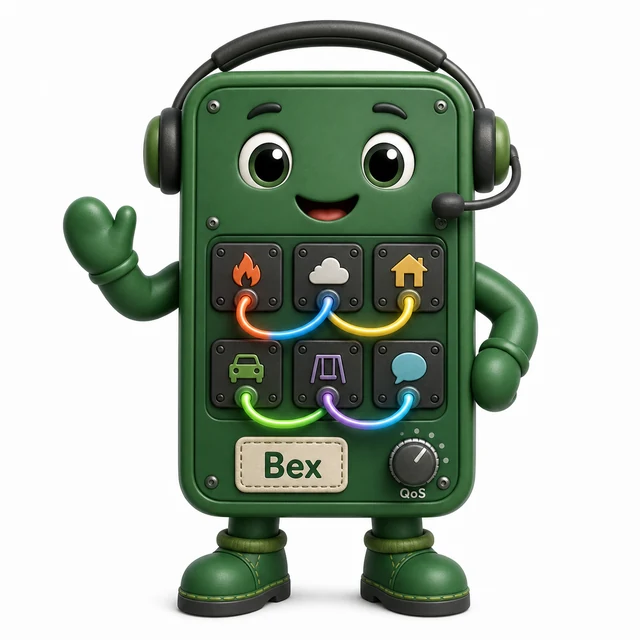
Your guide: Broker Bex
“A message with no subscriber is a tree falling in an empty forest — design the topic before the payload.”
AMQP is the application protocol many IoT backends use when messages need brokered routing, durable queues, acknowledgments, and stronger delivery controls than lightweight telemetry paths usually require. This module groups the AMQP chapters into a focused book so the protocol can be built, searched, and reviewed as its own route.
Use this book when you need to reason about AMQP as a system design choice for routed, reliable messaging. The chapters move from exchange and queue concepts through broker architecture, frames, delivery guarantees, reliability patterns, implementation pitfalls, production operations, and AMQP/MQTT tradeoffs.
Recommended Route
This section: Recommended Route
- Start with AMQP Core Concepts to understand exchanges, queues, bindings, routing keys, and exchange types.
- Use AMQP Core Architecture and AMQP Frames and Reliability before reasoning about producers, brokers, consumers, sessions, links, and protocol lifecycle.
- Read AMQP Message Delivery and AMQP Reliability Patterns before designing persistence, acknowledgments, publisher confirms, dead-letter queues, and flow control.
- Review AMQP Implementation Pitfalls to avoid durability gaps, auto-ack losses, topic wildcard mistakes, and unroutable messages.
- Move into AMQP Production Operations when deployment, monitoring, and operational evidence matter.
- Finish with AMQP and MQTT Tradeoffs to compare lightweight edge telemetry with broker routing, queuing, and backend integration.
Design Questions
This section: Design Questions
- Which messages need durable queues, acknowledgments, publisher confirms, or dead-letter handling?
- Which exchange types and routing keys make message flow explicit without overfitting the broker topology?
- Where should backpressure and consumer flow control be handled?
- Which delivery failures should be retried, dead-lettered, or surfaced to operators?
- What production evidence proves the broker, producers, consumers, and monitoring behave as expected?
Find help
3 reviewed answers.
Where should I start in a module?
Open the module page from the sidebar to see its chapters in order. Use the module map to return to a topic you need.
Modules and pathsReviewed
What can I try when a project does not work?
Check the symptom, then work through the diagnostic steps. Keep the error message and the smallest example that reproduces it.
When you are stuckReviewed
How do interactive examples work?
Use the interactive guide to check how examples and simulations work before changing your project.
Interactive examples guideReviewed