8 AMQP Frames: Storage and Throughput Calculations
More
Depth: Practitioner
Progress saves as you read. Mark sections complete as you go; your progress appears in the sidebar.
Trace One Message From Send to Useful Action
Picture a freezer sending an alarm to a duty team. Advanced Message Queuing Protocol, or AMQP, is a protocol: a shared set of rules for moving messages between software systems. A broker is the service that accepts and routes those messages. The payload is the useful content inside one message.
AMQP commonly uses Transmission Control Protocol, or TCP, for an ordered connection. Transport Layer Security means protection for that connection. It is often shortened to TLS. Those layers help, but they do not prove that the right queue kept the alarm or that a worker acted on it.
Write the sender, message identity, route, queue, time, expiry, reply rule, retry rule, final user, and owner. State what each frame or reply proves and what it cannot prove.
Test a broker restart, a broken connection, a full queue, a duplicate, an expired alarm, a wrong route, and a worker that fails after receiving the message. Check the stored record and final outcome, not only the send call.
Keep urgent freezer action at the site when messaging is late. This opening does not select every AMQP feature. Practitioner maps routes and reliability needs. Under the Hood examines frames, links, sessions, flow, storage, security, and settlement boundaries.
Use a short route check. Send one alarm, break the link, restart the broker, and repeat the alarm. Record the queue, reply, copy count, final user result, and owner. Run it again after a route or storage rule changes.
Start with the story: Every AMQP conversation is built from small, labelled frames. The useful habit is to read those frames like a delivery log: who opened the connection, which channel or link carried the message, and which reliability signal proved the next step happened.
8.1 Start With the Decision
This section: Start With the Decision — A fleet can fill a broker with gigabytes of stored messages each day.
A fleet can fill a broker with gigabytes of stored messages each day. Rate, size, and retention set the true storage cost.
8.2 Route Overview
This section: Route Overview — This is part 2 of 2.
This is part 2 of 2. Review AMQP Frames: Routing and Reliability for the preceding evidence.
8.3 Learning Objectives
This section: Learning Objectives
- Test putting numbers to it with a concrete scenario and pass criteria.
- Define amqp 1.0 credit and settlement contracts with explicit inputs, errors, and change rules.
8.4 Chapter Roadmap
This section: Chapter Roadmap
- Putting Numbers to It
- Quick Check: Why AMQP Won on Cost
- Visual Reference Gallery
- AMQP Architecture Diagrams
- Knowledge Check
- Quiz: Match Concepts to Definitions
- Label the Diagram
- Code Challenge
- Order the Steps
- Design Contract: AMQP 1.0 Credit and Settlement
- AMQP 1.0 Credit and Settlement Contracts
- Summary
- What’s Next
- Key Takeaway
We can calculate the exact daily storage requirements using message throughput:
For 90-day retention:
The disk I/O operations per second with batched fsync can be estimated from the write frequency. With fsync every 200 ms (5 batches/second) and 399 messages arriving per second:
This batching reduces disk writes from 399 IOPS to just 5 fsync operations per second, improving performance by a factor of approximately 80.
8.4.1 Interactive Calculator: AMQP Broker Storage Requirements
Estimate storage and I/O requirements for your AMQP deployment:
Try adjusting the parameters to see how message rate, size, and retention period affect storage requirements. Notice how batched fsync dramatically reduces disk I/O operations.
8.4.2 Broker Configuration
| Parameter | Value | Why |
|---|---|---|
vm_memory_high_watermark | 0.6 (of 16 GB) | Leave headroom for Erlang VM |
disk_free_limit | 5 GB | Prevent disk-full crashes |
channel_max | 128 | One channel per truck + consumers |
heartbeat | 30 sec | Detect dead cellular connections |
consumer_timeout | 60000 ms | Allow for mobile network delays |
queue_type | quorum | Replicated for archive durability |
Hardware for the illustrative fleet: three broker nodes with 16 GB RAM, 1 TB NVMe SSD and four CPU cores each for a three-replica quorum; recalculate infrastructure cost separately.
8.4.3 Delivery Guarantee Decision
| Queue | Type | Persistence | Rationale |
|---|---|---|---|
| GPS dispatch | Classic | Transient | Dashboard only needs latest position; lost messages acceptable |
| Compliance archive | Quorum | Persistent | Regulatory requirement: zero data loss, survives broker restart |
| Temperature alerts | Classic | Persistent | Cold chain violations must not be lost |
| Engine analytics | Classic | Transient | Analytics tolerates gaps; batch processing fills missing data |
8.4.4 Cost Comparison: AMQP vs MQTT
Illustrative comparison: this 2,500-truck model compares AMQP with MQTT as an alternative:
| Factor | AMQP (RabbitMQ) | MQTT (HiveMQ) |
|---|---|---|
| Multi-consumer routing | Native (topic exchange, bindings) | Requires shared subscriptions + bridge |
| Delivery guarantees per queue | Configurable (transient vs persistent) | Global QoS only |
| Message replay | With stream plugin | External storage needed |
| Broker clustering | Built-in quorum queues | Enterprise license required |
| Cellular overhead | Higher (AMQP frames ~20 bytes) | Lower (MQTT fixed header 2 bytes) |
| Illustrative monthly cellular data cost | $0.42/truck (59.9 KB/sec assumed fleet baseline) | $0.3892/truck (assuming the 11 B/message increment is priced proportionally) |
| Broker license | Free (open source) | $24,000/year (enterprise cluster) |
| Annual total cost | $12,600 (cellular only) | $35,676 (assumed cellular + license) |
Illustrative decision: AMQP offers native routing flexibility. At 399 messages/s fleet-wide, 11 extra bytes/message add about 4.55 MB per truck per 30-day month; price that increment using an explicit carrier tariff. Assuming proportional pricing, the increment is about $0.0308/truck/month, and the assumed $24,000/year MQTT broker licence keeps the modeled MQTT total higher.
8.4.5 Illustrative validation targets
| Metric | Target | Measurement to collect |
|---|---|---|
| Message delivery rate | > 99.9% target | To be measured |
| End-to-end latency (P99) | < 5 sec | To be measured |
| Archive completeness | 100% target | To be measured during broker failover |
| Broker uptime | 99.95% target | To be measured across planned failovers |
| Cold chain alerts delivered | 100% target | To be measured with persistent messages and confirms |
8.5 Visual Reference Gallery
This section: Visual Reference Gallery
These visual references provide alternative perspectives on AMQP architecture and frame concepts.
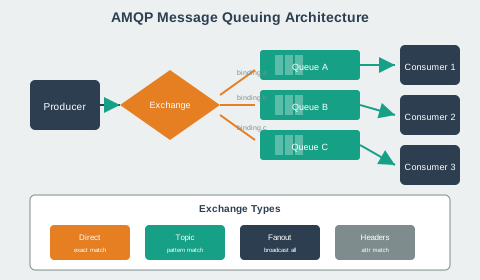
Inspect Figure 8.1 to locate the distinct promises in the publish path before treating AMQP reliability as one end-to-end guarantee.
Read Figure 8.1 from the producer into the exchange, then follow each binding to its queue and consumer. Broker acceptance, routing, and consumer completion occur at different boundaries, so each needs its own evidence. That separation prepares the queue-focused view next.
Now inspect Figure 8.2 to see why a queue is more than a line drawn between a producer and a consumer.
In Figure 8.2, follow a message from the producer into the exchange, where bindings decide which queue buffers receive a copy. Pause at the queue: this is where producer timing separates from consumer timing, so work can wait while a consumer is down. Configurable persistence decides whether that stored work survives a broker restart; it does not make processing successful. Continue to delivery only when a consumer is ready. If the message cannot be processed, the dead-letter exchange provides a separate route for inspection. The path distinguishes routing, waiting, durability, and failure handling instead of treating the broker as one undivided guarantee.
8.6 Knowledge Check
This section: Knowledge Check — Test your understanding of AMQP features and frame types.
Test your understanding of AMQP features and frame types.
8.7 Design Contract: AMQP 1.0 Credit and Settlement
This section: Design Contract: AMQP 1.0 Credit and Settlement — AMQP 0-9-1 frame vocabulary and AMQP 1.0 transfer semantics look similar only from a distance.
AMQP 0-9-1 frame vocabulary and AMQP 1.0 transfer semantics look similar only from a distance. The deeper treatment now lives in AMQP 1.0 Credit and Settlement Contracts, covering the protocol-model split, connection/session/link scopes, receiver-granted link credit, flow frames, dispositions, settlement modes, and how those choices map back to 0-9-1 prefetch and acknowledgments.
8.8 AMQP 1.0 Credit and Settlement Contracts
This section: AMQP 1.0 Credit and Settlement Contracts — Start with the story: AMQP 1.0 is what happens when the broker conversation becomes a negotiated handoff instead of a fixed RabbitMQ-style exchange-and-queue script.
Start with the story: AMQP 1.0 is what happens when the broker conversation becomes a negotiated handoff instead of a fixed RabbitMQ-style exchange-and-queue script. Before reading packet captures, picture each receiver handing out “permission slips” for how many deliveries it is ready to accept, then settling each delivery with a clear receipt.
8.8.1 Learning Objectives
Follow One Delivery Until Both Sides Agree
Picture a pump station sending a pressure record while a control service sends a valve command back. A connection can stay open even when one direction has no room to move. The useful question is which delivery stopped, why it stopped, and what state each side recorded.
AMQP means Advanced Message Queuing Protocol. A protocol is a shared set of message and state rules. A broker is a service that accepts and routes messages. A gateway is the device or service that joins two system paths. Telemetry means measurements and status sent from a remote device for review.
Send one numbered record, remove receiver credit, restore it, repeat the delivery, and restart one peer before settlement. Keep the delivery identity, direction, credit, outcome, and final application state together. Reachability alone does not prove that a valve acted once.
This runway does not choose a settlement mode for every workload. The deeper sections compare the two AMQP families, link credit, session windows, delivery outcomes, and the boundary between a settled message and an external side effect.
After this page, you should be able to:
- Explain why AMQP 1.0 is not a newer wire-compatible version of AMQP 0-9-1.
- Map AMQP 0-9-1 channels, publishing, prefetch, and acknowledgments to AMQP 1.0 sessions, links, credit, transfers, and dispositions.
- Trace how receiver-granted link credit constrains AMQP 1.0 message flow.
- Choose settlement behavior for at-most-once, at-least-once, and exactly-once link guarantees.
- Debug an AMQP 1.0 stalled transfer by checking both link credit and the session window.
8.8.2 Why This Follows AMQP Features and Frames
AMQP Features and Frames introduces frame roles, routing patterns, reliability features, AMQP 1.0 frame types, and the frame sequence workbench. This page narrows in on the design contract that matters during migrations and packet captures: AMQP 0-9-1 exposes exchanges, queues, bindings, and broker methods on the wire, while AMQP 1.0 exposes connections, sessions, links, credit, transfers, dispositions, and settlement.
Use it when a RabbitMQ team is moving to an AMQP 1.0 broker, when a gateway uses both telemetry and command streams on one connection, or when a packet trace shows flow credit and unsettled deliveries instead of basic.qos and basic.ack.
8.8.3 Overview: AMQP 1.0 Is a Different Protocol from AMQP 0-9-1
It is easy to assume AMQP 1.0 is just a newer AMQP 0-9-1, but they are genuinely different wire protocols that happen to share a name. AMQP 0-9-1 (what RabbitMQ speaks by default) bakes the broker model — exchanges, queues, bindings — into the protocol. AMQP 1.0 (the OASIS/ISO standard) deliberately does not: it standardises only the symmetric, peer-to-peer transfer of messages between two nodes and leaves routing to whatever broker or peer sits behind an address. That is why Azure Service Bus, ActiveMQ, and Qpid can all interoperate over AMQP 1.0 while implementing very different internals.
The difference shows up most clearly when you read the frames. In 0-9-1, the broker vocabulary is visible on the wire: clients issue methods such as exchange.declare, queue.bind, basic.publish, and basic.consume. A published message is then split into a method frame, a content header frame with properties and body size, and one or more body frames. In 1.0, the wire vocabulary is more abstract: peers open a connection, begin a session, attach sender or receiver links, exchange flow credit, transfer message sections, and settle deliveries with dispositions.
The 1.0 model nests three scopes: a connection carries one or more sessions, and each session carries one or more links. A link is unidirectional and has a role — a sender link or a receiver link — attached between a source and a target terminus. Messages travel as transfer frames along a link; the frames the chapter listed above (open, begin, attach, flow, transfer, disposition) are just the lifecycle of setting up and using those scopes.
That means migration is not a search-and-replace exercise. A RabbitMQ 0-9-1 producer might publish telemetry to a topic exchange with a routing key, where bindings choose the queue. An AMQP 1.0 producer instead attaches a sender link to an address; the broker decides what that address means. A packet capture therefore answers different questions. In 0-9-1 you ask, “Which exchange, queue, and method is this?” In 1.0 you ask, “Which connection/session/link is this transfer on, how much credit was available, and what delivery state settled it?”
8.8.4 Practitioner: Credit-Based Flow, and How the Two Versions Map
AMQP 1.0 flow control is credit-based and receiver-driven. A sender may not push at will: the receiver issues link credit in a flow frame, and the sender can emit only that many transfer frames before it must wait for more. This makes back-pressure explicit — a slow consumer simply stops granting credit. AMQP 0-9-1 achieves a similar effect differently, with basic.qos prefetch: the broker pushes up to a fixed number of unacknowledged messages and then pauses. Same goal, opposite direction: 1.0 receivers pull credit; 0-9-1 brokers push up to a cap.
Worked example: suppose a receiver link grants 25 credits. The sender can place 25 deliveries on that link and then must stop until another flow frame grants more credit. If the receiver processes 10 messages and grants 10 more credits, the sender gets room for 10 additional transfers without changing the TCP connection or creating a new link. The comparable 0-9-1 setting is basic.qos(prefetch_count=25), but the broker enforces that cap by withholding more pushed deliveries once 25 are outstanding.
| Concept | AMQP 0-9-1 (RabbitMQ) | AMQP 1.0 (OASIS/ISO) |
|---|---|---|
| Multiplexing unit | Channel | Session |
| Producer/consumer endpoint | Implicit in basic.publish / basic.consume | Explicit sender/receiver link (attach) |
| Send a message | basic.publish (method+header+body frames) | transfer frame |
| Flow control | Broker push, capped by prefetch | Receiver-granted link credit |
| Acknowledge | basic.ack / basic.nack | disposition with a delivery state |
| Routing model | In the protocol (exchanges/queues/bindings) | Not in the protocol; broker-defined addresses |
For IoT gateways, this affects failure isolation. Put a high-rate telemetry stream and a low-rate command stream on separate links, and each link can have its own credit policy. Telemetry might keep 200 messages in flight because each sample is small and replaceable; commands might grant only one or two credits so the device handles each command deliberately. The session window still caps total in-flight transfers across links, so a gateway that multiplexes many devices should size link credit and session windows together rather than treating them as independent knobs.
8.8.5 Under the Hood: Settlement Is How 1.0 Chooses a Guarantee
In AMQP 1.0 each delivery is settled or unsettled, and a receiver reports an outcome in a disposition: terminal delivery states are accepted, rejected, released (send it to someone else), or modified (return it with annotations, e.g. increment a failure count). The two settlement-mode knobs on the link decide the guarantee:
Before choosing a delivery label, inspect Figure 8.3 to identify exactly when sender and receiver consider a transfer finished.
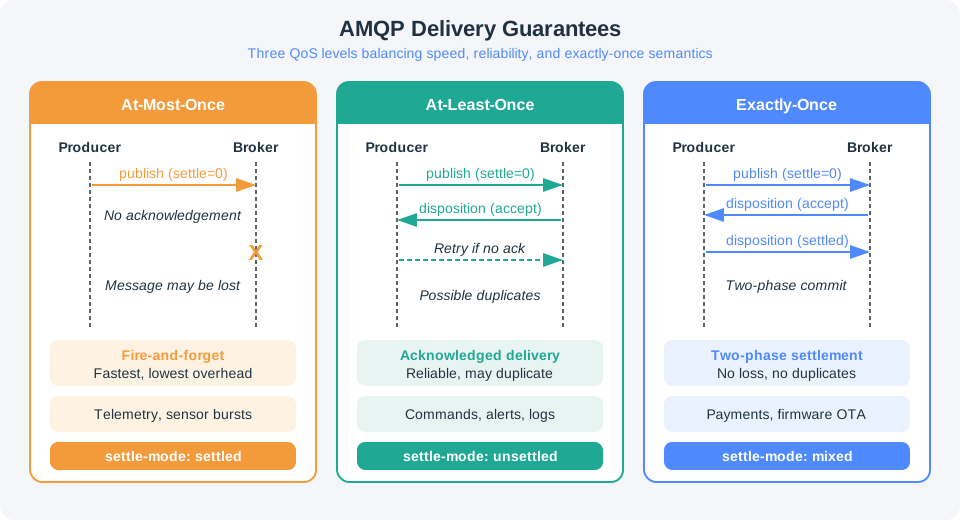
Read Figure 8.3 from at-most-once through at-least-once to coordinated settlement. The growing handshake reduces ambiguity on the link but adds state and latency. The final branch still cannot prove an external side effect occurred once, which is why the chapter returns to idempotency and transaction boundaries.
- At-most-once: the sender pre-settles — fires the transfer and forgets it. Fast, may lose.
- At-least-once: the sender leaves the delivery unsettled until the receiver’s disposition confirms
accepted; a lost confirm means resend, so duplicates are possible. - Exactly-once: a two-phase settlement (
rcv-settle-mode = second) where the receiver settles only after the sender acknowledges the receiver’s outcome, so neither loss nor duplication occurs on that link.
Use those modes as engineering choices, not labels on a marketing slide. A temperature sample sent every few seconds may be acceptable as at-most-once because a later sample replaces it. A valve command should usually be unsettled until accepted, and the application should include a command id so a retry does not execute the same command twice. Two-phase settlement can remove ambiguity on the AMQP link, but side effects outside that link still need idempotency or transaction boundaries. For example, if a consumer accepts a delivery and then writes to a database, the database write and AMQP settlement are separate unless the system explicitly coordinates them.
This is a real difference from AMQP 0-9-1, which offers no native exactly-once settlement mode and pushes most systems toward at-least-once plus idempotent consumers. Sessions also carry their own flow window (incoming-window and outgoing-window) on top of per-link credit, so 1.0 does back-pressure at two levels: the session bounds total in-flight transfers, and each link bounds its own. When debugging a stalled link, inspect both numbers; a link can have credit and still be blocked if the session window is exhausted.
8.9 Summary
This section: Summary
This chapter covered advanced AMQP features and protocol frames:
First: Routing Patterns: Applied direct, publish-subscribe, topic-based, and request-reply patterns for different messaging scenarios
Next: Reliability Features: Configured persistent messages, durable queues, and dead letter handling for enterprise-grade reliability
Then: Security Mechanisms: Implemented SASL authentication, TLS encryption, and access control lists
After that: Interoperability: Leveraged AMQP’s open standard benefits with multi-vendor broker support and language bindings
Also inspect: Frame Types: Analyzed AMQP 1.0’s nine frame types (OPEN, BEGIN, ATTACH, FLOW, TRANSFER, DISPOSITION, DETACH, END, CLOSE) for protocol-level understanding
Finally: Flow Control: Applied credit-based flow control to prevent consumer overload
8.10 What’s Next
This section: What’s Next
| Chapter | Focus | Why Read It |
|---|---|---|
| AMQP and MQTT Tradeoffs | Protocol comparison and selection criteria | Apply the security and frame knowledge from this chapter to evaluate when AMQP outperforms MQTT and when a hybrid architecture is warranted |
| AMQP Implementations and Labs | Hands-on RabbitMQ broker setup and client code | Implement the SASL authentication and TLS configuration patterns introduced here in a working environment |
| AMQP Core Architecture | Exchanges, queues, and bindings | Review the routing layer that the frame types in this chapter operate on top of |
| AMQP Messages and Delivery | Message structure, delivery guarantees, and acknowledgment | Deepen understanding of what TRANSFER and DISPOSITION frames actually carry and settle |
| Transport Layer Security | TLS/DTLS internals and certificate management | Extend the TLS configuration covered here with a full treatment of cipher suites, certificate rotation, and mutual TLS |
| IoT Security Fundamentals | Threat modeling and access control for IoT systems | Place the AMQP ACL and SASL mechanisms in this chapter within the broader IoT security landscape |
8.11 Key Takeaway
This section: Key Takeaway — AMQP frames, channels, confirms, and heartbeats are not incidental protocol details; they are the mechanisms that make brokered messaging observable and recoverable.
AMQP frames, channels, confirms, and heartbeats are not incidental protocol details; they are the mechanisms that make brokered messaging observable and recoverable. Production designs should size channels and confirmation behavior around throughput, latency, and failure handling.
8.12 Continue Your Route
This section: Continue Your Route — This is the last part of this chapter.
This is the last part of this chapter. Return to AMQP Frames: Routing and Reliability or continue from the AMQP Module Guide.
Find help
3 reviewed answers.
Where should I start in a module?
Open the module page from the sidebar to see its chapters in order. Use the module map to return to a topic you need.
Modules and pathsReviewed
What can I try when a project does not work?
Check the symptom, then work through the diagnostic steps. Keep the error message and the smallest example that reproduces it.
When you are stuckReviewed
How do interactive examples work?
Use the interactive guide to check how examples and simulations work before changing your project.
Interactive examples guideReviewed