2 Application Protocol Roles
More
Depth: Practitioner
Progress saves as you read. Mark sections complete as you go; your progress appears in the sidebar.
A soil sensor can have a working radio route and still lack a usable conversation with an irrigation service. The application protocol names requests, resources, topics, responses, errors, and representation meaning above network delivery. Choosing it means matching interaction shape to device and service constraints.
A protocol is a message rule, and a payload is its application data. A broker is a service that routes published messages. Constrained Application Protocol (CoAP) serves limited devices, while Routing Protocol for Low-Power and Lossy Networks (RPL) builds their paths.
2.1 Follow Meaning Above the Network Route
This section: Follow Meaning Above the Network Route — Read Figure 2.2 from physical or link transport upward through IP and routing to the application protocol and domain payload.
Read Figure 2.2 from physical or link transport upward through IP and routing to the application protocol and domain payload. Each lower layer can deliver bytes without defining whether they are a temperature observation, a valve command, or an error. The application layer supplies that conversation contract.
Figure 2.3 starts with interaction facts. Follow request/response, publish/subscribe, observation, streaming, device limits, intermediaries, security, and failure behavior toward a candidate. Do not choose from protocol popularity before deciding whether the application needs a reply, fan-out, cached state, or a long-lived update.
Figure 2.1 shows why the lower route still matters. Follow a packet through the RPL path and any source-routing information in non-storing mode. The application may send one CoAP request, but constrained hops, header overhead, loss, and downward routing determine whether that exchange completes.
Consider a moisture probe producing a 90-byte reading every five minutes. Direct request/response lets a service ask for current state, while pub/sub lets the probe publish once and a broker fan it out to archive and alarm consumers. Observation can maintain updates for an interested client. The correct role depends on reachability and freshness, not the 90-byte payload alone.
Write the message contract. Include resource or topic name, media type, schema version, unit, observation time, quality, identifier, allowed operations, response or acknowledgement, timeout, retry, duplicate handling, and authorization. A 2.xx protocol success or broker acknowledgement can confirm an exchange without proving the irrigation valve reached its physical target.
Predict protocol trials. Send the 90-byte fixture and expect the same decoded moisture, unit, and time at the consumer. Repeat its identifier and expect duplicate-safe handling. Remove the route and expect a visible timeout or queued state rather than false success. Send an unauthorized valve operation and expect denial at the application boundary even if the network path is open. Restore connectivity and check whether old observations remain marked with their original times.
Version error meanings as carefully as success data. A client should distinguish not found, unauthorized, busy, stale, malformed, and server failure because each leads to a different safe retry or operator action.
2.2 Overview: The Protocol That Names the Conversation
This section: Overview: The Protocol That Names the Conversation — A protocol is a set of rules that gives a message shared meaning.
A protocol is a set of rules that gives a message shared meaning.
Picture a sensor sending a reading and a worker sending a command back. Both sides need the same meaning for the names, replies, errors, and next step.
First, name the kind of talk: an event, a request, a live stream, or a queued job. Then state what proof will show that the exchange worked.
A rich message can be clear, but it may cost more power and data. A small message is cheap, but it can hide meaning or make faults hard to trace.
Protocol choice needs the required message flow and its bandwidth, timing, and device budget, not a single feature name.
Use the Practitioner section to build the choice record. Use Under the Hood to inspect meaning, delivery, gateways, and failure cases in more depth.
Plain check
- Name the sender. Name the receiver. Name the user goal. Name the reply need.
- Pick the talk shape. Mark each message name. Mark each error. Mark the end state.
- Test a lost message. Test a late reply. Test a repeated event. Keep the result clear.
- Check the device cost. Check the link cost. Check the service cost. Keep the trade clear.
- Use Practitioner to choose. Use deeper meaning checks. Test one gateway. Record each bound.
Start with a single IoT message: a temperature reading, a command to open a valve, a dashboard refresh, or a work item handed to maintenance. The application protocol is the agreement that tells every receiver what that message means, what should happen next, and what evidence will prove the exchange worked.
That is why this chapter reads like a route map rather than a catalogue. Each protocol name becomes useful only after the learner can name the conversation, the boundary it crosses, the delivery behavior it needs, and the review record it leaves behind.
An application protocol is the rule set that gives network messages their meaning. Lower layers move bytes; the application protocol says whether those bytes are a sensor event, command, configuration change, resource query, dashboard update, work item, or media session.
The first design mistake is choosing by popularity. MQTT, CoAP, HTTP APIs, WebSocket, AMQP, and realtime media protocols each fit different conversations. A good IoT design names the conversation first, then chooses the protocol family that can carry it with the right security, reliability, observability, and failure behavior.
Classic Internet services are useful landmarks for that role separation. Email is not one behavior: SMTP transfers a message between mail systems, IMAP lets a client access a mailbox, and MIME names message parts such as text, images, or attachments. The source's protocol-reference list anchors those roles to SMTP in RFC 5321 and IMAP version 4rev1 in RFC 3501; its MIME entry points to the multipart extension family rather than treating MIME as another transport. These references are lookup boundaries, not proof that a particular mail integration is interoperable or secure. Web browsing has the same lesson: HTML describes the page resource, while HTTP, browser state, and security controls decide how that resource is requested, rendered, and trusted.
Where This Chapter Sits in the Full Protocol Stack
MQTT, CoAP, HTTP APIs, WebSocket, and AMQP are one slice of a larger, functionality-based way to organize IoT protocols. Reading the full taxonomy is a useful check against "just use MQTT" thinking, because connectivity, identification, discovery, device management, and semantic description are separate jobs that a data protocol does not do by itself.
- Connectivity: mesh and routing protocols such as 6LoWPAN and RPL move packets across constrained links, below anything this chapter compares.
- Identification: EPC, uCode, IPv6 addresses, and URIs name the thing being talked about, separately from how its messages travel.
- Discovery: mDNS, DNS-SD, and similar protocols let a client find a service before any data protocol can be used against it.
- Data protocols: MQTT, CoAP, AMQP, and WebSocket -- the roles this chapter compares -- carry the actual application messages once the above are settled.
- Device management: protocols such as TR-069 and OMA-DM configure and monitor the fleet, a job that runs independently of any single message exchange.
- Semantic layer: JSON-LD and similar description formats give a receiver machine-readable meaning beyond the raw payload bytes.
A data protocol choice does not replace the work the other categories do. A device can speak flawless MQTT and still be undiscoverable, unidentifiable, or unmanageable if those neighboring roles were never planned.
If you only need the intuition, this layer is enough: choose an application protocol by role. Ask who talks to whom, whether the flow is event, request, command, stream, or durable work, and what evidence proves the receiver understood it.
Think of transport as a road and the application protocol as the delivery paperwork. The road can move a truck, but the paperwork says whether the truck carries groceries, medicine, returned equipment, or urgent parts. Without that top-level contract, the receiver may get bytes but not the right meaning.
The One-Minute View
Event Fan-Out
Brokered publish/subscribe protocols such as MQTT often fit telemetry events, alerts, and many-consumer distribution.
Resource Interaction
HTTP APIs and CoAP fit request/response interactions where the system reads, changes, or observes named resources.
Operational Evidence
The protocol choice must define identity, authorization, acknowledgement, retry, duplicate handling, logging, and failure review.
Beginner Examples
Start with a temperature sensor publishing room readings every minute: that is an event flow, so topic naming and subscriber behaviour shape the contract. A configuration screen instead reads and updates a named resource, bringing methods, status codes, validation, and stale-data handling into view. A live browser dashboard can combine both patterns by keeping a persistent state channel while using HTTP APIs for setup and history. Even an email notification needs the same precision: record which system sends through SMTP, which mailbox or service is read through IMAP or an API, and which MIME types the receiver accepts. These examples show why the conversation role must be named before the protocol.
Overview Knowledge Check
If this gives you the protocol-selection intuition, you can stop here. Continue to Practitioner when you need to build a reviewable protocol decision.
Before selecting an application protocol, Figure 2.1 gives a concrete reminder that a correct request can still inherit a root-centric network path.

Read Figure 2.1 at E, B, and A writes source route [B,F]. The route E → B → A → B → F does not decide whether the payload should use CoAP, MQTT, or another application contract, but it does change latency, packet space, and failure evidence that the protocol record must budget.
The selection funnel in Figure 2.2 then puts the application decision in its proper order.
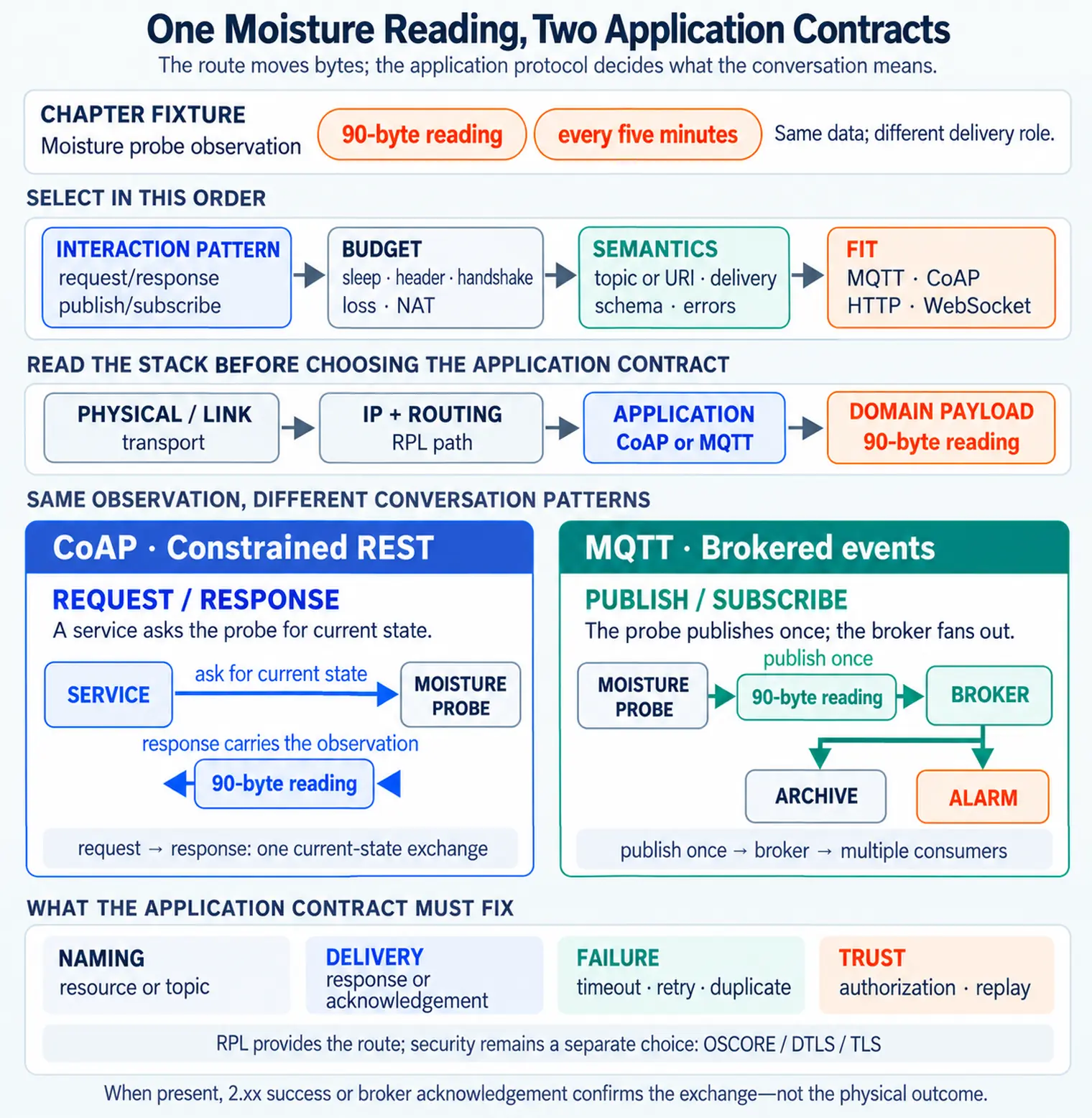
Start Figure 2.2 with Interaction pattern rather than a favourite protocol name. Budget records sleep, header, handshake, loss, and NAT pressure; Semantics fixes topic or URI, delivery, schema, and errors; then Brokered events and Constrained REST become evidence-backed candidates instead of interchangeable labels.
2.3 Practitioner: Build the Application Protocol Selection Record
This section: Practitioner: Build the Application Protocol Selection Record
The practical workflow starts with a flow, not a protocol name. A single product may use several application protocols: MQTT for telemetry, HTTP for administration, WebSocket for a live dashboard, and AMQP for enterprise work transfer. The selection record prevents those roles from being blended into one vague integration claim.
Inspect Figure 2.3 to see how one system can assign different protocol roles while requiring every choice to pass the same evidence gate.

Start with the interaction. Then compare only relevant protocols. The upper half of Figure 2.3 contrasts four evidence-backed roles: HTTP links an operator dashboard to a cloud resource API, CoAP links a constrained device to an edge gateway, MQTT fans fleet telemetry through a broker, and AMQP carries service work through a durable queue. The record below then moves from Flow and Participants through Delivery, Payload, and Trust to Evidence. That last box—trace, failure test, security profile, owner, and review date—is what converts protocol fit from a preference into a decision that can be reopened when the flow changes.
2.3.1 Walkthrough: From Flow to Protocol Fit
Begin by naming one flow—telemetry, command, configuration, query, alert, dashboard state, durable work, media, or audit—and its participants, including any device, gateway, broker, API service, browser, enterprise system, or operator boundary. Next state the delivery behaviour: fan-out, request/response, ordering, durable queueing, streaming, or a low-latency state update. Define the payload contract through schema, units, naming, versioning, validation, and stale-data handling, then mark the trust boundary and any identity change at a gateway. Finish with the evidence that will prove the contract: logs, traces, acknowledgements, retry counters, dead-letter records, failure tests, and the trigger for reopening the choice. This order keeps the protocol family subordinate to the communication need it must satisfy.
Worked Example: Building Monitor With Three Conversations
A building monitor may not have one application protocol. It can have one event path, one configuration path, and one operator path. Keeping those roles separate makes the decision reviewable.
Incremental Practice
Beginner
Pick one IoT message and label it as event, command, query, dashboard update, durable work, or media.
Intermediate
For that same message, write the topic, resource, queue, or channel name and the acknowledgement evidence you expect.
Advanced
Add the gateway boundary: which identity, payload, delivery guarantee, or log changes as the message crosses it?
Practitioner Knowledge Check
If your job is to defend a protocol selection, you can stop here. Continue to Under the Hood for the mechanics behind gateway and delivery contracts.
2.4 Under the Hood: Semantics, Gateways, and Delivery Contracts
This section: Under the Hood: Semantics, Gateways, and Delivery Contracts
The deeper layer explains why application protocol selection is not a checklist of names. Every protocol family brings a semantic contract: how endpoints are named, how messages are acknowledged, how failures are represented, and how operations teams prove the system is still behaving.
Protocol Contract Ledger
Gateway Translation Mechanics
A gateway boundary is not just a network hop. It may translate a constrained local protocol into MQTT topics, convert device fields into an HTTP resource model, write work into a queue, or push live updates to a browser channel. Each translation can change four things:
Trace identity first: the cloud may see the gateway, the device, or both, and authorization must match that choice. Then trace payload meaning because fields can be renamed, scaled, filtered, batched, or enriched. Follow the delivery contract next: a local retry may become broker delivery, durable queueing, or best-effort dashboard state. Finally, verify that logs, counters, and correlation identifiers survive the translation. Preserving that evidence is what lets an operator connect a cloud symptom to the original device exchange.
Common Pitfalls
Review acknowledgement before assuming that transport reliability proves success: a packet may arrive while the service rejects, ignores, or misinterprets its command. Treat topic and resource names as owned APIs with versioning, authorization, and change control. Keep recoverable work out of a best-effort realtime channel, because a dashboard update is not a durable job. Finally, make freshness visible; an old value that still looks current to a user is an application-protocol failure even when no packet is missing.
Under-the-Hood Knowledge Check
At this depth, application protocol design is a contract review: name the conversation, define delivery and trust behavior, preserve evidence across gateways, and reopen the choice when the flow or operating risk changes.
2.5 Summary
This section: Summary — Start with what the message means.
Start with what the message means. Compare each role and gateway change. Then record what could change the choice.
- Application protocols define the meaning of IoT messages above transport behavior.
- MQTT, CoAP, HTTP APIs, WebSocket, AMQP, and realtime protocols fit different conversation roles.
- Gateway translation can change identity, payload meaning, delivery behavior, and observability.
- Protocol selection should record naming, delivery, trust, operations evidence, and reopen triggers.
- A product may need several application protocols when its telemetry, configuration, dashboard, and enterprise-work flows have different contracts.
Choose an application protocol from the message role outward: identify the conversation, define the delivery and trust contract, and keep enough evidence to prove the receiver understood the right meaning.
2.6 See Also
This section: See Also
CoAP vs MQTT Comparison
Compare event and resource-oriented patterns in common IoT protocol choices.
MQTT Publish/Subscribe Fundamentals
Study brokered event distribution, topic naming, and subscriber behavior.
CoAP Fundamentals
Review constrained request/response and resource-oriented device interaction.
REST API Design Patterns
Connect device and service resources to HTTP API design evidence.
Find help
3 reviewed answers.
Where should I start in a module?
Open the module page from the sidebar to see its chapters in order. Use the module map to return to a topic you need.
Modules and pathsReviewed
What can I try when a project does not work?
Check the symptom, then work through the diagnostic steps. Keep the error message and the smallest example that reproduces it.
When you are stuckReviewed
How do interactive examples work?
Use the interactive guide to check how examples and simulations work before changing your project.
Interactive examples guideReviewed