17 XMPP: Protocol Fit and Operations
More
Depth: Practitioner
Progress saves as you read. Mark sections complete as you go; your progress appears in the sidebar.
Start with the story: XMPP is useful when an IoT system needs addressed conversations, presence, discovery, or federation rather than just another telemetry pipe. Start by asking who needs to know that a device is present, what stanza carries the fact, and whether the extra semantics are worth operating.
17.1 Start With the Decision
This section: Start With the Decision — XMPP fits some managed message flows but can burden small devices.
XMPP fits some managed message flows but can burden small devices. The choice must follow traffic, safety, and field needs.
17.2 Route Overview
This section: Route Overview — This is part 2 of 2.
This is part 2 of 2. Review XMPP: Messaging Foundations for the preceding evidence.
17.3 Learning Objectives
This section: Learning Objectives
- Compare XMPP fit with constrained IoT protocol needs.
- Design a secure facility-operations XMPP message flow.
17.4 Chapter Roadmap
This section: Chapter Roadmap
- Protocol Fit
- Core Technologies, Limits, and Uses
- Worked Example: Facility Operations Presence
- Scenario
- Common Pitfalls
- Avoid These XMPP Review Mistakes
- Knowledge Check
- Check: Stanza Choice
- Check: Match the Role
- Check: Order the Review
- Concept Relationships
- Deep Dive: How XMPP Moves, and Why It Is Heavy
- See Also
- Summary
- Key Takeaway
- What’s Next
17.5 Protocol Fit
This section: Protocol Fit — XMPP is one candidate in a protocol portfolio.
XMPP is one candidate in a protocol portfolio. Compare it by evidence, not by slogans about XML or decentralization.
17.5.1 DDS, AMQP, MQTT, and XMPP: Compare the Messaging Job
These protocols overlap, but they begin from different jobs. The important correction to a common shorthand is that DDS is not simply a TCP device protocol. DDS is a data-centric publish/subscribe standard with implementations commonly using the RTPS wire protocol over UDP, including discovery and multicast where supported; transports are implementation/profile choices. AMQP is oriented to reliable brokered or routed messaging between applications and services. MQTT is compact topic-based brokered telemetry. XMPP is addressed, extensible XML streaming with identity, presence, discovery, and federation semantics.
| Dimension | DDS | AMQP | MQTT | XMPP |
|---|---|---|---|---|
| Native mental model | shared typed data space; writers and readers discover each other | messages transferred through broker/routers, queues, exchanges, or links depending on AMQP version | clients publish to broker topics; broker fans out to subscriptions | clients exchange addressed XML stanzas through servers; optional federation, presence, PubSub, and extensions |
| Typical role | real-time local/edge device and system distribution | service-to-service, enterprise workflow, durable queueing and transactions | constrained-to-gateway/cloud telemetry and commands | identity-rich human/device coordination, presence, discovery, and cross-domain workflows |
| Transport shape | RTPS commonly over UDP; implementation-specific alternatives | TCP, normally protected with TLS; AMQP 0-9-1 and 1.0 have different models | TCP in the base protocol, normally protected with TLS; WebSocket transport is common for browsers | long-lived TCP or WebSocket XML streams; BOSH is an HTTP fallback; normally protected with TLS |
| Delivery controls | rich QoS policies: reliability, durability, deadline, history, liveliness, ownership, resource limits | settlement/acknowledgement, durable entities, store-and-forward, flow control; exact semantics depend on version and broker | QoS 0, 1, 2; retained messages, persistent sessions/session expiry, will messages | stream management/acknowledgement and application/XEP semantics; no MQTT-style QoS number |
| Data representation | typed topic schema and keyed instances | opaque body plus structured properties/annotations depending on version | opaque binary payload; topic and properties supply routing context | XML stanza structure; binary data normally encoded or moved by a negotiated external path |
| Constrained-device pressure | discovery state, QoS tables, multicast/network behavior, and implementation footprint can be heavy | broker client, framing, settlement, queue semantics, and TCP/TLS state are usually gateway/server class | small fixed header and simple client model, but TCP/TLS, retransmission, inflight state, and broker dependency still cost energy/RAM | XML parsing/serialization, verbose names, stream state, presence traffic, and extension compatibility are usually heaviest here |
Do not choose from the role names alone. Convert the device budget into wire and state costs. For one reporting interval,
where includes application payload, protocol framing, TCP/UDP/IP, link headers, acknowledgements, and security records. A two-byte minimum MQTT fixed header does not make a TLS reconnect cheap. Conversely, a long-lived connection saves handshakes only if keepalives and receive windows do not keep a battery device awake.
Latency also has components:
DDS can avoid a central broker on a suitable local network, but discovery and reliability repair add traffic. AMQP can deliberately queue through receiver outages, trading freshness for durable delivery. MQTT fan-out is operationally simple, but every path depends on broker availability and topic authorization. XMPP can route to an addressed identity and advertise availability, but XML and server/extension behavior must justify their cost.
Use this decision walk:
- Name the communication relation. Is it typed peer data distribution, durable business workflow, topic telemetry fan-out, or addressed presence/discovery?
- Set the delivery contract. Define loss, duplication, ordering, durability, deadline, expiry, and behavior while a receiver is offline. “Reliable” is too vague.
- Measure the constrained endpoint. Record flash/RAM, connection and reconnect energy, bytes in both directions, radio-on time, inflight state, and failure recovery.
- Place the heavy role. A tiny sensor may speak MQTT to a gateway while the gateway uses AMQP to enterprise services or XMPP for operator presence. Protocol boundaries can be intentional.
- Prove security end to end. Authenticate device/client and server, authorize topic/queue/JID/data instance, protect transport, rotate credentials, constrain federation/discovery, and decide what a compromised broker or participant can read or publish.
- Test failure semantics. Disconnect broker/server, duplicate a delivery, reorder or expire a message, exhaust a queue/resource limit, rotate credentials, and verify the application result—not just protocol acknowledgements.
For a sleeping soil sensor that emits 24-byte readings every 15 minutes, MQTT through a gateway is usually easier to bound than an always-present XMPP client. For deterministic robot state exchanged among several real-time processes, DDS QoS and typed keyed data may justify its discovery and implementation cost. For a work-order event that must survive a service outage and be consumed once by an enterprise worker, an AMQP queue may be the clearer contract. For maintenance staff and devices that need addressed identity, presence, capability discovery, and cross-domain routing, XMPP can justify the XML stream. These are fit examples, not winner badges; benchmark the exact library, security mode, and network.
Inspect Figure 17.1 to bring the chapter’s separate checks into one selection decision.
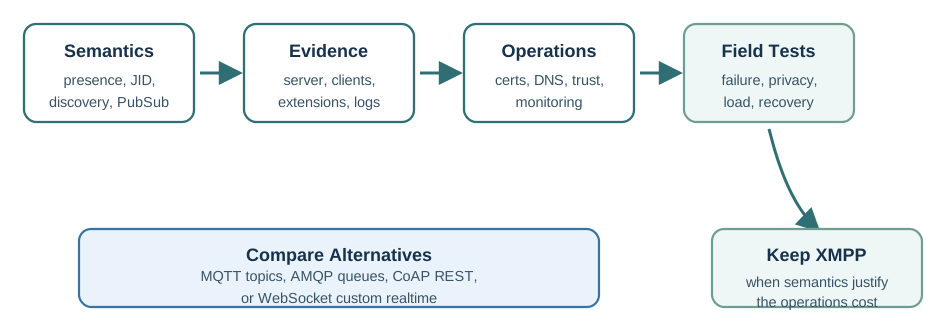
Start with the required exchange. Then test the protocol fit. Read Figure 17.1 by beginning with the semantics the product truly needs, then verify identity and discovery behavior. Move through transport and security to the people and systems that will operate servers, certificates, logs, extensions, and federation. Field validation supplies the final proof before comparing MQTT, CoAP, HTTP, AMQP, or a browser-media path. XMPP fits when its semantics justify that evidence and operating cost; otherwise the record should make the simpler alternative visible.
Use XMPP when several of these fit signals are true:
- The application needs first-class presence or availability state.
- JID-based identity and directed messaging are useful.
- Service discovery or feature advertisement matters.
- PubSub nodes, access models, or stored items are needed.
- Federation across administrative domains is a real requirement.
- Human-device interaction, chat-like control, or collaboration is part of the product.
- The team can operate XMPP servers, certificates, logs, abuse controls, and extension compatibility.
Use a simpler path when the workload is mostly constrained telemetry, fixed-topic publish/subscribe, RESTful device access, brokered enterprise messaging, or raw realtime browser communication without XMPP semantics.
17.6 Core Technologies, Limits, and Uses
This section: Core Technologies, Limits, and Uses — The protocol’s pieces should be evaluated as a stack rather than as one broad messaging promise.
The protocol’s pieces should be evaluated as a stack rather than as one broad messaging promise. Figure 17.2 joins core streams, stanza roles, extensions, and the constrained-node fit boundary.

Read Figure 17.2 from Core—XML streams, JIDs, TLS, and SASL—to Extensions, where PubSub and discovery work only if both peers implement the same XEP profile. The Fit boundary names federation and extensibility as strengths but verbose XML, persistent TCP state, server complexity, and absent hard QoS as costs.
XMPP is a family of XML-stream technologies, not a single “chat” feature. Core XMPP provides the stream, stanza, addressing, authentication, and routing base. Jingle adds session negotiation for voice, video, and file-transfer style media workflows. Multi-user chat supports group conversation rooms. PubSub provides nodes, subscriptions, publications, and notifications. BOSH carries XMPP over HTTP request pairs when a WebSocket or native TCP stream is not available.
Those capabilities have costs that matter in IoT reviews. XMPP has no native MQTT-style QoS 0/1/2 delivery contract, so reliability evidence must come from stanza acknowledgments, stream management, application state, or the chosen extension. Text XML increases network overhead, and binary data normally has to be encoded, such as with base64, before it can travel inside XML. That makes XMPP a poor fit for high-rate binary telemetry from constrained devices unless the gateway or server layer is doing the XMPP work.
Good XMPP candidates include publish-subscribe systems where PubSub policy matters, VoIP or media signaling through Jingle, file transfer coordination, social or collaborative services, gaming presence, smart-grid coordination, and cross-domain IoT workflows where identity, discovery, or presence is a product requirement. If the application only needs simple telemetry fan-out, MQTT or AMQP is usually easier to prove.
17.7 Worked Example: Facility Operations Presence
This section: Worked Example: Facility Operations Presence
-

How should these devices show they are available and exchange messages?
17.8 Scenario
A facility operations team wants maintenance tablets, room controllers, alarm panels, and supervisory dashboards to show each other’s availability and exchange low-volume directed messages. The system also needs a controlled way to discover device capabilities after maintenance replacement.
Why XMPP remains in scope
Presence and identity drive this case. Check server support before adding discovery or browser tools.
- Presence is part of the user workflow.
- Directed messages and identity matter.
- Service discovery can expose capabilities without a separate registry.
- WebSocket transport may help browser-based operator tools.
Evidence needed
Check stream security and naming rules first. Then test who can see presence and what happens offline.
- Server support for client streams, resource binding, TLS, SASL, roster or presence policy, and selected extensions.
- JID naming and deprovisioning policy for people, devices, rooms, and applications.
- Access-control rules for presence subscriptions, discovery, PubSub nodes, and control commands.
- Failure tests for offline devices, duplicate resources, stale presence, rejected IQ requests, and federation failures.
- Alternative comparison against MQTT, AMQP, HTTP/WebSocket, or CoAP for non-presence telemetry flows.
Decision
XMPP is a reasonable shortlist candidate for the interactive, presence-aware layer. It should not automatically carry high-volume telemetry unless field evidence shows the selected stack and operations team can support that path.
17.9 Common Pitfalls
This section: Common Pitfalls
Test XMPP against the real task, load, and privacy rules. Do not assume every feature is needed.
- Treating XMPP as a universal IoT replacement for MQTT, AMQP, CoAP, HTTP, or WebSocket.
- Claiming XML overhead is always decisive without checking absolute workload, transport, power, and feature needs.
- Assuming federation is required when all devices live under one administrative domain.
- Exposing service discovery or presence broadly without privacy and authorization review.
- Citing XEP support without proving the selected server and client libraries implement the exact extension behavior.
- Using presence as a substitute for health monitoring, audit logs, retry policy, or device lifecycle management.
- Ignoring certificate, DNS, trust, abuse, logging, and monitoring work for server-to-server federation.
17.10 Knowledge Check
This section: Knowledge Check
17.11 Concept Relationships
This section: Concept Relationships — JID plus stanza defines the route.
JID plus stanza defines the route. The JID identifies the entity and resource; the stanza family defines the type of interaction.
Presence is semantics, not telemetry. Presence can show availability and status transitions, but health monitoring still needs logs, alerts, retries, and lifecycle records.
Discovery needs authorization. Service discovery is useful for capability review, but exposing entity identities and features can create privacy and security risk.
PubSub is not just MQTT with XML. XMPP PubSub has nodes, subscriptions, access policy, notifications, and optional stored items. It should be chosen only when those semantics matter.
Federation is an operations commitment. Cross-domain messaging adds DNS, certificates, trust, policy, abuse controls, and monitoring work.
17.12 Deep Dive: How XMPP Moves, and Why It Is Heavy
This section: Deep Dive: How XMPP Moves, and Why It Is Heavy — The sections above cover XMPP’s roles and evidence.
The sections above cover XMPP’s roles and evidence. This layered walkthrough shows the mechanism underneath: XMPP is a long-lived XML stream rather than request/response, it carries everything as one of three stanzas, and its XML verbosity is exactly why it sits at gateways and servers while MQTT and CoAP sit on the constrained edge.
HTTP request semantics are stateless, although HTTP connections can be reused and streams can stay open. XMPP normally maintains an XML stream with session state. A client can open a TCP connection to its server, commonly on client-to-server port 5222, negotiate TLS, authenticate with SASL, bind a resource, and exchange XML stanzas until the stream closes. That maintained session makes presence and pushed messages natural, and can cost energy on a tiny sleeping device.
Use XMPP when the stream semantics are part of the requirement: presence, routed messages, discovery, human-device interaction, or federation. A sleeping sensor that reports every hour usually wants a cheaper store-and-forward protocol. If XMPP is justified, document reconnect behavior, keepalive interval, TLS certificate policy, offline queue limits, and who may subscribe to presence.
Everything XMPP does is carried by one of three stanza types, each addressed with a JID of the form localpart@domain/resource. A presence stanza announcing that a field sensor is online and available looks like this:
<presence from='sensor7@gw.example/field'
          to='ops@gw.example'>
  <show>chat</show>
  <status>online</status>
</presence>
The from JID names both the account, sensor7@gw.example, and the specific connected resource, /field. <show> gives availability and <status> carries free text. Keep the stanza roles separate so retry, timeout, and audit behavior stay clear.
| Stanza | Pattern | IoT use |
|---|---|---|
<message> | Fire-and-forget delivery; no reply expected | Push an alert, notification, or PubSub event |
<presence> | Publish and subscribe to availability | Know whether a device, gateway, or operator is online now |
<iq> | Request/response with get, set, result, or error | Service discovery, configuration, PubSub management, and bounded control queries |
The request/response nature of <iq> is especially important for configuration and discovery. A controller can correlate the returned result or error with the original request, apply a timeout, and decide whether to retry or surface a failed capability check. A pushed <message> may be useful, but it does not prove that a queried field exists. Log the stanza id with each result so support can trace failed queries through retries.
XMPP’s native transport is the long-lived RFC 6120 TCP stream secured with TLS. Two web bindings let the same XML stream traverse HTTP-only infrastructure: XMPP over WebSocket, defined by RFC 7395, carries the stream inside one WebSocket connection, while BOSH, XEP-0124, emulates the stream over HTTP long-polling for environments that permit nothing but HTTP.
The cost is verbosity. Every stanza is XML: element tags, namespaces, and full JIDs. That is bulky next to MQTT’s small fixed header or CoAP’s compact UDP framing. For a coin-cell sensor, both the framing overhead and the always-open TCP stream are expensive, so XMPP usually belongs at gateways, servers, and dashboards where presence and federation earn their cost. MQTT-SN or CoAP typically fit the constrained edge better. Where XML is mandated, EXI (Efficient XML Interchange) can compress it.
| Protocol | Model and framing | Fit |
|---|---|---|
| XMPP | XML stanzas over a long-lived TCP stream, WebSocket, or BOSH | Presence-rich messaging, discovery, and federation at gateways and servers |
| MQTT | Publish/subscribe over a long-lived TCP connection with compact MQTT framing | Brokered telemetry and event fan-out from capable devices and gateways |
| CoAP | REST-style UDP/DTLS protocol with compact messages and Observe for push | Constrained edge devices needing request/response plus lightweight observation |
Federation is a separate operations commitment. Server-to-server links, commonly on port 5269, let one domain’s entities message another domain’s entities, but each link adds DNS, certificate, trust, policy, monitoring, and abuse-control obligations.
Before choosing XMPP for IoT, write the evidence record in three lines: the XMPP semantic you need, the exact server/client/XEP support you verified, and the simpler protocol you rejected with a concrete reason.
17.13 See Also
This section: See Also — Start with core streams and messaging, then address format and extensions to see which XMPP features the deployment requires.
Standards and XMPP detail
Start with core streams and messaging, then address format and extensions to see which XMPP features the deployment requires.
- RFC 6120: XMPP Core
- RFC 6121: XMPP Instant Messaging and Presence
- RFC 7622: XMPP Address Format
- XEP-0030: Service Discovery
- XEP-0060: Publish-Subscribe
Course context
Place XMPP among the application protocols, then compare realtime, MQTT, and AMQP routes against the same workload.
- Application Protocols: protocol-family route and selection context.
- Real-Time Protocol Workflows: realtime and browser-facing communication patterns.
- MQTT Fundamentals: lightweight publish/subscribe comparison point.
- AMQP Fundamentals: enterprise messaging comparison point.
- CoAP Fundamentals: constrained REST-style comparison point.
17.14 Summary
This section: Summary — XMPP brings standards-based addressing, presence, federation, PubSub, and XML stanza semantics into IoT architecture reviews.
XMPP brings standards-based addressing, presence, federation, PubSub, and XML stanza semantics into IoT architecture reviews. It fits when identity, discovery, human-device workflows, or cross-domain messaging matter enough to justify server, extension, security, and operational complexity.
17.15 Key Takeaway
This section: Key Takeaway — Use XMPP for IoT only when presence, discovery, addressing, or federation semantics justify the extra XML, server, extension, and operations complexity.
Use XMPP for IoT only when presence, discovery, addressing, or federation semantics justify the extra XML, server, extension, and operations complexity.
17.16 What’s Next
This section: What’s Next — Pick the next chapter by task: live contact, topic data, or broker routing.
Choose the next chapter by the decision still open:
Pick the next chapter by task: live contact, topic data, or broker routing.
- Read Real-Time Protocol Workflows if the main question is browser or realtime media/event transport.
- Read MQTT Fundamentals if the workload is topic-based telemetry.
- Read AMQP Fundamentals if the workload needs brokered enterprise routing and delivery semantics.
- Read CoAP Fundamentals if the workload is constrained, REST-style device interaction.
17.17 Continue Your Route
This section: Continue Your Route — This is the last part of this chapter.
This is the last part of this chapter. Return to XMPP: Messaging Foundations or continue from the Application Protocols Module Guide.
Find help
3 reviewed answers.
Where should I start in a module?
Open the module page from the sidebar to see its chapters in order. Use the module map to return to a topic you need.
Modules and pathsReviewed
What can I try when a project does not work?
Check the symptom, then work through the diagnostic steps. Keep the error message and the smallest example that reproduces it.
When you are stuckReviewed
How do interactive examples work?
Use the interactive guide to check how examples and simulations work before changing your project.
Interactive examples guideReviewed