14 Location Privacy and Regulations
14.1 Learning Objectives
By the end of this chapter, you will be able to:
- Assess Privacy Risks: Evaluate the sensitivity of location data and the potential for re-identification from sparse spatio-temporal points
- Apply Privacy-Preserving Patterns: Implement tiered disclosure, anonymous aggregation, on-device geofencing, and differential privacy for location analytics
- Explain E911 Requirements: Describe FCC regulatory mandates for emergency location services, including handset-based vs. network-based accuracy tiers and z-axis requirements
- Design Ethically: Balance safety, functionality, and user autonomy in location-aware IoT systems using consent-first workflows and data minimization
14.2 Prerequisites
- Location Awareness Fundamentals: Understanding of positioning technologies (GPS, Wi-Fi, BLE, cellular)
- Privacy and Security Overview: Basic privacy principles including consent, data minimization, and purpose limitation
14.3 Introduction
Every IoT device that records a GPS fix, detects a BLE beacon, or estimates position from cell tower signals is generating data that can reconstruct where a person has been, for how long, and how often. Research by de Montjoye et al. (2013) demonstrated that just four spatio-temporal data points are sufficient to uniquely identify 95% of individuals in a dataset of 1.5 million mobile phone users – even when the data has been “anonymized” by removing names and phone numbers.
This chapter addresses the privacy implications of location-aware IoT at three levels. First, it provides a practical privacy risk assessment framework and four design patterns that reduce exposure without sacrificing functionality. Second, it examines the regulatory landscape – GDPR, CCPA, COPPA, and the FCC’s Enhanced 911 mandates – that sets legal boundaries for location data collection and retention. Third, it analyzes the 2018 Strava heatmap incident as a detailed case study in how aggregated location data can fail to protect privacy when context is ignored.
14.4 Location Privacy Considerations for IoT Design
The fundamental challenge of location privacy is that even coarse or aggregated position data can be re-identified through correlation with external datasets. A seemingly anonymous record showing “a device visited location X at time Y” becomes personally identifiable when cross-referenced with public transit schedules, building access logs, or social media check-ins. Effective privacy design must therefore address not just what data is collected, but how it can be combined with other information.
Privacy Risk Assessment Checklist
Before deploying location-aware IoT, evaluate these privacy dimensions:
14.4.1 Data Collection
Precision Guidelines:
| Use Case | Precision Needed | Privacy-Preserving Approach |
|---|---|---|
| Presence detection | Room-level | PIR sensors (anonymous), zone-based (no coordinates) |
| Home automation | Geofence (100m radius) | Coarse location API, on-device geofence detection |
| Asset tracking | Building-level | BLE proximity (which beacon, not coordinates) |
| Navigation | Meter-level | Ephemeral (do not store history) |
| Emergency/Safety | Precise coordinates | Only transmitted on SOS trigger |
14.4.2 Data Storage
14.4.3 Data Sharing
14.4.4 User Controls
14.4.5 Technical Safeguards
Privacy-Preserving Design Patterns
14.4.6 Pattern 1: Tiered Disclosure
Do not share precise location by default. Escalate precision only when the use case demands it:
| Tier | Precision | When to Use | Example |
|---|---|---|---|
| 0: Offline | No location shared | Normal operation | Smart thermostat does not need location |
| 1: Status | Boolean (home/away) | Automation triggers | “Someone is home” (lights on) |
| 2: Zone | Named area | Notifications | “Package delivered to porch” |
| 3: Coarse | ~100m radius | Geofencing | “Arrived in neighborhood” (start preheating) |
| 4: Precise | GPS coordinates | Emergency only | 911 call, fall detection alert |
Implementation:
Normal: No location tracking
Geofence trigger: "Device entered 'Home' zone" (no coordinates)
Emergency: "Fall detected at 37.7749 N, 122.4194 W"
14.4.7 Pattern 2: Anonymous Aggregation
For space utilization, collect presence counts, not identities:
Bad (invasive):
- Track “John’s phone is in Conference Room A”
- Store: {user_id: “john@company”, location: “Room_A”, timestamp: “2025-01-15 14:32”}
Good (anonymous):
- Detect: “4 people in Conference Room A”
- Store: {room: “A”, occupancy: 4, timestamp: “2025-01-15 14:30”} (15-min buckets)
14.4.8 Pattern 3: On-Device Geofencing
Detect zone entry and exit on the device, not the server:
Privacy-Preserving:
- App downloads geofence zones (coordinates of home, office)
- Phone continuously checks GPS against local zones
- On zone transition, sends trigger: “Entered zone ‘Home’” (no coordinates)
- Server never sees GPS coordinates, only zone events
Invasive Alternative:
- Phone streams GPS to server continuously
- Server checks against zones
- Creates coordinate trail revealing everywhere user went
14.4.9 Pattern 4: Differential Privacy for Analytics
Add mathematical noise to aggregated location data:
Use Case: Building management wants foot traffic heatmap
Without differential privacy:
- Store exact coordinates of every person
- Risk: Re-identification possible, especially for rare paths
With differential privacy:
- Add calibrated noise to aggregated counts
- Publish: “~42 people passed this hallway today” (plus or minus 5)
- Preserves general patterns while preventing individual tracking
14.4.10 Explore: Tiered Disclosure Designer
Use this interactive tool to explore how tiered disclosure works. Select a disclosure tier and observe what information is shared at each level, along with the privacy risk score.
14.5 Location Privacy Regulations
IoT designers must comply with location privacy laws in every jurisdiction where their devices operate. The following table summarizes the most significant regulations:
| Regulation | Key Requirements | Penalties |
|---|---|---|
| GDPR (EU) | Explicit consent, purpose limitation, right to deletion, 72-hour breach notification | Up to 20M EUR or 4% global annual revenue |
| CCPA/CPRA (California) | Disclosure, opt-out of sale, no sale without consent, private right of action | $2,500-$7,500 per intentional violation |
| COPPA (US, children) | Verifiable parental consent for under-13 location tracking | $50,120+ per violation (2024 adjusted) |
| US State Location Laws | Various states restrict employer tracking, stalkerware, and geolocation without consent | Varies by state |
Best Practices:
- Consent-first: Do not track location until the user explicitly enables it
- Continuous indication: Show icon or LED when location is active
- Easy opt-out: One-tap disable, not buried in settings
- Data minimization: GDPR Article 5 requires collecting only data necessary for the stated purpose
- Breach notification: Must report location data leaks within 72 hours (GDPR) or “without unreasonable delay” (most US state laws)
14.6 Regulatory Requirements: E911 Mandates
One of the most significant regulatory drivers for mobile location technology in the United States has been the Enhanced 911 (E911) mandates from the Federal Communications Commission (FCC). These regulations established mandatory location accuracy requirements for wireless emergency calls, and in doing so created the technical infrastructure that modern IoT location services build upon.
For Beginners: Why E911 Matters for IoT
The Problem: When you call 911 from a landline, emergency responders know exactly where you are – the phone is physically connected to your address. But what happens when you call from a mobile phone while driving or from an unfamiliar location?
The Solution: The FCC created E911 rules requiring mobile carriers to automatically transmit your location to 911 call centers. This drove massive investment in mobile location technology, making GPS and network-based positioning standard features in every phone – technology that IoT devices now use for tracking, geofencing, and safety applications.
Why IoT designers care: E911 accuracy requirements (50-300 meters) define what “good enough” location accuracy means for emergency applications, and the handset-based vs. network-based distinction maps directly to IoT design choices between on-device GPS and network-assisted positioning.
14.6.1 E911 Phase I and Phase II Requirements
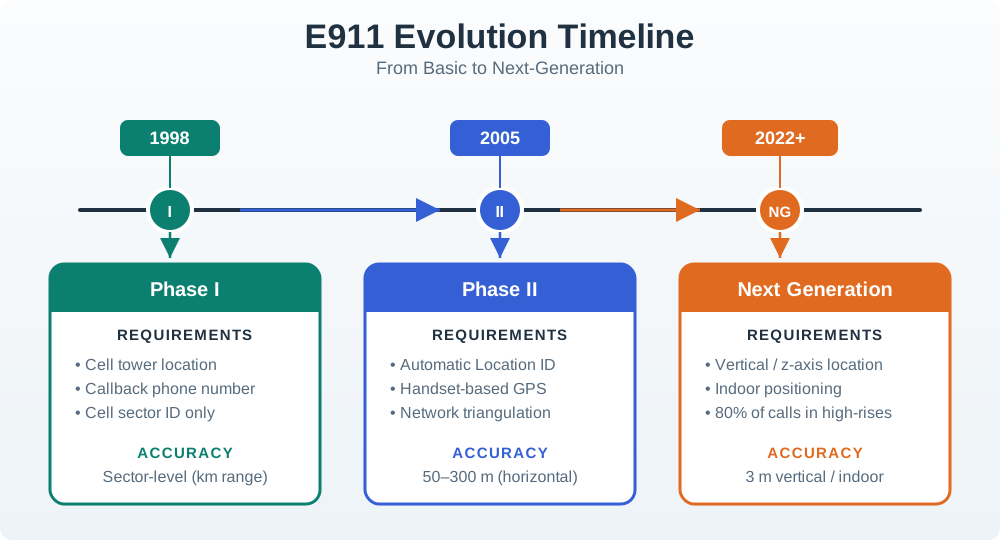
The FCC implemented E911 in two phases, each raising the bar for what wireless carriers must provide during emergency calls:
| Phase | Effective Date | Requirements |
|---|---|---|
| Phase I | April 1998 | All 911 calls must complete even without active subscription; report cell tower location and callback number |
| Phase II | December 2005 | 95% penetration of Automatic Location Identification (ALI) with specific accuracy requirements for handset-based and network-based solutions |
14.6.2 E911 Accuracy Tiers: Handset vs. Network-Based
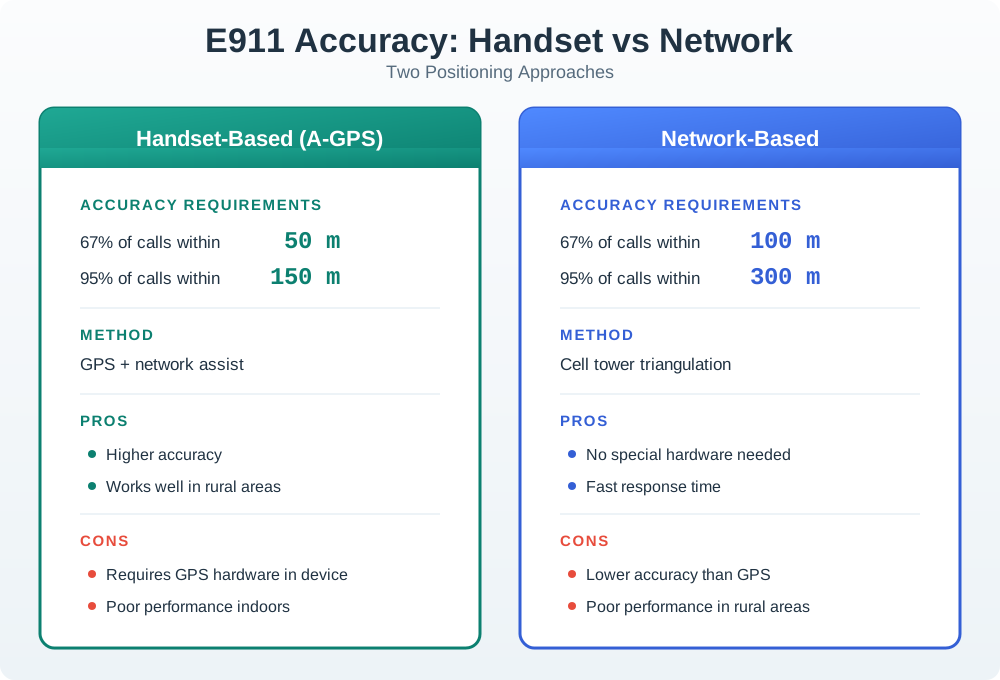
The FCC defined two distinct accuracy tracks, recognizing that handset-based solutions (which use GPS hardware in the phone) achieve better precision than network-based solutions (which triangulate from cell towers alone):
| Technology | 67% of Calls | 95% of Calls | Method | Advantages | Limitations |
|---|---|---|---|---|---|
| Handset-Based (A-GPS) | ≤ 50 meters | ≤ 150 meters | GPS receiver in phone + network assistance | Higher accuracy, works in rural areas | Requires GPS hardware, longer initial fix time, poor indoors |
| Network-Based | ≤ 100 meters | ≤ 300 meters | Cell tower triangulation (TDoA, AoA, signal strength) | No phone hardware required, faster response | Lower accuracy, depends on tower density, very poor in rural areas |
Why Two Accuracy Tiers?
The 67%/95% structure acknowledges that location accuracy varies even with the same technology:
- 67% (typical case): Most calls achieve this accuracy under normal conditions
- 95% (worst case): Almost all calls achieve at least this accuracy, accounting for challenging environments (urban canyons, buildings, interference)
IoT Design Implication: When specifying location accuracy for safety-critical IoT applications, use the 95% threshold (worst-case) rather than typical accuracy. If your asset tracker advertises “5 meter accuracy,” expect 15-20 meters in difficult environments.
14.6.3 Implications for IoT Location Design
The E911 framework provides valuable benchmarks for IoT location system design:
| Application | E911 Comparison | Recommended Accuracy |
|---|---|---|
| Personal safety devices (elderly trackers, child watches) | Similar to E911 emergency use | 50-100m (handset-level) |
| Fleet management | Less critical than 911 | 100-300m (network-level sufficient) |
| Asset tracking (shipping, equipment) | Non-emergency | 300m+ acceptable |
| Precision applications (agriculture, surveying) | Exceeds E911 requirements | 1-10 cm (RTK/PPP) |
E911 Accuracy Challenges for IoT
Indoor limitations: E911 accuracy requirements were designed for outdoor mobile calls. Achieving 50-150 meter accuracy indoors or in urban canyons remains challenging – a critical gap for IoT devices deployed in buildings.
Vertical location gap: Traditional E911 provides horizontal position only. For high-rise buildings, knowing you are at “100 Main Street” does not tell responders whether you are on floor 3 or floor 30. The FCC’s z-axis requirements (adopted 2020, phased implementation starting 2022) mandate vertical accuracy within 3 meters for 80% of indoor calls – driving development of barometric altimeter integration in phones and IoT devices.
IoT lesson: For indoor safety applications (hospital patient tracking, emergency evacuation), rely on BLE beacons or Wi-Fi fingerprinting rather than GPS/cellular location to meet accuracy needs.
14.7 Case Study: Strava Global Heatmap and Military Base Exposure (2018)
In January 2018, Strava – a fitness tracking app with 76 million users – published a global heatmap showing aggregated GPS tracks from its users’ running, cycling, and walking activities. The visualization inadvertently revealed the locations, layouts, and activity patterns of secret military installations worldwide. This incident remains one of the most instructive examples of how location data aggregation can fail catastrophically.
What Happened:
Strava’s heatmap aggregated 3 billion GPS data points from all users who had not explicitly opted out of data sharing. In populated areas, the heatmap showed well-known running routes. But in remote areas of Syria, Afghanistan, Niger, and Djibouti, bright lines on an otherwise dark map traced the perimeters and internal roads of forward operating bases used by US and allied forces.
Specific Exposures:
| Location | What Was Revealed | Intelligence Value |
|---|---|---|
| Bagram Airfield, Afghanistan | Jogging routes traced base perimeter, runway approaches, living quarters | Base layout, population density patterns |
| Camp Lemonnier, Djibouti | Internal road network, vehicle patrol routes visible | Operational patterns and shift schedules |
| Unknown site, Syria | Previously classified patrol base location revealed by 3 GPS tracks | Existence of base was classified |
| Pine Gap, Australia | Internal walking paths of NSA/ASD joint facility | Confirmed active areas within compound |
Why Aggregation Did Not Protect Privacy:
Strava assumed that aggregating millions of GPS tracks would anonymize the data. This assumption failed because:
- Context sensitivity: In populated cities, one GPS track is invisible among millions. In the Sahara Desert, three GPS tracks are a beacon.
- Temporal patterns: Heatmap brightness correlated with activity frequency, revealing shift changes (0600 and 1800 peaks) and weekend patterns.
- Route specificity: Perimeter jogging routes precisely traced installation boundaries – more accurate than commercial satellite imagery for some sites.
- Opt-out default: Data sharing was enabled by default (opt-out). Military personnel were not briefed on Strava’s data sharing practices, so most never changed the default setting.
Quantified Impact:
- US Department of Defense issued immediate guidance restricting fitness tracker use in operational areas
- Affected an estimated 10,000+ service members across 100+ installations
- Strava changed its default sharing setting from opt-out to opt-in for “enhanced privacy zones” within 30 days
- Multiple NATO countries issued similar guidance
- The incident delayed Strava’s planned IPO by over a year
Privacy Design Failures:
| Principle Violated | What Should Have Happened |
|---|---|
| Data minimization | GPS precision should have been reduced to 100m grids before aggregation |
| Contextual awareness | Heatmap rendering should suppress data in areas with fewer than k=50 unique users |
| Opt-in default | Location sharing should require explicit opt-in, especially for aggregation |
| Differential privacy | Add calibrated noise proportional to area population density |
| Geofencing exclusions | Known sensitive areas (military, government) should be excluded by default |
Key Lesson: “Aggregated” and “anonymous” are not synonyms. Aggregate location data reveals sensitive patterns when the background population density is low, when routes are distinctive, or when temporal patterns correlate with operational schedules. Location privacy requires analysis of the specific context in which data will be displayed, not just the technical anonymization method applied.
14.8 Real-World Privacy Failures
The Strava incident is not an isolated case. The following table summarizes additional location privacy failures that illustrate recurring design mistakes:
| Case | Privacy Failure | Lesson |
|---|---|---|
| Life360 (2021) | Family tracking app sold precise location data to approximately a dozen data brokers | “Free” apps monetize location data; read data-sharing agreements carefully |
| Tile/AirTag Trackers | Crowd-sourced finding networks track non-users unknowingly when tags are placed on their property | Opt-in required for participation; anti-stalking detection is essential |
| COVID Contact Tracing | Centralized approaches (e.g., Australia’s COVIDSafe) created mass surveillance potential | Decentralized architecture (Apple/Google Exposure Notification) is preferable for privacy |
| License Plate Readers (ALPRs) | Historical queries used for stalking, harassment, and warrantless surveillance | Access controls, audit logs, and data retention limits are critical |
| Clearview AI (2020) | Scraped billions of photos to build facial recognition database linked to locations | Public data scraping combined with location creates powerful surveillance tools |
Design Principles:
- Assume location data will leak eventually – minimize what you collect
- Users do not understand privacy policies – use clear UI indicators showing when location is active
- “Anonymous” is difficult to achieve – coordinate trails are often re-identifiable with as few as 4 data points
- Purpose creep is real – technical controls (not just policies) must prevent mission drift
14.9 Knowledge Check
14.9.1 Explore: k-Anonymity and Differential Privacy
Adjust the parameters below to see how k-anonymity thresholds and differential privacy noise affect the trade-off between data utility and re-identification risk.
Common Mistake: Aggregating Location Data Without k-Anonymity Protection
What practitioners do wrong: Publishing aggregated location statistics like “Average foot traffic by hour” or heat maps, believing that aggregation alone anonymizes the data.
Why it fails: Low-density aggregates can be de-anonymized through cross-referencing. For example:
- “3 people visited this parking garage between 2-3 AM on Tuesday”
- Cross-reference with building badge logs: Only 3 night-shift workers had access
- Result: You have now identified which specific employees were there
k-Anonymity Principle: Aggregated data should include at least k individuals such that no individual can be distinguished from at least k-1 others. A common threshold is k=10 (at least 10 people in any published aggregate).
Failure modes:
| Aggregate Query | k-Value | Risk |
|---|---|---|
| “5 users in Zone A at 2 AM” | k=5 | Low density, possible re-identification |
| “500 users in Zone A at 2 PM” | k=500 | Safe, cannot isolate individuals |
| “1 user from ZIP 12345 visited doctor” | k=1 | Directly identifies if only 1 person in that ZIP |
Correct implementation – Suppress low-k aggregates:
def publish_aggregate(zone, hour, count):
    K_THRESHOLD = 10
    if count < K_THRESHOLD:
        return "< 10"  # Suppress exact count
    else:
        return count
Differential Privacy Alternative – Add calibrated noise to aggregates:
import numpy as np

def publish_with_noise(true_count, epsilon=1.0):
    # Laplace mechanism for differential privacy
    noise = np.random.laplace(0, 1/epsilon)
    return max(0, true_count + noise)

# Example:
# True count: 47 users
# Published: 44 users (noise = -3)
# Attacker cannot determine if 47 or 44 is realLesson: “Aggregate” does not mean “anonymous.” The Strava incident showed that even millions of aggregate routes are revealing in low-density areas (deserts, military bases), where as few as 3 routes expose sensitive patterns. Always apply k-anonymity (suppress aggregates below k individuals) or differential privacy (add calibrated noise) before publishing location aggregates.
Putting Numbers to It
Context: Privacy protection mathematics for location data.
E911 Accuracy Requirements: FCC mandates 67% of handset-based calls within 50m, 95% within 150m. Statistical interpretation: if true position is \((x_0, y_0)\), reported position \((x, y)\) must satisfy error distribution where \(P(\text{error} \leq 50\text{m}) \geq 0.67\) and \(P(\text{error} \leq 150\text{m}) \geq 0.95\). Worked example: For 2D positioning error modeled as a Rayleigh distribution (the distance from the true position when horizontal errors are Gaussian), the 67th percentile at 50m gives \(\sigma \approx 50/1.18 \approx 42\)m per axis. The 95th percentile check: \(1.73\sigma \approx 73\)m for the Rayleigh 95th percentile, which is well within the 150m requirement. System must maintain per-axis \(\sigma \leq 42\)m.
K-Anonymity for Location Data: Dataset satisfies \(k\)-anonymity if every record is indistinguishable from at least \(k-1\) others on quasi-identifier attributes. Worked example: Coffee shop visits at 8am Monday. If only 3 people visited, publishing “3 visitors at Coffee Shop A, 8am Monday” has \(k=3\). Cross-reference with employee badge data showing only Alice, Bob, and Charlie work nearby – all three are identified. Need \(k \geq 10\) to prevent practical re-identification, requiring suppression of low-count cells.
Differential Privacy Noise: Laplace mechanism adds noise \(\text{Noise} \sim \text{Laplace}(0, \Delta f / \epsilon)\) where \(\Delta f\) is sensitivity (max change from one person’s data), \(\epsilon\) is privacy budget (smaller = more private). Worked example: For location count query with \(\Delta f = 1\) (adding/removing one person changes count by at most 1), \(\epsilon = 1.0\), noise has scale \(1/1 = 1\). True count 47 becomes published count \(47 + \text{Laplace}(0,1)\), e.g., 44 or 49. An attacker cannot determine whether any specific individual was present.
Re-identification from Sparse Data: de Montjoye et al. (Science, 2013): 4 spatio-temporal points \((t_i, x_i, y_i)\) uniquely identify 95% of individuals in a dataset of 1.5 million mobile users. Worked example: Points: (Mon 8am, home area), (Mon 9am, downtown), (Mon 6pm, gym), (Tue 8am, home). Home location narrows to ~1,000 people in neighborhood. Downtown commute narrows to ~200. Adding gym membership (publicly searchable) narrows to ~20. With 4 points, the individual is often unique. Removing user IDs is insufficient – location trails themselves are quasi-identifiers.
Decision Framework: On-Device vs. Cloud-Based Geofencing
Option A: On-Device Geofencing (Privacy-Preserving)
- Geofence zones downloaded to device as coordinates
- Device’s GPS continuously checks position against local zones
- Only events (“entered Home zone”) sent to server, not coordinate trails
Pros:
- Server never sees GPS coordinates (maximum privacy)
- Works offline (no network required for geofence detection)
- Zero cloud processing cost per check
- GDPR-friendly (minimal data collection)
Cons:
- Limited to simple circular/polygonal zones (complex geofences require more device CPU)
- Cannot update zones instantly (must push update to all devices)
- Device must stay powered for continuous checking (battery drain)
Option B: Cloud-Based Geofencing
- Device streams GPS coordinates to server
- Server checks position against zones
- Server stores complete location trail
Pros:
- Complex dynamic geofences (traffic-aware, time-of-day zones)
- Centralized analytics (“how many users entered Zone A today?”)
- Instant zone updates (change radius without app update)
- Cross-device geofencing (detect when two users meet)
Cons:
- Privacy risk: Server has complete movement history
- Network dependency (fails offline)
- Processing cost: $0.001 per location check at scale
- GDPR challenges: Requires explicit consent and data retention policies
| Use Case | Recommendation | Rationale |
|---|---|---|
| Home automation (“unlock door when I arrive”) | On-device | User location is sensitive; server does not need coordinate trail |
| Marketing (“send coupon when near store”) | Cloud-based (with consent) | Retailer needs analytics; user accepts trade-off for discounts |
| Child safety (“alert if child leaves school zone”) | Hybrid: on-device check, cloud alert | Privacy plus parental visibility balance |
| Fleet management | Cloud-based (work context) | Employer has legitimate interest; not personal device |
| Contact tracing | On-device (Apple/Google model) | Decentralized to prevent mass surveillance |
Privacy Best Practice: Default to on-device geofencing unless you have a specific business need for coordinate trails AND explicit user consent.
Worked Example: Implementing GDPR-Compliant Location Tracking for Fleet Management
Company: European logistics company tracking 500 delivery vans with GPS telemetry
GDPR Compliance Requirements:
- Explicit consent: Drivers must opt-in to location tracking
- Purpose limitation: Location used ONLY for route optimization, not employee surveillance
- Data minimization: Collect minimum precision needed
- Retention limits: Auto-delete location data after business need expires
- Right to access: Drivers can view their own location history
- Right to erasure: Drivers can delete their location data (except legally required retention)
Implementation:
Step 1: Consent Workflow
- Driver logs into mobile app on first use
- Plain-language explanation: “We track your location to optimize routes and provide accurate ETAs to customers. Location data is deleted after 48 hours. You can pause tracking anytime.”
- Checkbox: “I consent to location tracking for route optimization”
- Record consent timestamp and IP address (proof of consent per GDPR Article 7)
Step 2: Purpose-Limited Collection
- Precision: Zone-level (100m grid) instead of precise coordinates (5m GPS)
- Temporal: Sample every 2 minutes during work hours only (not 24/7)
- Geofencing: Only track when van is more than 500m from home base (not at personal home)
Example Data Stored:
{
  "driver_id_hashed": "sha256(driver_id + salt)",
  "timestamp": "2025-01-15T14:32:00Z",
  "zone": "E3-A4",
  "on_delivery_route": true,
  "speed_bucket": "30-50kph"
}
Step 3: Retention Policy
- 48-hour auto-delete: All individual location points deleted after 2 days
- Aggregated analytics retained: “Zone E3-A4 had 47 deliveries this month” (no driver identity)
- Legal retention: Delivery proof-of-location retained 7 years (separate system, explicit legal basis under GDPR Article 6(1)(c))
Step 4: User Controls in App
- “Pause Tracking” button: Temporarily disables location (break, lunch, personal errand)
- View My Data: Shows last 48 hours of location history
- Download My Data: GDPR Article 15 (right to access) – exports as JSON
- Delete My Data: GDPR Article 17 (right to erasure) – deletes all location except legally required delivery proofs
Cost: approximately $12,000 implementation (consent UI, pseudonymization, auto-deletion scheduler, export tools), $2,000/year ongoing (storage reduction from short retention).
Benefit: Full GDPR compliance, reduced data breach risk (only 48 hours of data exposed if breached), increased driver trust through transparent controls.
GDPR Penalties Avoided: Up to 20M EUR or 4% annual global revenue (whichever is higher) for non-compliance.
Common Pitfalls
1. Collecting precise location data when coarse data is sufficient
Precise GPS trajectories (meter-level, second-interval) reveal sensitive patterns – home address, medical appointments, religious practices – creating disproportionate privacy risk for most IoT use cases. Apply location precision minimization: delivery tracking needs city-level during transit, postal code on arrival; environmental monitoring needs grid coordinates, not device-level GPS trails. Collect the minimum precision that satisfies the functional requirement.
2. Storing location data indefinitely without retention policies
Raw location logs are not business records – they are a privacy liability that grows with time. A device that tracks location every minute generates 525,600 data points per year per user. Without automated deletion policies, years of historical location data accumulates, creating GDPR and CCPA liability for data you never needed. Define retention periods at data model design time: typically 30 days for operational data, 1 year maximum for analytics, with aggregated summaries replacing raw trajectories.
3. Presenting location consent as all-or-nothing
Single ‘allow location’ consent dialogs prevent users from making informed choices. IoT applications with multiple location uses (navigation, analytics, advertising) must present granular consent options per purpose. Under GDPR and many jurisdictions, each distinct purpose requires separate consent that can be individually withdrawn. A user consenting to navigation does not consent to their location history being used for behavioral profiling.
14.10 Summary
Location Privacy Principles:
- Minimize collection: Only collect the precision and frequency your application requires
- Tiered disclosure: Share zone events, not coordinate trails – escalate precision only when necessary
- Local-first processing: Perform geofencing on device, not on the server, to avoid creating movement histories
- User control: Provide easy pause, delete, and selective sharing options
- Anonymous aggregation: Count presence, do not track individuals – and apply k-anonymity or differential privacy before publishing
Regulatory Framework:
- E911: Defines minimum accuracy for emergency positioning (50-300m depending on technology) and vertical accuracy (3m for indoor calls)
- GDPR: Requires explicit consent, purpose limitation, data minimization, and right to deletion for location data
- CCPA/CPRA: Mandates disclosure, opt-out of sale, and private right of action for California residents
- COPPA: Requires verifiable parental consent for location tracking of children under 13
Ethical Design:
- Balance safety with autonomy (especially for elderly and child tracking)
- Assume location data will eventually leak – minimize what you collect
- Provide transparency about what is tracked and who sees it
- Prevent purpose creep through technical controls, not just written policies
Key Takeaway
Location privacy is not just about legal compliance – it is a core design responsibility. Always collect the minimum precision needed, process location data on-device when possible, provide users with transparent controls (pause, delete, selective sharing), and use tiered disclosure so that coordinate trails are never shared when zone events suffice. Remember: just four location data points can identify 95% of individuals, so “anonymization” through ID removal alone is never sufficient.
For Kids: Meet the Sensor Squad!
The Sensor Squad learns that knowing WHERE someone is can be a big responsibility!
14.10.1 The Sensor Squad Adventure: The Secret Hideout Problem
Sammy the Sensor was super excited. “I can tell exactly where everyone is at all times!” he announced proudly. “I know Lila is in the garden, Max is in the kitchen, and Bella is in her secret reading nook!”
Bella the Battery gasped. “Wait – my reading nook is supposed to be SECRET! I go there when I need quiet time. If everyone knows where I am all the time, I can never have privacy!”
Max the Microcontroller thought carefully. “Sammy, do we REALLY need to know exactly where everyone is? What if we just know whether someone is HOME or AWAY? That’s enough to turn on the porch light when someone arrives.”
Lila the LED added, “And what about strangers? If a bad person got hold of Sammy’s data, they would know when our house is empty!”
The Squad came up with their Privacy Rules:
- Only know what you need – “Someone is home” is enough for the lights. No need for exact coordinates!
- Keep secrets safe – Location information gets deleted after one day
- Ask permission first – Never track someone who has not said “Yes, that is okay”
- Emergency exception – If someone falls down and needs help, THEN share the exact location with the emergency team
“I get it now,” said Sammy. “Just because I CAN know where everyone is does not mean I SHOULD. Privacy means respecting people’s right to have their own space!”
14.10.2 Key Words for Kids
| Word | What It Means |
|---|---|
| Privacy | Your right to keep personal things (like where you go) to yourself |
| Geofence | An invisible boundary around a place – like a magic circle around your house |
| Consent | Getting permission before collecting someone’s information |
| Data Minimization | Only collecting the smallest amount of information you actually need |
Concept Relationships
Location Privacy and Regulations connect to:
- Privacy Fundamentals - Core privacy principles applied to location data
- GDPR Compliance - European data protection requirements for location tracking
- Data Anonymization - k-anonymity and differential privacy for location aggregates
- Emergency Services - E911 accuracy requirements and implementation
- Geofencing - Privacy-preserving on-device geofence detection
See Also
Privacy Regulations:
- GDPR Articles 5-7 - Lawful basis, principles, and consent for location processing
- CCPA/CPRA Section 1798.100 - California Consumer Privacy Act location rights
- COPPA 16 CFR Part 312 - Children’s Online Privacy Protection (location restrictions)
E911 and Emergency Location:
- FCC 47 CFR Part 20.18 - Enhanced 911 requirements
- NENA i3 Standard - Next Generation 911 architecture
- 3GPP TS 23.271 - Location Services (LCS) for cellular networks
Privacy-Enhancing Technologies:
- Differential Privacy - Apple and Google’s use in location services analytics
- Homomorphic Encryption - Computing on encrypted location data without decryption
- Zero-Knowledge Proofs - Proving location properties (e.g., “I am within this zone”) without revealing coordinates
14.12 What’s Next
| If you want to… | Read this |
|---|---|
| Understand GPS and outdoor location fundamentals | GPS and Outdoor Positioning |
| Implement indoor positioning systems for GPS-denied spaces | Indoor Positioning Systems |
| Understand GPS accuracy enhancement techniques | GPS Accuracy and Enhancement |
| Apply privacy principles in IoT user consent design | Privacy User Consent |
| Get an overview of all location technologies and their tradeoffs | Location Awareness Overview |