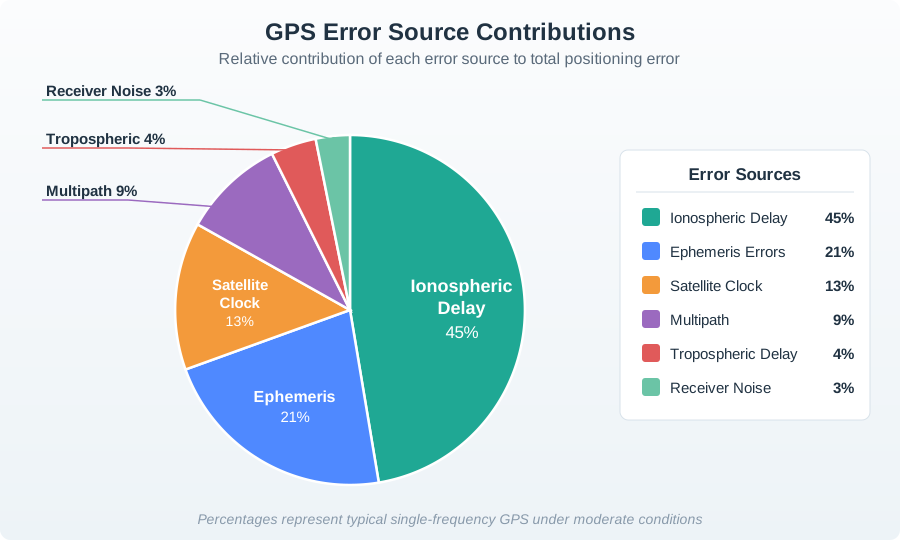
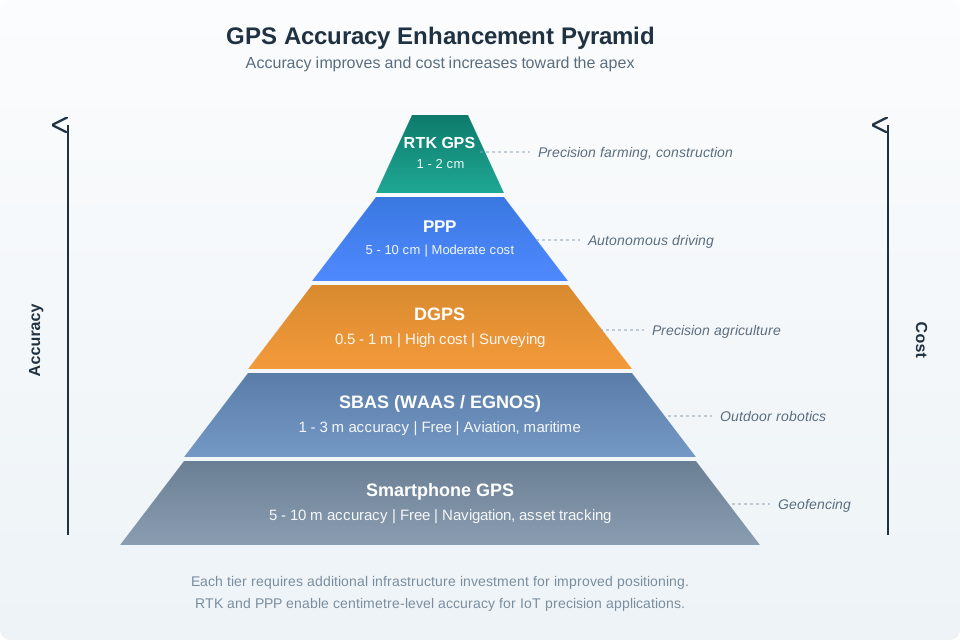
Standard GPS achieves 5-10 meter accuracy under open sky, dominated by ionospheric delay (45% of error budget). Enhancement technologies dramatically improve this: DGPS removes common-mode errors to reach sub-meter accuracy, while RTK GPS uses carrier phase measurements for 1-2 cm precision. The key design principle is matching accuracy to application – RTK for autonomous tractors planting 50 cm rows, but basic GPS suffices for shipping container tracking.
13.1 Learning Objectives
By the end of this chapter, you will be able to:
Analyze GPS Error Budget: Quantify each error source’s contribution to total positioning uncertainty using root-sum-square
Calculate UERE and Position Error: Combine independent error sources and apply geometric dilution of precision (GDOP)
Compare Enhancement Technologies: Evaluate DGPS, SBAS, RTK, and PPP for different accuracy requirements and cost constraints
Design for Accuracy Requirements: Select the appropriate positioning technology for specific IoT applications based on cost-benefit analysis
For Beginners: GPS Accuracy and Enhancement
When you use a map app on your phone, it shows your location with a blue dot and a circle around it. That circle represents how confident the phone is about your position – a bigger circle means less accuracy. Standard GPS gets you within about 5-10 meters, which is fine for navigation. But what if you need a robot tractor to stay between crop rows only 50 cm apart? That requires special enhancement technologies like RTK GPS, which can pinpoint your location to within 2 centimeters. This chapter explores how GPS errors accumulate, why accuracy varies by environment, and how different enhancement technologies trade off cost against precision.
Understanding where GPS accuracy comes from – and where it breaks down – is critical for designing reliable IoT location services. A GPS error budget quantifies each error source’s contribution to total positioning uncertainty.
13.3.1 Error Budget Breakdown
The table below shows the six main error sources, their typical magnitude in open-sky conditions, and how each can be mitigated:
Error Source
Typical Error
Notes
Satellite clock
1.5 m
Atomic clock drift compensated by ground control uploads every 12 hours
Ephemeris data
2.5 m
Orbital prediction errors; broadcast ephemeris updated every 2 hours
Ionospheric delay
5.0 m
Largest single source; varies with solar activity, time of day, and latitude
Tropospheric delay
0.5 m
Weather dependent; humidity and temperature affect signal propagation
Multipath
1.0 m
Urban canyons worst case; signals bounce off buildings creating echoes
Real-time kinematic uses carrier phase for centimeter-level precision
13.3.2 How Errors Combine: Root Sum Square
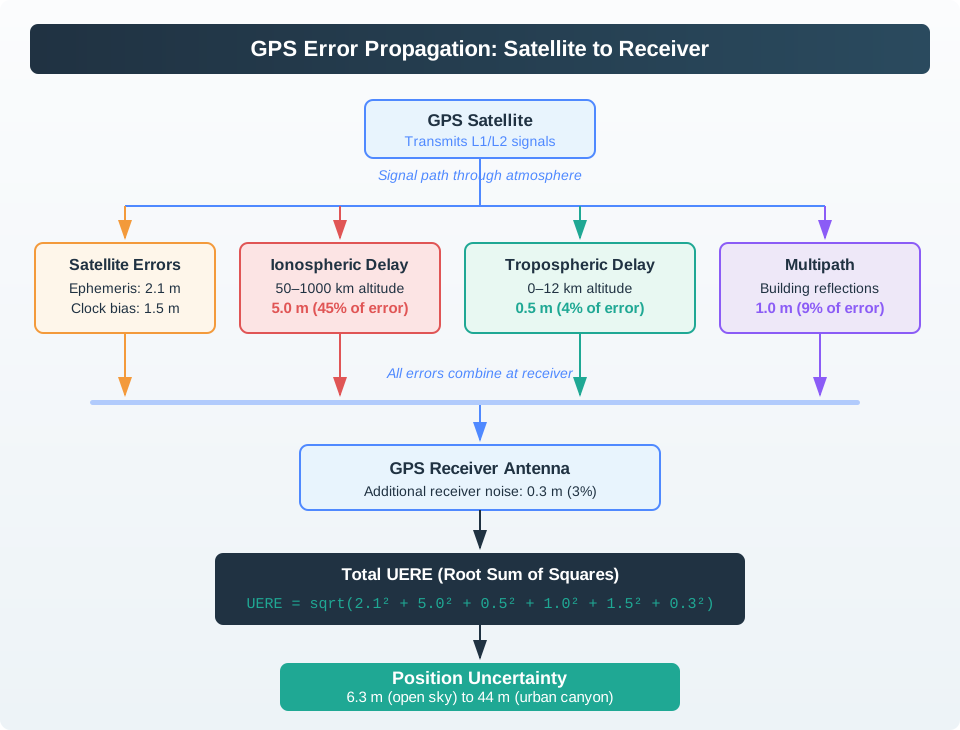
GPS errors do not simply add up – they combine using root sum square (RSS) because the individual error sources are independent random variables. The combined metric is called UERE (User Equivalent Range Error):
Why RSS and not simple addition? If errors added linearly, the total would be 10.8 meters. But because these errors are statistically independent, some positive errors cancel against negative ones at any given moment, resulting in the more realistic 6-meter UERE.
UERE vs. Position Error: The GDOP Multiplier
UERE (6 meters) is the range error per satellite measurement. Your actual position error depends on satellite geometry, quantified by the Geometric Dilution of Precision (GDOP):
13.4 Worked Example: Urban Delivery Tracker Error Budget
Let’s calculate the total GPS position error for an IoT asset tracker deployed in an urban delivery scenario, where multipath from buildings significantly increases error:
Component Error Budget (Urban Environment):\[
\begin{aligned}
\sigma_{\text{iono}} &= 5.0\text{ m (ionospheric delay)} \\
\sigma_{\text{tropo}} &= 0.5\text{ m (tropospheric delay)} \\
\sigma_{\text{clock}} &= 1.5\text{ m (satellite clock error)} \\
\sigma_{\text{ephemeris}} &= 2.0\text{ m (orbital prediction error)} \\
\sigma_{\text{multipath}} &= 3.0\text{ m (urban canyon reflections -- 3x open-sky)} \\
\sigma_{\text{receiver}} &= 1.0\text{ m (consumer-grade receiver noise)}
\end{aligned}
\]
This 40% accuracy improvement explains why logistics companies deploy DGPS base stations for urban fleet tracking. Note that multipath (3.0 m) is now the dominant error source because DGPS cannot correct location-specific reflections.
Figure 13.1: Pie chart showing relative contribution of GPS error sources to total positioning error.
Figure 13.2: Flowchart showing how GPS errors propagate from satellite to receiver.
Why Ionospheric Delay Dominates (45% of Error Budget)
The ionosphere (60-1,000 km altitude) is a layer of charged particles created by solar ultraviolet radiation. GPS signals travel through this layer, and the free electrons slow down the radio waves in a frequency-dependent manner, making measured distances appear longer than actual distances.
Why it is variable:
Solar activity: During solar storms, ionospheric delay can spike to 10-15 meters (vs. 5 m typical). Solar maximum cycles occur roughly every 11 years.
Time of day: Peak ionization occurs around local noon (sun overhead), with minimum delay at night.
Geographic location: Equatorial regions have 2-3x higher ionospheric Total Electron Content (TEC) than polar regions.
Mitigation strategies:
Dual-frequency receivers: Civilian L1+L5 (and military L1+L2) receivers measure two frequencies and calculate ionospheric delay directly from the frequency-dependent dispersion, removing ~99% of ionospheric error.
SBAS augmentation: WAAS (North America), EGNOS (Europe), MSAS (Japan), and GAGAN (India) broadcast real-time ionospheric correction grids.
Single-frequency compromise: L1-only receivers use the Klobuchar model (GPS) or NeQuick model (Galileo) to predict and remove approximately 50-60% of ionospheric error.
13.4.1 Accuracy Levels: From Smartphones to Precision Agriculture
Different IoT applications require different levels of positioning accuracy. Here is how the major enhancement technologies compare:
GPS signals are approximately -130 dBm (extremely weak) even outdoors
Building materials attenuate signals by 20-40 dB (concrete and steel are worst)
Result: No GPS fix indoors in most commercial buildings
Alternatives: Wi-Fi fingerprinting (3-5 m), BLE beacons (1-3 m), or UWB (10-30 cm)
Common GPS Accuracy Misconceptions
Myth 1: “GPS is always accurate to within 5 meters”
Reality: 5-10 m is open-sky accuracy with good satellite geometry. Urban canyons can degrade accuracy to 50+ meters due to multipath and poor GDOP.
Myth 2: “More satellites always mean better accuracy”
Reality: Satellite geometry matters more than count. Four widely-spaced satellites (GDOP = 1.5) outperform eight clustered satellites (GDOP = 4.0) for position accuracy.
Myth 3: “Differential GPS eliminates all errors”
Reality: DGPS only corrects common-mode errors (ionospheric delay, satellite clock) that affect both base station and rover identically. It cannot fix multipath (location-specific) or receiver noise (hardware-specific).
Myth 4: “RTK gives 2 cm accuracy everywhere”
Reality: RTK requires continuous carrier phase lock to at least 5 satellites. Driving under bridges, through dense tree cover, or into tunnels breaks phase lock (cycle slips), and accuracy degrades to standard GPS levels until lock is re-established (30 seconds to several minutes).
13.5 Differential GPS (DGPS)
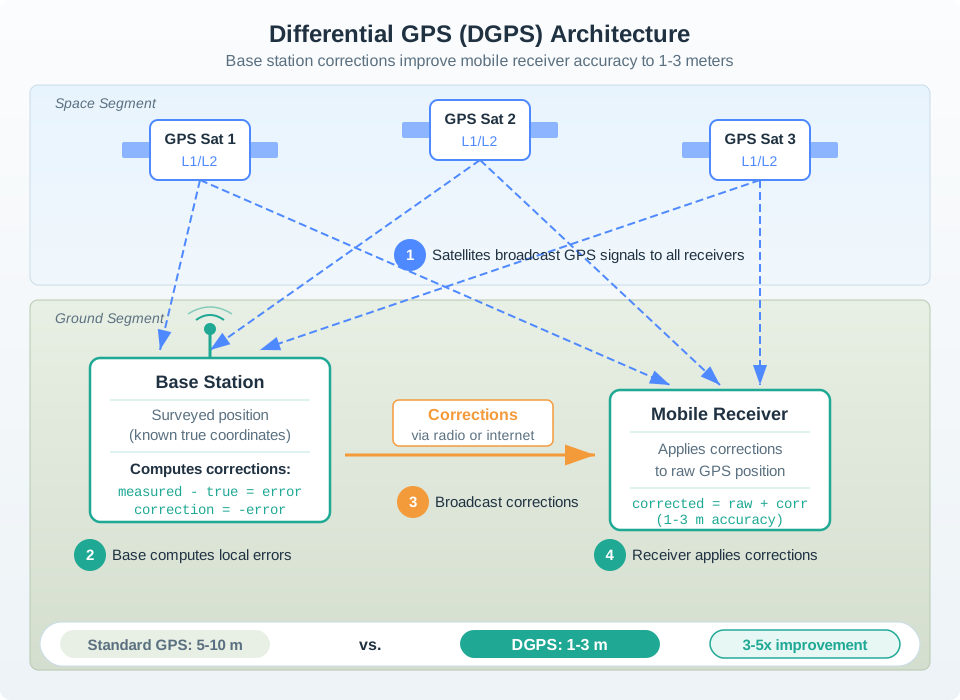
Figure 13.4: Differential GPS system showing base station at known location broadcasting corrections to mobile receivers.
Figure 13.5: DGPS architecture with base station, correction transmission, and mobile receiver applying differential corrections.
DGPS improves GPS accuracy by exploiting the fact that atmospheric and satellite errors are spatially correlated – two receivers within roughly 50 km of each other experience nearly identical ionospheric and tropospheric delays.
DGPS Operating Principle:
Base Station at Known Location: A reference receiver is placed at a precisely surveyed position (known to millimeter accuracy). It continuously computes GPS positions and compares them against its true location.
Error Calculation: The difference between the GPS-calculated position and the true position represents the local error budget – primarily ionospheric delay, tropospheric delay, and satellite clock offsets.
Correction Broadcast: These corrections are transmitted to nearby mobile receivers via radio (283.5-325 kHz for maritime DGPS), FM subcarrier, or internet (NTRIP protocol). Mobile receivers apply the corrections in real-time to achieve 0.5-1 meter accuracy.
Key limitation: Corrections degrade with distance from the base station. Ionospheric gradients cause roughly 1 cm per km of additional error, meaning DGPS at 100 km from the base may only achieve 2-3 meters.
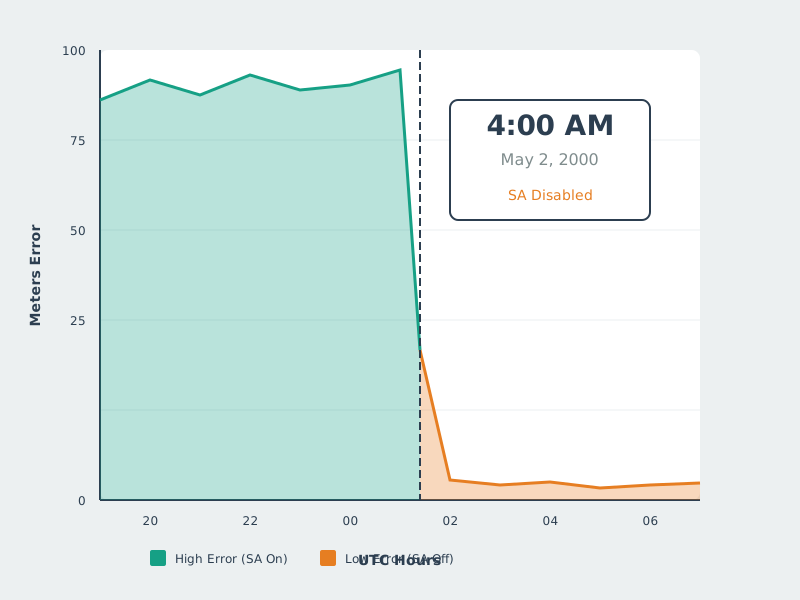
Historical Context: DGPS originally gained importance to counter US military Selective Availability (SA), which intentionally degraded civilian GPS accuracy to ~100 meters. SA was permanently disabled on May 2, 2000, but DGPS remains valuable for removing natural atmospheric errors.
13.6 Advanced GPS Techniques
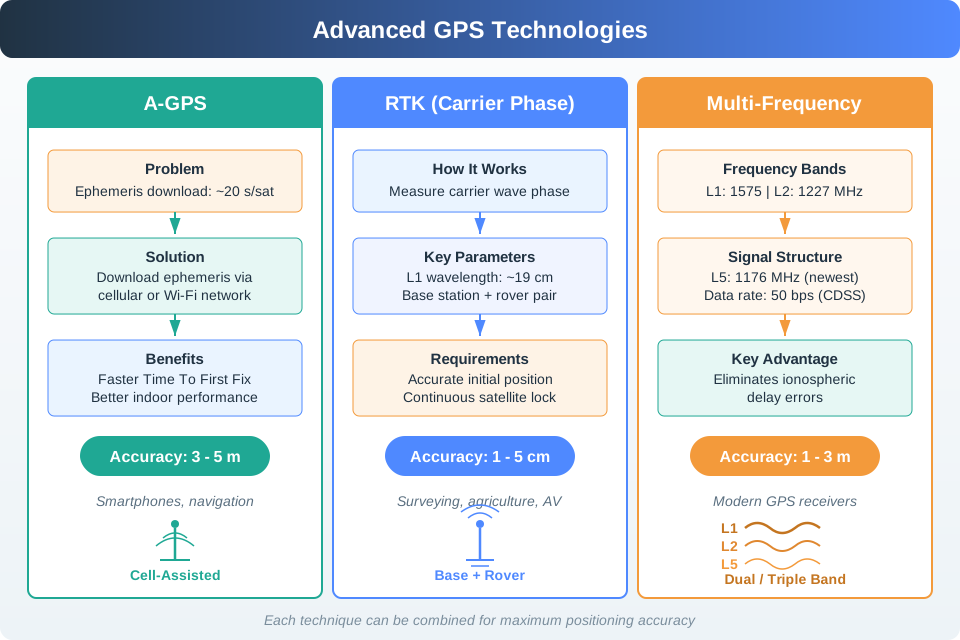
Figure 13.6: Three advanced GPS enhancement technologies: A-GPS for faster fixes, RTK for centimeter precision, and multi-frequency for ionospheric correction.
13.6.1 Assisted GPS (A-GPS)
Problem: A cold start GPS receiver must download a complete almanac and ephemeris from satellite signals at only 50 bits per second, requiring 12-30 minutes for first fix.
Solution: Deliver almanac, ephemeris, and approximate position via cellular data or Wi-Fi, reducing Time to First Fix (TTFF) from minutes to 2-8 seconds.
Benefit: Faster acquisition and improved sensitivity in weak-signal environments (indoors, urban canyons).
13.6.2 Carrier Phase Positioning (RTK)
Standard GPS measures the code (C/A or P-code) on the signal to determine range. RTK instead measures the carrier phase of the L1 signal (wavelength = 19.05 cm at 1575.42 MHz), which provides roughly 1000x finer distance resolution.
Accuracy: 1-2 cm horizontal, 2-5 cm vertical
Requirements:
Base station at known location transmitting phase observations
Minimum 5 satellites with continuous carrier phase lock
Integer ambiguity resolution (determining the unknown number of whole wavelengths)
Applications: Precision agriculture, construction machine guidance, drone surveying, autonomous vehicles
Navigation message data rate: 50 bits per second (extremely slow by modern standards)
Spreading: Direct Sequence Spread Spectrum (DSSS) using pseudo-random noise (PRN) codes enables signal reception at -130 dBm (below thermal noise floor) and distinguishes signals from different satellites on the same frequency
13.7 Practical Example: RTK GPS in Precision Agriculture
Understanding when GPS enhancement is needed is critical for IoT system design. Precision agriculture provides a compelling example where centimeter-level accuracy delivers measurable return on investment.
Case Study: Autonomous Tractor Row Guidance
Problem: Modern farms use autonomous tractors for planting and harvesting. Crop rows are spaced 30-76 cm (12-30 inches) apart. Standard GPS (5-10 meter accuracy) would cause the tractor to:
Destroy crops: Driving over planted rows instead of between them
Miss coverage: Leaving unplanted gaps
Overlap excessively: Wasting seeds, fertilizer, and fuel
Why Standard GPS Fails:
Technology
Accuracy
Can Navigate 50 cm Rows?
Result
Smartphone GPS
5-10 m
No
10x too imprecise – tractor wanders across 20 rows
DGPS
0.5-1 m
Marginal
Still too imprecise for consistent inter-row navigation
RTK GPS
1-2 cm
Yes
Maintains row centerline within the required tolerance
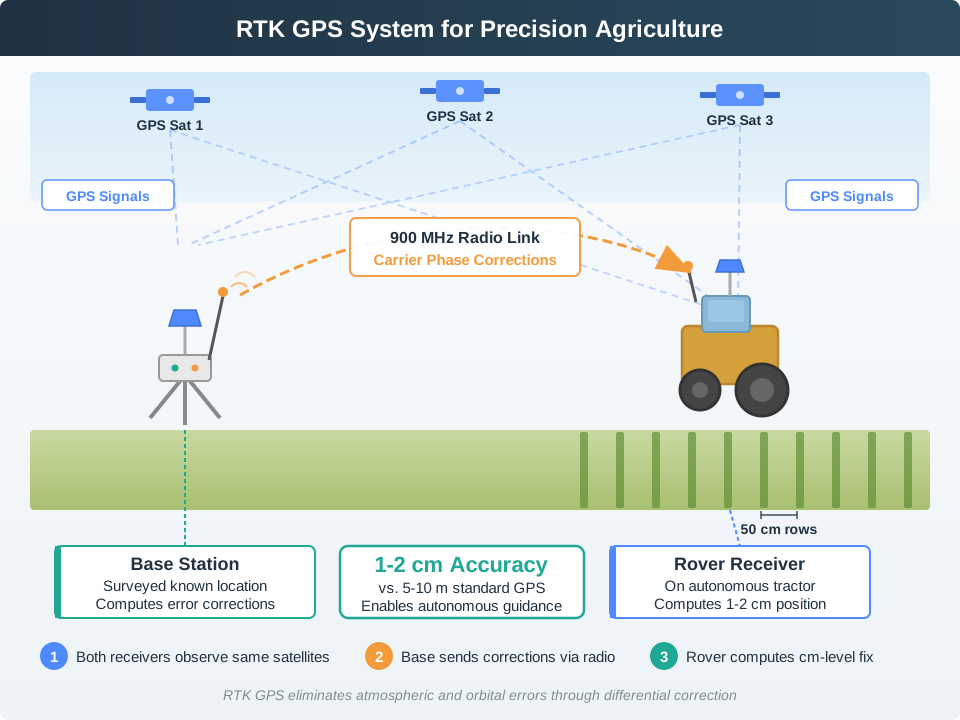
Solution: RTK GPS provides sub-2 cm pass-to-pass accuracy enabling:
Straight-line guidance: Maintain row centerline within +/-2 cm over 1 km field runs
Repeat-pass accuracy: Return to exact same tracks across planting, spraying, and harvesting operations
24/7 autonomous operation: No visual references needed, enabling nighttime operation
Reduced overlap: Typical 5-10% overlap reduced to 1-2%, saving $25,000-$50,000 per year on a 1000-acre farm in fuel, seeds, and chemicals
Figure 13.7: RTK GPS configuration for autonomous tractor guidance showing base station, radio link, and rover receiver on the vehicle.
Hills, trees, and buildings block the 900 MHz or 2.4 GHz correction signal
Effective range: typically 10 km line-of-sight, much less in rugged terrain
Mitigation: Deploy multiple base stations or use NTRIP (Networked Transport of RTCM via Internet Protocol) for internet-delivered corrections
Carrier Phase Lock is Fragile:
Driving under tree canopy, bridges, or through narrow canyons causes cycle slips (loss of integer ambiguity count)
Recovery time: 30 seconds to several minutes for re-initialization
During outages, accuracy degrades to DGPS (sub-meter) or standard GPS (5-10 m)
High Cost and Power Consumption:
Base station: 5-15 W continuous power (requires mains power or large solar panel)
Rover receiver: 2-5 W (vs. 0.5 W for standard GPS chipsets)
System cost: $15,000-$25,000 (base + rover + radio + professional installation)
Professional Setup Required:
Base station must be precisely surveyed to sub-centimeter accuracy
Radio frequency coordination to avoid interference with other equipment
Antenna requires clear sky view, stable mounting, and lightning protection
When RTK is NOT the right choice:
Tracking shipping containers (5-10 m GPS is sufficient to identify the warehouse zone)
Hospital asset tracking indoors (GPS does not work indoors – use BLE beacons)
Wildlife tracking collars (battery life matters more than centimeter precision)
13.8 Knowledge Check
Quiz: GPS Accuracy and Enhancement
Worked Example: Selecting GPS Accuracy for Delivery Fleet Management
Scenario: A logistics company operates 500 delivery trucks across a metropolitan area. They need to track vehicle locations for dispatch optimization, customer ETA notifications, and driver performance monitoring.
Requirements Analysis:
Dispatch optimization: Know which truck is closest to new pickup (city block level, ~100 m adequate)
Customer ETAs: “Your delivery is 5 minutes away” (street-level, ~10 m sufficient)
Geofencing: Alert when truck enters/leaves customer loading dock (zone-level, ~20 m acceptable)
Budget constraint: $200/truck maximum for hardware
Operational: Drivers must operate without technical assistance
Technology Evaluation:
Option
Accuracy
Equipment Cost/Truck
Monthly Service
Meets Requirements?
Smartphone GPS
5-10 m
$0 (driver’s phone)
$0
Yes – sufficient for all use cases
SBAS (WAAS)
1-3 m
$150 (GPS module)
$0
Overkill – 1 m accuracy not needed
DGPS
0.5-1 m
$2,500
$50/month
Overkill – far exceeds budget
RTK GPS
1-2 cm
$15,000
$150/month
Massively over-engineered
Decision: Standard smartphone GPS with map-matching software
Implementation:
Driver app uses phone GPS (no additional hardware cost)
Backend applies map-matching algorithm (snap GPS points to road network) to reduce urban multipath errors from 10-15 m to 3-5 m effective accuracy
Geofences configured with 25 m radius (accounts for 10 m GPS error + 15 m operational buffer)
Position updates every 30 seconds (sufficient for moving vehicles)
Performance After 6 Months:
Metric
Target
Actual
Dispatch accuracy
95% correct “closest truck”
97%
ETA accuracy
+/-5 minutes
+/-3.5 minutes
Address verification
90% correct delivery
94%
False geofence alerts
<2%/day
1.3%/day
Cost per truck
<$200
$0 hardware + $15/month app
Key Insight: The company initially considered DGPS because vendor materials promised “precision tracking.” Engineering analysis demonstrated that standard GPS exceeded every stated requirement. This saved $1.25 million in hardware costs (500 trucks x $2,500). The lesson: specify accuracy requirements quantitatively before evaluating technologies.
Common Mistake: Assuming Constant GPS Accuracy Across All Environments
The Mistake: A shipping company designs a container tracking system assuming GPS provides “5-10 meter accuracy everywhere.” They deploy 10,000 trackers. Six months later, customer complaints flood in: containers showing incorrect locations, sometimes 50+ meters off.
Why the assumption fails: GPS accuracy is not constant. It varies dramatically by environment due to GDOP, multipath, and atmospheric conditions:
Environment
Typical GDOP
Typical Error
Worst Case
Open ocean
1.2-1.5
3-5 m
8 m (solar storm)
Suburban street
1.5-2.5
5-10 m
15 m (dense tree cover)
Urban canyon (downtown)
3.0-8.0
15-50 m
100+ m (tall buildings)
Container port (stacked metal)
6.0-12.0
30-80 m
200+ m (metal multipath)
Indoor warehouse
N/A
No fix
No signal
What went wrong at the shipping company:
Containers in open areas of the port: GPS worked as expected (5 m accuracy)
Containers stacked 4-high between metal walls: GPS showed 50-80 m errors due to severe multipath
Containers in covered warehouses: GPS lost fix entirely
Customer complaint: “Your tracker says my container is in the harbor water!” (300 m error from multipath near port edge)
The Fix (three-part approach):
Show uncertainty, not false precision: Display an error circle in the UI sized to the estimated accuracy (10 m in open areas, 50 m when stacked, “Last known: 2 hours ago” when signal lost).
Sensor fusion: Combine GPS with RFID gate readers at warehouse entrances (confirm zone transitions), accelerometer data (if container has not moved, the last good GPS fix is still valid), and cellular triangulation (100-300 m backup when GPS fails completely).
Environment-aware geofencing: Replace the original 20 m radius geofences (which assumed 10 m GPS error) with 100 m radius geofences that account for 50 m urban/port error plus operational buffer. Result: false alerts reduced by 85%.
Lesson: Never specify GPS accuracy as a single number. Always define error bounds for each deployment environment and test in worst-case conditions (urban canyons, metal structures, obstructed sky) rather than only open-sky best-case scenarios.
Key Takeaway
GPS accuracy is not a fixed number – it ranges from 3-5 meters (open sky, good satellite geometry) to 50+ meters (urban canyons, poor GDOP, severe multipath). Enhancement technologies form a spectrum of cost and precision: SBAS adds 1-3 m accuracy for free, DGPS achieves sub-meter for moderate infrastructure cost, and RTK delivers 1-2 cm at significant expense. The critical design decision is matching technology to requirements: over-engineering wastes money (RTK for fleet tracking), while under-engineering causes failures (smartphone GPS for autonomous farming). Always compute the UERE error budget for your specific deployment environment and multiply by the expected GDOP to determine realistic position accuracy.
For Kids: Meet the Sensor Squad!
GPS accuracy is like giving directions – sometimes “near the school” is good enough, but sometimes you need “third desk from the left!”
13.8.1 The Sensor Squad Adventure: The Accuracy Challenge
The Sensor Squad entered the “Location Olympics” with three different challenges, each needing a different level of accuracy!
Challenge 1: Find the Pizza Delivery Truck “Which street is the truck on?” asked Sammy the Sensor. Regular GPS said “Main Street, near the park.” That was close enough! The pizza was only a few minutes away. “5-10 meter accuracy is PLENTY for tracking delivery trucks,” Sammy announced. GOLD MEDAL!
Challenge 2: Guide the Robot Farmer “The robot tractor needs to plant seeds in rows that are only 50 centimeters apart!” said Max the Microcontroller. Regular GPS said “somewhere around here” (5-10 meters off). The tractor ran over three rows of plants! DISASTER!
“We need RTK GPS!” said Bella the Battery. They set up a special base station that sent correction signals. Now the tractor knew its position within 2 CENTIMETERS. The rows were perfectly straight! GOLD MEDAL!
Challenge 3: Find the Lost Cat Indoors “Where is Whiskers in the house?” asked Lila the LED. GPS said… nothing. Zero signal indoors!
“GPS does not work inside buildings!” explained Sammy. “The satellite signals are too weak to go through walls. We need BLUETOOTH BEACONS instead!” They put tiny beacons in each room, and now they could tell Whiskers was in the kitchen (probably near the food bowl). GOLD MEDAL!
“Different accuracy for different jobs!” said the Sensor Squad. “Do not use a ruler when you need a microscope, and do not use a microscope when you just need a ruler!”
13.8.2 Key Words for Kids
Word
What It Means
Error Budget
All the little mistakes that add up to make GPS less accurate (like adding up all the small delays)
DGPS
A helper station on the ground that fixes some GPS errors to make it more accurate
RTK GPS
Super-precise GPS that knows your position within 2 centimeters (width of a thumb!)
GDOP
How well-spread the satellites are in the sky – spread out is good, bunched together is bad
Concept Relationships
GPS Accuracy and Enhancement connects to:
GPS Fundamentals - Base understanding of time-of-flight, multipath, and error sources
Indoor Positioning - Technologies for environments where GPS cannot operate