9 IoT Design Patterns: Responsibility Boundaries
More
Depth: Practitioner
Progress saves as you read. Mark sections complete as you go; your progress appears in the sidebar.
9.1 Start With the Decision
This section: Start With the Decision — A building light can fail after one part changes because no one knows which part owns state.
A building light can fail after one part changes because no one knows which part owns state. A pattern must make that duty clear.
9.2 Route Overview
This section: Route Overview — This is part 1 of 2.
This is part 1 of 2. Continue with IoT Design Patterns: Gateways, Twins, and Commands.
9.3 Part Objectives
This section: Part Objectives
- Assign sensing, command, storage, and recovery duties.
- Test a pattern boundary before choosing its name.
9.4 Chapter Roadmap
This section: Chapter Roadmap
- Start Simple
- In 60 Seconds
- Check Your Pattern Boundary
- Minimum Viable Understanding
- Prerequisites
- Overview: Patterns Assign Responsibility
- Practitioner: Make Contracts Concrete
- Boundary Drift in Models
- Review Pattern Responsibilities
- Component Boundaries
9.5 Start Simple
This section: Start Simple — Picture a building light that stops after one part is replaced.
Picture a building light that stops after one part is replaced. The team needs to know which part owns the command, which part stores state, and which part reports the result. A pattern is useful when it makes that duty clear.
A gateway is a device or service that joins one system boundary to another. A design pattern is a reusable way to assign a job. Start with the job, not the pattern name. A gateway may translate and buffer. A digital twin may hold a known view of device state. A command record may track an asked-for action. An observer may pass an event to listeners. Each choice needs a clear owner, input, output, fault state, and test.
Ask one duty at a time:
- What job must be owned?
- Which part owns it?
- What enters that part?
- What leaves it?
- Which state can become stale?
- Can one action run twice?
- Can one event arrive late?
- Who sees a failed command?
- Can the part be replaced?
- Which test proves the boundary?
A pattern does not make a design good by its name. Several patterns can also hide a gap between owners. Practitioner writes the interface and failure record. Under the Hood covers stale state, event order, repeated commands, and model drift. Those details can change the chosen pattern. They do not excuse a duty with no owner.
Use this quick retell before the full review. Begin with the user need. Name the physical job. Name the wanted result. Name the part in charge. Give that part one clear duty. Give its input a plain name. Give its output a plain name. Keep its state visible. Keep its fault state visible. Name the person who supports it.
Now check a gateway. It sits at a boundary. It may change message form. It may join small records. It may hold data offline. It may enforce a local rule. It must not hide bad input. It must report its own health. It needs a safe update path. It needs a known fallback.
Now check a digital twin. It is a view of state. It is not the real device. Its source must be known. Its age must be shown. Its confidence may be limited. Two sources may disagree. One rule must resolve that clash. A stale twin stays marked stale. A user must see the limit.
Now check a command. A person or rule asks for an act. The request names its target. The request names its owner. Rights are checked first. Safe preconditions are checked. A repeated request is handled on purpose. A timeout has a result. A rejection has a reason. The final state is checked.
Now check an observer. One part sends an event. Other parts may listen. A late event stays late. A repeated event stays known. Event order may matter. A slow listener must not block safety. A listener must not become a hidden controller. Logs keep the event source. Support can trace the event path.
Now check a component. Its edge is small and clear. Its private work stays inside. Its public contract stays stable. A test can replace the real part. A new part can keep the contract. A bad input gets a known response. A failed output stays visible. The owner can change it safely.
Now check a shared model. It holds common names. It holds common types. It can make settings. It can make code or tests. The source model has a version. Generated work names that version. A manual change cannot drift unseen. A wrong model can still make wrong work. Review still needs field proof.
Finish with the joined design. Each duty has one owner. Each boundary has one contract. Each state has one trusted source. Each failure has one visible result. Each fallback has one trigger. Each change has one retest rule. The user sees what happened. Support sees where it failed. The team can explain why the pattern remains.
A pattern is a promise about responsibility. Start by asking what work the gateway, digital twin, command path, observer, component, or model boundary is meant to own, then check whether the people using the system can see enough evidence to trust that responsibility.
9.6 In 60 Seconds
This section: In 60 Seconds — IoT design patterns are reusable ways to assign responsibility.
IoT design patterns are reusable ways to assign responsibility. They are useful only when they make a real boundary, interface, state rule, command path, event path, or failure behavior easier to understand and test.
This chapter reviews component-based design, Gateway, Digital Twin, Command, Observer, and model-driven design as implementation choices. The goal is not to name patterns from memory. The goal is to decide where responsibility belongs, what evidence supports that choice, what tradeoff is accepted, and what future change should reopen the decision.
9.7 Learning Objectives
This section: Learning Objectives
By the end of this chapter, you will be able to:
- define component boundaries that hide implementation details but expose the evidence a system needs
- explain when Gateway, Digital Twin, Command, and Observer patterns fit an IoT design problem
- combine patterns without hiding ownership, stale state, duplicate commands, or event-ordering problems
- use model-driven design when repeated deployments need consistent generated artifacts
- record pattern decisions with interface, failure, owner, open issue, and change conditions
- reject pattern choices that add complexity without solving a reviewed responsibility
9.8 Minimum Viable Understanding
This section: Minimum Viable Understanding — A pattern is not automatically good design.
A pattern is not automatically good design. A pattern is justified when it answers a specific responsibility question:
Gateway: What translates, filters, buffers, or locally decides at a boundary? Digital Twin: What is the authoritative representation of device state, and when can it become stale? Command: What action is requested, authorized, queued, retried, rejected, canceled, or audited? Observer: What event is published, who subscribes, and what happens when delivery is late or duplicated? Component boundary: What interface lets a part be tested, replaced, or reused without hiding risk? Model-driven design: What shared model generates consistent configuration, code, documentation, or tests?
If the team cannot connect a pattern to evidence, an interface, failure behavior, and an owner, the pattern is probably decoration.
9.9 Prerequisites
This section: Prerequisites
This chapter builds on:
- IoT Pattern Selection Assessment, which frames pattern choice as an evidence review.
- IoT Architecture Model Selection, which defines the system boundary that patterns must respect.
- Design Thinking for IoT, which supplies user and prototype evidence.
- Calm Technology Attention Policy, which keeps attention, feedback, service, and platform effects visible.
- Connected Device Fundamentals, which defines endpoints, gateways, actuators, interfaces, and infrastructure roles.
9.10 Overview: Patterns Assign Responsibility
This section: Overview: Patterns Assign Responsibility — IoT patterns are useful when they make a responsibility testable.
IoT patterns are useful when they make a responsibility testable. A gateway is not just a box between devices and the cloud. A digital twin is not just a database row. A command is not just a function call. An observer stream is not just a list of subscribers. Each pattern should clarify who owns state, what crosses the boundary, what fails visibly, and what support can inspect.
The first review question is not “which pattern sounds familiar?” It is “which responsibility is unclear without this pattern?” A room controller may need a gateway because field devices speak Zigbee, BLE, Modbus, or BACnet while operations needs one MQTT or HTTP contract. It may need a digital twin because several services need the same room state, freshness, and confidence rule. It may need commands because physical actions must be accepted, rejected, retried, or audited. It may need observers because dashboards, logs, alerts, and support views should receive events without becoming hidden controllers.
Use Figure 9.1 to follow a building command and its evidence across component boundaries.
A light sensor sends a reading through the gateway, where the MQTT contract names the topic, schema, units, timestamp source, and retry rule. The room twin then represents occupancy and freshness rather than owning the sensor itself. A command follows a separate route back toward the device, where local fallback and the result must be visible. The two traces reveal who can change state and who can only observe it. That distinction is needed when a repeated command or stale reading reaches the dashboard.
For a building-control system, a gateway may translate Modbus, BACnet, Zigbee, or BLE data into MQTT topics. A room twin may represent occupancy, freshness, confidence, and actuator relationships. A command handler may validate authorization and preconditions before changing ventilation. Observer events may feed dashboards, logs, alerts, and support tools without turning every subscriber into a controller.
The pattern record should also show rejected alternatives. A retained MQTT topic may be enough for a simple last-known state, while AWS IoT Device Shadows, Azure Digital Twins, Eclipse Ditto, or a custom state service may be justified when relationships, simulations, access rules, or fleet-scale consistency matter. A direct REST call may be enough for a harmless configuration change, while a command object is safer for actuator changes that need preconditions, idempotency, timeout, and support evidence.
Boundary: name the component, the owned state, the interface contract, and what it deliberately does not own. Pattern: choose Gateway, Digital Twin, Command, Observer, Adapter, or Model-driven design because it answers a responsibility question. Failure: define stale state, duplicate events, rejected commands, queue overflow, offline fallback, and support evidence before implementation.
9.11 Practitioner: Make Contracts Concrete
This section: Practitioner: Make Contracts Concrete — Pattern reviews should leave behind contracts that engineers and support teams can test.
Pattern reviews should leave behind contracts that engineers and support teams can test. MQTT topic names, QoS level, retained-message policy, CoAP response codes, REST status codes, OpenAPI paths, AsyncAPI channels, JSON Schema payloads, OPC UA node ids, LwM2M object resources, and Matter clusters all shape what the pattern actually means.
Write the contract at the boundary where a wrong assumption would harm the user promise. For a gateway, that means the device-side protocol, normalized field names, units, timestamp source, queue limit, retry policy, and local fallback rule. For a twin, it means desired state, reported state, last update time, confidence, relationship fields, schema version, and authority for conflict resolution. For command and observer patterns, it means command ID, idempotency key, acceptance state, rejection reason, event type, event version, subscriber permission, and duplicate handling.
- Gateway: state which protocols are translated, which payloads are normalized, what is buffered locally, and what works during internet loss.
- Digital Twin: state source of truth, freshness, desired versus reported state, confidence, schema owner, and how twins are archived or deleted.
- Command and Observer: state idempotency key, sequence number, authorization, acceptance rule, acknowledgement, retry, duplicate handling, subscription permission, and event version.
Use real alternatives in the review. AWS IoT Device Shadows, Azure Digital Twins, Eclipse Ditto, a Postgres state table, or a simple retained MQTT state topic make different tradeoffs. The pattern choice should explain why the selected option fits the user promise and operating burden.
A good practitioner review tests one uncomfortable case before accepting the pattern. If the gateway is offline for ten minutes, does the room twin say stale, unknown, inferred, or available? If a user taps a ventilation command twice, does the command handler deduplicate it or actuate twice? If observer delivery is delayed, do dashboards and alerts display event time, receive time, or a misleading current label? If the model-driven generator emits an invalid dashboard label, is the source model fixed or is the generated file patched by hand? These cases expose whether the pattern owns real behavior or only vocabulary.
9.12 Boundary Drift in Models
This section: Boundary Drift in Models — Pattern drift happens when two components quietly own the same responsibility.
Pattern drift happens when two components quietly own the same responsibility. A gateway and cloud service may both rewrite device state. A command queue and direct API may both actuate the same relay. A digital twin may store desired state while the dashboard treats it as measured state. An observer may publish an event that one subscriber treats as a fact and another treats as a command.
The technical cause is usually a missing authority rule. Telemetry, state, command intent, command result, alert, and support diagnosis are different facts even when they share a device ID. A robust pattern model separates them before code is written. Telemetry may come from firmware, normalized state may be owned by a gateway, desired state may be owned by a cloud service, command result may be owned by an actuator controller, and user-visible status may be owned by the application. Each one needs a timestamp, version, and failure label.
Model-driven design can reduce this drift only when the model is clear. A source model can generate MQTT topics, JSON Schema payloads, OpenAPI documentation, dashboard labels, test fixtures, or support checklists. It becomes a risk when teams edit generated output by hand or when the model cannot express a field condition such as replacement device diagnostics or site-specific permissions.
Under the hood, the safest pattern combinations are traceable. A sensor event can be followed through topic, schema, gateway log, twin update, observer event, dashboard render, and support record. A command can be followed from issuer, permission check, precondition, queue, actuator acknowledgement, retry decision, and user feedback. A generated artifact can be followed back to the source model field and generator version that produced it. Without that chain, teams cannot tell whether a problem is a device fault, a stale twin, a duplicate observer event, a direct-control bypass, or a generator drift.
- Version contracts: version schemas, events, commands, and generated artifacts so old devices and new services can coexist safely.
- Trace ownership: connect each state, command, event, and generated artifact back to an accountable owner and source model field.
- Boundary tests: use simulator, hardware-in-loop, contract tests, and field logs to prove behavior under stale, duplicate, offline, and rejected-command cases.
9.13 Review Pattern Responsibilities
This section: Review Pattern Responsibilities — The gateway example in Figure 9.2 gives one concrete boundary for a reusable component pattern.
The gateway example in Figure 9.2 gives one concrete boundary for a reusable component pattern.
Modbus, BACnet, Zigbee, and BLE field devices meet at the building control gateway. Inside that component, translation, aggregation, offline storage, and a local rule are private responsibilities. Outside it, the MQTT or HTTP contract is the stable interface other components can rely on. The figure separates those two sides so a review can ask what crosses the boundary and what stays inside. If the field protocol changes, the public message form and its failure behavior still need explicit checks.
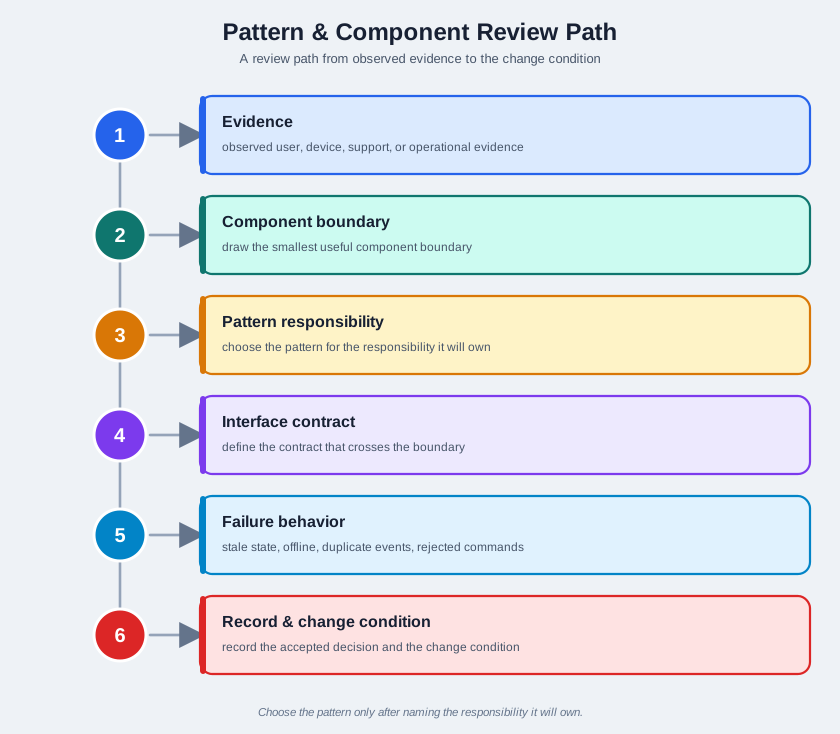
start with observed user, device, support, or operational evidence. draw the smallest useful component boundary. choose the pattern only after naming the responsibility it will own. define the interface contract that crosses the boundary. review stale state, offline behavior, duplicate events, rejected commands, and support paths. record the accepted decision and the change condition.
9.14 Component Boundaries
This section: Component Boundaries — Component-based design breaks a system into parts with explicit contracts.
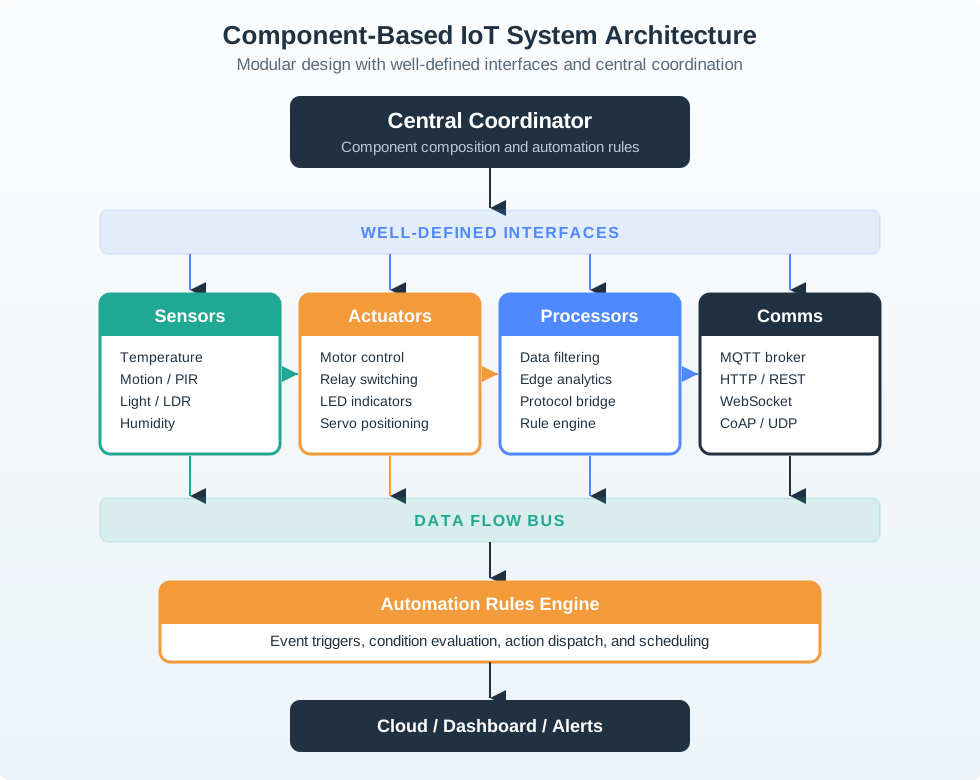
Component-based design breaks a system into parts with explicit contracts. In an IoT system, a component may be a physical device, firmware module, gateway service, cloud service, mobile app feature, dashboard widget, provisioning step, support tool, or data model.
A useful component boundary makes these questions answerable:
- What does this component own?
- What does it deliberately not own?
- What crosses the boundary?
- What format, timing, state, permission, and error meaning cross with it?
- What evidence proves the interface works?
- What can replace this component without changing the rest of the system?
- What failure must be visible to users, operators, or support teams?
Avoid boundaries that only mirror the team org chart or technology stack. A cloud service, gateway process, and app view can still be one unresolved responsibility if no one knows which part owns device state, command acceptance, or failure recovery.
9.14.1 Component Interface Evidence
Review component interfaces with evidence, not just names:
Inputs: messages, events, readings, commands, configuration, identity, permissions, and context. Outputs: state changes, acknowledgements, alerts, logs, command results, user feedback, and support evidence. State: current value, source of truth, freshness, confidence, and conflict resolution. Failure: timeout, stale reading, rejected command, duplicate event, unavailable path, invalid payload, or degraded mode. Test evidence: unit tests, integration tests, hardware-in-loop checks, field observations, support records, and simulation results.
9.15 Continue to the Next Part
This section: Continue to the Next Part — Carry this evidence into IoT Design Patterns: Gateways, Twins, and Commands, which begins with Gateway Pattern.
Carry this evidence into IoT Design Patterns: Gateways, Twins, and Commands, which begins with Gateway Pattern.
9.16 Additional Knowledge Checks
This section: Additional Knowledge Checks
Find help
3 reviewed answers.
Where should I start in a module?
Open the module page from the sidebar to see its chapters in order. Use the module map to return to a topic you need.
Modules and pathsReviewed
What can I try when a project does not work?
Check the symptom, then work through the diagnostic steps. Keep the error message and the smallest example that reproduces it.
When you are stuckReviewed
How do interactive examples work?
Use the interactive guide to check how examples and simulations work before changing your project.
Interactive examples guideReviewed