9 Sensor Production: Assessment and Decisions
More
Depth: Practitioner
Progress saves as you read. Mark sections complete as you go; your progress appears in the sidebar.
9.1 Start With the Decision
This section: Start With the Decision — A sensor workflow is not ready because its diagram looks complete.
A sensor workflow is not ready because its diagram looks complete. The assessment must prove that each trust decision, failure path, and operator action has evidence.
9.2 Route Overview
This section: Route Overview — This is part 4 of 4.
This is part 4 of 4. Review Sensor Production: Framework and Review for the preceding evidence.
9.3 Learning Objectives
This section: Learning Objectives
- Assess sensor-production decisions against trust and failure evidence.
- Connect quiz, review, and deployment records to a release decision.
9.4 Chapter Roadmap
This section: Chapter Roadmap
- Summary
- Key Takeaway
- Concept Relationships
- What’s Next
9.4.1 Sensor Production Quiz
9.4.1.1 Start With the Production Choice
Make the Answer Safe to Use
Picture a cold-store quiz that shows one old temperature reading and a device that is still online. The tempting answer says the room is safe because the device can be reached. That choice confuses connection with fresh evidence.
Read each item as a small release review. Mark what was observed, when it was observed, what quality state applies, and which action the evidence can support. Then name the missing fact that would change the answer.
Test the choices against stale, absent, conflicting, and uncertain readings. A strong wrong answer should expose a real mistake, not a trick in the wording. Feedback should explain the boundary and tell the learner what to check next.
One quiz item cannot prove field skill. It can practise a sound chain from evidence to state, action, and retest. The deeper sections build that chain across production cases so a correct label never hides an unsafe reason.
Production quiz questions should feel like small release decisions. The learner should have to decide whether the evidence is strong enough, which quality state applies, what action is bounded, and what feedback would make a weak answer better.
Use this chapter to practice that judgment. The answer is not just the right label; it is the reason the label, action gate, and retest trigger fit the scenario.
9.4.1.2 In 60 Seconds
A sensor production quiz should test review judgment, not memorized slogans. A useful item gives a scenario, observable evidence, a quality state question, a bounded action, and feedback that explains why the answer is safe for the stated decision.
This chapter practices the production framework from the previous chapter. The focus is evidence quality: what was observed, what is missing, what action the record supports, and what later change should reopen the decision.
9.4.1.3 Learning Objectives
By the end of this chapter, you will be able to:
- Read a sensor production quiz item as a review record.
- Identify the evidence needed before a quality state or action gate is accepted.
- Choose a bounded action for stale, missing, conflicting, or uncertain sensor evidence.
- Write feedback that explains the evidence behind each answer option.
- Define retest triggers for production review practice.
9.4.1.4 First Step: Sensor Production Quiz Evidence
9.4.1.5 Minimum Viable Understanding
A production quiz item starts with observable evidence, and its correct answer fits the scenario’s decision boundary. Feedback explains that evidence rather than merely naming the right option. A strong item preserves uncertainty instead of inventing a cause, while a retest trigger keeps the answer aligned with sensor evidence that can change.
9.4.1.6 Prerequisites
- Sensor Production Framework: quality states, action gates, ownership, validation, and retest triggers.
- Sensor Behaviors Production and Review: production review records for behavior logic.
- Sensor Behavior Applications: Quiz Review: assessment-style scenario evidence and feedback.
- Sensor Node Behavior Classification: behavior labels based on observable evidence.
9.4.1.7 Practice Scope
Keep this quiz chapter scoped to production review decisions. It should not become a general exam page, broad architecture survey, platform comparison, or code exercise.
Each item identifies the decision that depends on sensor evidence and the visible source, role, message, reading, or quality state. It also exposes evidence that is missing, stale, contradictory, or outside scope. The learner then selects the action gate supported now and receives feedback that helps revise the reasoning. The item ends by naming the later evidence that should trigger retest.
9.4.1.8 Assessment Route
A production quiz route should move from scenario evidence to a review decision and feedback. Follow Figure 9.1 before accepting an item so its quality state, action, explanation, record, and retest condition form one traceable argument.
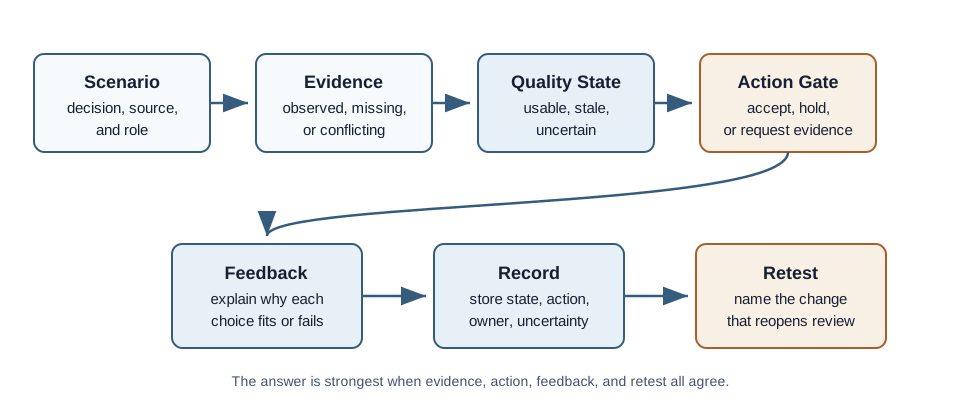
Read Figure 9.1 from scenario evidence to quality state, first establishing what the system saw and which decision depends on it. Then classify the evidence as acceptable, stale, conflicting, unavailable, recovering, or uncertain before choosing what the action gate may safely permit. Feedback explains why each option is or is not supported, and the review record preserves source, state, action, owner, and uncertainty. The final trigger names the change that reopens the decision, connecting the assessment answer to the same reversible production logic used throughout the module.
9.4.1.9 What A Good Item Tests
A good item tests one production-review move at a time.
Evidence recognition
The learner identifies what the scenario actually says. For example, a source may be present but stale, plausible but contradicted, or missing context needed by the action gate.
Quality-state choice
The learner chooses a quality state that fits the evidence. The state should not be stronger than the scenario supports.
Action boundary
The learner selects an action that protects the affected decision without changing unrelated decisions.
Feedback reasoning
The learner sees why an option is right or wrong. Strong feedback names the evidence, the missing evidence, and the boundary of the action.
Retest trigger
The learner identifies what new observation, configuration change, recovery result, or related evidence should reopen the review.
9.4.1.10 Quiz Review Record
A production quiz item should leave a compact review record, so inspect Figure 9.2 to verify that the prompt purpose and case evidence support the proposed state, action, and feedback.
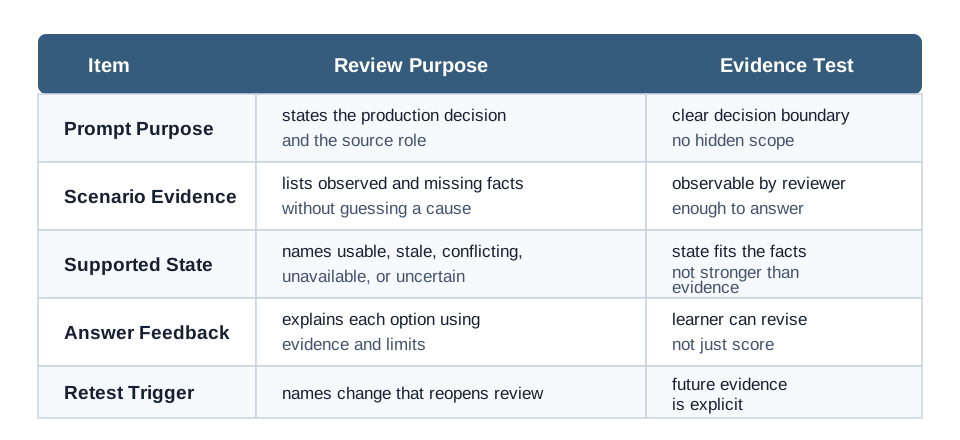
Read Figure 9.2 from the prompt to the final action. First ask what the prompt tests. Then find the facts from the case that support the answer. The quality state shows how much trust those facts deserve. Any doubt stays visible instead of being hidden by the chosen option. Next, check that the feedback explains why the action is safe. The retest trigger states what new fact could change it. This record turns recall into a claim that the learner can support with evidence.
9.4.1.11 Worked Review: Stale Source Item
Scenario: a production rule is about to use a sensor source for an equipment-state decision. The latest message is available, but its observation time is old relative to the decision. Related evidence has changed since that message.
Concrete example: a pump-status quiz item may show a pressure reading that arrived successfully but is older than the control decision, while a flow source has changed since then. The supported answer should protect the current decision from stale evidence without claiming the pressure sensor has permanently failed.
Question focus
What action gate should the production framework apply before the decision uses this source?
Supported answer
Mark the source stale or unavailable for this decision, preserve the latest message as evidence, and request a current observation or corroborating evidence.
Why this is supported
The scenario does not say the sensor is broken or misleading. It says the evidence is no longer current enough for the decision. The action should protect the decision without inventing a root cause.
Good distractors
- Accept the value because it is reachable.
- Permanently reject the source.
- Reclassify every related source as faulty.
These distractors are useful because they represent common overreactions or underreactions.
Retest trigger
Reopen the review when a current observation arrives, related evidence changes again, the source role changes, or the quality rule is revised.
9.4.1.12 Worked Review: Conflicting Evidence Item
Scenario: a sensor source sends complete messages, and the values are possible by themselves. The same decision also uses related evidence that repeatedly contradicts that source.
Question focus
Which quality state and action gate should the learner choose?
Supported answer
Mark the source conflicting or suspect for the affected decision, require corroboration before accepting it, and preserve the contradiction in the review record.
Why this is supported
Presence and plausibility are not enough. The contradiction matters because it affects the decision. The review should avoid claiming a physical cause until separate evidence supports it.
Good feedback
Feedback should say that the source is active but not fully trusted for this decision. It should also explain that the action is bounded to the affected decision, not a permanent source-wide rejection.
Retest trigger
Reopen the review after a related-source check, source recovery evidence, role update, or repeated agreement under the same decision context.
9.4.1.13 Common Item Problems
A weak prompt asks for a label without observable evidence or makes the correct answer assume a cause never stated by the scenario. Random distractors do not expose common review mistakes, and feedback that only says “correct” or “incorrect” does not teach the evidence boundary. Do not accept reachable data without checking freshness and quality, or let the action gate affect more of the system than the evidence supports. Every item needs the trigger that would reopen its answer.
9.4.1.14 Knowledge Check
9.4.1.15 Matching Quiz
9.4.1.16 Ordering Quiz
9.4.1.17 Summary
The Sensor Production Quiz is a practice chapter for evidence-bound production review. Strong items make the learner identify observable evidence, choose a supported quality state, apply a bounded action gate, explain feedback, and name a retest trigger. Weak items drift into recall, unsupported causes, broad claims, or actions larger than the evidence supports.
9.4.1.18 Key Takeaway
Production quizzes should check whether learners can turn specialized architecture concepts into concrete review decisions.
9.4.1.19 Concept Relationships
Sensor Production Framework provides the quality-state, action-gate, ownership, validation, and retest language used here. Sensor Behaviors Production and Review explains why those decisions need records before downstream use, while Sensor Behavior Applications: Quiz Review focuses on scenario and feedback design. Sensing as a Service applies the same evidence discipline to shared sensing boundaries.
9.4.1.20 What’s Next
Next, continue with Sensing as a Service to apply evidence-bound review records to shared sensor access, quality states, permissions, and consumer decisions.
9.4.2 Summary
A sensor production framework makes behavior decisions reviewable. It does this by connecting observations, evidence records, quality states, trust and recovery support, action gates, ownership, validation, and retest triggers.
The safest framework does not overstate certainty. It preserves uncertainty, keeps labels evidence-bound, limits actions when context is missing, and reopens decisions when the source, role, evidence, or decision context changes.
9.4.3 Key Takeaway
A production sensor framework needs evidence for behavior, duty cycle, trust, topology, maintenance, and incident response.
9.4.4 Concept Relationships
Sensor Behaviors Production and Review provides the gate that this chapter turns into a framework record. Trust Management explains how trust and recovery can support behaviour review without replacing observations, while Sensor Node Behaviors: Taxonomy keeps labels tied to current evidence. Sensing as a Service applies the same record discipline at a shared-data boundary.
9.4.5 What’s Next
Next, continue with Sensor Production Quiz to practice applying production-framework evidence, action gates, and retest decisions.
9.5 Summary
This section: Summary — Trust management is a way to connect sensor behavior evidence to routing, data acceptance, and validation decisions.
Trust management is a way to connect sensor behavior evidence to routing, data acceptance, and validation decisions. The useful implementation question is not “Which universal formula should every system use?” It is “Can this trust decision be reviewed from expected role, observations, related checks, local rule, bounded action, and retest trigger?”
Keep trust states conservative. If evidence is incomplete, hold a suspect or unknown state, request corroboration, or narrow the affected decision. If action is justified, preserve the evidence and name the condition that could change the decision later.
9.6 Key Takeaway
This section: Key Takeaway — Trust implementation should combine identity, behavior evidence, anomaly handling, revocation, and audit records instead of relying on a single score.
Trust implementation should combine identity, behavior evidence, anomaly handling, revocation, and audit records instead of relying on a single score.
9.7 Concept Relationships
This section: Concept Relationships — Sensor Node Behaviors: Taxonomy defines the labels used when trust evidence is interpreted, and Sensor Node Behavior Classification supplies the checks that precede trust action.
Sensor Node Behaviors: Taxonomy defines the labels used when trust evidence is interpreted, and Sensor Node Behavior Classification supplies the checks that precede trust action. Selfish & Malicious Nodes separates non-cooperation from active disruption without overclaiming motive. Mine Safety Case Study shows why missing or contradictory evidence must remain visible, before Sensor Behaviors Production and Review carries the trust record into a broader production gate.
9.8 What’s Next
This section: What’s Next — Previous: Sensor Behavior Applications: Quiz Review and Mine Safety Case Study for the behavior-review context that leads into trust decisions.
Previous: Sensor Behavior Applications: Quiz Review and Mine Safety Case Study for the behavior-review context that leads into trust decisions.
Next: Sensor Behaviors Production and Review for applying the same evidence and retest standard to production behavior rules.
9.9 Continue Your Route
This section: Continue Your Route — The Summary records the assessment decision; What’s Next names the evidence still needed before production.
The Summary records the assessment decision; What’s Next names the evidence still needed before production. Return to Sensor Production: Framework and Review or continue from the specialized-arch module index.
Find help
3 reviewed answers.
Where should I start in a module?
Open the module page from the sidebar to see its chapters in order. Use the module map to return to a topic you need.
Modules and pathsReviewed
What can I try when a project does not work?
Check the symptom, then work through the diagnostic steps. Keep the error message and the smallest example that reproduces it.
When you are stuckReviewed
How do interactive examples work?
Use the interactive guide to check how examples and simulations work before changing your project.
Interactive examples guideReviewed