7 Sensor Trust: Production Records
More
Depth: Practitioner
Progress saves as you read. Mark sections complete as you go; your progress appears in the sidebar.
7.1 Start With the Decision
This section: Start With the Decision — A trust score changes after a lost packet, but no one can say why.
A trust score changes after a lost packet, but no one can say why. A production record must keep the inputs, rules, decision, and review state.
7.2 Route Overview
This section: Route Overview — This is part 2 of 4.
This is part 2 of 4. Review Sensor Trust: Evidence and Review for the preceding evidence.
7.3 Learning Objectives
This section: Learning Objectives
- Design a sensor trust record with observation and policy provenance.
- Trace trust updates, expiry, and bounded actions through production state.
7.4 Chapter Roadmap
This section: Chapter Roadmap
- Sensor Behavior Production Record
- Knowledge Check: revise a production trust state
- Knowledge Check: preserve trust policy provenance
7.5 Sensor Behavior Production Record
This section: Sensor Behavior Production Record
7.5.1 Start With the Release Decision
-

Pause before one sensor rule changes live actions.
-

Match what was seen to the smallest action the evidence can support.
-

Name an owner and retest trigger, then keep the action small while doubt remains.
Picture a team about to let one sensor rule change live actions. The label may shape an alert, a route, or the data that people trust.
First, ask what was seen and which action that evidence can support. Record the owner and the test that will reopen the choice.
A strong label built from weak evidence can block good data or hide a real fault. A safe review keeps the action small while doubt remains.
That is the simple story, but it does not prove why a label is right in each case. The records and worked reviews later in the chapter provide that detail.
Use the Practitioner sections to review rules and release records. Use the Under the Hood material to test trust, intent, and change over time.
Plain check
- Name the observed act. Name the expected role. Keep the two apart. Mark what is unknown.
- Pick the smallest response. Name its owner. Set the next test. Keep the record open.
- Review with Practitioner next. Test the hard cases. Read the deeper limits. Reopen weak claims.
A production record is where a behavior label becomes an operating commitment. Before release, someone has to explain what the node can do, what evidence supports that claim, which action is allowed when behavior changes, and when the review must run again.
Read this chapter as the handoff from analysis to operation. The review is complete only when the classification, rule, action, owner, and retest trigger are visible to the people who must maintain the system.
7.5.2 In 60 Seconds
Sensor behavior logic becomes production-ready when each classification can be reviewed from evidence rather than from assumptions. A review should show what the system expected, what it observed, how the classification was chosen, what action follows, and what new evidence would change the decision.
This chapter is the review checkpoint between behavior concepts and implementation. It does not add a new taxonomy. It turns the behavior vocabulary from earlier chapters into a release record that reviewers can inspect, challenge, and retest.
7.5.3 Learning Objectives
By the end of this chapter, you will be able to:
- Build a production review record for sensor behavior classification.
- Separate evidence inputs, classification rules, action boundaries, and retest triggers.
- Identify review gaps before behavior logic is trusted by downstream decisions.
- Keep mitigation actions scoped to the affected data path, route, or validation rule.
- Verify that the review links behavior labels to observable evidence.
7.5.4 First Step: Sensor Behaviors Production and Review Evidence
7.5.5 Minimum Viable Understanding
Production review is about traceability: every behaviour label points back to evidence. A classification rule is not ready if it cannot explain the expected role, observations, confidence, action, and retest trigger. Reviewers challenge weak evidence before actions become automatic, and usually choose a bounded response such as reducing reliance, requesting corroboration, or routing around the affected path while the record remains open. The review ends only when it names the condition that would confirm, downgrade, or clear the label.
7.5.6 Prerequisites
- Sensor Node Behaviors: Taxonomy: the behavior vocabulary used across this module.
- Sensor Node Behavior Classification: the evidence-first method for assigning behavior labels.
- Trust Management: how cooperation evidence can influence routing and trust decisions.
- Dumb Nodes & Recovery: how limited diagnostic evidence should be handled conservatively.
7.5.7 Review Scope
This chapter focuses on production and review decisions for sensor behavior logic. The review asks whether a behavior rule is clear, bounded, and testable before downstream systems rely on it.
Keep the scope narrow:
- classify behavior from observable evidence;
- document expected role and observed behavior;
- check ordinary explanations before intent-heavy labels;
- choose the smallest action that protects the affected decision;
- record confidence, residual uncertainty, and retest trigger;
- verify that the next chapter’s implementation can preserve this record.
Do not treat a review page as a place for broad architecture catalogs, product comparisons, or claims that are not backed by the chapter evidence.
7.5.8 Production Review Gate
The production review gate connects behaviour evidence to a decision record. A rule is not ready merely because it produces a label; inspect Figure 7.1 to see whether the evidence, permitted action, reviewer decision, and retest condition can be assessed together.
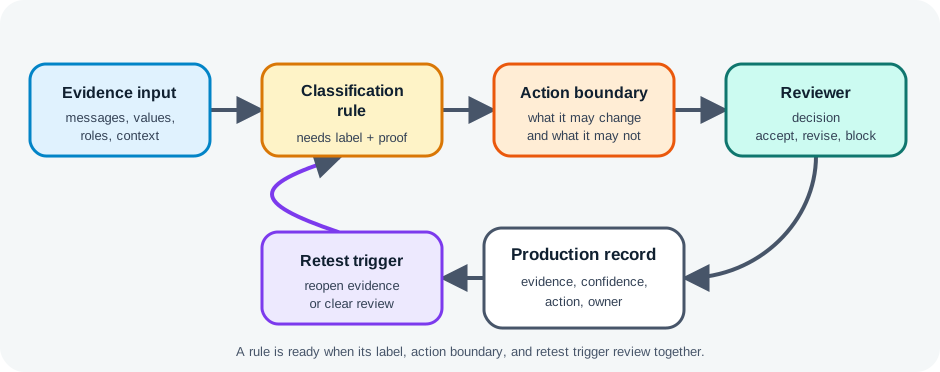
Read Figure 7.1 from evidence input to classification rule, checking that message presence, plausibility, route role, or related-node comparison is observable and sufficient for the proposed label. Next inspect the action boundary to see what the rule may change and what remains untouched. The reviewer then accepts, revises, or blocks the rule based on evidence quality. The production record preserves evidence, confidence, action, and owner, while the final trigger names the change that reopens review. This order prevents an automatic label from escaping the decision boundary it was designed to protect.
7.5.9 Review Record Fields
A review record should be short enough to use repeatedly and complete enough to explain the decision later. Inspect Figure 7.2 to verify that context and expected role lead to observable evidence before classification or action.
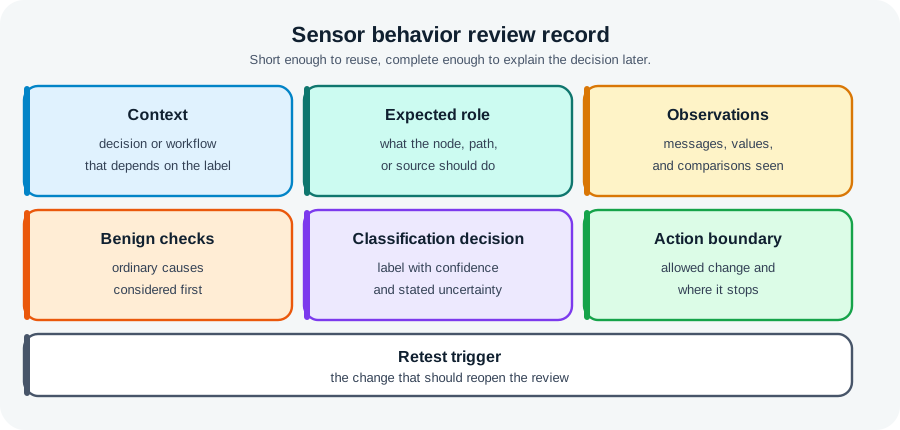
Read Figure 7.2 from context and expected role to observations, establishing which decision depends on the node and what it should have done. Benign checks come before classification so ordinary explanations are considered before assigning a label and confidence. The action boundary then states what may change and where the response stops, and the retest trigger names evidence that confirms, changes, or closes the decision. Any threshold or policy in this chain must be recorded as local configuration rather than presented as a universal fact.
7.5.10 Production Review Questions
A strong review asks practical questions before a rule becomes part of the production path. Begin with whether each source is observable and whether missing, stale, and contradictory inputs remain distinguishable. Then test whether the classification uses the module vocabulary without claiming motive beyond the evidence, and why a simpler label is insufficient. Check that the action protects only the affected decision, remains reversible, and preserves evidence. Finally, identify what observation reopens the review, who consumes the record next, and what would clear the label rather than letting it persist by inertia.
7.5.11 Worked Review: Rule Acceptance
Consider a rule that marks a sensor source as misleading when its readings remain plausible by themselves but repeatedly disagree with related observations used for the same decision. The production review should not ask only whether the label sounds reasonable. It should ask whether the evidence and action are reviewable.
Concrete example: a cold-chain review rule may flag a trailer temperature source as misleading for the current shipment decision when it reports plausible values that repeatedly conflict with adjacent package probes and door-state evidence. The rule should preserve that local evidence and action boundary instead of removing the source from every future use.
A review-ready record might state:
- the affected decision uses the source as one input, not as the only input;
- the expected role is to provide readings that remain consistent with related observations;
- the observed behavior is repeated disagreement while messages remain present;
- ordinary explanations, such as stale metadata or changed role assignment, were checked;
- the classification is misleading with moderate confidence;
- the action is to require corroboration before accepting that source for the affected decision;
- the retest trigger is a later observation that agrees with related evidence under the same role.
This record is production-useful because it preserves uncertainty. It does not remove the source from every future decision, and it does not pretend to know a physical cause that the evidence does not show.
7.5.12 Common Review Gaps
Label without evidence
The rule assigns a behavior label but does not show the observations that support it. Fix this by adding expected role, observed behavior, corroboration, and confidence.
Action larger than evidence
The rule changes more of the system than the evidence supports. Fix this by narrowing the action to the affected data path, route choice, or validation rule.
No retest trigger
The label can persist even after conditions change. Fix this by naming the evidence that would confirm, change, or clear the label.
Mixed review purpose
The page tries to be a taxonomy, implementation guide, case study, and assessment all at once. Fix this by keeping the chapter focused on production review decisions.
7.5.13 Knowledge Check
7.5.14 Matching Quiz
7.5.15 Ordering Quiz
7.5.16 Summary
Sensor behavior production review turns a classifier into a reviewable decision system. The chapter’s key standard is traceability: a behavior label should connect to expected role, observations, benign checks, confidence, action boundary, and retest trigger.
The review should be conservative. If the evidence is incomplete, use a weaker label, request corroboration, or keep the record open. If the evidence supports action, scope that action to the affected decision and preserve enough context for later review.
7.5.17 Key Takeaway
Production review should connect monitoring and classification quality to the decisions that sensor behavior logic may change. Keep the expected role, observations, ordinary explanations, confidence and policy configuration visible so that reviewers can assess the label and consider false positives. A classification needs supporting evidence and a defined action boundary before downstream systems rely on it.
Record the operator action rules, owner and update path, including the evidence that would confirm, downgrade or clear the label. When uncertainty remains, a weaker label, corroboration or an open review record may be appropriate. Scope supported actions to the affected decision and preserve the evidence for later review. The implementation should carry these records forward so that changes remain traceable.
7.5.18 Concept Relationships
Sensor Node Behaviors: Taxonomy defines the vocabulary used in review records, and Sensor Node Behavior Classification provides the evidence-first method. Trust Management then shows how cooperation evidence influences bounded route and trust decisions. Sensor Production Framework is the next step because it implements that behaviour logic while preserving the review record.
7.5.19 What’s Next
Previous: Trust Management for cooperation evidence and trust decisions that feed production review.
Next: Sensor Production Framework for implementing the reviewed behavior logic in a framework.
7.6 Continue to the Next Part
This section: Continue to the Next Part — Carry this evidence into Sensor Production: Framework and Review, which begins with Sensor Production Framework.
Carry this evidence into Sensor Production: Framework and Review, which begins with Sensor Production Framework.
Find help
3 reviewed answers.
Where should I start in a module?
Open the module page from the sidebar to see its chapters in order. Use the module map to return to a topic you need.
Modules and pathsReviewed
What can I try when a project does not work?
Check the symptom, then work through the diagnostic steps. Keep the error message and the smallest example that reproduces it.
When you are stuckReviewed
How do interactive examples work?
Use the interactive guide to check how examples and simulations work before changing your project.
Interactive examples guideReviewed