8 Sensor Production: Framework and Review
More
Depth: Practitioner
Progress saves as you read. Mark sections complete as you go; your progress appears in the sidebar.
8.1 Start With the Decision
This section: Start With the Decision — A fleet rule passes a demo and then blocks healthy nodes after a noisy week.
A fleet rule passes a demo and then blocks healthy nodes after a noisy week. The framework review must expose thresholds, uncertainty, rollback, and the evidence that reopens the rule.
8.2 Route Overview
This section: Route Overview — This is part 3 of 4.
This is part 3 of 4. Review Sensor Trust: Production Records for the preceding evidence.
8.3 Learning Objectives
This section: Learning Objectives
- Review a sensor-production framework for thresholds and uncertainty.
- Define rollback, monitoring, and revalidation evidence.
8.4 Chapter Roadmap
This section: Chapter Roadmap
- Sensor Production Framework
- Knowledge Check: rollback and revalidation record
8.5 Sensor Production Framework
This section: Sensor Production Framework
8.5.1 Start With the Framework as a Promise
Picture a team that says a sensor path is ready for daily use. That promise must cover data, rules, action, support, and the next change.
First, name the user choice the path supports. Then trace the source, checks, output, owner, and test that can reopen the release.
A strict rule can block weak data, but it may also stop useful work for a small fault. A loose rule keeps work moving, yet it can pass a bad claim.
The production review must name the site rule, accountable owner, and evidence that draws each sensor boundary.
Use the Practitioner sections to build and review the release path. Use the Under the Hood material to study drift, stale data, trust, and fault spread in more depth.
Plain check
- Name the user choice. Name the source. Name the data check. Name the allowed act.
- Mark the owner. Mark the safe state. Mark the open risk. Mark the next test.
- Test stale data. Test a bad value. Test a lost link. Test a wrong label.
- Keep the response small. Keep the reason clear. Keep the record current. Reopen on change.
- Use Practitioner to review. Use deeper drift checks. Test the weak handoff. State each bound.
A production framework is a promise that sensor behavior decisions will be made the same careful way after the prototype is gone. It links behavior evidence, quality state, trust, recovery, action gates, and retest rules so a later operator can understand the decision.
Use this chapter to build that promise from small records. Each framework element should answer what evidence enters, what decision comes out, who owns the action, and what change forces another review.
8.5.2 In 60 Seconds
A sensor production framework is the operating record that keeps sensor behavior decisions repeatable. It connects observations, behavior labels, quality states, trust or recovery evidence, allowed actions, ownership, validation, and retest triggers.
The goal is not to prove that every sensor is always correct. The goal is to make review decisions traceable: what was observed, what state was assigned, what action was allowed, what evidence was missing, and what change would reopen the decision.
8.5.3 Learning Objectives
By the end of this chapter, you will be able to:
- Explain the purpose of a sensor production framework in behavior review.
- Separate raw observations, behavior labels, quality states, and action gates.
- Identify the record items needed to support trust, recovery, validation, and retest.
- Review a framework decision without turning it into a broad platform comparison.
- Define conservative actions when evidence is incomplete, stale, conflicting, or outside scope.
8.5.4 First Step: Sensor Production Framework Evidence
8.5.5 Minimum Viable Understanding
A production framework turns sensor-behaviour evidence into repeatable review decisions. A label describes current evidence rather than permanently branding a sensor, and each action gate is tied to quality state, trust or recovery support, and a review owner. Validation and retest triggers are part of the framework, not afterthoughts. When evidence is unclear, the safe state is usually lower confidence, limited action, recovery review, or retest.
8.5.6 Prerequisites
- Sensor Node Behaviors: Taxonomy: evidence-bound behavior labels.
- Sensor Behaviors Production and Review: production review gates and review records.
- Trust Management: trust and recovery evidence for sensor behavior decisions.
8.5.7 Framework Scope
Keep the framework focused on review decisions. Record the observation or event that started review and the sensor, feed, or node it covers. Then preserve the available behaviour evidence, assigned quality state, and any trust, recovery, or corroborating support. The record states which action is allowed, limited, or blocked, who owns the next step, and which validation or retest condition closes the loop. Storing only labels is too thin, while solving every architecture concern is too broad; the useful middle ground is a short, repeatable record for bounded decisions from visible evidence.
8.5.8 Review Flow
The production framework turns observations into gated actions and then keeps the decision open to validation and retest. Follow Figure 8.1 when a condition opens review so that evidence quality and ownership are resolved before action.
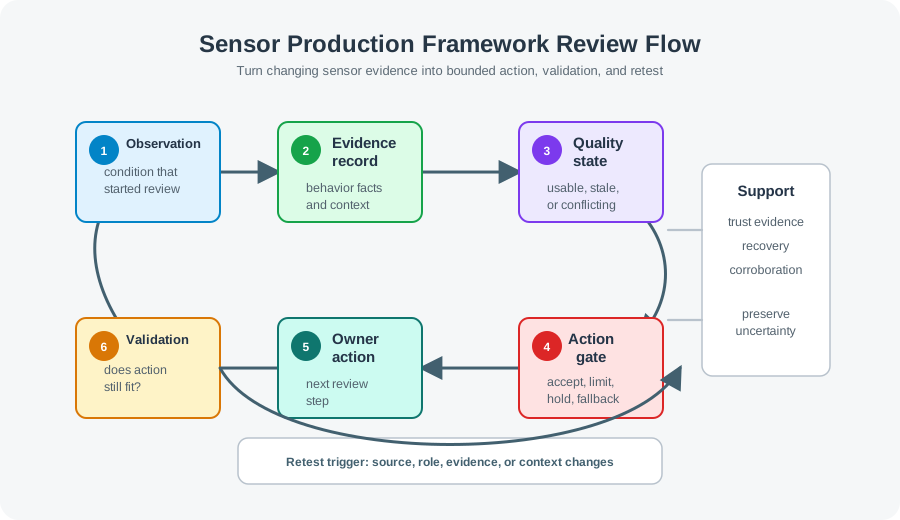
Read Figure 8.1 from observation to evidence record, preserving the opening condition, behaviour facts, quality clues, and related observations. The quality state then distinguishes usable, uncertain, stale, conflicting, and unavailable evidence before the action gate permits an action, fallback, recovery review, or hold. Ownership carries that response into validation, which checks whether it still fits the observed condition. The final trigger reopens the decision when context, calibration evidence, role, or neighbouring observations change. This loop matters because an uncertain sensor may recover and an apparently healthy sensor may later lose the evidence supporting that state.
8.5.9 Evidence Layers
Review the framework in layers rather than as one large approval.
Identity and source
The record should identify the sensor, logical feed, or node role being reviewed. The identity should be stable enough to connect observations, quality state, and later retest evidence.
Behavior evidence
Behavior evidence describes what the sensor or node did: reported plausible values, stayed silent, repeated stale values, missed expected messages, contradicted peers, recovered after reset, or required manual review.
Quality state
Quality state explains whether the evidence can support a decision. Useful states include acceptable, uncertain, stale, conflicting, unavailable, recovering, and rejected for this decision.
Trust and recovery evidence
Trust evidence should be treated as review support, not as a magic score. Recovery evidence should show whether the condition was transient, recurring, or unresolved.
Action gate
The action gate ties evidence to a bounded decision. Examples include accept for this decision, use with lower confidence, request corroboration, start recovery review, hold action, or retest before use.
Ownership
Every non-final state needs an owner for the next action. Ownership can mean reviewing evidence, checking a calibration record, comparing related observations, or updating the retest rule.
8.5.10 Production Record
The framework is only useful when the record is short enough to maintain and specific enough to audit. Inspect Figure 8.2 to see whether identity and opening evidence remain connected to quality, action, ownership, validation, and retest.
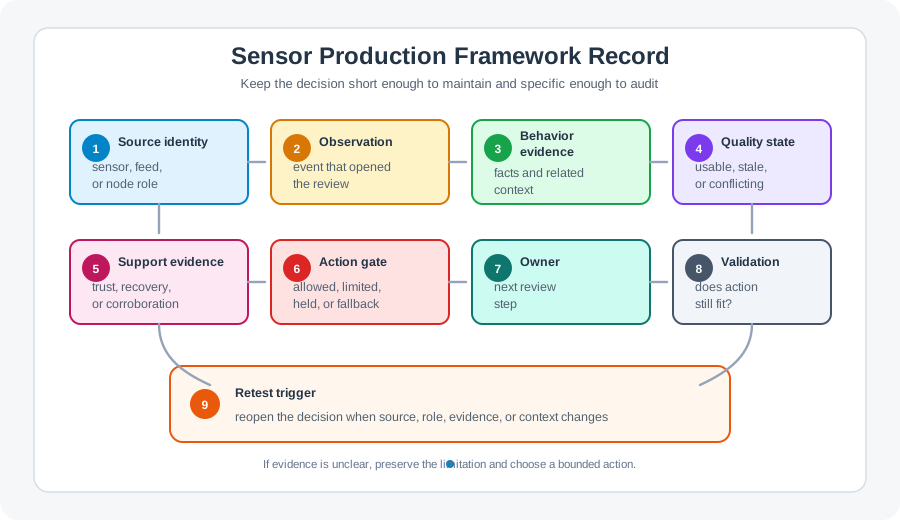
Read Figure 8.2 from source identity and role to the observation that opened review, then inspect behaviour evidence, related context, and the current quality state. Trust, recovery, or corroborating evidence supports—but does not replace—that state. The allowed action or fallback leads to an owner and validation result, and the final trigger states when review begins again. Missing context, stale observations, and conflicting evidence must remain visible in this chain so the chosen action reflects uncertainty instead of hiding it inside a final label.
8.5.11 Review Decisions
Use the same record pattern for routine and exceptional states.
Accept
Accept when the evidence fits the decision, the quality state is acceptable, and no unresolved conflict changes the action. The record still needs a retest trigger.
Use with lower confidence
Use with lower confidence when the evidence is relevant but incomplete. The action should be limited to decisions that can tolerate that uncertainty.
Request corroboration
Request corroboration when related sensors, logs, or state transitions can clarify a surprising observation. The framework should state what evidence would resolve the question.
Start recovery review
Start recovery review when the sensor may be silent, stuck, stale, misconfigured, or in a role mismatch. Recovery review should preserve the before and after evidence.
Hold or mark unavailable
Hold action or mark the source unavailable when evidence is missing, contradictory, stale, or outside the decision scope.
8.5.12 Worked Review: Repeated Stale Readings
Scenario: a sensor feed continues to report the same value while related observations show changing conditions.
Concrete example: a cold-room temperature feed repeats the same value across several review windows while door-state and compressor-status records show activity that should normally change the local condition. The framework should treat availability, freshness, and related evidence separately before allowing the value into the current decision.
Observation
The value is reachable, but it has not changed when related evidence suggests it should. The framework opens a record for the source and the decision that would use it.
Evidence check
The reviewer records source identity, observation time, receive time, related observations, current role, quality state, and any recovery evidence. The value is not accepted solely because it is available.
Action gate
If the stale condition is unresolved, the source is marked lower confidence or unavailable for decisions that require current values. A related source or fallback process may be used when the record supports it.
Validation
After recovery or replacement evidence appears, the reviewer checks whether the feed updates as expected and whether related observations agree well enough for the intended decision.
Retest trigger
Retest when the source resumes updates, the role changes, related evidence contradicts the feed again, the review owner changes the quality rule, or the decision context changes.
8.5.13 Common Review Findings
Weak frameworks store labels without their observations, mix trust and recovery into one unclear approval, or accept a value because it is reachable rather than fit for the decision. They record actions without validation or retest, collapse uncertain, stale, and conflicting evidence into one failure state, or leave the next owner unclear. Keep the framework centred on production evidence and bounded decisions instead of drifting into broad platform promises.
8.5.14 Knowledge Check
8.5.15 Matching Quiz
8.5.16 Ordering Quiz
8.6 Continue to the Next Part
This section: Continue to the Next Part — Carry this evidence into Sensor Production: Assessment and Decisions, which begins with Summary.
Carry this evidence into Sensor Production: Assessment and Decisions, which begins with Summary.
Find help
3 reviewed answers.
Where should I start in a module?
Open the module page from the sidebar to see its chapters in order. Use the module map to return to a topic you need.
Modules and pathsReviewed
What can I try when a project does not work?
Check the symptom, then work through the diagnostic steps. Keep the error message and the smallest example that reproduces it.
When you are stuckReviewed
How do interactive examples work?
Use the interactive guide to check how examples and simulations work before changing your project.
Interactive examples guideReviewed