MQTT Production Operations: Reference
More
Depth: Practitioner
Progress saves as you read. Mark sections complete as you go; your progress appears in the sidebar.
From a Test Message to a Running Service
A test message shows that one path works once. A building with 4,000 devices needs more evidence. Its team must know how much work the broker can carry, who may use each topic, and what happens when a node fails.
An MQTT broker receives messages and routes them to clients whose subscriptions match. Quality of service, or QoS, sets the delivery promise on each MQTT leg. A leg is one link, such as publisher to broker. That promise does not prove that a device took an action.
Start with the message promise. Then count the workload and test recovery. The building worksheet below starts at 440 publications and sensor deliveries per second. That number is an input to a load test. The second node still needs a failure test before the team can rely on it.
Start With Release Evidence
Choose the protocol version first. Then find the setting and the evidence needed to rely on it. A protocol rule comes from the standard. A broker policy depends on the implementation. A worksheet uses stated assumptions.
| Need | MQTT 3.1.1 | MQTT 5.0 |
|---|---|---|
| Resume a session | Clean Session 0; stable client ID | Clean Start 0; surviving session; positive Session Expiry for storage after disconnect |
| Start a new session now | Clean Session 1 | Clean Start 1; choose Session Expiry separately |
| Discard session after disconnect | Clean Session 1 | Session Expiry 0, including when omitted |
| Expire an undelivered message | No protocol expiry property | Message Expiry, in seconds; separate from Session Expiry |
| Limit in-flight publications | Broker/client policy | Receive Maximum for unacknowledged QoS 1 and 2; separate queue limits still needed |
| QoS, both versions | Successful exchange on one leg | Use when |
|---|---|---|
| 0: at most once | PUBLISH; one packet | A missed reading is replaceable |
| 1: at least once | PUBLISH, PUBACK; two packets | Delivery matters and repeats are safe |
| 2: exactly once | PUBLISH, PUBREC, PUBREL, PUBCOMP; four packets | Protocol duplicate control justifies the extra state |
Application actions still need their own result evidence. Packet counts exclude retries.
Protocol sources: MQTT 3.1.1, sections 3.1.2.4, 4.1.1 and 4.3; MQTT 5.0, sections 3.1.2.4, 3.1.2.11.2, 3.3.2.3.3, 4.3 and 4.9.
| Decision | Lookup | Approval evidence |
|---|---|---|
| Which QoS, filter or connection setting? | Quick-reference card | Trace each MQTT leg; confirm application results separately |
| How much load and spare capacity? | Building worksheet | Include fan-out, queues, acknowledgments and surviving-node load |
| Is this device allowed to act? | Security configuration | Test transport, identity and topic permissions separately |
| Will an outage be visible and recoverable? | Observability boundaries | Controlled faults, alerts, recovered state and rollback record |
Use the linked tables for a quick decision. Open the operational detail when collecting its evidence:
- Size the cluster: connections, publication rate, fan-out and recoverable state.
- Secure the path: TLS, client identity and topic access rules.
- Diagnose the load: delivery exchanges, client ID collisions and gateway mappings.
- Approve the release: calculator assumptions, the building worksheet, checks and a failure record.
The merged card keeps the connection and routing lookup together. The deeper worksheets retain their assumptions beside the numbers.
Learning Objectives
Use these goals to guide your release review. Each goal should lead to a setting you can check or a test you can repeat.
Use this reference to:
- Size a cluster from connection, routing and stored-state measurements.
- Configure security with TLS, authenticated identities and topic permissions.
- Diagnose saturation by separating connection churn, payload traffic and acknowledgment work.
- Choose QoS from the consequences of losing or repeating each message family.
- Calculate a capacity plan with explicit memory, throughput and availability assumptions.
- Prevent session failures with unique, stable client IDs and a version-specific recovery policy.
Key Concepts
Keep these terms distinct as you read. Each one names a different part of the message path or its saved state.
- Broker: receives publications and routes them to permitted, matching subscriptions.
- Topic and filter: the publication names a route; the subscription selects routes, with optional wildcards.
- QoS: the protocol delivery level on one MQTT leg; it does not confirm a physical action.
- Retained message: a topic’s stored snapshot for new matching subscriptions; it is not a history or freshness check.
- Will: a preconfigured publication sent under the protocol’s Will conditions; it may follow unexpected connection loss or, in MQTT 5.0, a deliberate DISCONNECT requesting Will publication (reason code 0x04). See MQTT 5.0 sections 3.1.2.5 and 3.14.2.1.
- Session: client-related state such as subscriptions and eligible queued messages. Persistence depends on the protocol settings and storage policy.
Prerequisites
Review the linked chapters if topics or delivery levels are new to you. The examples also assume some knowledge of secure links and load balancing.
Required Chapters:
- MQTT Architecture Patterns - Pub/sub concepts and topics
- MQTT QoS and Reliability - Delivery guarantees
Technical Background:
- TLS/SSL concepts
- Load balancing basics
- Database fundamentals (Redis, PostgreSQL)
Estimated Time: 27 minutes for the full chapter; use the opening tables for a targeted lookup.
MQTT Broker Clustering Architecture
Separate connection distribution from state recovery. A load balancer can send a reconnecting client to a healthy node. That node still needs the subscriptions, queued publications and retained state required by the service contract.
In the broker-cluster figure, trace a device connection, a publication delivered through another node, and the stores needed after a failure.
Read the broker-cluster figure from the device to the receiver. The load balancer spreads connections across nodes. The brokers must also route messages and recover the saved state that the service needs. How they copy and store that state depends on the chosen broker. Stop one broker in a planned test, then check both an existing subscriber and a late subscriber. Check subscriptions, queued messages and retained messages. A publisher that reconnects has proved only one part of this path.
Diagram scope: rates round at the end: 2,778 outbound deliveries and 3,333 publication/delivery operations per second per node. The 100,000 operations/s limit is assumed; state recovery needs broker support and tests. The 53 millisecond sum does not prove the 100 millisecond service target.
Clustering Architecture Layers
Layer 1: IoT Devices (10,000+)
| Device Type | Role | Connection Pattern |
|---|---|---|
| Sensors | Publishers | Periodic data upload |
| Actuators | Subscribers | Command reception |
| Gateways | Pub/Sub | Bidirectional |
Layer 2: Load Balancer
| Function | Method |
|---|---|
| Distribution | Round Robin / Sticky Sessions |
| Monitoring | Health Checks |
| Ports | 1883 (TCP), 8883 (TLS) |
Layer 3: MQTT Broker Cluster
| Node | Connections | Inter-Node Communication |
|---|---|---|
| Broker Node 1 | ~3K–4K in the 10K+ device architecture shown | Broker-specific routing and state replication, if supported |
| Broker Node 2 | ~3K–4K in the 10K+ device architecture shown | Broker-specific routing and state replication, if supported |
| Broker Node 3 | ~3K–4K in the 10K+ device architecture shown | Broker-specific routing and state replication, if supported |
The separate 50,000-device sizing example below assigns about 16,667 connections to each of three nodes.
Layer 4: Shared Storage
| Store | Technology | Purpose |
|---|---|---|
| Session Store | Broker-specific durable or replicated store | Persistent sessions and subscriptions, if supported and configured |
| Message Persistence | Broker-specific persistence | Retained and queued messages, if supported and configured |
Put the Cluster Numbers on One Node
Scenario: 3-node cluster serving 50,000 IoT devices, each publishing every 30 seconds.
Load distribution:
With 5 subscriber deliveries per publication, rounding only the final rates:
Memory requirements (4 kB decimal per connection + queues):
Latency budget:
Modeled utilization:
The timing sum includes a network round trip. It is not a measured one-way delivery time or latency percentile. The rate subtotal excludes acknowledgment, retry and replication traffic. Benchmark those costs and the surviving nodes after failover.
Capacity Planning Metrics
Record limits for the actual broker, edition and configuration. A vendor’s large-scale result cannot supply an untested release limit.
| Metric | Unit and scope | Release measurement |
|---|---|---|
| Connections | Simultaneous connections per node | Steady load and a reconnect burst |
| Routing rate | Incoming publications and outgoing deliveries per second | Fan-out, QoS exchanges and inter-node traffic separately |
| Latency | Milliseconds, with endpoints and percentile named | Peak workload and failure recovery |
| Memory | Bytes for connections, queues, retained state and runtime | Peak storage and slow-consumer behavior |
| Surviving-node capacity | Same workload with a node unavailable | Saturation threshold and recovery time |
 Checkpoint: Cluster Sizing
Start with 50,000 devices across three nodes. Each device publishes every 30 seconds. Each publication has five deliveries. Per node, expect about 556 incoming publications and 2,778 subscriber deliveries per second. The unrounded subtotal is about 3,333 operations per second. The memory subtotal is 83.335 megabytes. It uses rounded connections and assumed queue sizes. Measure the timing and node limits before release. The 53 millisecond sum and the 100,000-operation node limit are model inputs.
Security Configuration
Treat encryption, identity and permission as separate acceptance tests. Transport Layer Security, or TLS, protects the connection. Authentication checks identity. An access-control list, or ACL, restricts the topics that identity may use.
Ports 1883 and 8883 are registered for non-TLS and TLS MQTT respectively. A port number does not configure security. Verify the listener and the connection. Plaintext MQTT exposes unencrypted credentials, topics and payloads to someone who can observe that path. MQTT 3.1.1, sections 4.2 and 5.
TLS Configuration
client.tls_set(
    ca_certs="ca.crt",
    certfile="client.crt",
    keyfile="client.key"
)
Knowledge check · self-test
Knowledge check
Test your understanding.
The snippet enables Paho TLS support and supplies a client certificate and key. Mutual TLS also requires the broker to validate the client certificate. Call tls_set before connecting and test rejection of an untrusted certificate. Paho client API.
The reconnect quiz is a configuration sketch, not a complete program. Its disconnect signature uses Paho’s version 2 callback API. The ellipsis in mqtt.Client(...) stands for the client configuration. Its reconnect bounds are one and 60 seconds; its connection uses a 60-second Keep Alive chosen by the example.
Security Layers
| Control | What it establishes | What to test |
|---|---|---|
| TLS with server verification | Protected transport to the expected server | Reject an untrusted server certificate |
| Client authentication | An accepted client identity | Reject invalid credentials |
| Mutual TLS, when required | Broker validation of a client certificate | Reject an untrusted client certificate |
| Topic authorization | Allowed reads and writes for that identity | Permit the assigned branch; deny another device’s branch |
Access Control Lists (ACLs)
Production example:
# Mosquitto acl_file entries (the broker config points acl_file to this file)
user sensor_device
topic write sensors/device_123/#
topic read commands/device_123
These Mosquitto entries grant sensor_device writes under sensors/device_123/# and reads of commands/device_123. With no other grants, another device’s branch remains denied. Check the complete listener and authorization policy, then test both an allowed topic and a denied sibling topic. Mosquitto ACL syntax.
Why Alternatives Are Insufficient
- Payload encryption alone: protects content, while MQTT topics and connection credentials remain outside that payload.
- VPN alone: can protect a network tunnel, but does not define the broker’s identities or topic permissions.
For a managed service, check its supported identity methods and topic policy. For a self-managed listener, inspect the configured authentication and ACLs. In either case, keep separate evidence for encrypted transport, rejected identities and denied topics.
Performance Troubleshooting
Start with the workload and the symptoms you can measure. Use those results to choose a change, then test the same load again.
Symptom: Broker CPU at 100%, Message Delays
A saturated CPU identifies a resource limit, not its cause. Correlate CPU with connection churn, TLS handshakes, publication rate, fan-out and queued work.
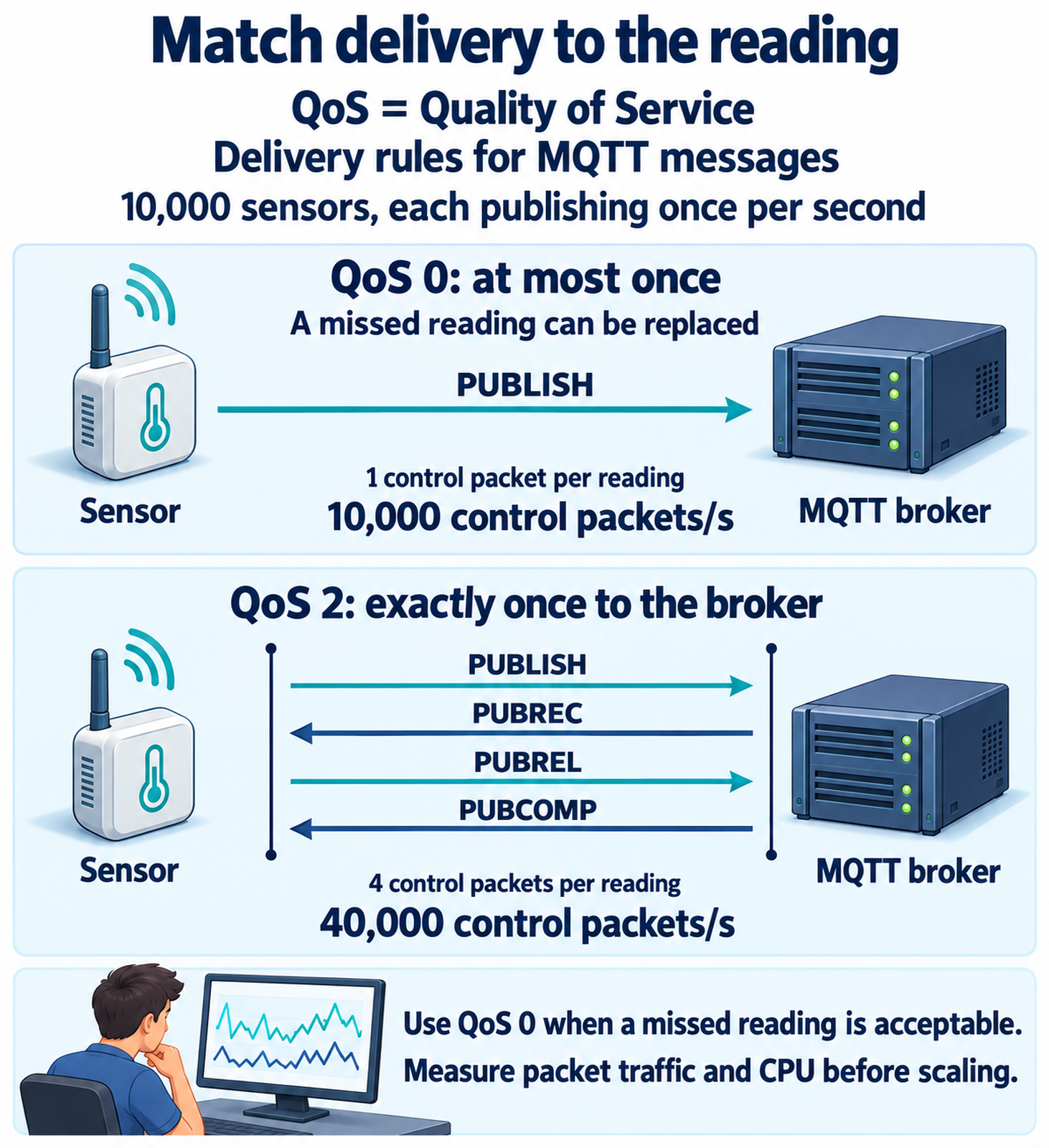
- Count the exchanges. For 10,000 sensors publishing once per second at QoS 1, the publisher legs carry 10,000 PUBLISH and 10,000 PUBACK packets per second before retries or subscriber fan-out.
- Count payload bytes. A 10 kilobyte payload at 10,000 publications per second is 100 megabytes per second of payload alone, using decimal units.
- Inspect authorization and routing. Profile the actual topic filters and ACL checks before changing the broker topology.
Solutions
| Observed cost | Candidate change | Evidence before adopting it |
|---|---|---|
| Unnecessary delivery exchanges | Lower QoS for replaceable data | Loss tolerance and packet/CPU comparison |
| Repeated large payloads | Send deltas or batch readings | Required information survives; delay remains acceptable |
| Connection or routing saturation | Distribute work across broker nodes | Measured limits, inter-node cost and failover behavior |
| Repeated upstream traffic | Aggregate through edge brokers | Local freshness, outage policy and upstream load |
Keep the workload and configuration with every benchmark. A broker name and a throughput figure without QoS, TLS, payload, fan-out and persistence settings cannot determine capacity.
- Monitor broker and consumer signals with an owned dashboard and alerts.
- Bound publisher rates and stored work; test the response to a slow consumer.
- For a managed service, verify its quotas and recovery contract for this workload.
Common Pitfalls
Two common choices can break a sound design: using the same delivery level for all data, and giving two clients the same ID. Check both before a release.
Pitfall 1: Using QoS 2 for All Messages
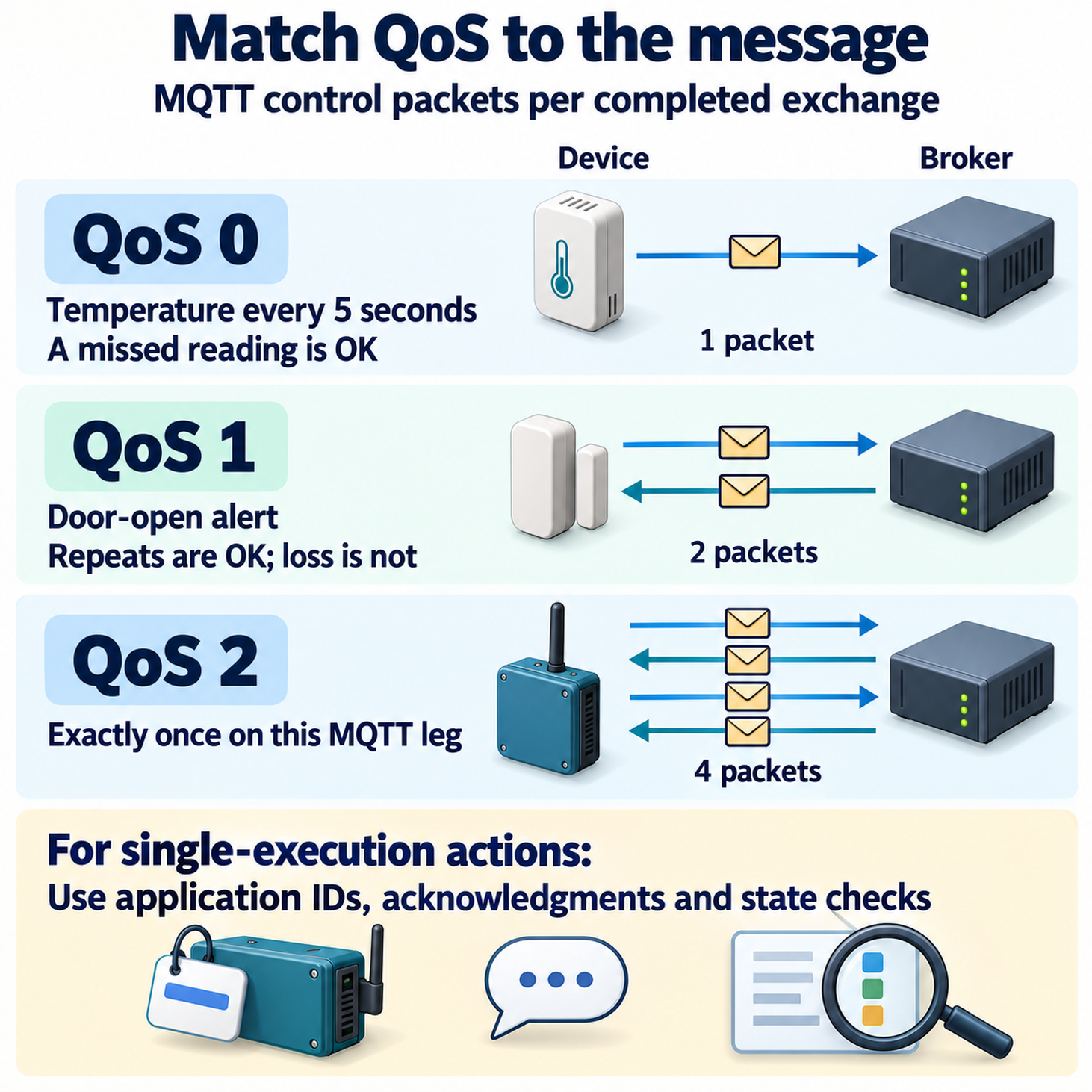
Choose QoS by the cost of loss and repeats. The strip compares three message needs and the packets used for each successful exchange.
Read the strip from the temperature sample to the alert and then the four-packet exchange. A later temperature sample can replace one that is lost. An alert needs a delivery policy that allows the consumer to handle repeats safely. QoS 2 adds steps to control duplicate delivery on one MQTT leg. It still needs a separate check of the action result. Compare these cases before setting one delivery level for the whole fleet.
The Mistake: Developers set QoS 2 (exactly-once delivery) for all messages, assuming higher QoS always means better reliability without considering the costs.
Why It Happens: QoS 2 sounds like the safest option, and developers don’t realize the significant overhead. The 4-way handshake (PUBLISH, PUBREC, PUBREL, PUBCOMP) seems like “extra safety” rather than a trade-off.
The Fix: Match QoS to actual requirements:
- QoS 0 for high-frequency sensor data (temperature every 5 seconds) - missing one reading is acceptable
- QoS 1 for important alerts and commands (door open, motion detected) - duplicates are acceptable, loss is not
- QoS 2 when exactly-once delivery on an MQTT leg is required; use application IDs, acknowledgments and state checks for single-execution actions
Packet-count impact: A completed QoS 2 exchange uses four MQTT control packets versus one for QoS 0 and two for QoS 1. For 10,000 sensors publishing once per second, that is 40,000 versus 10,000 control packets per second on the publisher-to-broker legs, before subscriber fan-out. Actual latency and battery impact need measurement on the target hardware and network.
Use the QoS decision-tree figure to test that fix against message semantics before changing a fleet-wide default. The decision starts with what happens if one publication is lost or repeated, not with the assumption that a larger QoS number is always safer.
Read the QoS decision-tree figure from the loss question to the duplicate question. If a later periodic sample replaces a missed one, QoS 0 avoids acknowledgement traffic. If delivery matters but the consumer can make duplicate processing safe, QoS 1 supplies retransmission with a simpler exchange. Reach QoS 2 only when both loss and duplicate delivery are unacceptable and the extra handshake is justified. Actions still need IDs, result records and state checks. Its QoS 2 branch controls protocol delivery on one leg; it cannot establish single execution of an action.
Pitfall 2: Client ID Collisions
The Mistake: Provisioning two active clients with the same ID. When the second connection is accepted, the broker disconnects the existing client. A predictable name is acceptable if allocation keeps it unique; randomness alone is not a uniqueness check.
Why It Happens: In development, a single device works fine. In production with auto-scaling, containerized deployments, or device replacements, multiple instances may attempt to use the same client ID simultaneously.
The Fix: Allocate a unique ID for each simultaneously connected client, then preserve it for reconnects. These are provisioning sketches:
# Good: UUID-based client ID
import uuid
client_id = f"sensor_{uuid.uuid4().hex[:12]}"  # Use once at provisioning, then persist for reconnects

# Good: Device-specific identifier
client_id = f"sensor_{device_mac_address}_{deployment_id}"

# Bad: Sequential or predictable IDs
client_id = "sensor_1"  # Will collide with other "sensor_1" devices
The truncated UUID example has 12 hexadecimal digits, or 48 bits. Check for provisioning collisions. The device-specific example depends on the uniqueness of its inputs. The code’s “predictable” warning applies to reusing sensor_1, not to every sequential naming scheme.
Recovery risk: If both clients keep reconnecting, they can repeatedly take over the same identity. Look for:
- Interrupted delivery when each connection is displaced
- Broker log flooding with connect/disconnect events
- Session takeover or loss of the expected persistent-session continuity
Before releasing firmware, test that separate devices retain distinct IDs across restart and reconnect. Reuse the same ID for the same intended session; do not regenerate it at every connection.
Checkpoint: Secure and Efficient Operations
Test TLS, identity and topic ACLs separately. At 10,000 publications per second, a successful QoS 2 exchange uses 40,000 control packets per second on publisher legs, compared with 10,000 at QoS 0 before retries. Choose by loss and duplicate consequences. Keep each active client’s ID unique and stable across reconnects.
Protocol Bridging
A bridge joins two message systems. Define what each request means on the far side, then test that meaning when a link fails.
CoAP-MQTT Gateway
A gateway can translate a local CoAP request into an MQTT publication. The mapping is an application contract: CoAP resource operations and MQTT subscriptions have different meanings.
Example path:
- Sensors use CoAP over UDP on the local link.
- The gateway publishes normalized events through MQTT over TCP.
- Applications subscribe to device updates and publish commands through the MQTT broker.
Mapping decisions to preserve:
- Sensor event: a POST to
coap://gateway/sensor/tempbecomes a publication onsensors/temp. - Device configuration: a publication on
commands/sensor1becomes a PUT tocoap://sensor1/config. - Observed resource: the gateway observes the sensor’s CoAP resource and turns notifications into MQTT publications.
Review the boundary:
- Define payload conversion and error handling.
- Keep the identity and allowed topics explicit on both sides.
- If the gateway caches readings, preserve their age.
- Test repeated commands and loss of either network connection.
| CoAP operation | MQTT-side design choice | Avoid this assumption |
|---|---|---|
Resource /sensor/temp | A named topic such as devices/{device_id}/sensor/temp | Resource paths do not automatically define broker permissions |
| GET | Fetch a representation, then publish a result if required | GET is not a standing subscription |
| POST | Publish the mapped event | Protocol delivery does not establish the event’s application result |
| PUT | Apply the mapped configuration and report its result | PUT does not require the MQTT retained flag |
| Observe | Publish resource notifications | The gateway is the CoAP observer, not an MQTT subscription on the sensor |
The operation meanings come from RFC 7252, section 5.8 and RFC 7641, sections 2 and 3. The example translation is a design choice to test, not a mapping required by either standard.
Production MQTT in Plain Language
Use three questions to review the service: can it carry the work, can it recover, and can each device act only where allowed? Keep a test result for each answer.
| Release question | Plain-language check |
|---|---|
| Can it carry the workload? | Count connections, copies, stored work and bursts |
| Can it recover? | Stop a node and verify the promised state and deliveries |
| Can this identity act? | Test the allowed topic and a forbidden topic |
- Too much work: measure the bottleneck before adding nodes.
- Repeated disconnects: check for two clients using one ID.
- Protected but overprivileged clients: test topic permissions after TLS succeeds.
Interactive Calculators
Use these models to explore a plan before a load test. Their results depend on the stated inputs and costs. Keep those assumptions with any result you share.
MQTT Broker Cluster Sizing Calculator
Use measured connection and routing limits as inputs. The result is a worksheet, not a release recommendation. It forces at least two nodes but does not prove that the remaining nodes can carry the workload after a failure.
Memory assumes four decimal kilobytes per connection, ten queued payloads per connection and 200 megabytes of runtime overhead. Bandwidth counts payload copies only. Protocol, TLS, retry and replication costs need separate measurements.
Cluster Availability Calculator
This model treats node failures as independent. It assumes instant failover. It also assumes enough capacity when any node is available. Shared power, networks and storage can break those assumptions. So can a delay in failover.
The calculator uses a 365.25-day year. A separate estimate uses a 30-minute incident to infer how many events occur. That duration is a model choice. It is not evidence of the failure rate. The main uptime result excludes the shown failover downtime. It does not promise a service level.
QoS Overhead Comparator
Compare a completed publisher-to-broker exchange using MQTT 3.1.1. This model includes the topic name and packet identifier where required. It excludes retries, subscriber fan-out, TCP and TLS. Acknowledgments carry no copy of the payload.
The default topic length is 12 bytes, the length of sensors/temp. Bandwidth uses kibibytes per second and gibibytes per day. The displayed 300 percent overhead compares packet counts, not bytes. MQTT 5.0 properties and reason codes need a different byte model. MQTT 3.1.1 packet layouts, sections 2.2.3 and 3.3 through 3.7.
MQTT Infrastructure Cost Estimator
Enter cost assumptions for nodes, compute, memory, a load balancer and durable state. These are worksheet prices, not provider quotes. The model uses 730 hours per month and twelve months per year. It excludes support, traffic, storage, backup and labor. Its defaults are separate from the building example’s cost assumptions.
Visual Reference Gallery
Use the routing figure to check the fan-out and permission scope used in a capacity plan.
Visual: MQTT Topic Hierarchy
For the topic-matching figure, predict recipients from the topic and filters before counting outgoing deliveries.
Read the topic-matching figure level by level before checking the filter matches. The figure starts with a concrete published topic, compares it at the broker with stored exact or wildcard filters, and marks both filters as matches. Exact text must agree. Plus accepts one level, while a final hash accepts the parent and its descendants. A filter that starts with a wildcard excludes names starting with a dollar sign. The figure also marks wildcard placement rules and a least-privilege review for broad filters. Use the topic and filters to predict recipients first, then check those expected matches against subscriber receipts and ACL tests.
Interactive: MQTT Broker Clustering Workbench
Worked Example: Sizing an MQTT Broker Cluster for a Smart Building
The worksheet has 40 floors, each with 80 sensors and 20 actuators. Sensors report every 30 seconds. Assume one command per actuator every 60 seconds and three subscriber deliveries per sensor publication. The target is 99.9 percent uptime and delivery in under 200 milliseconds. These are scenario inputs, not measured results.
Step 1: Calculate Connection and Message Load
| Metric | Calculation | Result |
|---|---|---|
| Device connections | 40 floors times 100 devices | 4,000 devices: 3,200 sensors and 800 actuators |
| Incoming sensor publications | 3,200 divided by 30 seconds | About 106.67 per second |
| Incoming commands | 800 divided by 60 seconds | About 13.33 per second |
| Dashboard and analytics subscribers | 40 floor dashboards plus one building view plus five analytics | 46 subscribers |
| Outgoing sensor deliveries | Three times 3,200 divided by 30 seconds | 320 per second |
| Publication and sensor-delivery subtotal | Add the unrounded rates | 440 per second |
The connection subtotal excludes the dashboard, analytics and command-publisher connections. The traffic subtotal excludes command deliveries to actuators, acknowledgments, retries and inter-node traffic. Add those before using a broker limit.
Step 2: Determine Node Count
| Constraint | Required evidence |
|---|---|
| Connections | Device connections plus application connections fit the measured limit |
| Routing | Full traffic, including the omitted copies and exchanges, fits the measured rate |
| Failure recovery | Surviving capacity and required state meet the recovery target |
A single node might carry the workload. A second node is an availability candidate only if the service can recover through it. Choose from measured limits for the selected broker, edition and settings.
Step 3: Design for 99.9% Uptime
99.9% uptime allows at most 8.76 hours of downtime in a 365-day year. If two nodes each had 99.5% availability, their failures were independent, and failover were instantaneous, the idealized parallel-availability calculation would be:
- Cluster availability:
1 - (1 - 0.995)^2 = 1 - 0.000025 = 99.9975% - Downtime:
0.000025 x 365 x 24 x 60 = 13.14 minutes/yearunder those idealized assumptions; shared dependencies and failover time lower real availability
Architecture candidate: A redundant broker deployment with a load balancer; verify the chosen broker’s session, queue and retained-state recovery under a node-failure drill.
Step 4: Memory Sizing per Node
- Connections per node:
4,000 / 2 = 2,000 - Memory per connection:
4 kB decimal, an assumed session and subscription cost - Connection memory:
2,000 x 4 kB = 8 MB, using decimal units - Message queue:
2,000 x 100 x 200 bytes = 40 MBfor QoS 1 with a 100-message buffer - Routing table:
4,000 topics x 64 bytes = 256 kB, or 0.256 MB - Broker overhead:
~200 MB illustrative placeholder; measure the selected broker runtime - Subtotal per node:
8 + 40 + 0.256 + 200 = 248.256 MB, or about 250 MB before omitted costs
Sizing starting point: Test two 1 GB nodes under TLS, queue and failover load. This device-only memory worksheet omits the application connections and broker-specific costs. It cannot prove a fourfold operational margin.
Step 5: QoS Selection by Data Type
| Data Type | QoS | Rationale |
|---|---|---|
| Temperature/humidity (periodic) | QoS 0 candidate | A fresh reading follows in 30 seconds if the next transfer succeeds; expose staleness |
| Carbon dioxide threshold event | QoS 1 candidate | Test duplicates, freshness and application confirmation of the alert |
| Occupancy count | QoS 0 | Frequent updates, loss tolerable |
| HVAC desired-state commands | QoS 1 candidate | Repeating “set temperature to 22 degrees Celsius” preserves the requested state; confirm the result |
| Fire alarm dashboard integration | QoS 1 plus retained snapshot candidate | Test late-subscriber display and freshness; MQTT delivery and retention do not establish life-safety adequacy |
Cost Summary:
| Component | Specification | Estimated Cost |
|---|---|---|
| Two broker VMs | 2 vCPU, 1 GB RAM each | $120/month (illustrative assumption) |
| Load balancer | 1 vCPU, 512 MB RAM | $30/month (illustrative assumption) |
| Durable state or replication | Broker-specific design | $25/month (illustrative placeholder) |
| Illustrative subtotal | Excludes support, traffic, storage, backup and labor | $175/month |
| Illustrative per-device subtotal | $175 / 4,000 devices | $0.04375/device/month |
Key Insight: The assumed $175/month subtotal divided by 4,000 devices is $0.04375 per device per month before omitted costs. The 99.9975% figure is an idealized two-node calculation, not a service guarantee. QoS 0 removes the QoS 1 acknowledgment packet on each publish leg; actual CPU savings require measurement.
Checkpoint: Release Evidence
The building worksheet starts with 4,000 device connections. Its subtotal is 440 publications and sensor deliveries per second. Add the app connections and traffic that it leaves out. The uptime model gives 99.9975 percent. It assumes independent failures and instant failover. The cost example is 175 dollars per month, or 0.04375 dollars per device. It leaves out some costs. Check the measured load, recovered state and app results in separate tests.
The calculation companion uses a 365.25-day year and assumes one broker can carry the load. The building worksheet uses a 365-day year and still requires a capacity test. Compare the assumptions before using either result.
Maths · guided foundations
The Second Node Buys Uptime, Not Capacity
Check the quantities and assumptions.
Knowledge Check
Try a timed lookup: find the session-resume settings for MQTT 3.1.1 and MQTT 5.0, then state what happens when MQTT 5.0 omits Session Expiry. Record how long the lookup took. Explain why a surviving session still needs a freshness rule before answering the application questions.
Test Your Understanding
Use the QoS exchanges to choose a policy. A CPU percentage alone does not identify its bottleneck.
Match each MQTT production concept to its correct definition or use case:
Arrange the following steps in the correct order for onboarding a new secure MQTT device to a production cluster:
Knowledge check · self-test
Knowledge check
Test your understanding.
Label the Production Deployment
Trace the path from the device fleet through the broker to the backend. Then label who owns identity, message routing, saved state and alerts in the exercise below.
Knowledge check · self-test
Knowledge check
Test your understanding.
Scale-Out Migration Evidence
Keep a migration record that connects each design change to an observed result. Include a rollback route before moving production clients.
| Migration question | Evidence |
|---|---|
| Why does one broker no longer fit? | Connection, publish, retained-state, queue, CPU, memory and reconnect traces |
| How do consumers share work? | Shared-subscription support and groups where available; consumer lag and processing limits |
| How does state recover? | Session policy, broker-specific durable or replicated storage, retained-state recovery and a node-failure result |
| How do sites exchange traffic? | Bridge topic allowlist, loop-prevention rule, latency budget and outage behavior |
| How is the change reversed? | Canary observations, rollback route, alarm owner and saturation threshold |
Adding nodes changes routing and recovery responsibilities. Verify the selected broker’s state contract rather than assuming that a shared database or load balancer supplies it.
Deep-Dive Note: Production Observability Boundaries
MQTT 5.0 reason codes can distinguish rejected operations such as authorization failures, quota limits and a busy server. Keep the reason code with the affected identity and operation. It explains a protocol response, not whether a device acted.
Shared subscriptions such as $share/workers/site/+/telemetry distribute matching traffic to one eligible session per shared subscription. They are standardized in MQTT 5.0; check broker support when using MQTT 3.1.1 extensions. Monitor worker lag as well as broker acceptance. MQTT 5.0, sections 4.8.2 and 4.13.
Message Expiry limits a message’s useful delivery window. Session Expiry controls stored session lifetime. Receive Maximum limits in-flight QoS 1 and QoS 2 publications per connection and direction. It does not bound offline queues, retained storage or QoS 0 traffic. Set separate storage limits and rate controls; test a slow consumer and an expired command before relying on either. MQTT 5.0, sections 3.3.2.3.3 and 4.9.
Monitor client churn, message rates, dropped messages, retained topic count, queue depth and age, authorization failures, certificate expiry and bridge reconnects. Give each alarm an owner and prove it with a controlled fault. A healthy connection count can coexist with stale data and growing queues.
Give each bridge its own client ID, TLS credentials, ACL, Keep Alive and topic prefix. Allow only the branches that belong in the destination. Test for loops, stale forwards and accidental command exposure.
If the broker exposes telemetry under $SYS, use an authorized $SYS/# subscription. A leading wildcard does not match a topic beginning with a dollar sign. The metrics tree and its permissions are implementation-specific; MQTT does not make every $SYS topic universally read-only.
Keep the reason-code trace, worker lag, expiry result, slow-consumer test, system-topic subscription, bridge policy and controlled-alert result in the acceptance record. Rehearse rollback with the same workload and state requirements.
Reference: MQTT Quick Reference Card
Use this card to look up a setting after you have chosen the message promise. Check the protocol version and the limits of the chosen broker before using a value.
MQTT Cheat Sheet
Use the card for connection and routing settings. Use the opening version table for sessions and expiry. The QoS counts describe one successful MQTT leg without retries; they do not prove application execution.
| Limit or setting | Protocol rule | Deployment boundary |
|---|---|---|
| Keep Alive | Client-selected seconds; zero disables its timer. MQTT 5.0 can supply Server Keep Alive | No universal 60-second default; test reconnect separately |
| Remaining Length | At most 268,435,455 bytes, excluding the fixed header, in both versions | Not a payload allowance; broker limits may be smaller |
| Maximum Packet Size | MQTT 5.0 receiver property; total control-packet bytes | Check each peer’s limit; MQTT 3.1.1 has no equivalent property |
Sources: MQTT 3.1.1, sections 2.2.3 and 3.1.2.10; MQTT 5.0, sections 2.1.4, 3.1.2.11.4 and 3.2.2.3.14.
A filter starting with # or + does not match a topic starting with $. If the broker exposes metrics under $SYS, subscribe explicitly to $SYS/# with an authorized identity. The dollar sign is part of that topic name, not another wildcard.
Summary
Keep a release record with these decisions and tests. Each test should show what passed and what still needs work.
- Capacity: measure connection, routing and storage limits. Include the load after a node fails.
- Security: test TLS and client identities. Test allowed and denied topic operations too.
- Delivery: choose QoS for each message family. Handle repeats and check the app result.
- Recovery: keep client IDs unique and stable. Set the session policy for the chosen version. Give messages a separate rule for freshness.
- Gateway behavior: test how resources map to topics. Check permissions, stale data and repeated commands.
Key Takeaway
Find the versioned setting, state exactly what it promises, then test the missing boundary. A protocol receipt cannot prove device action. A capacity worksheet cannot prove recovery.
Legacy illustrations moved from the chapter
These illustrations contain lettering and were moved here whole from the chapter page.
QoS myth strip (CP-0086)
-
Match each message's delivery level to what happens if it is lost or repeated.
Delivery work strip (CP-0183)
-
Use simpler delivery for readings that can be missed, then measure the broker's workload before adding capacity.