Client Role
A client can publish, subscribe, or do both. The role is per flow, not per device: a gateway may publish sensor events and subscribe to command topics.
Progress saves as you read. Mark sections complete as you go; your progress appears in the sidebar.
Why now: Trace a sensor warning first to see why its listeners need a broker. About 2–4 min (estimate)
This section: Start With One Sensor Message — Picture a greenhouse sensor with one heat warning and three listeners, the screens that need it.
Follow One Reading to Every Listener
Picture a greenhouse sensor with one heat warning and three listeners, the screens that need it. A broker receives the warning and routes it to those listeners. One screen is offline, unable to receive now; another joins late, after the warning; and the third loses its link just after the warning. Sending the same reading separately to each screen creates three different failure paths.
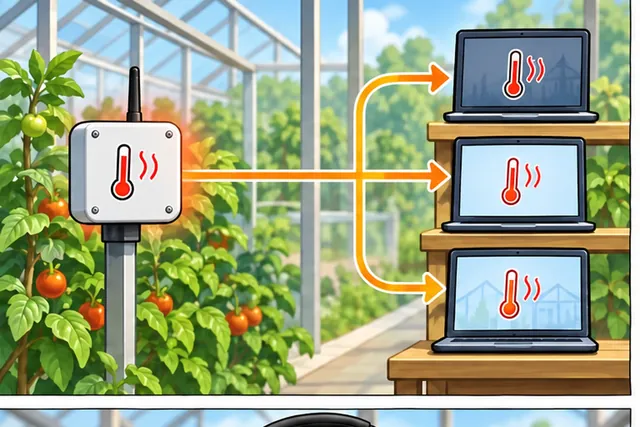
One greenhouse warning must reach three different screens.
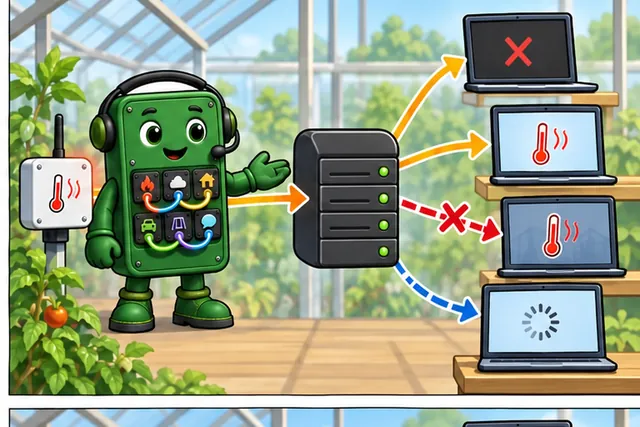
Direct sends create three paths that can fail in different ways.
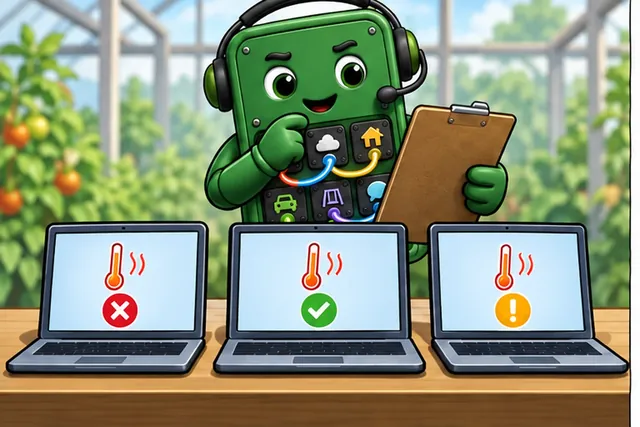
Test the broker with an offline screen, a late join, and a restart.
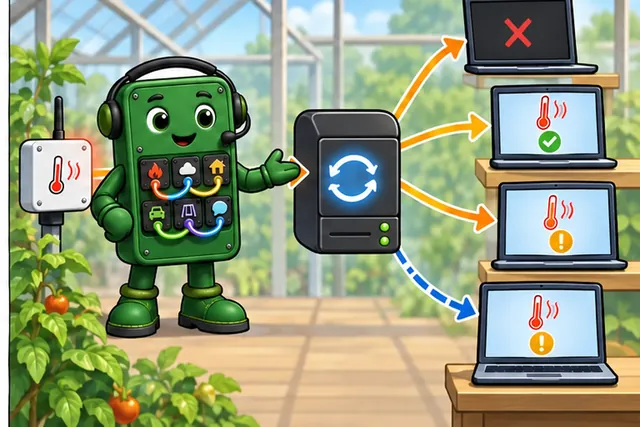
Approve the path only when each screen gets an honest result.
Telemetry here is the device readings and status carried as broker messages. A protocol is an agreed set of message and timing rules. Message Queuing Telemetry Transport (MQTT) is a protocol for passing named messages through a broker.
Draw one path from the sensor to the broker and from the broker to each listener. Then disconnect a listener, repeat the warning, restart the broker, and let a new listener arrive. Record which copy each screen receives, what state is kept, and whether an old warning can look new. Treat network reach as separate from permission to read or send.
This path test does not choose every topic, delivery level, or storage rule. The deeper sections show how names, sessions, retained state, last-will notices, and security boundaries turn the simple route into a reviewable design.
Picture a temperature sensor with one reading to share and three dashboards that may or may not be online. MQTT solves that problem by putting a broker in the middle: the device publishes once, subscribers express what they care about, and the broker owns the routing and state evidence. Start with that path before choosing topics, sessions, retained messages, or last-will behavior.
Why now: Once the warning reaches the broker, map who publishes and which topic filters receive it. About 2–4 min (estimate)
This section: The Broker Separates Senders From Receivers — MQTT is a publish-subscribe protocol built around a broker.
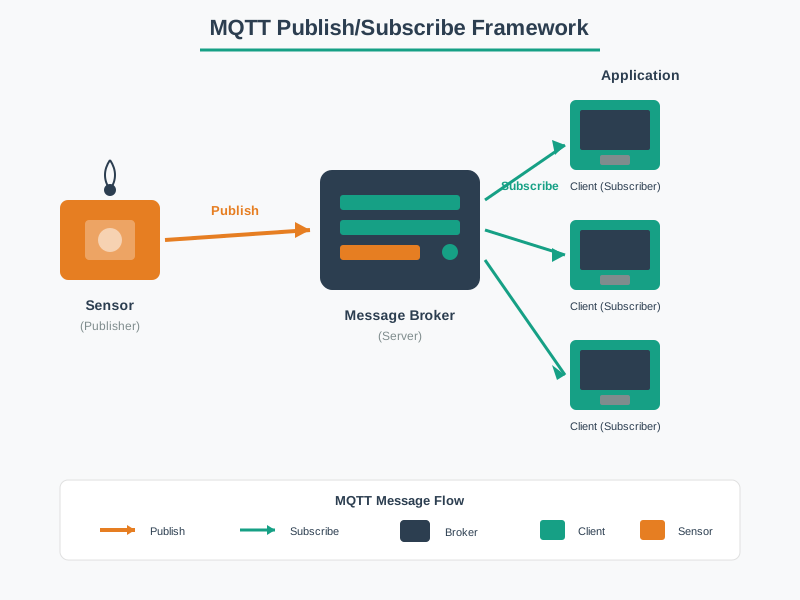
MQTT is a publish-subscribe protocol built around a broker. A publisher sends a message to a topic. A subscriber registers a topic filter. The broker compares the published topic with the filters and forwards matching messages.
The key architectural idea is decoupling. Publishers do not need subscriber addresses, and subscribers do not need publisher addresses. Both sides keep one application relationship with the broker instead of a growing set of direct relationships with each other.
MQTT is not a recent invention: IBM introduced it in 1999 for monitoring oil-pipeline telemetry over slow, unreliable satellite links, and the protocol was later standardized by OASIS in 2013 and published as ISO/IEC 20922. That original brief — connectivity over networks that are slow, lossy, and battery-constrained — is still why the same broker model now carries Facebook Messenger's chat delivery, AWS IoT Core and Azure IoT Hub telemetry, the EVRYTHNG M2M platform, and hobbyist projects on Adafruit IO: very different scales, the same decoupled publish-subscribe contract.
Who may publish, what must the broker remember, and what still needs proof after delivery?
Why now: Compare the message route with other protocol roles before choosing an MQTT design. About 2–4 min (estimate)
This section: Protocol Role Comparison — Figure 2.1 separates the communication contracts served by MQTT and the other protocols.
Figure 2.1 separates the communication contracts served by MQTT and the other protocols.

Read Figure 2.1 by comparing DDS, which connects writers and readers through a peer data space, with MQTT, which fans publishers through a topic broker. AMQP highlights durable queue routing and XMPP highlights addressed federated streams; the lower cards keep power, bandwidth, latency, reliability, and security as measured questions.
If you only need the intuition, this layer is enough: MQTT architecture is a hub for application messages. The broker owns routing, session state, retained messages, and delivery negotiation; devices own the meaning of the payloads they publish and consume.
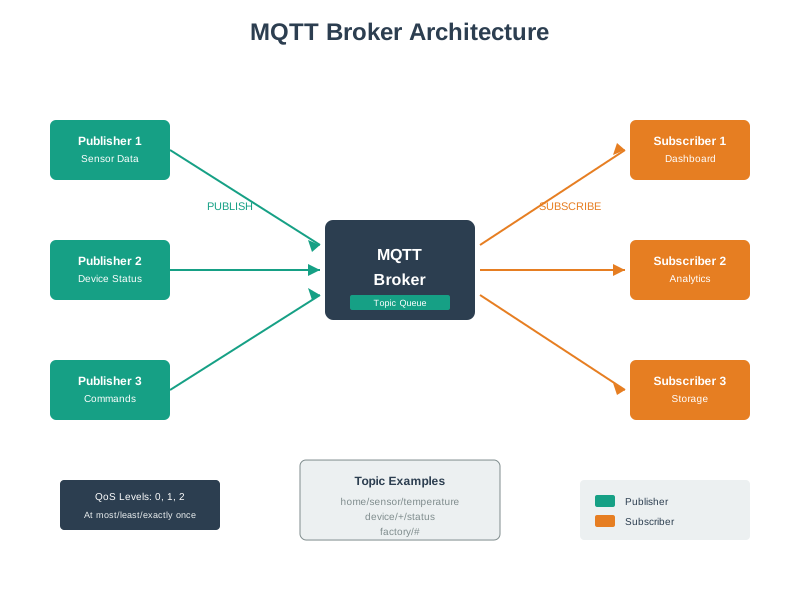
Before assigning topic or session policy, inspect Figure 2.2 to trace two publishers through the broker to subscribers with different filters. The point is to see what becomes decoupled, how one publication can fan out, and what responsibility moves into the middle. The match-evidence band makes the routing result explicit instead of leaving the arrows to imply it.
Read Figure 2.2 from the sensor and gateway into the broker, following their concrete topic names rather than receiver addresses. Inside the boundary, authentication and authorization precede topic indexing, stored-filter matching, fan-out, and session-state handling. Then test the three filters against the evidence band: plant/7/temp matches both plant/+/temp and plant/#, so one publication reaches the dashboard and logger; building/a/air matches only building/+/air, so the alert service receives it while the plant subscribers do not. This separation is the chapter’s running architecture: client roles define flows, the topic tree defines routing, and broker policy defines what is allowed and what survives disconnection.
A client can publish, subscribe, or do both. The role is per flow, not per device: a gateway may publish sensor events and subscribe to command topics.
The topic tree is the routing contract. It should express stable ownership, location, asset, event type, or command boundary.
The broker may hold subscriptions, session state, retained messages, queued messages for persistent sessions, and last-will configuration.
These examples show how topics connect devices and services. A temperature node publishes to building/a/floor/2/room/204/temperature; dashboards subscribe to the parts of the tree they need. A maintenance service subscribes to fault topics without changing device firmware. A gateway can bridge non-MQTT sensors into MQTT by publishing normalized events under agreed topics.
If this gives you the broker model, you can stop here. Continue to Practitioner when you need to design and review a brokered MQTT deployment.
Why now: Record the clients and topics now so the routing choices can be reviewed. About 2–4 min (estimate)
This section: Build The MQTT Architecture Record — A reviewable MQTT design does not start with sample code.
A reviewable MQTT design does not start with sample code. It starts with a short architecture record that says which clients connect, what they publish, what they subscribe to, what the broker stores, and what evidence proves the system is operating correctly.
Inspect Figure 2.3 to follow messages from publishers through a broker to subscribers.
The boiler sensor publishes plant/7/temp with payload 83.4 at QoS 1 and packet identifier 42. The broker checks authentication and ACLs, matches plant/+/temp and plant/#, then returns PUBACK to confirm the publisher-to-broker leg. It sends PUBLISH to the dashboard and logger; each subscriber’s delivery QoS depends on its subscription and the publication QoS. The lower band separates routing, memory policy, authorization, and debugging.
Follow the sequence from decision to evidence. First, Name the flow. Separate telemetry, command, alert, configuration, and state-feedback messages. Next, Name the clients. Record publishers, subscribers, gateways, brokers, bridges, dashboards, and backend services. Next, Name the topic tree. Define the stable topic levels and the wildcard filters subscribers are allowed to use. Next, Name the session policy. Decide clean start, persistent subscription, queued delivery, retained message, and last-will behavior per flow. Next, Name the trust boundary. Record client identity, ACLs, TLS policy, certificate or credential handling, and bridge boundaries. Finally, Name the evidence. Keep broker logs, connection counts, subscription records, publish acknowledgements, dead-letter or error handling, and application-level state feedback for commands.
Devices publish readings under stable measurement topics. Dashboards and analytics subscribe with filters that match their scope.
Operators publish command requests to device-specific command topics. Devices publish state feedback to separate state topics.
Reopen the architecture decision when topic filters broaden, client counts grow, broker ownership changes, or command confirmation becomes safety relevant.
Topic board
Why now: Follow CONNECT and PUBLISH packets to see what the broker stores after the design is set. About 2–4 min (estimate)
This section: Routing, Packets, Sessions, And State — At the protocol level, MQTT clients exchange control packets with the broker.
At the protocol level, MQTT clients exchange control packets with the broker. The common architecture path is CONNECT, CONNACK, SUBSCRIBE, SUBACK, PUBLISH, acknowledgement packets for higher QoS levels, and DISCONNECT. The details matter because the broker's state machine is what turns topic strings into reliable operating behavior.
To connect the broker state machine to observable packets, inspect Figure 2.4 in lifecycle order rather than treating the methods as an unordered API list.
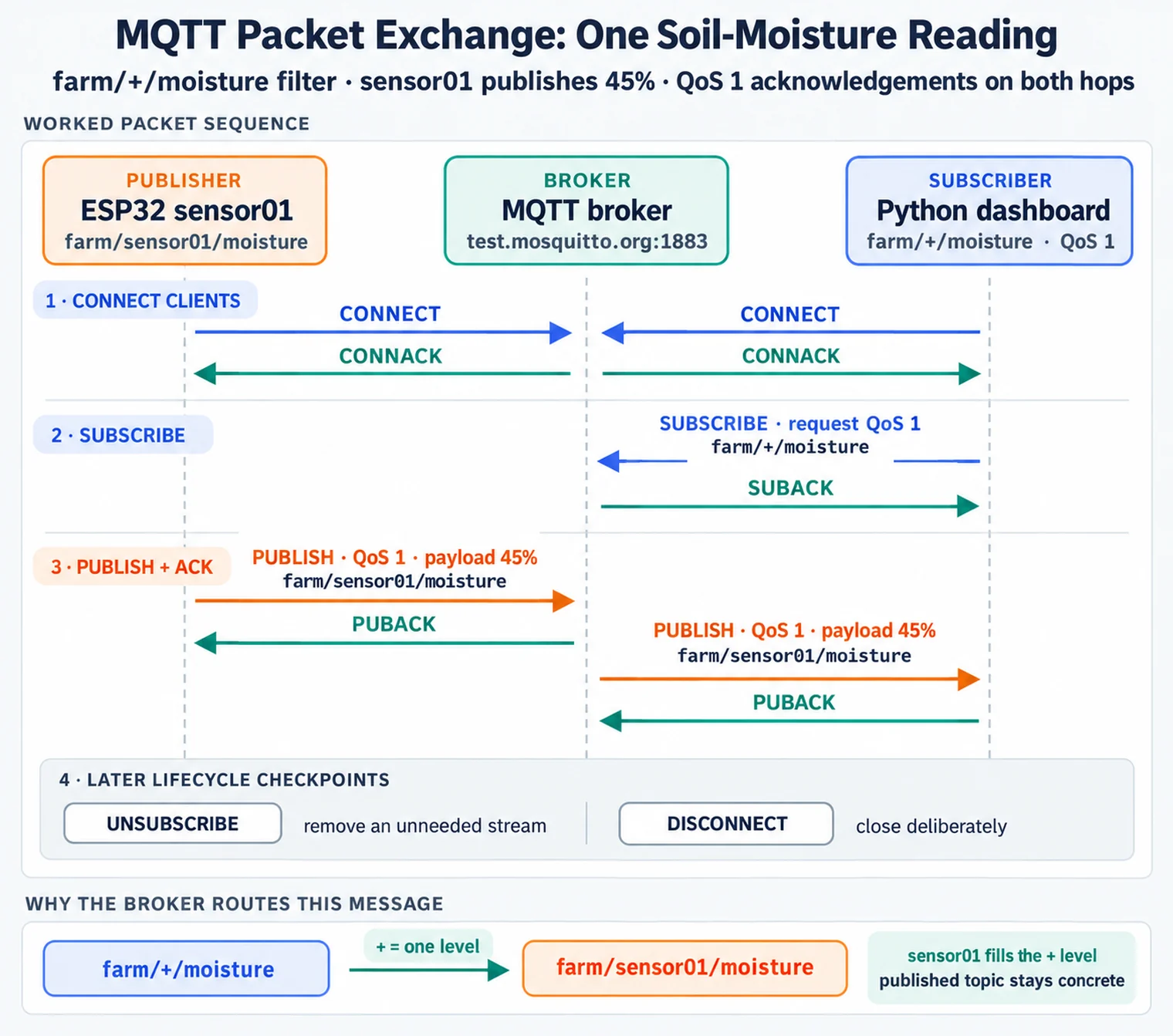
Read Figure 2.4 from connection setup to subscription management, publication and acknowledgement, then teardown. CONNECT establishes identity and session policy; SUBSCRIBE installs routing filters; PUBLISH carries a concrete topic and payload; acknowledgement packets advance QoS state; and DISCONNECT closes cleanly. This packet order is the evidence trail behind the broker responsibilities named above.
The broker compares each published topic name with stored subscription filters. The single-level wildcard + matches exactly one topic level. The multi-level wildcard # matches the remaining levels and must appear at the end of the filter. Published topic names are concrete names; wildcard characters belong in subscription filters.
Inspect Figure 2.5 to test the matching rules against concrete examples before broad filters become ACL or fan-out mistakes.
Read Figure 2.5 from the published topic across each stored filter. Exact text must match one level at a time. A + stands for one level. A final # takes the rest of the branch. The failed cases show extra levels, wrong text, and wildcards in an invalid place. The system-topic rule also keeps a normal first wildcard from taking \$ topics. These fixed rules let the team predict both subscribers and access scope. An observed fan-out test then proves that the broker made the same matches.
The broker may remember subscriptions and queued messages for a client across reconnects, depending on the session policy and broker configuration.
A retained message gives new subscribers the latest retained value for a topic. It is useful for state snapshots and risky for one-time commands.
A last-will message lets the broker publish a preconfigured status if a client disconnects unexpectedly. Treat it as a signal to investigate, not a complete fault diagnosis.
Topic board
+ matches exactly one level; a multi-level # takes the rest and must end the filter.publish topic: factory/line-a/pump-17/temperature
subscriber filter: factory/+/+/temperature
match result: yes, because + matches line-a and pump-17
publish topic: factory/line-a/pump-17/command/start
subscriber filter: factory/+/+/temperature
match result: no, because the final level differsAfter predicting the two matches in the sketch, inspect Figure 2.6 to check the broker’s fan-out and the boundary beyond which MQTT acknowledgements provide no physical proof.

Read Figure 2.6 from each concrete factory topic to the candidate filters, checking one level at a time. The temperature publication matches the two + levels and the final literal, while the command path fails that last comparison. Then follow delivery to the application boundary: broker routing and MQTT acknowledgement can prove a protocol exchange, but device state feedback must prove that the pump acted. This completes the chapter’s route from topic design to operational evidence.
Reliability boundary: MQTT QoS describes message exchange between an MQTT client and broker, and between broker and subscriber. It does not prove that a machine moved, a valve opened, or a database committed the business action. Critical actions need application-level confirmation.
The broker path and packet anatomy in Figure 2.7 show exactly which state the architecture must route and which state belongs to delivery control.

Read the fixed header first. Then follow the payload. Read Figure 2.7 from the boiler sensor to the broker’s topic match, which fans one publication to two subscribers without coupling either consumer to the publisher. In the packet below, the fixed header carries PUBLISH flags, remaining length frames the packet body, and the topic name selects routes. The packet identifier exists only for QoS 1 or 2 exchange state; it is not application identity. The payload retains the measured value and unit, so routing success and schema validity remain separate checks at the application boundary.
Why now: Use the broker route to choose topic levels and filters for the listeners. About 2–4 min (estimate)
This section: MQTT Topic Design and Wildcards
Route One Alarm to the Smallest Correct Audience
Picture a cold-room alarm published under a name that includes site, room, device, and event. A broad subscription may send it to the wrong team, while a vague name may hide which sensor it belongs to. The first design question starts with who needs the message and why.
A broker means a service that accepts and routes messages. Telemetry means measurements and status sent for remote use. MQTT means Message Queuing Telemetry Transport, a lightweight way to exchange messages. A payload means the useful reading or command carried inside a message.
List real topic names and the narrowest filter for each receiver. Add one room, change one level, try each wildcard, publish a system topic, disconnect a subscriber, and restart it. Record which receiver gets each alarm and which access rule rejects excess reach.
This runway does not prove that topic names provide identity or trust. The deeper sections explain topic levels, single-level and subtree wildcards, system-topic limits, retained state, access rules, and matching evidence.
Before the broker can route anything, a team has to name the message. building/2/room/214/temperature tells a clearer story than sensor1: it reveals place, device role, and the kind of reading a subscriber expects. Good MQTT topic design starts with the subscriber’s question, then works backward to names, filters, wildcards, and access boundaries.
An MQTT topic is a case-sensitive UTF-8 name attached to a published message. Brokers do not inspect the payload to decide who receives the message; they compare the published topic with each subscriber's topic filter.
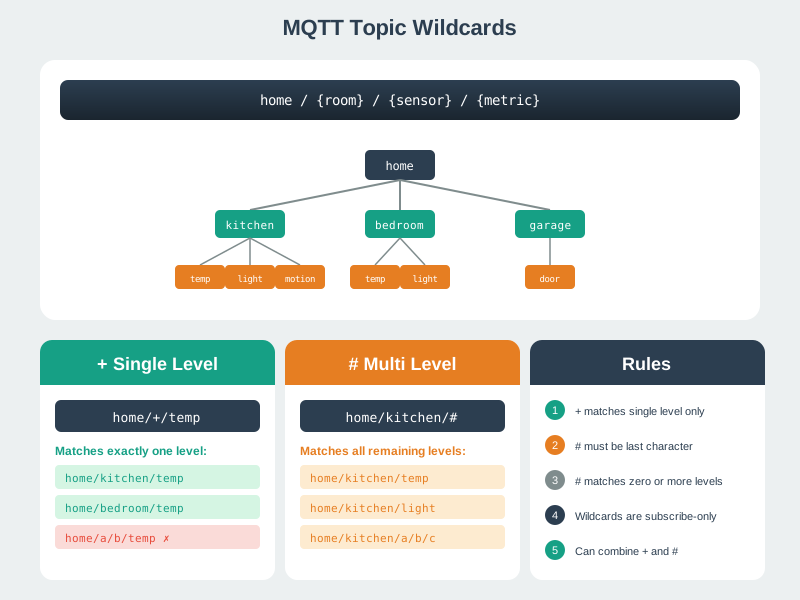
Inspect the topic-filter matrix to determine which exact and wildcard subscriptions match one concrete publication and why the rejected filters fail.
+ fills exactly one missing level, # takes the rest of a subtree, and publishers still send concrete topic names without wildcards.Read the diagram from the concrete topic tree downward. The publisher sends names such as home/kitchen/temp; the subscriber chooses how much of that tree it wants. home/+/temp is selective because it fixes the first and last levels while allowing one room name to vary. home/kitchen/# is broader because it accepts anything below the kitchen branch, including deeper subtopics. Those two wildcard types solve different routing problems, so a good topic plan keeps levels consistent enough that a subscriber can choose the narrowest filter that still covers its job. If a team cannot explain which level each wildcard represents, the topic tree is not yet stable enough for production ACLs or dashboards. Review filters with real sample topics before release.
Which subscribers match this topic tree, and where do the wildcards change the route?
The publisher's exact route, such as factory/line_a/machine_012/temperature. Publish topics do not use wildcards.
The subscriber's match pattern. It may be exact or use the MQTT wildcards + and #.
Each segment between slashes is a level. The levels in home/kitchen/thermostat/state are home, kitchen, thermostat, and state.
Rule of thumb: design topics around stable routing questions: who owns the device, where it is, which asset it represents, and what measurement or command it carries.
factory/line_a/machine_012/temperature
factory/line_a/machine_012/vibration
factory/line_b/machine_004/pressure/Factory/Line A/Machine 012 Temperature
machine_012_temperature
factory/line_a/machine_012/status_and_commandThe best topic tree is not simply a directory of devices. It is a set of routes that lets dashboards, alarms, automation services, and maintenance tools subscribe without client-side filtering.
Identify dashboards, analytics jobs, control services, and alerting systems before naming the levels.
Use durable groups such as factory, line_a, building_b, or fleet.
Ending with temperature, pressure, command, or state keeps wildcard filters useful.
factory/line_a/#factory/+/+/pressurefactory/line_a/machine_012/+#Common mistakes: leading slashes create an empty first level; spaces and mixed case produce inconsistent client code; flat topics such as sensor_001_temp prevent useful wildcard subscriptions; one topic should not carry both desired commands and reported state.
Topic board
factory, line_a, building_b, fleet — then end with the metric or role.factory/line_a/# receives every topic below one production line, the shape a maintenance screen owns.Design review should therefore start with example subscriptions, not just example publishes. If a dashboard needs all pressure readings on one line, the hierarchy must put line and measurement in stable positions. If a controller must write commands to one device but only read state from the same device, the command and state branches should be separate levels so ACLs can express that difference. Treat every wildcard as a contract with future subscribers: it should be obvious which levels are allowed to vary and which levels are intentionally fixed. Keep a short table of approved filters beside the topic naming standard.
Every subscription adds broker state. Exact filters are easiest to reason about, but a large fleet that subscribes one topic at a time can create a large reconnect burst. A small number of well-shaped wildcard filters reduces subscription count while still keeping unwanted messages out of the client.
+ Matches One Levelhome/+/temperature matches home/kitchen/temperature but not home/kitchen/sensor_7/temperature.
# Matches A Subtreehome/kitchen/# matches home/kitchen, home/kitchen/temperature, and deeper topics. It must be the final level in the filter.
A device can be allowed to publish devices/device_042/state/# while a controller can publish devices/device_042/command/#.
Reserved namespaces: broker system topics commonly live under prefixes such as $SYS/. Do not rely on a broad application filter to cover broker-reserved namespaces; subscribe to those namespaces explicitly when you need them.
Topic board
home/+/temperature matches home/kitchen/temperature, not a deeper home/kitchen/sensor_7/temperature.# must be the final level in the filter — it takes a topic and everything deeper beneath it.state/# while a controller owns command/#.Under load, the broker's topic matcher benefits from a hierarchy that avoids both extremes. Thousands of exact subscriptions can make reconnect storms expensive because each client must reinstall a long list of filters. A catch-all # filter is cheap to install but expensive and risky to use because it sends unrelated traffic to the client and moves authorization mistakes into application code. The balanced design is a small set of precise wildcard filters whose level positions mirror product boundaries: site, line, asset, direction, and measurement or command. That same shape also makes retained-message cleanup and audit logs easier, because topic prefixes map to real ownership boundaries instead of arbitrary strings.
A client that installs 50 exact filters on every reconnect causes more broker work than a client that installs 3-5 precise wildcard filters.
Replacing all filters with # reduces subscription count but pushes unwanted traffic and security decisions into application code.
MQTT methods share one ordered connection, while topic filters decide message routing and access control decides whether that routing is permitted.

Figure 2.8 places CONNECT · PUBLISH and SUBSCRIBE · delivery around the BROKER, then contrasts site/+/temperature with site/#; the TRANSPORT + SECURITY stack shows MQTT control packets inside TLS over an ordered TCP byte stream, leaving per-topic ACLs as a separate decision.
MQTT topic design is the routing plan for a publish-subscribe system. Publishers send to exact topic names, subscribers install exact or wildcard topic filters, and the broker matches those filters without interpreting the payload.
Use stable, hierarchical names such as factory/line_a/machine_012/temperature. Use + when one level varies and # when a whole subtree is intentionally in scope. Avoid leading slashes, spaces, mixed naming styles, flat topic strings, and topic paths that mix commands with reported state.
Design MQTT topics from subscriber needs backward. A good hierarchy lets dashboards, safety services, maintenance tools, and ACL policies use a small number of precise filters instead of broad catch-all subscriptions or long lists of exact topics.
Next, trace one reading through every subscription and compare what each receiver accepted.
MQTT Pub/Sub BasicsMQTT Architecture: Broker architecture and publish-subscribe routing.
MQTT Publish-Subscribe Basics: Message flow, retained messages, and last-will behavior.
MQTT QoS Levels: Delivery guarantees and session behavior.
MQTT Security Fundamentals: Authentication, TLS, and topic-level access control.
This section: Summary — MQTT architecture is broker centered.
MQTT architecture is broker centered. Clients publish concrete topic names, subscribers register topic filters, and the broker routes matching messages while managing session-related state. The strongest designs treat topics, sessions, retained messages, last will, identity, and command confirmation as architecture decisions rather than code details.
This section: Key Takeaway
Design MQTT around broker responsibilities and review evidence: who connects, which topics route messages, what state the broker stores, and how the application proves important actions actually happened.
This section: See Also
Use this next to practice the client-side publishing and subscribing pattern that sits on top of the broker architecture.
Deepen the topic hierarchy and wildcard rules that make broker routing predictable.
Connect architecture decisions to QoS tradeoffs, acknowledgements, duplicates, and delivery boundaries.
Review identity, ACLs, transport protection, and broker hardening after the routing model is clear.
Open printable teacher run sheet
3 reviewed answers.
Open the module page from the sidebar to see its chapters in order. Use the module map to return to a topic you need.
Modules and pathsReviewed
Check the symptom, then work through the diagnostic steps. Keep the error message and the smallest example that reproduces it.
When you are stuckReviewed
Use the interactive guide to check how examples and simulations work before changing your project.
Interactive examples guideReviewed