6 Open-Loop and Closed-Loop Systems
More
Depth: Practitioner
Progress saves as you read. Mark sections complete as you go; your progress appears in the sidebar.
6.1 Start With the Missing Measurement
This section: Start With the Missing Measurement — Picture a heater that runs for ten minutes even after the room becomes warm.
Watch the Heater Meet Its Target
Picture a heater that runs for ten minutes even after the room becomes warm. An actuator means the part that causes a physical action, such as switching the heater on or off.
Name the target, sensor, controller, actuator, update time, and safe limits. Test a cold start, an open door, a missing sensor, and a command that reaches the limit.
Keep the target, measured value, controller output, action, time, and fault state. This proves one loop under chosen conditions, not every room or delay; the deeper sections compare open and closed loops, feedback, error, tuning, and failure handling.
The difference between open-loop and closed-loop control is easiest to see when a measurement disappears. A timed heater can run for ten minutes whether the room is warm or cold; a closed-loop heater checks the temperature and changes course.
IoT teams make this choice constantly when deciding whether a command should trust a schedule, a model, or live feedback. Start by naming the measurement that would prove success. If you cannot measure it in time, the control shape must acknowledge that gap.
6.2 Learning Objectives
This section: Learning Objectives
By the end of this chapter, you will be able to:
- Explain the practical difference between command-only control and feedback control.
- Identify when an open-loop design is acceptable for an IoT system.
- Identify when a closed-loop design is required because the system must correct error.
- Describe how disturbances, sensor quality, actuator limits, and placement affect loop design.
- Create a control-loop decision record so later tuning and troubleshooting have useful proof.
Core concept: Open loop acts from a plan. Closed loop acts from measurement.
Why it matters: A controller cannot correct an error it does not measure. Adding feedback improves adaptation, but it also adds sensor, timing, stability, and fallback responsibilities.
Key takeaway: Many durable IoT systems combine both: an open-loop schedule or model provides a baseline, and a closed-loop correction trims the output when measurements are trustworthy.
6.3 Prerequisites
This section: Prerequisites
Before working through this chapter, revisit:
- Feedback Fundamentals: setpoint, process variable, error, and feedback direction.
- Actuators: output devices that turn control decisions into physical action.
- Sensor Fundamentals: measurement quality, sampling, calibration, and sensor failure modes.
6.4 The Two Control Shapes
This section: The Two Control Shapes — Open-loop and closed-loop systems differ in one specific design question: does the measured output change the next control command?
Open-loop and closed-loop systems differ in one specific design question: does the measured output change the next control command? Start with the command-path diagram in Figure 6.1 so the missing feedback path is explicit before the design is compared with closed loop.
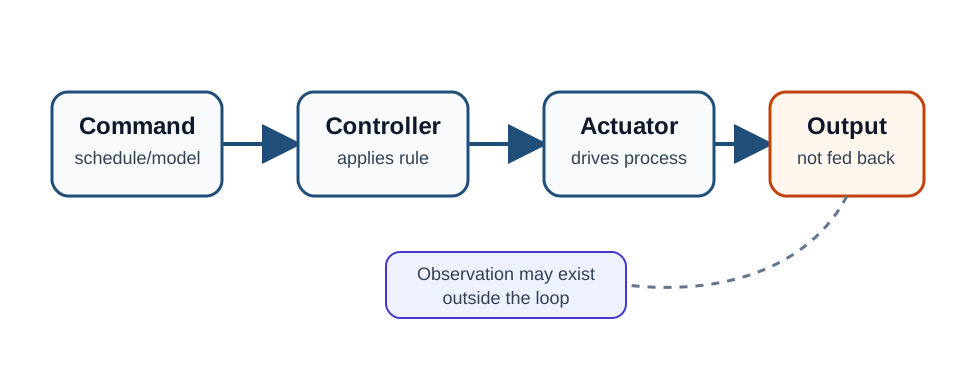
Read Figure 6.1 from the command source through the controller and actuator to the process output. The observer can inspect or log the result, but there is no arrow returning the measured output to the controller. That absent return path is the meaning of open loop: the next command depends on the schedule, setting, or model rather than on measured error. This establishes the baseline for the chapter’s running question about whether process variation is observable and correctable.
Open loop can be a good design when:
- The relationship between command and result is predictable enough.
- A small output error is acceptable.
- The action is reversible or low consequence.
- A feedback sensor would be unreliable, hard to place, or more complex than the value it adds.
- A supervisory system can inspect results at a slower pace.
Now inspect the fish-farm diagram in Figure 6.2. It adds a measured process variable and an error calculation, allowing the next command to respond to the physical result rather than merely repeating the planned input.
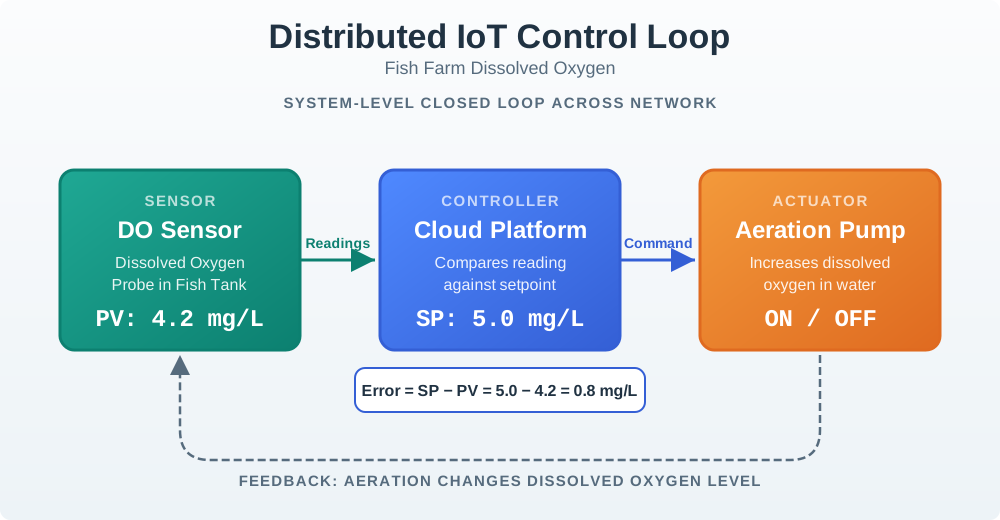
Trace Figure 6.2 from the 5.0 mg/L setpoint to the comparison with the measured 4.2 mg/L process value, producing a 0.8 mg/L error. Follow the controller command to the aeration pump and then the oxygen response back through the sensor. That return path makes the system closed loop; the cloud placement shown is an architectural choice, not a requirement for feedback. The comparison advances the narrative from control shape to timing, reliability, and fallback evidence.
Closed loop is usually required when:
- The output must stay near a target value.
- Disturbances or loads change during operation.
- The process drifts because of wear, environment, or material variation.
- The system must recover without waiting for a person.
- The team needs proof that the controller reaches and holds the target.
6.5 How to Choose
This section: How to Choose — The choice is not “simple versus smart.” It is a fit decision based on observability, consequence, timing, and expected variation.
The choice is not “simple versus smart.” It is a fit decision based on observability, consequence, timing, and expected variation.
Use Open Loop When
- The process is repeatable over the operating range.
- The output does not need tight correction.
- The actuator effect is easy to predict.
- Failure is visible before it becomes severe.
- A slower inspection path is enough.
Use Closed Loop When
- The process variable must be held near a setpoint.
- Disturbances change faster than manual response can handle.
- The actuator response changes with load or wear.
- Overshoot, undershoot, or steady error matters.
- The system must document correction behavior.
Use Hybrid Control When
- A baseline schedule is useful but not sufficient.
- Feedback is available only during some operating states.
- A local loop must keep the process stable while a remote layer adjusts targets.
- A sensor fault should fall back to a known conservative action.
- Commissioning starts with an open-loop test before closing the loop.
6.6 Control Family Addendum
This section: Control Family Addendum — Open loop and closed loop are the first split, but IoT designs often need a more precise control-family label.
Open loop and closed loop are the first split, but IoT designs often need a more precise control-family label. Use the label only after the measurement, actuator, timing, and fallback proof justify it.
| Control family | When it fits |
|---|---|
| Open-loop schedule | The process is predictable enough, drift is low consequence, and verification can happen at a wider process boundary. |
| On/off with hysteresis | A binary output can keep the process inside a band, and the hysteresis gap prevents rapid toggling. |
| Proportional-family control | The actuator accepts variable command strength, and measured error should change command magnitude. |
| Closed-loop PID candidate | P, I, or D terms each solve an observed loop behavior with trusted measurement, declared sample timing, and output limits. |
| Hybrid placement | Remote policy or edge coordination sets targets or modes, while local feedback protects fast correction and fallback behavior. |
Record the selected family, the controlled variable, actuator authority, expected disturbances, local or remote placement, fallback state, and the trigger for reopening the decision.
6.7 Disturbances and Observability
This section: Disturbances and Observability — A disturbance is any influence that changes the process output without being the controller command.
A disturbance is any influence that changes the process output without being the controller command. Wind, load, supply variation, occupancy, friction, and material changes are common examples. Open-loop control cannot correct a disturbance unless the disturbance is already included in the model or schedule.
The clean-room diagram in Figure 6.3 shows why feedback only helps with disturbances that become visible in time for the actuator to counter them.

Read Figure 6.3 from the setpoint to the error and PID controller. Follow the command through the HVAC unit to room temperature. Then trace the sensor path back. An open door and equipment heat enter at the room, not through the command path. The loop can react only after the sensor sees their effect. This ties control of a disturbance to what the system can see and how soon it can act. The test must cover sensor place, sample time, actuator range, and a safe state for stale or wrong feedback.
Closed loop does not magically solve every disturbance. It helps only when the loop can observe the output, compute error, and act quickly enough for the process. A feedback design should answer four questions:
- What is measured? Name the process variable, sensor location, sample rate, and quality checks.
- What is corrected? Name the actuator command and the allowed operating limits.
- What changes the process? List expected disturbances and the speed at which they appear.
- What happens on bad data? Define sensor-fault behavior, stale-measurement handling, and fallback state.
6.8 Hybrid Feedback Timing Addendum
This section: Hybrid Feedback Timing Addendum — Hybrid IoT control is common: a remote service sets policy, an edge layer coordinates nearby equipment, and a local loop performs time-sensitive correction.
Hybrid IoT control is common: a remote service sets policy, an edge layer coordinates nearby equipment, and a local loop performs time-sensitive correction. The design is closed-loop at the physical process when measured output changes the next actuation, whether the controller is local or remote.
| Loop item | Proof to preserve |
|---|---|
| Remote policy | Approved setpoints, schedules, alerts, reports, and fleet comparison, with proof that fast correction does not depend on the remote layer. |
| Edge coordination | Shared limits, conflict avoidance, gateway or controller ownership, and behavior during wide-area connectivity loss. |
| Local feedback | Controlled variable, sensor location, sample period, actuator authority, safety limit, and deterministic correction near the process. |
| Feedback timing | Sample delay, decision delay, actuator response, process response, verification delay, and whether the loop can tolerate missing or noisy samples. |
| Fallback state | Hold, safe output, alarm, manual mode, limited schedule, or other bounded action when measurement, actuation, or communication is unreliable. |
| Failure modes | Open-loop drift, bad feedback, oscillation, saturation, repeated alarms, and the trigger that reopens the control-type decision. |
A ventilation system may keep a minimum schedule while local feedback extends or reduces fan operation when measured conditions require it. The decision record should compare runtime, process excursions, sensor reliability, and fallback behavior in the actual installation.
6.9 Placement in IoT Systems
This section: Placement in IoT Systems — Feedback can be local, distributed, or supervisory.
Feedback can be local, distributed, or supervisory. The correct placement depends on how quickly the process needs correction and whether the system can continue when the network is unavailable.
Local Loop
- Sensor, controller, and actuator are near the process.
- Best for fast correction and autonomous operation.
- Requires local limits, validation, and tuning records.
Distributed Loop
- Measurement and actuation are separated across devices.
- Useful when one node observes what another node affects.
- Needs message timing, stale-data handling, and conflict rules.
Supervisory Loop
- A slower layer adjusts setpoints, schedules, or operating modes.
- Useful for coordination and long-horizon optimization.
- Should not be the only loop for fast or high-consequence correction.
The common IoT pattern is local closed-loop control for stability, plus a slower supervisory layer for setpoint changes and inspection. A device can also behave open-loop locally while the larger system forms a slower feedback loop through inspection, command updates, or operator checks. The key is to state the loop boundary clearly.
6.10 Control Decision Record
This section: Control Decision Record — A control decision should leave a short record.
A control decision should leave a short record. This prevents a later maintainer from guessing why a loop was left open, closed locally, or split across layers. Use the record diagram in Figure 6.4 to connect the chosen loop shape to the field evidence that can confirm or reopen it.
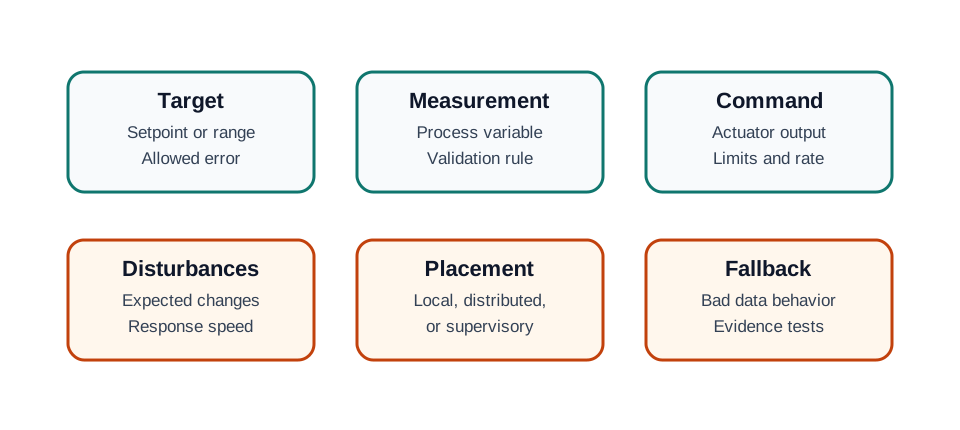
Read Figure 6.4 from target and process variable to actuator command and limits, then continue through expected disturbances, placement, fallback, and proof. The first fields define what the loop may influence; the middle fields bound authority and failure exposure; the final fields make the choice testable. That order connects the chapter’s open, closed, and hybrid shapes to a maintained engineering decision: if the sensor, disturbance, timing, actuator, or fallback evidence changes, the record shows exactly which assumption must be reviewed.
Target and Variable
- Setpoint or acceptable range.
- Measured process variable.
- Sensor location and validation rule.
Command and Limits
- Actuator command and units.
- Minimum, maximum, and rate limits.
- Manual override or lockout behavior.
Loop Proof
- Step response or disturbance test.
- Overshoot, settling, steady error, or retry behavior.
- Fallback test for missing or invalid measurement.
6.11 Worked Example: Pumped Tank Level
This section: Worked Example: Pumped Tank Level — Consider a tank where a pump adds liquid and an outlet removes liquid at a variable rate.
Consider a tank where a pump adds liquid and an outlet removes liquid at a variable rate.
Open-loop design: The controller runs the pump for a fixed duration every cycle. This works only if the outlet flow and starting level are predictable. If outlet demand changes, the tank may drift high or low because the command does not depend on the measured level.
Closed-loop design: A level sensor reports the tank level. The controller compares level with the target range and adjusts pump output. The loop can correct outlet variation, but it must handle sensor faults, pump saturation, and delayed level response.
Hybrid design: A schedule provides a baseline pump plan, while the level sensor trims the command. If the sensor fails validation, the controller reverts to a conservative open-loop command and raises a maintenance event.
The hybrid design is often the most practical design answer: it uses feedback when the measurement is trusted, and it still has defined behavior when the measurement is not trusted.

6.12 Common Pitfalls
This section: Common Pitfalls
Closing a Loop Without a Reliable Measurement
A noisy, delayed, or misplaced sensor can make a closed-loop system worse than a simple command plan. Validate the measurement before tuning the controller.
Treating Open Loop as Always Wrong
Open loop is appropriate for predictable, low-consequence tasks. The design issue is not whether feedback exists; it is whether missing feedback creates unacceptable error.
Ignoring Actuator Limits
A controller cannot correct an error if the actuator is already at its limit. Record saturation behavior and recovery behavior.
Putting Fast Correction in a Slow Layer
If the process changes faster than messages can travel, keep the stabilizing loop local and use remote layers for slower coordination.
6.13 Knowledge Check
This section: Knowledge Check
Key Concepts
This section: Key Concepts — The chapter’s vocabulary describes one causal path: a controller compares a setpoint with a process variable, acts within its authority, and encounters disturbances across a chosen loop boundary.
The chapter’s vocabulary describes one causal path: a controller compares a setpoint with a process variable, acts within its authority, and encounters disturbances across a chosen loop boundary. Use the list below as a compact recap after tracing that path in the diagrams and decision record.
Keep the terms coupled when reviewing a real system. A process variable is useful only when its sensor location and timing reveal the error the actuator can correct. A disturbance matters when it changes that variable outside the command path. Loop placement then determines whether the measurement, decision, actuation, and fallback remain available within the required response time. The definitions summarise those relationships; they do not replace the control-path and failure evidence developed above.
- Open-loop control: Control that applies a command without measuring the output for correction.
- Closed-loop control: Control that uses measured output to reduce error between a target and a process variable.
- Setpoint: The desired target value or target range.
- Process variable: The measured output that represents process behavior.
- Error: The difference between the setpoint and the measured process variable.
- Disturbance: A factor outside the controller command that changes process output.
- Loop placement: The architectural boundary that determines where sensing, control, actuation, and fallback behavior run.
6.14 Overview: Loop Choice Is A Risk Boundary
This section: Overview: Loop Choice Is A Risk Boundary — Open loop, closed loop, and hybrid control are not maturity levels.
Open loop, closed loop, and hybrid control are not maturity levels. They are different promises about what the system will notice and correct. An open-loop design promises that the command plan is good enough until inspection. A closed-loop design promises that a measured process variable can safely change the next actuator command.
The risk boundary is the moment the process drifts. If the drift is slow, visible, and low consequence, open loop may be acceptable. If the drift can damage equipment, waste energy, spoil material, or hide until a user is affected, feedback or a bounded hybrid design needs to be part of the architecture.
The choice-map diagram in Figure 6.5 turns that risk boundary into an ordered architecture gate.
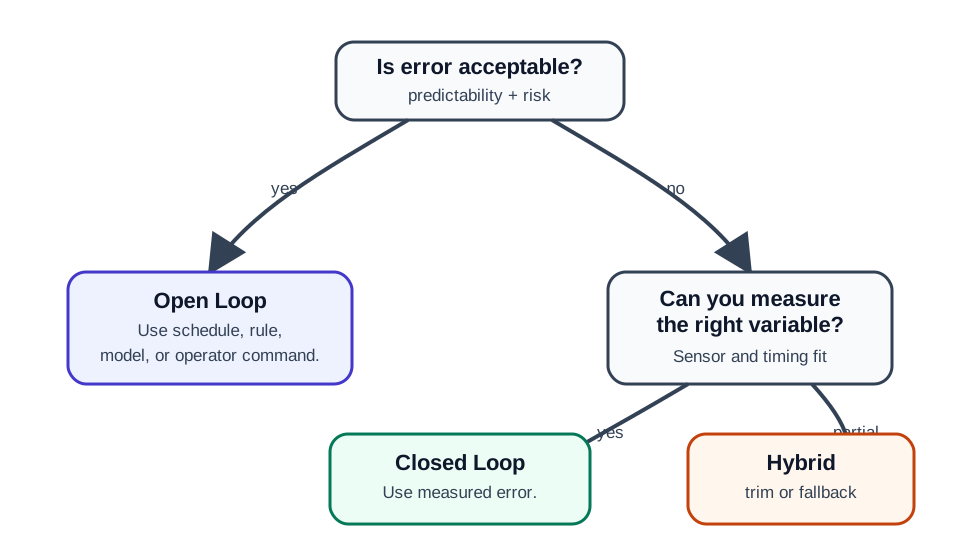
Read Figure 6.5 from acceptable output error. If drift is tolerable and inspection can catch it, the route can remain open loop; if error is unacceptable, test whether the right variable can be measured and corrected within the process timescale. Partial measurement, unreliable timing, or a required fallback leads to a hybrid record rather than an unqualified closed-loop claim. This reconnects the chapter's running narrative to risk: the selected shape is justified by consequence, observability, authority, and recovery evidence.
Small-screen read: acceptable drift can stay open loop; unacceptable drift needs measurement; partial or unreliable measurement needs hybrid baseline, feedback trim, and fallback proof.
6.15 Hybrid Loop Record
This section: Hybrid Loop Record — Many IoT systems should not be labeled simply open loop or closed loop.
Many IoT systems should not be labeled simply open loop or closed loop. They combine a baseline schedule, local correction, remote setpoint updates, alarms, and fallback states. Write the record so each layer has a clear job instead of an implied promise.
Baseline Plan
Record the schedule, model, or default command, plus the inspection interval that proves the plan is still acceptable.
Local Correction
Record the measured variable, sensor validation rule, actuator authority, output limit, and stale-measurement behavior.
Supervisory Role
Record which remote layer may change setpoints, modes, alarms, or reports, and which fast corrections must remain local.
A useful record names the rejected alternatives as well. For example, "remote-only feedback rejected because the cabinet temperature can rise faster than the cloud round trip and reconnect path" is more useful than "closed loop selected."
6.16 Under the Hood: Delay Can Destabilize a Closed Loop
This section: Under the Hood: Delay Can Destabilize a Closed Loop — A feedback path can remain closed even when delay makes the response too slow to regulate safely.
A feedback path can remain closed even when delay makes the response too slow to regulate safely. Delay does not merely make a loop slower. It can make the controller act on old state, send repeated corrections after the process has changed, or treat a stale measurement as current proof.
That is why remote supervision is usually safer as a target-setting or reporting layer than as the only stabilizing loop. The local controller can keep a bounded state near the process, while the slower layer changes policy, records evidence, and reopens the decision when operating conditions move outside the original proof.
6.17 Summary
This section: Summary — Open-loop systems are simple command paths.
Open-loop systems are simple command paths. They are valid when the process is predictable, consequences are low, and slower inspection is enough. Closed-loop systems measure output and correct error, which makes them better for drift, disturbances, and accuracy requirements. Robust IoT designs often use a hybrid pattern: a baseline command plan, local feedback when measurements are valid, and documented fallback behavior when measurement or communication fails.
6.18 See Also
This section: See Also
6.19 What’s Next
This section: What’s Next — Continue with Lab: PID Implementation to implement PID loops as sampled controllers with clear timing, state, limits, anti-windup behavior, and derivative filtering.
Continue with Lab: PID Implementation to implement PID loops as sampled controllers with clear timing, state, limits, anti-windup behavior, and derivative filtering.
Find help
3 reviewed answers.
Where should I start in a module?
Open the module page from the sidebar to see its chapters in order. Use the module map to return to a topic you need.
Modules and pathsReviewed
What can I try when a project does not work?
Check the symptom, then work through the diagnostic steps. Keep the error message and the smallest example that reproduces it.
When you are stuckReviewed
How do interactive examples work?
Use the interactive guide to check how examples and simulations work before changing your project.
Interactive examples guideReviewed