NoSec
No DTLS. Plain coap:// on 5683. Security must come from the link or network layer.
Progress saves as you read. Mark sections complete as you go; your progress appears in the sidebar.
This section: Start With the Proxy Boundary — Picture a clinic sensor sending a room reading through a small relay to a care service.
Follow One Protected Reading Across Every Stop
Picture a clinic sensor sending a room reading through a small relay to a care service. The relay may need to route or cache the message, but it should not gain more access than its job needs.
A protocol is a shared set of rules for exchanging data. The Constrained Application Protocol, or CoAP, gives small devices a web-style method. Transport Layer Security means protection for a network connection. Datagram Transport Layer Security, or DTLS, applies that idea to one CoAP network hop. Object Security for Constrained RESTful Environments, or OSCORE, protects the message content so it can remain protected across a relay.
Write one route from sensor to final user. Name each identity, key owner, visible field, protected field, message age, replay check, and place where trust ends. State who may read the value and who may only forward it.
Test a copied old message, a wrong device key, a changed relay, a lost reply, a sleeping sensor, and a key change. Check both rejection and recovery. A successful secure session is not enough if an old command can be accepted again or no one can explain which relay saw plain text.
Keep urgent care action local when the wider protected route is late. This opening does not select one security mode for every device. Practitioner maps protection to the route. Under the Hood examines handshakes, replay windows, proxy behavior, group cases, and proof records.
Use a short route check. Send one fresh reading, repeat an old one, change the relay, and use the wrong key. Record what each stop can see and why each item is accepted or refused.
Repeat the check after a key, relay, message form, clock, or sleep rule changes. A reviewer should be able to follow the result without trusting the name of the security mode.
A CoAP proxy can save energy and bridge protocols, but it also raises a blunt question: who can see plaintext? DTLS protects a hop; OSCORE can protect the object across a proxy; credentials and replay windows decide whether the protection is auditable.
Use this page as the security boundary map. Each mode is useful only when the review can say what is hidden, what remains visible, where trust terminates, and what evidence proves replay protection.
This section: Learning Objectives
After this page, you should be able to:
This section: Why This Contract Comes After Security and Applications — CoAP Security and Applications covers DTLS, credentials, constrained deployments, and real application use cases.
CoAP Security and Applications covers DTLS, credentials, constrained deployments, and real application use cases. This page narrows in on the deeper security contract: which protection layer is in use, what metadata it hides, whether a proxy can see plaintext, and which replay and credential records make the deployment auditable.
The CoAP security lesson remains tied to deployment choices: CoAP security controls such as DTLS, OSCORE, credentials, proxies, replay windows, and audit records must line up with the threat model.
Use it when a CoAP deployment includes healthcare, building control, industrial monitoring, caching proxies, HTTP translation, multicast, or sleepy devices that cannot pay a full handshake on every wake cycle.
RFC 7252 defines four security modes for CoAP. NoSec means no protocol-layer security: plain coap:// on UDP port 5683, relying on something else (link-layer keys, a physically closed network) for protection. The other three all run DTLS and are addressed as coaps:// on UDP port 5684: PreSharedKey uses symmetric keys shared in advance, RawPublicKey uses an asymmetric key pair with no certificate, and Certificate uses an X.509 chain validated against a trust anchor.
What matters most is the scope of protection. DTLS secures the entire CoAP message between the two DTLS endpoints — the method, the URI path, every option, and the payload. That is why a path like /patient/12345/vitals is concealed under DTLS, whereas encrypting only the payload would leave that revealing metadata in the clear. The trade is a handshake: several messages to agree keys before any request flows.
For a closed hospital ward, a monitor might be provisioned with identity bed-042 and a 128-bit PSK, then send coaps://gateway/patient/12345/vitals over a long-lived DTLS session. A passive sniffer can still see that UDP packets are going to the gateway on port 5684, but cannot read the CoAP code, Uri-Path, Observe option, content format, or vital-sign payload. For a third-party device ecosystem, certificates may be worth the larger handshake because the server can validate vendor identity without manually sharing a secret with every device.
Inspect Figure 21.1 to connect each RFC 7252 security mode to the endpoints and metadata actually protected on the route to cloud services.
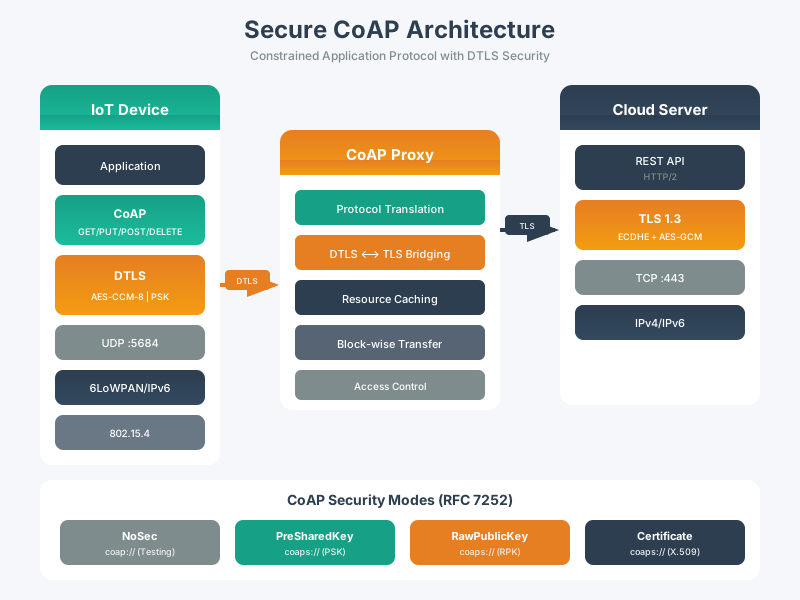
Follow one protected message. Check who owns each key. Read Figure 21.1 from the device's CoAP-over-DTLS stack to the proxy and onward over TLS. Then compare NoSec, PreSharedKey, RawPublicKey, and Certificate as authentication choices around that transport protection. DTLS hides the CoAP code, options, path, and payload only between its endpoints; a terminating proxy creates a new trust boundary where plaintext may be available for forwarding. That endpoint scope prepares the chapter's later contrast with object security and tells the deployment record which keys, identities, proxy controls, and logs must support the claim.
No DTLS. Plain coap:// on 5683. Security must come from the link or network layer.
DTLS with symmetric keys shared in advance. Cheapest handshake; ideal for closed deployments.
DTLS with an asymmetric key pair and no certificate authority — asymmetric strength without PKI.
DTLS with an X.509 chain validated to a trust anchor — full PKI for open ecosystems.
Choosing a DTLS mode is a resource decision. PreSharedKey has the lightest handshake and no certificate parsing, so it suits tightly managed fleets. RawPublicKey gives asymmetric-key strength without the cost and operational burden of a certificate authority. Certificate mode fits open ecosystems where devices from many vendors must be validated to a common trust anchor. To keep the handshake from dominating energy use, keep the DTLS session open and reuse it across many requests, and rely on the handshake's HelloVerifyRequest cookie to blunt spoofed-source denial-of-service before the server commits any state.
A sizing example makes the trade visible. If a meter sends one reading every 30 seconds, it sends 2,880 CoAP reports per day. A PSK DTLS handshake of roughly 500-700 bytes is expensive if repeated for every report, but almost negligible if the device keeps one session alive for an hour or a day and pays only the DTLS record overhead on each message. A deep-sleep sensor is different: if RAM is lost on every wake, the DTLS session state and sequence numbers vanish, so either session resumption state must be stored safely or OSCORE/EDHOC-style object security should be considered.
The architectural catch: DTLS secures exactly one hop between two endpoints. A CoAP proxy that caches responses or translates CoAP to HTTP must terminate the DTLS session, decrypt, and re-encrypt on the far side — which means the proxy sees plaintext. If you do not fully trust that middlebox, DTLS alone does not give you end-to-end confidentiality.
OSCORE — Object Security for Constrained RESTful Environments (RFC 8613) — answers the proxy problem by securing the CoAP message rather than the transport. It uses COSE (CBOR Object Signing and Encryption) with an AEAD algorithm (default AES-CCM-16-64-128) and derives its keys with HKDF-SHA-256 from a shared Master Secret. The request method, the payload, and the sensitive options are encrypted and integrity-protected inside a compact COSE object, which is carried as the payload of an outer CoAP message that bears the OSCORE option (option 9) and a generic outer code such as POST.
DTLS protects the hop; OSCORE protects the object. A proxy can terminate DTLS and still see plaintext, but an OSCORE-protected request stays encrypted between the original client and the final server while the proxy reads only the outer routing fields it needs.
The clever part is which options stay visible. OSCORE classifies options into an encrypted inner class and an unprotected outer class: options a proxy legitimately needs to do its job — Uri-Host, Proxy-Uri, Observe, and the block options — remain in the outer, readable header, while content-bearing options like Uri-Path and Uri-Query are encrypted inside. So a forwarding or caching proxy can still route and cache the outer message, yet it cannot read the protected content. Replay protection comes from a per-sender sequence number used to build the AEAD nonce, checked against the recipient's replay window. Because protection lives in the object, OSCORE survives untrusted proxies and can even run over a DTLS hop for defense in depth.
An AEAD-protected CBOR structure holding the encrypted method, payload, and inner options.
Marks a message as OSCORE-protected and carries the key ID and partial IV a recipient needs.
Routing/caching options stay outer and visible; content options are encrypted inner, so proxies still work.
A per-sender counter forms the AEAD nonce and is checked against a replay window.
This section: Release Checklist
Before shipping a CoAP security contract, verify these records:
This section: See Also — Return to the applications chapter for deployment choices, then review the message fields those protections cover.
Return to the applications chapter for deployment choices, then review the message fields those protections cover.
This section: Next — Return to CoAP Security and Applications, then continue to CoAP Implementation Labs for operational practice.
Return to CoAP Security and Applications, then continue to CoAP Implementation Labs for operational practice.
3 reviewed answers.
Open the module page from the sidebar to see its chapters in order. Use the module map to return to a topic you need.
Modules and pathsReviewed
Check the symptom, then work through the diagnostic steps. Keep the error message and the smallest example that reproduces it.
When you are stuckReviewed
Use the interactive guide to check how examples and simulations work before changing your project.
Interactive examples guideReviewed