GET
Read a resource. Success is 2.05 Content with the representation in the payload. Safe: it never changes state.
Progress saves as you read. Mark sections complete as you go; your progress appears in the sidebar.
A room controller wants a lamp on. Its first reply is lost, so it repeats the operation. The method contract depends on whether a request retrieves content, sets a desired state or repeats an action.
This section: Start With the Duplicate Command — Picture a controller asking ten lamps for their state, then sending one lamp a change.
Repeat One Request Without Repeating the Physical Action
Picture a controller asking ten lamps for their state, then sending one lamp a change. A lost reply may cause a retry. The safe design must show which requests can repeat and which physical actions must happen only once.
An application programming interface is a defined way for software parts to request work or data; API is its short name. A protocol means the shared rules for a message exchange. CoAP means Constrained Application Protocol, a compact web-style message system for small devices.
Capture one request, its method, message token, response code, target, and final lamp state. Drop a reply, repeat the request, send it to a group, restart one lamp, and check that responses spread out while physical action remains bounded.
This runway does not prove every group or resource design is safe. The deeper sections explain method codes, repeat-safe behavior, created-resource locations, multicast response timing, and the evidence each result requires.
A light switch can safely retry a GET /state, but retrying a badly designed POST /toggle might turn the light back off. Multicast adds another risk: one request can wake many devices, so responding devices must avoid an ACK storm.
This page turns method names into an implementation contract. It asks what can be retried, what response code proves the result, how Location options identify new resources, and how multicast replies stay orderly.
This section: Learning Objectives
After this page, you should be able to:
This section: Why This Contract Comes After Methods and Multicast — CoAP Methods and Multicast introduces the core resource operations and feature set.
CoAP Methods and Multicast introduces the core resource operations and feature set. This page narrows in on the protocol contract beneath those examples: how method intent is encoded, what response codes prove, which operations tolerate retransmission, and how multicast discovery avoids ACK storms while still returning many endpoint-specific responses.
The CoAP methods frame is still the parent lesson: CoAP methods such as GET, POST, PUT, DELETE, plus response codes and multicast discovery, must each carry a reviewable operational promise.
Use it when a device API includes retried writes, POST-created resources, group discovery, /.well-known/core, proxy caches, or any code path where a duplicate request must not create hidden state.
CoAP borrows its verbs directly from HTTP. GET reads the current representation of a resource. PUT writes a representation to a known URI, creating or replacing it. POST asks a resource to process an enclosed representation, which often means "create a subordinate" or "trigger an action." DELETE removes a resource. The difference from HTTP is only the packaging: these methods travel in the 8-bit Code byte of a compact UDP datagram.
Every response carries a Code too, grouped into families. Class 2 is success (2.05 Content for a GET, 2.01 Created, 2.04 Changed, 2.02 Deleted). Class 4 is a client error (4.04 Not Found, 4.05 Method Not Allowed, 4.00 Bad Request). Class 5 is a server error (5.00 Internal Server Error, 5.03 Service Unavailable). A client can branch on the class alone before it ever parses a payload.
On the wire, the method names become tiny numeric method codes: GET is 0.01, POST is 0.02, PUT is 0.03, and DELETE is 0.04. Response codes use the same class/detail split, so 2.05 means "success class, detail 5" and is encoded as one byte. That is why a constrained client can reject 4.xx errors, accept 2.xx success, and defer payload parsing until it knows the method-level outcome.
Numeric method and response codes are easier to remember when attached to the resource change they represent. Inspect the three client/server exchanges in the diagram Figure 9.1 to connect the compact Code byte to familiar REST semantics.
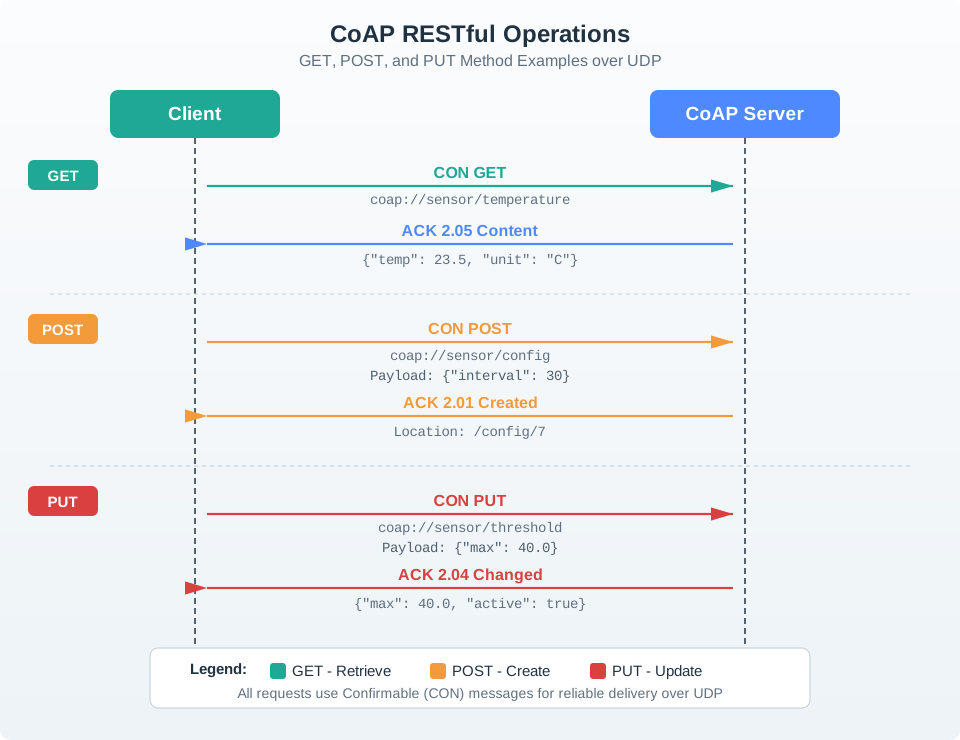
The first lane of Figure 9.1 sends GET as CON GET coap://sensor/temperature and receives ACK 2.05 Content, pairing a safe read with its representation. POST carries {"interval": 30} to /config and returns 2.01 Created plus a new location, whereas PUT sends {"max": 40.0} to the known /threshold resource and returns 2.04 Changed. These method/outcome pairs are the application contract; their compact numeric encoding is what makes the same semantics practical in multicast and constrained-link designs later in the chapter.
Read a resource. Success is 2.05 Content with the representation in the payload. Safe: it never changes state.
Write to a known URI. Returns 2.04 Changed on update or 2.01 Created if it made a new resource.
Process an enclosed representation, often creating a subordinate. Typically 2.01 Created with a Location option, or 2.04 Changed.
Remove a resource. Returns 2.02 Deleted on success. Repeating it leaves the resource absent, even if the response policy later reports Not Found.
Two method properties drive real decisions. A safe method never changes server state; only GET is safe. An idempotent method produces the same end state whether applied once or many times; GET, PUT, and DELETE are idempotent, but POST generally is not. These properties are exactly what makes retransmission safe: a Confirmable GET that gets retransmitted is harmless, and a repeated PUT converges to the same value, but a repeated POST can create two resources unless the server deduplicates.
Use that rule when designing device APIs. If a thermostat receives the same PUT /config/interval payload three times because ACKs were lost, the state is still "interval = 30 seconds"; the duplicate packets are annoying but not semantically dangerous. If the same device receives POST /readings three times without an application record ID, it may store three readings. For POST on unreliable links, add a client-supplied identifier, deduplicate by Message ID while it is in the exchange lifetime, or model the operation as PUT to a known URI.
The same properties govern multicast. A CoAP request sent to a group address must be Non-confirmable — you cannot acknowledge on behalf of a whole group. The canonical use is discovery: a GET to /.well-known/core at the "All CoAP Nodes" address (IPv4 224.0.1.187, IPv6 FF02::FD link-local) asks every listening node what resources it hosts. Because the message is not idempotent-sensitive and only reads, GET is the right verb; a multicast PUT or POST would be reckless.
Response codes carry more than success or failure. A POST that creates a resource should return 2.01 Created and should include Location-Path and/or Location-Query options when the new URI differs from the request URI; without them, the resource was created at the request URI. A PUT that updates existing state returns 2.04 Changed; a PUT that creates returns 2.01 Created. DELETE returns 2.02 Deleted when deletion succeeds; a repeated DELETE should still return 2.02 even if the resource is already absent. Attempting an unsupported verb yields 4.05 Method Not Allowed.
Multicast changes the messaging layer, not the meaning of the codes. There is no acknowledgment to a group, so a multicast request is always Non-confirmable and no Message ID is matched with an ACK. A server that has nothing relevant may simply stay silent. To keep many servers from replying in the same instant and swamping a constrained link, each server waits a random interval within a Leisure period before answering, and its reply is a unicast Non-confirmable message. The client therefore has to tolerate anywhere from zero to many responses, correlating each one to its request by the Token.
In a trace, a multicast discovery exchange therefore looks unlike a normal request/response. The outbound request has one Token and one multicast destination, then the client receives zero, one, or many unicast replies from different source endpoints. With the RFC default DEFAULT_LEISURE of 5 seconds, replies should be spread across the leisure window rather than arriving as a burst. A practical client keeps listening until that window closes, then merges the returned link-format entries by endpoint and resource path.
Answer to a POST/PUT that made a resource; carries Location options naming the new URI.
Answer to a PUT/POST that modified existing state without creating a new resource.
Answer to successful DELETE. Idempotent means the resource remains absent; later status may be Deleted or Not Found.
Random pre-response delay that spreads multicast replies in time to avoid a response storm.
This section: Retry a Desired State, Then Count Discovery Replies — For a worked method example, assume the lamp starts off.
For a worked method example, assume the lamp starts off. A PUT requesting the state on changes it to on. Repeating that desired-state request leaves it on. A POST that means toggle changes off to on on its first execution, then on to off if the server executes it again as a new operation. Message-level duplicate detection helps within its scope, but it does not make every later POST repeat-safe.
Read Figure 9.1 across its three exchanges. GET retrieves Content without asking for a state change. POST creates a resource and reports its location. PUT addresses a known resource and reports Changed. These outcomes explain why the client must interpret response codes before treating a returned body as the requested content.
The compact Code byte carries a class and detail. For the illustrated Content response, class 2 and detail 5 produce 2 × 32 + 5 = 69. This calculation explains the byte value; it does not mean that every successful method returns the same response. Created content has its own location, which the client retains from the returned Location options.
Now consider multicast discovery with 12 devices. If their unicast replies are spread over an illustrative 6 s response window, the mean offered response rate is 2 replies per second. That average does not guarantee even spacing: random delays can still place replies close together. The discovery client must accept content from zero, one or many endpoints and preserve each source address. One request Token associates discovery replies without merging different endpoints’ content into one device.
Predict whether an empty discovery result proves the room contains no devices. Missing content can also result from loss, scope, sleeping endpoints or access policy. Also predict whether repeating the toggle after a client restart is safe. Without an application-level safeguard or a desired-state design, the second execution can reverse the intended result.
These examples give the method contract a physical consequence. The API should make retries preserve the requested lamp state, while group discovery should gather useful content without turning a single query into a burst of acknowledgements.
This section: Release Checklist
Before shipping a CoAP method or multicast design, verify these records:
2.01 Created and Location-Path or Location-Query options for the new resource./.well-known/core at the proper All CoAP Nodes scope, not a Confirmable group request.This section: See Also — Review the method tour first, then the message types that govern delivery and retransmission.
Review the method tour first, then the message types that govern delivery and retransmission.
This section: Next — Return to CoAP Methods and Multicast, then continue to CoAP API Design for resource naming, payload design, and API review patterns.
Return to CoAP Methods and Multicast, then continue to CoAP API Design for resource naming, payload design, and API review patterns.
3 reviewed answers.
Open the module page from the sidebar to see its chapters in order. Use the module map to return to a topic you need.
Modules and pathsReviewed
Check the symptom, then work through the diagnostic steps. Keep the error message and the smallest example that reproduces it.
When you are stuckReviewed
Use the interactive guide to check how examples and simulations work before changing your project.
Interactive examples guideReviewed