Confirmable (CON)
Elicits an ACK and is retransmitted on timeout. Use for commands, writes, and any message whose loss would leave wrong device state.
3 reviewed answers.
Open the module page from the sidebar to see its chapters in order. Use the module map to return to a topic you need.
Modules and pathsReviewed
Check the symptom, then work through the diagnostic steps. Keep the error message and the smallest example that reproduces it.
When you are stuckReviewed
Use the interactive guide to check how examples and simulations work before changing your project.
Interactive examples guideReviewed
Progress saves as you read. Mark sections complete as you go; your progress appears in the sidebar.
A battery valve sends a CoAP request over a lossy radio and waits for an acknowledgement that may never arrive. Confirmable and non-confirmable messages express different reliability choices, while message IDs and tokens connect protocol events. The application must decide what a retry means for the physical valve.
For this reliability contract, CoAP means Constrained Application Protocol. A protocol is a rule for message exchange, and a payload is the application data carried by that exchange.
This section: Separate the Exchange From the Valve Action — Start with Figure 7.1.
Start with Figure 7.1. Read the confirmable, non-confirmable, acknowledgement, and reset types with their direction. A confirmable message asks the peer to acknowledge the exchange. A non-confirmable message does not create that acknowledgement duty. Reset says a message was received but could not be processed in the expected context.
Figure 7.2 then follows one request and its response. Note message ID, token, retransmission interval, acknowledgement, and any separate response. The message ID supports duplicate detection for the message exchange. The token lets a client match a response to its request. Neither identifier alone proves that a physical command is safe to repeat.
Suppose a client sends confirmable request message ID 4102 with token 7a to set a valve target to 30%. The valve applies the target and sends an acknowledgement, but that packet is lost. The client retransmits message ID 4102. Duplicate handling should return the prior exchange result without applying a second non-idempotent action. A command identifier in the application payload gives longer-lived protection when protocol duplicate state expires.
Use the retransmission timing configured for the test rather than assuming a fixed network value. If the first wait is 2 s and each retry doubles it, waits before three retries are 2 s, 4 s, and 8 s, totalling 14 s. Record actual randomized timeout behavior and the final application deadline. A safety system may need local fallback long before the exchange gives up.
Non-confirmable telemetry can be suitable when new samples replace old ones and occasional loss is acceptable. It is unsuitable when the application interprets silence as success. Confirmable delivery improves evidence that the peer received a message, but the response code and device state must still show whether the requested operation was accepted.
Predict the packet trace. Lose the first acknowledgement and expect the same message ID to repeat. Return reset and expect the exchange to stop with a visible error. Delay a separate response and verify the token still matches it. Finally repeat the valve command after protocol duplicate state is cleared and confirm the application identifier prevents an unintended second action.
This section: Start With the Lost ACK — Picture a valve that opens once, even though its reply disappears and the client sends the command again.
Prove a Retry Does Not Repeat the Action
Picture a valve that opens once, even though its reply disappears and the client sends the command again. A protocol means agreed rules and message order for communication. Constrained Application Protocol (CoAP) is a web-style method made for small devices and limited networks.
Name the request, Message ID, Token, action, reply, and retry timer. Test a normal reply, a lost acknowledgement, a duplicate request, and a delayed separate response.
Keep packet times, identifiers, server decisions, action count, and final response. This proves one exchange and duplicate rule, not every loss pattern; the deeper sections define message types, timing, correlation, and reset behavior.
A Confirmable command can be delivered, executed, and still look failed if the ACK disappears on the way back. The client retries; the server must recognize the duplicate; the response still needs to match the original request instead of running the command twice.
This contract page follows that failure path. It separates Message ID, Token, timers, duplicate suppression, piggybacked responses, separate responses, and Reset so a trace review can prove what happened.
This section: Learning Objectives
After this page, you should be able to:
This section: Why This Contract Comes After Message Types — CoAP Message Types introduces CON, NON, ACK, and RST as the four exchange types used by constrained devices.
CoAP Message Types introduces CON, NON, ACK, and RST as the four exchange types used by constrained devices. This page narrows in on the reliability contract behind those labels: which layer a field belongs to, how long a sender waits before retrying, how a delayed response is matched to its request, and how a server avoids executing the same Confirmable request twice.
CoAP has two layers: Message Type and Message ID support acknowledgement matching and duplicate detection; Token correlates requests and responses, and Code identifies the method or result.
Use it when you are reviewing traces, sizing retry windows for sleepy devices, deciding which messages are allowed to be NON, or debugging why a rebooted endpoint answers with Reset instead of a normal acknowledgment.
CoAP (RFC 7252) splits every exchange into two layers. The messaging layer handles the datagram itself and uses four message types plus a 16-bit Message ID. The request/response layer handles application meaning with a Method or Response Code plus a Token. The message type is orthogonal to whether a datagram carries a request or a response: a single message is both a type (CON/NON/ACK/RST) and, usually, a request or response.
Confirmable (CON) asks for reliability: the sender expects an acknowledgment and will retransmit if none arrives. Non-confirmable (NON) is fire-and-forget: no acknowledgment, no retransmission. Acknowledgment (ACK) confirms one specific CON by echoing its Message ID. Reset (RST) says "I received your message but cannot process it" — for example when a node reboots and loses the context for an ongoing exchange.
A useful packet-trace habit is to name both layers for every datagram. Type=CON, Code=0.01 is a confirmable GET request; Type=ACK, Code=2.05 is a piggybacked Content response; Type=ACK, Code=0.00 is an empty acknowledgment that only stops retransmission; and Type=RST, Code=0.00 rejects an unexpected or unprocessable message. Looking at only the Code hides the reliability behavior.
Keep this straight: CON and NON are how you ask a resource question; ACK and RST are how the network layer reacts to a CON. A reading sent as NON is never retransmitted, so the next sample is your only recovery.
The four message types become clearer when placed into complete exchanges rather than memorised as abbreviations. Inspect Figure 7.1 before deciding which delivery contract fits a request and how long the server may take to answer.
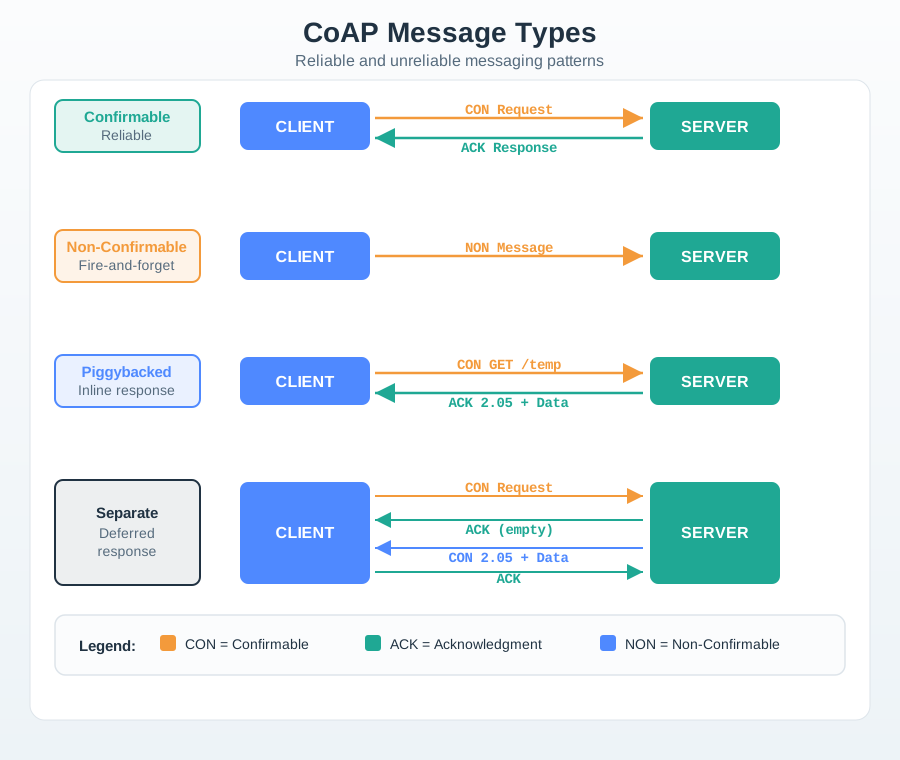
The top row of Figure 7.1 contrasts Confirmable / Reliable, where a CON Request receives an ACK Response, with Non-Confirmable / Fire-and-forget, where the NON Message has no return arrow. The lower Piggybacked / Inline response exchange carries ACK 2.05 + Data in one return packet. By contrast, Separate / Deferred response first sends ACK (empty), later delivers CON 2.05 + Data, and requires a final ACK. Those sequences keep delivery timing separate from the GET or PUT meaning assigned at the request/response layer.
Elicits an ACK and is retransmitted on timeout. Use for commands, writes, and any message whose loss would leave wrong device state.
No ACK and no retransmission. Use for frequent, replaceable readings where the next sample corrects any loss.
Confirms exactly one CON by echoing its Message ID. It may be empty, or it may piggyback the response.
Signals that a received message could not be processed for lack of context. It also answers a CoAP ping (an empty CON).
When you mark a message CON, you inherit RFC 7252's retransmission machinery, and its constants are worth knowing by name. The first retransmission timeout is a random value between ACK_TIMEOUT (default 2 s) and ACK_TIMEOUT × ACK_RANDOM_FACTOR (default 1.5, so up to 3 s). The timeout then doubles on each retry — binary exponential backoff — for up to MAX_RETRANSMIT (default 4) retransmissions. With default parameters, MAX_TRANSMIT_SPAN is 45 seconds from first to last transmission; MAX_TRANSMIT_WAIT is 93 seconds until the sender gives up waiting for ACK or RST.
By default NSTART = 1, meaning an endpoint keeps only one CON exchange outstanding to a given destination at a time. This is deliberate congestion control for constrained links: a device cannot flood a sleepy peer with parallel confirmable traffic. If you need concurrency, you either raise NSTART carefully or use NON for the bulk traffic.
A controller issues PUT /actuators/valve as CON because a lost "close valve" command is unsafe. The same node reports /sensors/temp every 10 seconds as NON because the next reading replaces the last. If the valve ACK is lost, the timeline below plays out; the temperature NON simply relies on the next sample.
Start with the cost of failure: choose CON only when silent loss is unacceptable, because one exchange can consume four retransmissions of radio-on time. Let CoAP's exponential backoff own those retries rather than layering an application retry over the same message. Account for NSTART = 1 as well; confirmable writes to one peer serialize, so the latency budget must cover the queue. When the requirement is merely peer liveness, use an empty CON as a CoAP ping and expect a healthy peer to answer with RST instead of constructing a full resource request.
A server has two ways to answer a Confirmable request. In a piggybacked response, the ACK itself carries the answer: the same ACK that stops retransmission also holds the response code and payload (for example 2.05 Content). The ACK reuses the request's Message ID, and the Token matches the request's Token. This is the common case when the server can answer right away.
In a separate response, the server first returns an empty ACK (message code 0.00) to stop the client retransmitting, then sends the actual response later in a brand-new message — a fresh CON or NON with its own Message ID. The client recognizes it as the answer because the Token matches the original request. If that later message is CON, the client ACKs it in turn. Separate responses exist for resources that need time: waking a sensor, running a measurement, or querying a back-end.
The difference between a piggybacked and separate response becomes clear when Figure 7.2 is read with Message ID and Token as two distinct threads.
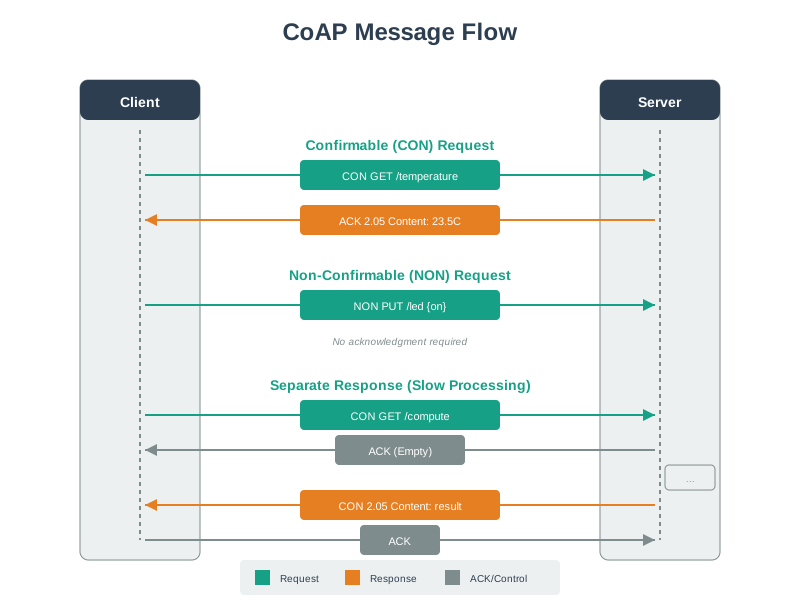

1A slow request arrives with a message number and token.

2An empty acknowledgement stops the request from being sent again.

3The sensor works. Bex keeps the request token safe.

4The result returns in a new message with the same token.

5If that new message asks, the client confirms it too.
In Figure 7.2, first follow the Message ID that pairs a CON with its ACK. Then follow the Token that pairs the application response with the original request. A ready response can ride inside the ACK; a delayed response uses a new message exchange but retains the Token. This separation also explains why duplicate suppression is keyed at the message layer while application correlation survives across exchanges.
Because a CON can be retransmitted, a server may receive the same message twice. CoAP handles this with deduplication: the server tracks recently seen Message IDs per source endpoint for about EXCHANGE_LIFETIME (roughly 247 seconds with default timers). A duplicate CON must not be acted on twice; instead the server resends the cached ACK. This matters most for non-idempotent operations — a duplicated POST that appended a log entry, or a relative counter increment, would be wrong if processed twice.
ACK carries the response. Same Message ID as the request, Token matches. Used when the answer is immediate.
Empty ACK stops retransmission, then a new CON/NON carries the response, correlated only by Token.
16-bit field that pairs ACK/RST with a specific CON/NON and drives duplicate detection.
Servers remember Message IDs for about EXCHANGE_LIFETIME so a retransmitted CON is answered, not re-executed.
This section: Release Checklist
Before signing off a CoAP message-flow design, verify that:
Read these points as one connected sequence: start with Each interaction names the Type, Code, Message ID, Token, and CON/NON policy; then ACK timeout, ACK random factor, maximum retransmits, and any NSTART change are recorded with their rationale; then Piggybacked and separate response cases are distinguished, including when an empty ACK is sent; then Duplicate cache lifetime, Message ID reuse policy, and non-idempotent operation handling are explicit; then RST behavior is defined for unknown tokens, lost Observe state, rebooted endpoints, and malformed messages; and finish with The energy budget explains which traffic is allowed to be NON and what loss rate the application tolerates.
This section: See Also — Review the message types before the field layout, since the exchange contract depends on both type and matching fields.
Review the message types before the field layout, since the exchange contract depends on both type and matching fields.
This section: Next — After you can read a message exchange at both layers, continue with CoAP Message Format to inspect the exact bits and option fields carried in each datagram.
After you can read a message exchange at both layers, continue with CoAP Message Format to inspect the exact bits and option fields carried in each datagram.
3 reviewed answers.
Open the module page from the sidebar to see its chapters in order. Use the module map to return to a topic you need.
Modules and pathsReviewed
Check the symptom, then work through the diagnostic steps. Keep the error message and the smallest example that reproduces it.
When you are stuckReviewed
Use the interactive guide to check how examples and simulations work before changing your project.
Interactive examples guideReviewed