9 Detecting Hidden Cameras and Rogue Devices
9.1 Start With the Story
Radio Remi is checking a rented meeting room before a private discussion. A phone app lists several nearby radios, but none says “hidden camera.” A shiny screw reflects a torch, while a smart television sends steady network bursts. Remi does not touch, disable, or join unknown equipment. Instead, the team records candidates, compares several safe clues, asks the venue owner to inspect, and treats uncertainty as part of the result.
9.2 Overview
Hidden-device detection is not one test. Discovery asks whether a signal or object exists. Identification estimates a device class. Localisation narrows where it may be. Confirmation asks whether an authorised inspection establishes a camera, microphone, or another device. Wi-Fi metadata, spectrum energy, lens reflections, phone time-of-flight sensors, and visual checks cover different parts of that chain. Encryption can hide payload content while packet sizes, direction, and timing still reveal traffic patterns.
9.3 Learning Objectives
By the end of this chapter, you will be able to:
- Distinguish device discovery, type classification, localisation, and proof of recording.
- Extract bounded timing and packet-size features from supplied synthetic metadata.
- Compare RF, lens-reflection, and phone ToF methods by blind spots, false positives, and lawful use.
9.4 Read traffic without reading content
A streaming camera often sends sustained uplink data with regular bursts, while a phone may alternate short interactive bursts and idle periods. A smart plug may send small, sparse status messages. Useful metadata features include packet-size distribution, uplink/downlink ratio, inter-arrival time, burst duration, duty cycle, and periodicity. These are statistical cues, not device names. Firmware updates, cloud retries, video buffering, background sync, and network congestion can imitate another class.
Only inspect networks, captures, and equipment you own or are authorised to assess. The chapter lab uses generated metadata with no payloads, addresses, live capture, exploit, or target network. In a real concern, preserve safety, avoid confrontation or tampering, document what you observed, and escalate through the property owner, security team, platform, or police as appropriate.
9.5 Compare three synthetic traces
Figure 9.1 turns packet timing into measurable patterns instead of a labelled-box shortcut.
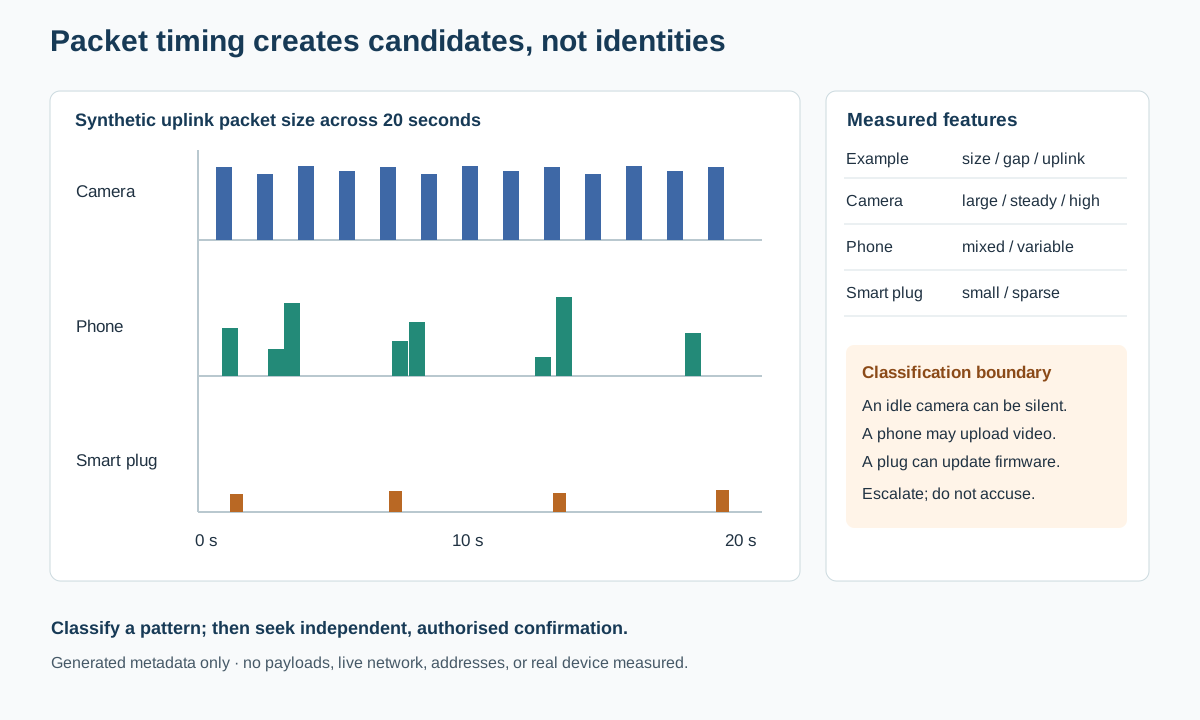
In Figure 9.1, scan the three timelines from top to bottom. The camera fixture has repeated large uplink bursts, the phone fixture mixes directions and gaps, and the smart-plug fixture sends small periodic messages. Then read the feature table rather than trusting the colours: size, interval variation, and uplink ratio give the classifier its evidence. The final uncertainty note matters most because a new firmware state or an idle camera can fall outside these examples.
9.6 Sweep the spectrum with limits
An RF spectrum sweep can reveal energy by frequency and time without decoding traffic. It may find an unexpected transmitter, but it cannot prove the device is a camera. Frequency hopping, quiet periods, wired devices, local storage, weak signals, shielding, and crowded bands create misses or false positives. A detector also needs a local noise baseline and calibrated antenna response; a bright peak on an uncalibrated display is not a location.
RSSI gathered along a known walk can narrow a transmitting candidate, but reflections and body blocking distort the path-loss model. Directional antennas or several observation points can add evidence. Do not present a heat map as centimetre-level truth unless the site, geometry, and error distribution support it.
9.7 Look for a lens, not every shiny point
Camera lenses can return a bright retro-reflection when illumination and viewing geometry align. Commercial optical detectors use this effect, and research systems such as LAPD combine a phone time-of-flight sensor’s distance and reflected-intensity images. The lens may expose only a tiny opening, the useful reflection has a limited angle, and metal, glass, decorations, and other optics can look similar. A thorough scan needs overlapping viewpoints and still produces candidates for authorised inspection.
Phone lidar or ToF hardware differs by model, field of view, resolution, and access API. A research result on supported phones does not establish that every handset can detect every hidden camera. Likewise, a network method misses offline or wired cameras, while an optical method does not identify a hidden microphone. Combine independent clues only after naming the devices each method cannot see.
9.8 Decision and Trade-offs
Begin with the least intrusive lawful method: visual inspection and the venue’s own inventory. Add an authorised network inventory or spectrum sweep when unexplained transmitters remain. Use lens-reflection or ToF scanning to find optical candidates, then request authorised physical confirmation. Never treat an app alert as permission to enter equipment, intercept content, damage property, or accuse a person.
Continue with Sensing Privacy and Consent before designing a continuous detector. The same metadata that helps find a rogue device can expose occupants’ routines, device ownership, and behaviour.
9.9 Practice the Method
The linked JupyterLite lab generates packet-size and inter-arrival traces for a streaming camera, phone, and smart plug. You will inspect features, fit a simple transparent classifier, tune one threshold, and score a held-out set with a confusion matrix. The result card keeps false positives, false negatives, synthetic provenance, and lawful-use limits beside the candidate list.

9.10 Check Your Reasoning
9.11 Summary
A responsible detector separates discovery, classification, localisation, and confirmation. Traffic metadata can reveal patterns even when payloads are encrypted, while spectrum and optical methods observe different evidence. Keep false positives, blind spots, authorisation, and a safe escalation route visible from the first scan to the final record.
- Packet size, direction, timing, and periodicity are cues, not proof of a camera.
- RF sweeps, RSSI walks, lens reflection, and phone ToF each miss important device classes.
- Use supplied or authorised evidence only; do not intercept content, enter devices, tamper, or accuse from an app result.
9.12 Sources and Boundaries
- Lumos separates identifying and locating hidden Wi-Fi devices using coarse wireless features and phone motion evidence.
- The LAPD research project explains phone ToF reflection sensing, limited viewing angle, and reflective false positives.