7 Presence and Vital-Sign Sensing with Radar and Wi-Fi
7.1 Start With the Story
Radio Remi is helping a care-home team check whether a room is occupied at night. A camera would reveal too much. A simple motion sensor may miss a sleeping person. Radar can notice tiny chest movement, but a turned blanket or a second person can confuse it. Remi asks the team to make a limited claim: detect a steady breathing-like pattern, reject large motion, and call for another check when the signal is unclear.
7.2 Overview
Radar and Wi-Fi can sense people because bodies change reflected or multipath signals. A radar receiver can track phase in one range bin; Wi-Fi CSI can track changes across subcarriers and antenna paths. Slow chest motion often places breathing energy near 0.1–0.5 Hz, while a smaller heartbeat cue may appear near 0.8–2 Hz. These bands are useful teaching ranges, not universal diagnostic limits. Geometry, clothing, posture, motion, other people, noise, and hardware drift can move or hide the peaks.
7.3 Learning Objectives
By the end of this chapter, you will be able to:
- Explain how small chest displacement changes radar phase and Wi-Fi channel measurements.
- Separate simulated breathing and heartbeat bands while detecting motion contamination.
- Bound presence and wellness claims by geometry, people count, consent, and validation evidence.
7.4 Turn displacement into phase
For a monostatic radar, a target displacement changes the round-trip path by . The corresponding phase change is approximately , where is wavelength. Shorter wavelengths create more phase change for the same motion, but wrapping, noise, multipath, and poor target selection still matter. Wi-Fi CSI offers a related multipath cue across communication links, yet its phase also carries clock and hardware errors that need calibration.
An FMCW radar first selects a range bin before following phase over slow time. That range step can separate people at different distances, but it cannot always separate people at the same distance or overlapping angles. A single-tone Doppler sensor has no range bins, so multiple subjects mix more easily. The sensing layout, antenna field of view, update rate, and no-decision rule are part of the measurement contract.
7.5 Read the displacement and spectrum
Figure 7.1 connects the chest-motion model to the frequency bands used in the lab.
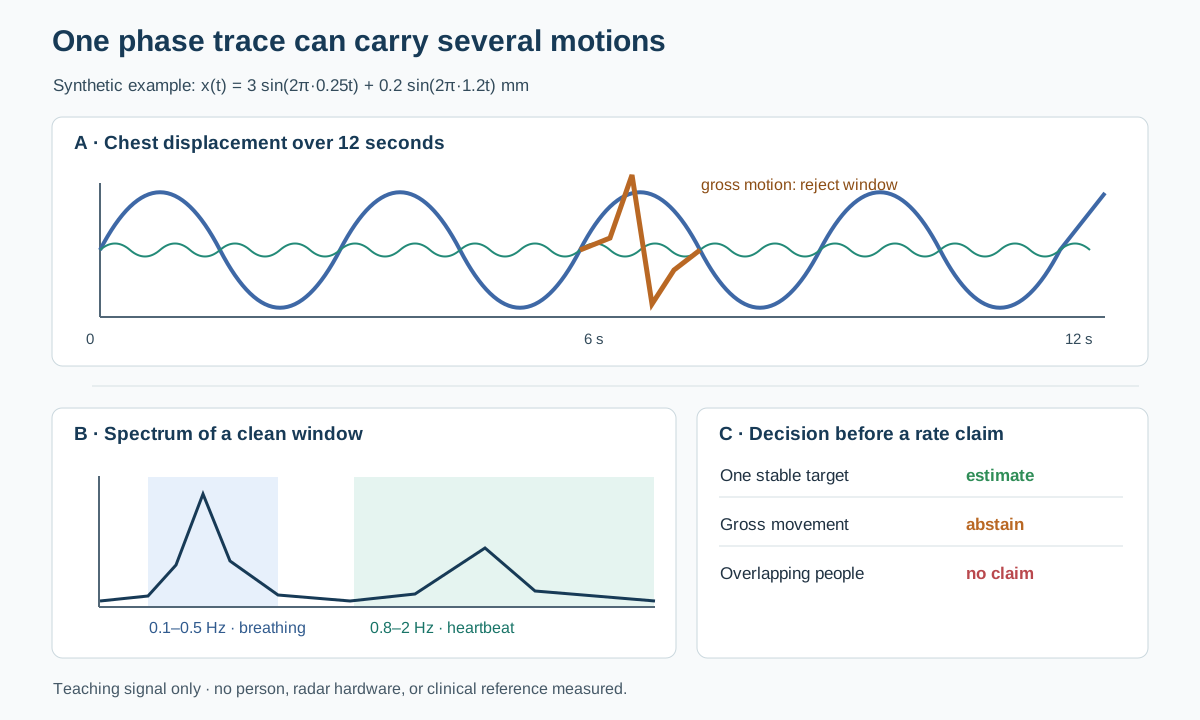
In Figure 7.1, begin at the upper-left waveform. The broad blue swing is breathing, while the smaller green ripple is the heartbeat component. The amber burst is deliberate gross motion, so its window must not produce a vital-sign estimate. Move to the spectrum and compare energy only inside the two named bands. Finish at the decision table: one clear target can produce a bounded estimate, motion causes abstention, and overlapping people require a different geometry or another sensor.
7.6 Filter without hiding artefacts
A band-pass filter can separate slow breathing energy from faster heartbeat energy in a clean simulated trace. It cannot prove that either peak came from one person. Large motion spreads energy across frequencies and can shift phase by many cycles. A robust pipeline first detects motion or low signal quality, then abstains before calculating rates. It should retain the rejected window and reason instead of deleting inconvenient evidence.
Frequency resolution depends on observation time. A ten-second window has bins about 0.1 Hz apart, so neighbouring slow rates are hard to distinguish. Longer windows sharpen frequency estimates but delay alarms and assume the signal remains steady. Report the chosen window, filter edges, sampling rate, range bin, signal-quality rule, and percentage of windows rejected.
7.7 Handle more than one person
Two people may occupy different radar range bins, but equal range, side lobes, reflections, or a narrow Wi-Fi path can mix them. Beamforming and several antennas can add angle evidence; multiple links can add spatial diversity. Neither removes the need to validate the room, poses, bedding, pets, fans, and everyday movements. A detector trained on one adult lying still must not silently become a monitor for children, patients, or crowded rooms.
7.8 Place products inside the evidence boundary
Consumer sleep and elder-care products may use radar to support presence, motion, respiration-rate, or sleep-pattern features. Product labels and authorisations determine the claim; the sensing method alone does not. A wellness trend is not a diagnosis, and an unauthorised monitor must not replace supervision, clinical assessment, or an approved safety device. The lab in this chapter teaches phase and filtering with synthetic signals only.
Design the privacy path before deployment. Sensing Privacy and Consent explains purpose, lawful basis, notice, minimisation, retention, access, and a no-sensing option. A signal without image pixels can still reveal presence, routine, sleep, or health-related information.
7.9 Decision and Trade-offs
Use radar when contact-free motion evidence, range separation, and low-light operation fit the task. Use a pressure mat, contact sensor, wearables, or supervised clinical equipment when they answer the question with less ambiguity. Combine sensors only when their errors and privacy costs are independently tested. If the decision can harm a person, require a clear fallback and human review.
7.10 Practice the Method
The linked JupyterLite lab generates a known chest-displacement phase signal with breathing, heartbeat, noise, and a large motion artefact. Predict which frequency peak will dominate, inspect the time trace and spectrum, tune the band limits, and finish with a result card that reports accepted and rejected windows. The output verifies the calculation path, not a medical or installed-room claim.
7.11 Check Your Reasoning
7.12 Summary
Phase can reveal tiny periodic displacement, but the final claim depends on target selection, observation time, motion rejection, geometry, and validation. Keep accepted and rejected windows together so abstention remains measurable. Treat any presence, routine, or health-related inference as sensitive design evidence rather than harmless radio exhaust.
- Radar phase changes with round-trip displacement; Wi-Fi CSI changes with multipath.
- Breathing and heartbeat bands help separate a clean fixture, while motion and multiple people can defeat the estimate.
- Synthetic filtering practice does not validate a medical device, consumer product, or occupied room.
7.13 Sources and Boundaries
- The adult frequency ranges and motion challenges are summarized in an open review of radar vital-sign methods.
- The FDA warning on unauthorised infant vital-sign monitors illustrates why a consumer sensing feature must not be stretched into an unreviewed safety claim.