Actuators and Control Module Guide
More
Depth: Practitioner
Progress saves as you read. Mark sections complete as you go; your progress appears in the sidebar.
Start With One Safe Action
This section: Start With One Safe Action — An actuator is a part that makes a physical change.
An actuator is a part that makes a physical change. PWM means switched output control. Picture a greenhouse fan that must start gently, move enough air, and stop if its heat or current becomes unsafe.
Follow that job through the guide. Choose the output device, driver, power path, protection, control method, feedback, and safe stop. Test the real motion or other result instead of treating a software command as proof.
Follow Motor Max through four physical jobs before choosing any part.
-

One device has four jobs to do.
-

It must unlock a latch and open a vent.
-

It must spin a fan and warn a nearby person.
-

Name each physical job before you compare parts.
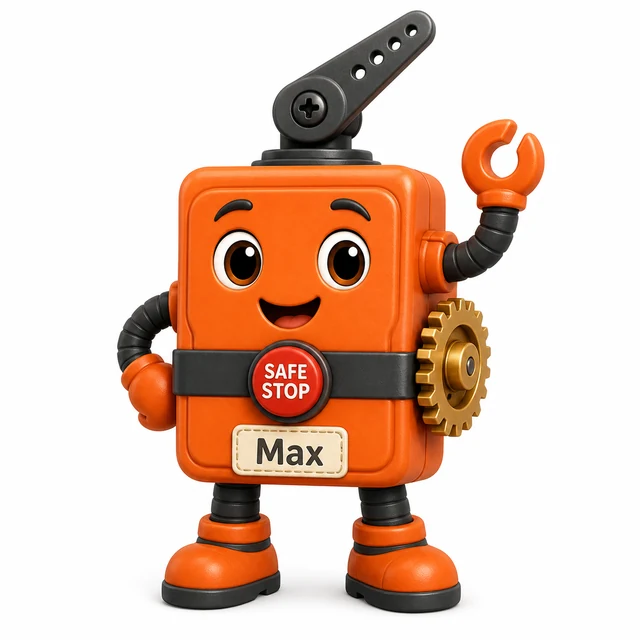
Your guide: Motor Max
“Sensing decides; actuating commits — and a commit to the physical world needs a safe stop.”
Actuators turn IoT decisions into physical output: motion, force, flow, light, sound, heat, and safety interlocks. This module connects actuator types, motor control, PWM, relays, solenoids, alarms, and lab practice so learners can choose output devices that are useful, controllable, and safe.
Start With the Story
This section: Start With the Story — Imagine a greenhouse controller that has already sensed heat and decided the plants need cooling.
Imagine a greenhouse controller that has already sensed heat and decided the plants need cooling. The useful question is no longer “what did the sensor read?” It is “what must move, switch, flash, buzz, open, close, or stop so the physical world changes safely?”
That is the actuator story for the whole module. Start with the action, then choose the output device, driver, power path, protection, and feedback evidence that prove the command became a real result.
Module Snapshot
This section: Module Snapshot — This is Part 2.4 of the IoT Class curriculum, which covers actuators and control as part of Module 2: Physical World.
This is Part 2.4 of the IoT Class curriculum, which covers actuators and control as part of Module 2: Physical World. Read it after sensors and electronics when possible: sensors describe what the world is doing, while actuators change what happens next.
Use the module to answer four practical questions:
- What output device fits the job? Compare motors, servos, steppers, relays, solenoids, LEDs, buzzers, displays, and safety indicators.
- How should the controller drive it? Connect PWM, switching circuits, H-bridges, duty cycle, position control, and feedback.
- What can go wrong physically? Account for current draw, heat, flyback, stalls, moving parts, interlocks, and user safety.
- How do I prove it works? Use labs, checks, and assessment chapters to test behavior before connecting real equipment.
Recommended Route
This section: Recommended Route — Start with the actuator overview and classification chapters, then move through motor families before using the output-device and safety chapters.
Start with the actuator overview and classification chapters, then move through motor families before using the output-device and safety chapters. The labs and assessment chapters make better sense after learners can explain what an actuator converts, what its driver circuit protects, and how the command becomes a measurable physical result.
- Actuator fundamentals: build the vocabulary for energy conversion, output type, force, torque, speed, and response time.
- Motor control: compare DC motors, servos, steppers, and PWM control patterns.
- Output devices: apply relays, solenoids, visual indicators, audio indicators, and safety logic.
- Practice and assessment: test actuator choices, wiring decisions, and control reasoning before using hardware.
Learning Resources
This section: Learning Resources — Use the sidebar navigation or search to explore topics in this section.
Each chapter may include:
- Comprehensive explanations
- Practical examples
- Interactive demonstrations
- Knowledge check quizzes
- Hands-on lab exercises
Use the sidebar navigation or search to explore topics in this section.
Find help
3 reviewed answers.
Where should I start in a module?
Open the module page from the sidebar to see its chapters in order. Use the module map to return to a topic you need.
Modules and pathsReviewed
What can I try when a project does not work?
Check the symptom, then work through the diagnostic steps. Keep the error message and the smallest example that reproduces it.
When you are stuckReviewed
How do interactive examples work?
Use the interactive guide to check how examples and simulations work before changing your project.
Interactive examples guideReviewed