11 DTLS: Authentication Boundaries

More
Depth: Practitioner
Progress saves as you read. Mark sections complete as you go; your progress appears in the sidebar.
11.1 Start With the Decision
This section: Start With the Decision — A packet is one unit of data sent over a network.
A packet is one unit of data sent over a network. Transport proof can show that its protected contents came from an expected peer, but the packet can still ask the wrong device to unlock a gate. Identity answers who sent it; action permission answers whether that sender may request this gate action. Test both claims.
11.2 Route Overview
This section: Route Overview — This is part 1 of 2.
This is part 1 of 2. Continue with DTLS: Handshake and UDP Protection.
11.3 Part Objectives
This section: Part Objectives
- Bound confidentiality, integrity, identity, and permission claims.
- Choose PSK or certificate evidence for a device.
11.4 Chapter Roadmap
This section: Chapter Roadmap
- Start With the Identity Check
- Overview: DTLS Security Claims Need Boundaries
- Practitioner: Build the Check From Evidence, Not From Mode Names
- Under the Hood: Authentication Is a Repeatable Identity Decision
11.5 Start With the Identity Check
This section: Start With the Identity Check
11.5.1 Bound the Claim Before Testing It
A protocol is an agreed set of exchange rules. Transport layer security is a way to protect a transport exchange. Datagram transport layer security (DTLS) protects messages carried by user datagram protocol (UDP). UDP sends separate packets without building a lasting connection first.
Picture a gate controller receiving an unlock request. A protected transport record may show that the message came through an approved peer path and was not changed in transit. It cannot show that the visitor is allowed in or that the gate is clear to move.
Write one narrow claim for each test. Try a false address, a copied protected record, an old key, changed negotiation data, and a device with the wrong identity. Record what is rejected, when costly work begins, and whether the application sees any failed input. Keep transport identity separate from user permission and physical safety.
These tests cover the stated threat, policy, keys, and software version. They do not prove the whole system secure. The deeper sections explain handshakes, replay windows, identity choices, downgrade resistance, and the evidence needed to renew the claim after a change.
A secure transport path still has to answer a simple question: which peer is this message allowed to represent? Start by checking the identity evidence, the key material, and the replay or downgrade protections that support that answer. Attack review then becomes a search for ways those records can be missing, stale, spoofed, or overclaimed.
11.6 Overview: DTLS Security Claims Need Boundaries
This section: Overview: DTLS Security Claims Need Boundaries — DTLS adds handshake negotiation and protected records to UDP traffic.
DTLS adds handshake negotiation and protected records to UDP traffic. Peer authentication depends on the configured credentials and roles, and record replay detection must be enabled and verified for a replay claim. A useful DTLS check names the exact threat or identity claim and keeps the conclusion inside the evidence the transport layer can actually provide.
For IoT deployments, the common mistake is to write "DTLS is enabled" as if it proves device authorization, event validity, or safe actuation. DTLS can help prove a protected transport path and a peer-identity decision. Authorization, provisioning ownership, sensor validity, and application event handling remain separate checks.
A bounded record reads more like a lab notebook than a slogan. For a spoofed-address load claim, the record should show that an initial unauthenticated ClientHello received a return-reachability challenge before the server allocated expensive session state, and that only a reachable endpoint progressed to the costly handshake work. For a replay claim, the record should show a normal protected record accepted and a duplicate protected record rejected or quarantined before the application treats it as a new event. For a peer-identity claim, the record should name the expected device or gateway role, the accepted PSK identity, certificate chain, raw public key, or pin, and the behavior when stale or wrong material appears.
Downgrade and tamper checks follow the same pattern. A record can say that the server refused an obsolete version or disallowed cipher suite, that Finished-message validation failed when negotiated parameters changed, and that the failure did not silently fall back to NoSec. It still cannot say the command was safe to execute. The output is a bounded claim such as "the gateway rejected stale replay and disallowed negotiation material under policy X," not a broad claim that the system is secure.
Attack-Resistance Claim
Names a specific transport threat such as spoofed-address handshake load, replayed protected records, or tampered negotiation data.
Authentication Claim
Names the accepted peer identity model: pre-shared key, certificate chain, raw public key, pinned identity, or another local trust model.
Open Limit
States what DTLS did not decide, such as application authorization, command safety, firmware provenance, or whether telemetry is truthful.
Inspect Figure 11.1 to ask where DTLS transport proof ends and which app access or device-setup questions remain open.
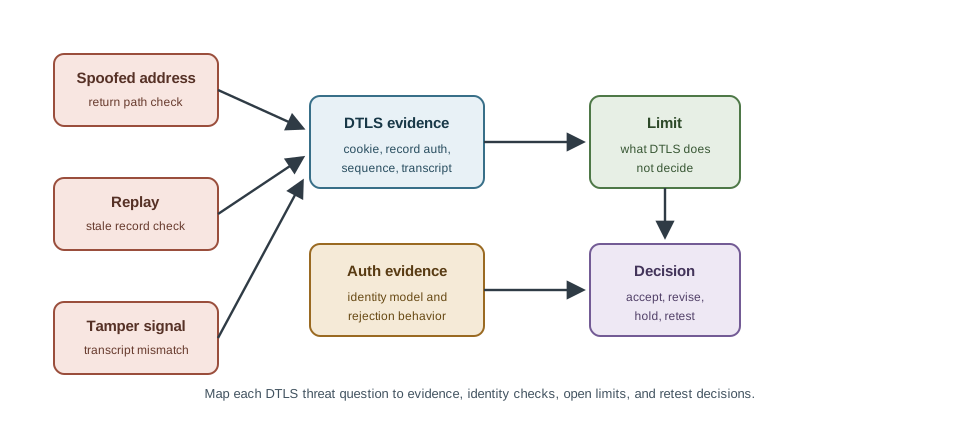
Read Figure 11.1 from the fake-peer, replay, and changed-data questions to the transport checks. Next inspect the proof of peer identity and the stated limit. Then follow the path to the choice and the cause for a new test. A sound DTLS exchange proves a protected link with the named peer. It does not prove that the peer may use every app action or that its sensor data is true. Keep the peer key apart from the app role that the peer is allowed to use.
Safe Scope
This chapter is defensive. It describes how to verify bounded DTLS protection and authentication records. It does not provide attack playbooks or procedural misuse instructions.
11.7 Practitioner: Build the Check From Evidence, Not From Mode Names
This section: Practitioner: Build the Check From Evidence, Not From Mode Names — Start each DTLS security check with a claim sentence: which peer role, which threat or identity question, which endpoint, and which policy.
Start each DTLS security check with a claim sentence: which peer role, which threat or identity question, which endpoint, and which policy. Then collect both acceptance and rejection records. A completed handshake is useful, but it is not the same thing as proving the intended identity was accepted and stale material was rejected.
For example, a gateway review might state: "sensor uplink DTLS-PSK accepts only provisioned identity sensor-17, rejects the retired lab identity, bounds unauthenticated handshakes with a cookie challenge, and prevents duplicate protected records from reaching the metering application." That sentence creates four evidence needs. The reviewer keeps a successful handshake for sensor-17, a failed or denied attempt for the retired identity, server counters showing incomplete handshakes stayed bounded, and an application log or transport trace showing the replayed record did not create a second meter event. Without the rejection records, the check only proves the happy path.
Attach the test date, endpoint role, policy version, and key or trust-anchor reference so a later rotation does not inherit stale evidence.
Gateway Example
A gateway accepts sensor messages over a DTLS-protected UDP path. A normal packet trace proves protected delivery for one session. It does not prove replay handling. The check needs a duplicate or stale protected record that is rejected or recorded by policy, plus a note about whether the application ever receives that data.
11.8 Under the Hood: Authentication Is a Repeatable Identity Decision
This section: Under the Hood: Authentication Is a Repeatable Identity Decision — DTLS authentication is not one universal mechanism.
DTLS authentication is not one universal mechanism. Constrained IoT systems commonly use pre-shared keys, certificate-based authentication, raw public keys, or locally pinned identities. The important audit question is whether the chosen model binds the expected peer role to the material that was accepted and to the behavior when material is wrong, stale, missing, or unexpected.
With PSK, the identity string and secret are the material under test: a completed handshake should be tied to the expected PSK identity, the provisioning source, the rotation owner, and a rejected old secret. With certificates, the record should name the trust anchor, expected subject or SAN policy, validity window, chain result, and what happens to expired, revoked, or wrong-role certificates. With raw public keys or pinned keys, the record should explain how the bare key maps to the peer role and how replacement is governed. The same handshake transcript can be acceptable for one model and insufficient for another; the audit value comes from connecting the transcript to the intended trust rule.
A useful identity record therefore has two halves. The positive half says, for example, "gateway role accepted certificate with expected SAN gw-east-01 under trust anchor A on policy version 2026-07." The negative half says what happened to a retired lab PSK, an expired certificate, a certificate from the wrong trust anchor, or an unexpected raw public key. If the negative half is missing, the record cannot distinguish "the intended peer was authenticated" from "some still-configured credential was accepted." That distinction matters after lab-to-production migrations, certificate renewal, field replacement, and emergency key rotation.
Authentication is repeatable only when another reviewer can reconstruct what identity was expected and what material was actually accepted. Inspect the diagram Figure 11.2 for that reconstruction before the chapter compares credential models.
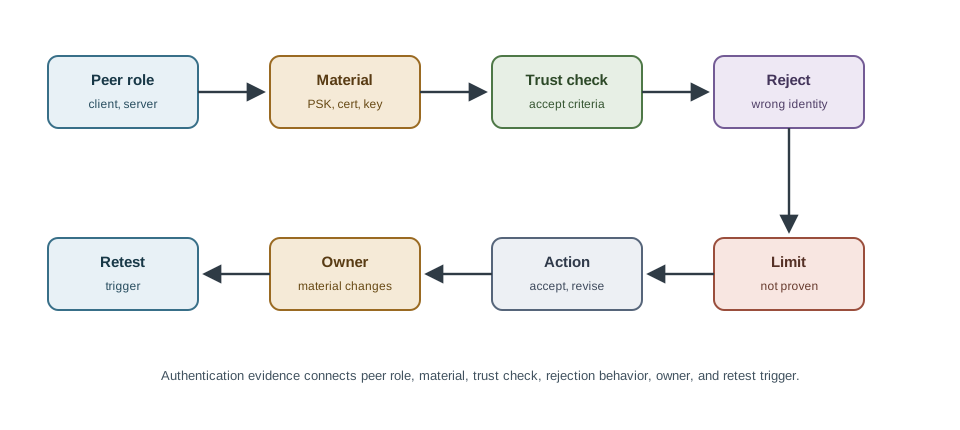
In the diagram Figure 11.2, start with the peer role and presented material, then inspect the trust check and the result for wrong or retired material. Continue through the open limit and action, and finish with the owner and retest trigger. That order makes the negative test as important as the successful handshake and connects PSKs, certificates, and pinned keys to the same auditable identity decision.
Pre-Shared Keys
Useful when each peer has a managed secret and the record names provisioning ownership, uniqueness, rotation, rejection behavior, and stale-material handling.
Certificates
Useful when the record names trust anchors, expected identities, chain or pinning policy, expiry handling, revocation or replacement behavior, and renewal ownership.
Pinned Keys
Useful in constrained systems only when the record explains how the key maps to the expected peer and how replacement or loss is governed.
Material Change Walkthrough
A device moves from a lab identity to an operational identity store. The handshake still completes. That result shows some identity was accepted, but not that the intended operational identity was accepted. The check must compare expected peer role, material reference, trust source, rejection behavior for retired material, and the retest trigger.
Bounded Conclusion
When identity material is unclear, the record supports only "a DTLS session completed." It does not support "the intended peer identity was authenticated" until the material and rejection records are attached.
11.9 Continue to the Next Part
This section: Continue to the Next Part — Carry this evidence into DTLS: Handshake and UDP Protection, which begins with Inside the DTLS Handshake.
Carry this evidence into DTLS: Handshake and UDP Protection, which begins with Inside the DTLS Handshake.
Find help
3 reviewed answers.
Where should I start in a module?
Open the module page from the sidebar to see its chapters in order. Use the module map to return to a topic you need.
Modules and pathsReviewed
What can I try when a project does not work?
Check the symptom, then work through the diagnostic steps. Keep the error message and the smallest example that reproduces it.
When you are stuckReviewed
How do interactive examples work?
Use the interactive guide to check how examples and simulations work before changing your project.
Interactive examples guideReviewed