Active-Set Selection
Decides which sources, relays, observers, coordinators, and fallback nodes currently participate in the decision path — and which are excluded, held in reserve, or marked unavailable.
Progress saves as you read. Mark sections complete as you go; your progress appears in the sidebar.
A warehouse moves a wireless gateway to clear a loading bay, and twenty sensor routes change with it. Live topology management must discover the new paths without hiding lost devices or creating a loop. Controlled change begins with an expected managed topology state and ends with observed reachability.
A gateway is the node that joins this managed sensor topology to another network.
This section: Manage a Gateway Move Without Losing the Map — Follow the proposed change through impact, method, observation, and accept or rollback.
Follow the proposed change through impact, method, observation, and accept or rollback. Separate planned maintenance from an unexpected fault. A planned move can have a window and baseline; an unplanned topology route loss needs containment before optimization.
Keep the details needed to close the change: identity and time, old and new neighbours or paths, reachability results, performance measures, exceptions, and decision. A final managed topology picture without the previous state cannot show which dependencies moved.
Suppose gateway G2 serves 20 shelf sensors. Before relocation, 18 have direct routes and two use one relay. After the topology change, 14 are direct, five use one relay, and sensor S19 has no path. The total number still shown in inventory is 20, but reachable service has fallen to 19. Approving the change because “most nodes rejoined” would leave one physical shelf unmonitored.
Allow topology discovery a set convergence window, then compare actual nodes and edges with the expected set. Watch for flapping, where a sensor alternates between parents, and loops, where forwarded traffic revisits a node. A stable but overloaded relay can also be a failed outcome even if every device appears connected.
Use staged control. Move G2 during a maintenance window, capture the baseline, make one change, observe convergence, test all 20 identities, and compare latency or retry counts. If S19 remains absent or a relay exceeds its limit, restore the old position or apply the pre-approved alternate. Do not stack a channel change and firmware update onto the same trial because their effects become hard to separate.
Predict the results before moving hardware. Expect the old gateway position to show 20 reachable sensors. List which shelves may need relays at the new position. After the move, require 20 identities and no persistent loop or flap. Finally disconnect the busiest relay and check the documented alternate or expected service loss. The change summary should explain every changed topology route, not merely contain a green status.
Maintain an expected inventory independent of discovery. A node disappearing from the live map must remain visible as missing, not vanish from both the picture and denominator. Bind serial number, network identity, role, location, approved firmware, and current parent or observed links. Retired devices need a dated state so they are not mistaken for faults.
Change control should cover automatic behavior too. A routing system may choose a new parent without a human ticket, but thresholds, hysteresis, timers, and allowed neighbours are still managed policy. Store the reason and measurements for important topology route changes. Repeated movement between two parents can drain batteries and reorder traffic even when both links pass simple reachability.
Back up configurations before a gateway, switch, or controller update, and test restoration on compatible hardware. An existing file does not show that restoration works. Confirm that device identities, security material, topology policy, and monitoring return without creating duplicate nodes or accepting an old revoked credential.
For the G2 move, compare more than reachable count. Measure worst path length, busiest relay load, retry rate, and time to stable routes before and after. If nineteen sensors work but the remaining routes now depend on one battery relay, the change may have introduced a failure concentration that the count hides.
Coordinate maintenance with data interpretation. A missing stream during the approved move should be labelled maintenance, but the label must have a start, end, responsible person, and affected devices. It must not suppress an unrelated loss outside the window. After closure, check that normal alerting resumes for all twenty sensors.
Keep a rollback point until the new topology passes a full operating cycle. Some faults appear only when doors close, machines start, traffic bursts, or batteries reach a low state. The final change summary should state which conditions were observed and which remain assumptions requiring later checks.
Automate comparison without automating approval. A tool can flag added nodes, missing links, changed parents, and threshold breaches, but a named person responsible for the change should decide whether the observed topology fits the maintenance intent. Store the before and after graphs with the same identity rules so renaming a node does not look like one removal plus one addition.
After rollback, repeat the original baseline checks. Returning hardware to its old position does not establish that routes, credentials, alerts, and stored data all returned to their former state. Close the change only when those checks agree with the baseline.
This section: Start With the Story — Picture a warehouse network after one relay loses power.
Treat Every New Path as a Reviewed Change
Picture a warehouse network after one relay loses power. A nearby device takes over and the warning path works again. The quick repair looks successful, but no one has checked whether replies return, batteries will last, or the new path crosses an unapproved boundary.
A gateway is a device that joins one network to another. Start with the current path and name every sender, relay, gateway, receiver, and owner. Record why a role or route should change, what evidence supports it, and which service promise the change must preserve.
Remove one link, add a noisy device, drain a relay, and restore the old path. Check forward and return delivery, delay, energy use, identity, and recovery. Mark when the system may adapt on its own and when a person must approve, reverse, or investigate the change.
One set of trials cannot prove every future network shape. Movement and load can create new risks. The deeper sections show how active sets, role changes, route updates, data value, and context rules turn live adaptation into a controlled topology record.
After deployment, the topology is still alive. A node can become a relay, a route can be retired, a gateway can move to fallback, or a noisy sensor can be removed from the active set. Topology management is the story of those controlled changes: what changed, which evidence path it affected, why it was accepted, and what trigger forces a retest or rollback. Five techniques do that work in practice — active-set selection, role assignment and rotation, route adjustment, data-value decisions, and context-triggered mode changes — and each one earns acceptance from the same review record.
This section: Topology Management Is Controlled Change To Network Evidence — Topology management is the discipline for changing which nodes participate, which roles they hold, which paths carry evidence, and which data is accepted for a decision.
Topology management is the discipline for changing which nodes participate, which roles they hold, which paths carry evidence, and which data is accepted for a decision. The change is useful only when the review record says what changed, why it changed, which decision path it affects, and what retest trigger makes the record stale.
The important distinction is that topology management is not the same as drawing a new network shape. A gateway can keep the same star-looking diagram while changing which sensors are trusted, which node acts as a relay, which route is used after a failure, or which readings are suppressed as stale. Each of those changes can alter the evidence seen by an alert, dashboard, control loop, or maintenance review. The topology-management record therefore has to preserve the before-and-after state, not just the final connected state.
A useful record answers four questions in plain terms. Which decision path is affected? Which nodes are in, out, fallback-only, or unavailable? Which role or route changed? What event forces a retest, rollback, or fresh review? Without those answers, the system may be connected but no longer auditable. That audit trail is the point of management.
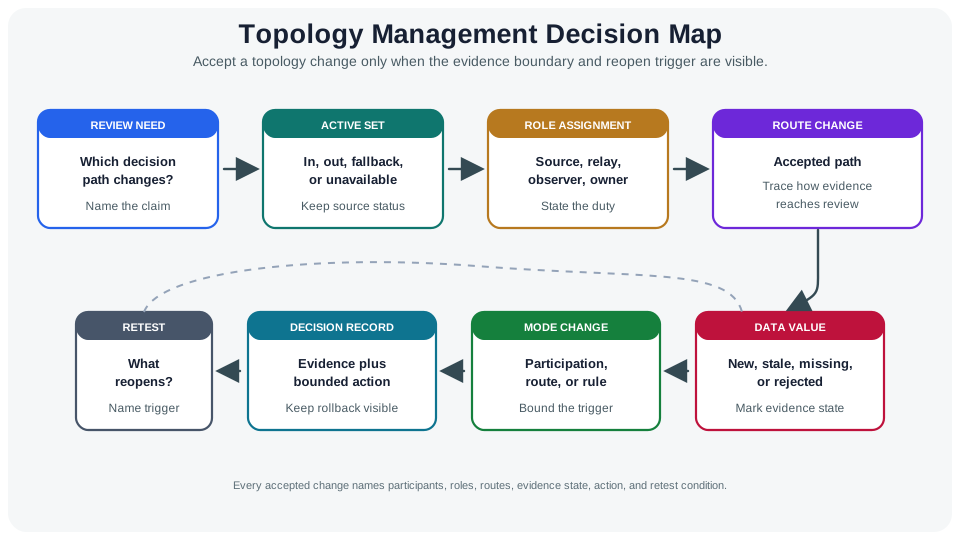
Read the map as a review flow rather than an architecture diagram:
Topology management is not a single algorithm. This module uses steps two to six as five practical decision types for reviewing the shape and behaviour of a live network; they are a working framework, not an exhaustive taxonomy of the discipline.
Decides which sources, relays, observers, coordinators, and fallback nodes currently participate in the decision path — and which are excluded, held in reserve, or marked unavailable.
Decides who senses, relays, buffers, validates, or observes, and changes those duties over time or after a review trigger.
Decides which path carries accepted evidence to the next decision point after a route fails, a relay role changes, or a source is marked suspect.
Decides which readings are accepted, reduced, held for comparison, rejected, or marked stale when a technique suppresses repeated or low-value traffic.
Decides when a local event, a trusted context signal, or an operator review finding changes participation, route, or acceptance rules — and when the network returns to normal.
Each technique is bounded to the application question it supports. A change that is acceptable for a periodic status review may be unacceptable for a faster response path, or for a path that needs corroboration from several sources. A topology that passes messages is not automatically a topology that preserves decision evidence. Source identity, freshness, route role, quality state, rollback behavior, and excluded-source handling determine whether the topology change is safe to accept.
This section: Practitioner Pattern: Write The Change Record Before Accepting The New Topology — Most topology-management failures come from accepting the new path too early.
Most topology-management failures come from accepting the new path too early. A relay change, active-set reduction, or denser observation mode should first be written as a bounded decision record: baseline, trigger, proposed change, evidence, impact, rollback, and retest.
Before writing that record, name which of this module's five decision types the change uses. Each one is reviewed against different evidence, and each one has a characteristic weak case that a reviewer should refuse.
For example, suppose a cold-room gateway stops hearing one corner sensor and promotes a nearby mains-powered device to relay. The change record should not simply say "relay enabled." It should name the affected temperature-alarm path, the old active set, the missing source, the new relay role, the first accepted messages through that relay, and the condition for reversing the change. If the missing sensor later returns, the record should say whether it is accepted immediately, held for quality review, or kept out of scope until a maintenance check confirms placement and freshness.
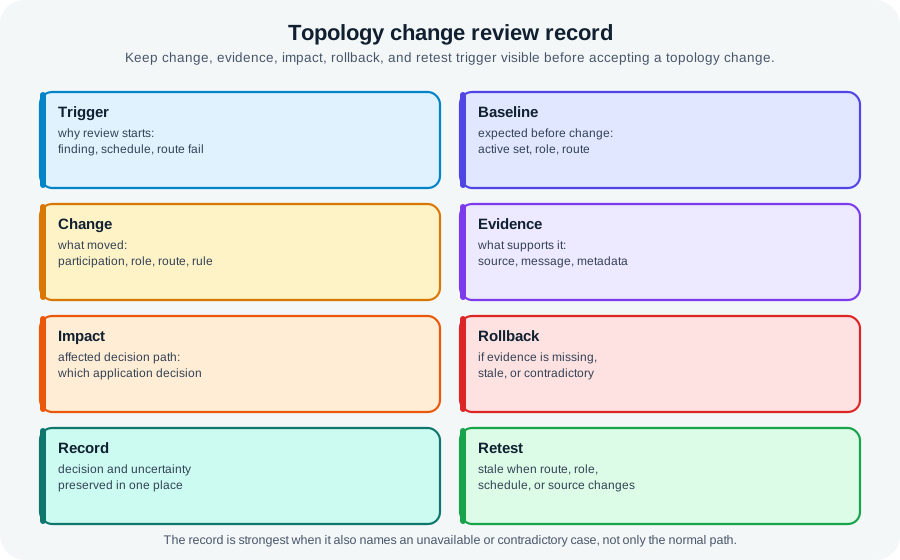
That shortcut keeps operations from treating topology management as an optimization-only step. The reviewer is not asking whether the new route is prettier or faster in isolation; the reviewer is asking whether the route still preserves source identity, freshness, quality state, affected decision, rollback option, and the next retest trigger. A record is strongest when it includes an unavailable or contradictory case, not only the normal path.
A mode change stresses the same record differently. Suppose a cold-room monitoring system normally accepts periodic temperature records, and one source crosses the local review rule, so nearby nodes are asked to report more often until an action decision can be made. The technique here is a context-triggered mode change, not a role or route change, but the record still has to name an active set: which nodes joined the dense mode, which stayed excluded or unavailable, and when the system returns to the normal set. Excluded sources are not silently forgotten; they remain visible as missing or out of scope.
The rest of the record follows the same discipline. Some nodes provide source readings, some relay accepted evidence, and some serve only as observers for consistency checks — and the review does not assume a source node can safely become a relay without its own evidence. Accepted readings are still traced from source to next decision point with identity and freshness preserved. The denser mode is accepted only for the stated review need, so reusing it for a different response path means checking role, route, and data-quality evidence again. Retest if the trigger rule changes, if a participant becomes unavailable, if a relay role changes, if a route changes, or if the data-quality rule changes.
This section: Practice Checks — Two short drills before the implementation view.
Two short drills before the implementation view. The first checks that each technique is tied to the evidence it should capture; the second checks the order a topology change is reviewed in.
This section: Under the Hood: Keep Missing, Stale, and Rejected Data Visible — Under the hood, topology management is a state transition.
Under the hood, topology management is a state transition. The active set, role map, route map, data-value rule, and mode trigger all change the meaning of later observations. Keep unavailable, stale, suppressed, buffered, rejected, and contradictory data as explicit states rather than erasing them.
The data model needs more than a current neighbor table. Keep current and previous active-set states, role assignments, observed routes, timestamps, quality markers, excluded-source reasons, and the operation that authorized the transition. If the system stores only the new route, a later check cannot tell whether a missing reading was never expected, temporarily unavailable, suppressed by a rule, rejected for low quality, or hidden by a topology change.
A source can be excluded, unavailable, fallback-only, or out of scope. Those states should be explicit because they affect confidence.
A node that senses locally has not automatically proven relay, buffer, observer, or coordinator behavior.
A new path must preserve source identity, observation time, quality state, and which decision is affected.
Suppressed or reduced data can still matter when a later review investigates a gap, conflict, or fallback decision.
Keep topology changes reversible or at least explainable afterward. Document what changed, which data was accepted, held, or rejected, which action applied to the current path, and what event requires the topology to be checked again.
Use a small state machine rather than overwriting the old state. A candidate route can be proposed, observed, accepted, held, rolled back, or marked unavailable. In the earlier G2 move, missing S19 keeps the candidate from acceptance; after rollback, check all 20 sensor identities again. A node can be proposed as a relay, tested by forwarding data, accepted for one decision path, and later revoked when the gateway, duty cycle, firmware, or responsibilities change. This is slower than a silent automatic switch, but preserves how data reached a decision and why it was trusted.
This section: Summary — Topology management techniques change participation, roles, routes, data-value rules, and mode behavior.
Topology management techniques change participation, roles, routes, data-value rules, and mode behavior. They are safe to accept only when the review starts with the affected decision, records the baseline, names the trigger, checks evidence, chooses a bounded action, preserves uncertainty, and defines the retest trigger. The key distinction is between a topology that merely passes messages and a topology that preserves decision evidence.
This section: Key Takeaway
Topology management is a controlled evidence transition: every active-set, role, route, data-value, or mode change needs rollback behavior and a retest trigger.
This section: See Also
3 reviewed answers.
Open the module page from the sidebar to see its chapters in order. Use the module map to return to a topic you need.
Modules and pathsReviewed
Check the symptom, then work through the diagnostic steps. Keep the error message and the smallest example that reproduces it.
When you are stuckReviewed
Use the interactive guide to check how examples and simulations work before changing your project.
Interactive examples guideReviewed