3 Measuring Topologies with Graph Metrics
More
Depth: Practitioner
Progress saves as you read. Mark sections complete as you go; your progress appears in the sidebar.
A network diagram with twelve nodes may contain one fragile bridge or several alternate routes. Graph metrics turn those visible links into counts that expose reachability, path length, and concentration. The numbers matter only when tied back to the physical devices and failure being decided.
A gateway is the graph node that connects the measured topology to another network.
-

Will all forty sensors still connect after setup?
3.1 Start With the Story
This section: Start With the Story — Picture forty shelf sensors that can all reach a store system during setup.
Break One Link Before Trusting the Drawing
Picture forty shelf sensors that can all reach a store system during setup. The map looks like a strong web, yet most messages cross one powered relay near a loading door. If that relay fails, half the shelves disappear. The network owner needs to see that weak point before release.
Turn the drawing into nodes and links. Mark source devices, relays, border devices, power sources, channels, owners, and final receivers. Count paths, path length, shared parents, busiest links, and the groups lost when each key part is removed.
Unplug one relay, block one link, add busy traffic, move a shelf, drain a battery, and restore power. Measure delivery, delay, route change, energy cost, and recovery. Check the receiver record as well as the radio map; a path that exists but misses the decision time may still fail the job.
Graph measures describe the stated model, not every wall, radio effect, queue, software fault, or field change. Keep site measurements and the model version with the result.
Practitioner builds the topology scorecard and failure trial. Under the Hood explains degree, paths, cuts, scale, route overhead, and why several neat-looking shapes can hide the same failure domain.
Suppose two network sketches both look tidy, but one loses half the building when a parent node fails and the other only slows down. Topology analysis is the habit of proving that difference before release. You turn the drawing into graph metrics, failure-domain evidence, scale limits, and routing-overhead notes so a reviewer can see what the shape can actually survive.
3.2 Measure the Route Graph, Then Break It
This section: Measure the Route Graph, Then Break It — Start with Figure 3.2.
Start with Figure 3.2. Read its nodes and edges before the metric labels. Degree counts a node’s direct neighbours. Path length counts the edges along a route. Density compares present links with possible links. Centrality can highlight a node that sits on many paths. None of these values alone states whether the network meets its service target.
Figure 3.1 follows traffic between named endpoints. Count each hop and note any alternate path. Figure 3.3 then groups devices that share a component or cut. A node can have several neighbours yet remain inside one power or gateway failure domain.
Figure 3.4 closes the analysis with topology version, data source, metric values, tested removals, exceptions, and decision. Read it after the diagrams because a metric without the exact graph snapshot cannot be reproduced.
Use a five-node graph with edges A-B, B-C, C-D, D-E, and B-D. Node B has degree 3, while A and E each have degree 1. The shortest route from A to E is A-B-D-E, which has three edges. Remove B and A becomes isolated, even though C, D, and E remain connected. B is therefore a critical articulation for A in this graph.
Adding edge A-C changes the failure result. After B is removed, A can still reach E by A-C-D-E. The new edge adds installation and traffic cost, so the decision record should link that cost to the required resilience. Calling the graph “more connected” is weaker than naming the protected route.
Metrics from intended drawings and discovered networks may differ. Capture actual neighbours over a stable window, handle one-way or intermittent links explicitly, and record whether edges are directed or weighted. A wireless link observed once should not automatically become a permanent symmetric edge.
Predict the calculations. Before using a tool, state B’s degree, the three-edge A-to-E shortest path, and A’s isolation after B fails. Add A-C and predict the surviving route. Then compare software output and a real fault test with those hand results. A disagreement often reveals a direction, weight, or filtering assumption in the graph model.
3.3 Overview: Topology Analysis Turns Diagrams Into Evidence
This section: Overview: Topology Analysis Turns Diagrams Into Evidence — A topology diagram is a useful sketch, but analysis asks what the sketch proves.
A topology diagram is a useful sketch, but analysis asks what the sketch proves. Model devices and links as a graph, measure the paths that traffic depends on, and test which nodes, links, gateways, channels, power sources, or ownership boundaries can break the service.
The goal is not to crown one topology name as good or bad. Star, tree, ring, mesh, bus, and hybrid patterns all work in the right conditions. A design is defensible when its metrics, failure behavior, and field evidence match the deployment constraints.
Consider a warehouse design where forty shelf sensors appear to form a healthy wireless layout because every sensor can reach a gateway during installation. The graph record may tell a different story: most routes still cross one relay aisle, the gateway has the highest degree, and the cold-room sensors have longer retry paths than the rest of the floor. A useful analysis records those dependencies before release. It asks which nodes become unreachable if the relay aisle loses power, whether alarms still arrive during a burst, and whether operations can see the difference between weak radio links, gateway queues, and application ingestion delays.
If you only need the intuition, this layer is enough: count the graph, identify the busiest and weakest dependencies, remove one likely failure, and record what evidence would make the topology safe to reuse.
The warehouse sketch becomes defensible only when its nodes and links pass through a repeatable analysis. Figure 3.1 previews that route so each later metric and probe has a clear place in the final decision record.
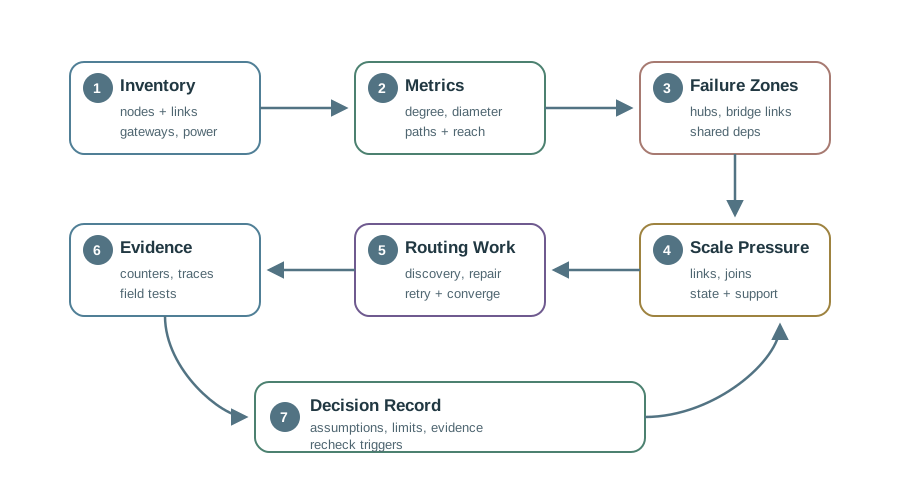
The numbered path in Figure 3.1 begins with Inventory, recording nodes and links, then moves through Metrics such as degree, diameter, paths, and reach. Failure Zones exposes hubs, bridge links, gateways, and power dependencies before Scale Pressure and Routing Work add state, support, discovery, and repair costs. Evidence captures counters and traces, and Decision Record binds the assumptions, limits, evidence, and recheck triggers. That sequence turns the opening warehouse example from a tidy drawing into an inspectable claim about what remains reachable under stress.
Nodes
Devices, routers, access points, gateways, brokers, cloud services, and any boundary whose failure changes reachability.
Edges
Radio links, cables, uplinks, tunnels, broker paths, or logical dependencies that carry traffic between nodes.
Paths
Hop sequences for the flows that matter: telemetry, commands, local control, diagnostics, and recovery traffic.
Failure Domains
Shared dependencies that can disconnect devices even when the diagram appears to show alternate paths.
Overview Knowledge Check
3.4 Practitioner: Build the Topology Analysis Record
This section: Practitioner: Build the Topology Analysis Record — A practical analysis should fit on one page.
A practical analysis should fit on one page. It names what the graph includes, the metrics that matter, the failure probe, the logs and counters to keep, and the site change that requires the decision to be checked again.
Counting links alone cannot reveal whether the remaining paths are useful. Compare degree, shortest path, diameter, bridge links, and weighted links to complete the one-page analysis.
See Figure 3.2 in the figure below.
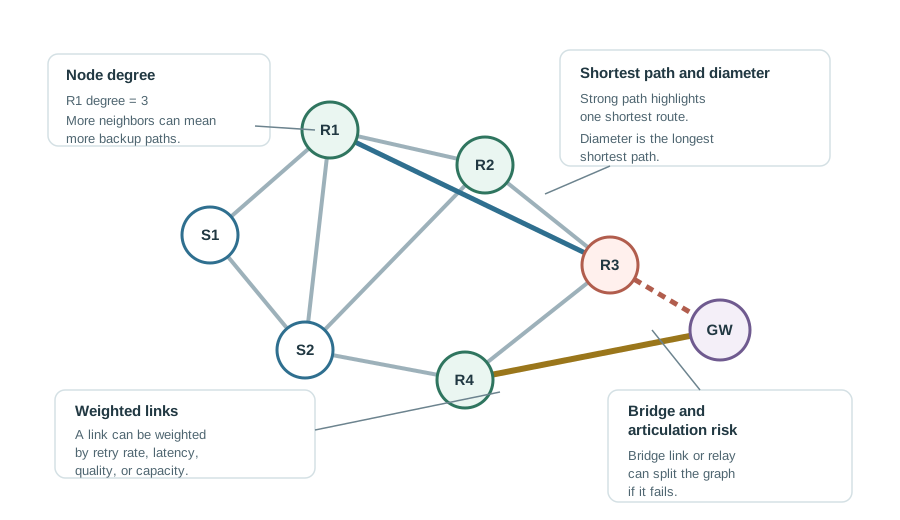
Router R1 degree = 3 illustrates Node degree, while the highlighted route between sensors and the gateway, labelled GW, illustrates one Shortest path. Diameter is the longest shortest path, not simply the longest drawn edge. A Bridge link or relay can split the graph when it fails. Weighted links attach retry rate, latency, quality, or capacity to edges that would otherwise look equal. Connectivity shows whether a path exists; weights and failure probes show whether it is useful in operation.
Use formulas as first-pass checks, not as deployment truth. A full mesh with n nodes needs n(n - 1) / 2 links, while a partial mesh with average degree k has about n * k / 2 links. Those numbers reveal maintenance pressure, but the decision still needs weighted links and failure probes.
Accept
The devices and links included in the graph, key metrics, failure probe, and field measurements support the selected topology.
Constrain
Limit the topology decision to a named area, flow, gateway, traffic rate, device role, or ownership model.
Retest
Run a focused probe when node count, placement, relay role, traffic shape, or route behavior changes.
Hold
Do not approve when the graph hides a gateway, bridge link, power source, shared channel, or service dependency.
Practitioner Knowledge Check
3.5 Under the Hood: Failure Domains Decide Whether Metrics Matter
This section: Under the Hood: Failure Domains Decide Whether Metrics Matter — A topology can be connected and still be fragile.
A topology can be connected and still be fragile. A graph has an articulation node if removing one node separates reachable groups. It has a bridge link if removing one link partitions traffic. It has a shared dependency when apparently redundant paths rely on the same gateway, switch, channel, power circuit, certificate, cloud service, or operating team.
Routing overhead also grows through the graph. Neighbor discovery, route maintenance, acknowledgements, retries, state storage, convergence (settling on working routes after a change), and sleep behavior can make a theoretically resilient topology expensive or unstable in the field.
Pair failure tests with measured link weights. Removing a bridge link from an unweighted graph shows partition risk, but it does not show whether the alternate path is usable under battery, latency, duty-cycle, or interference constraints. A sleepy relay may be a valid backup for slow telemetry and a poor backup for command traffic. A redundant uplink may still share one power circuit or one operations team. Document the assumed failure, affected flows, measured or observed weights, degraded mode, and exact condition that requires another test.
Graph metrics matter only when they predict the service effect of a plausible loss. Compare familiar shapes by what fails together.
See Figure 3.3 in the figure below.
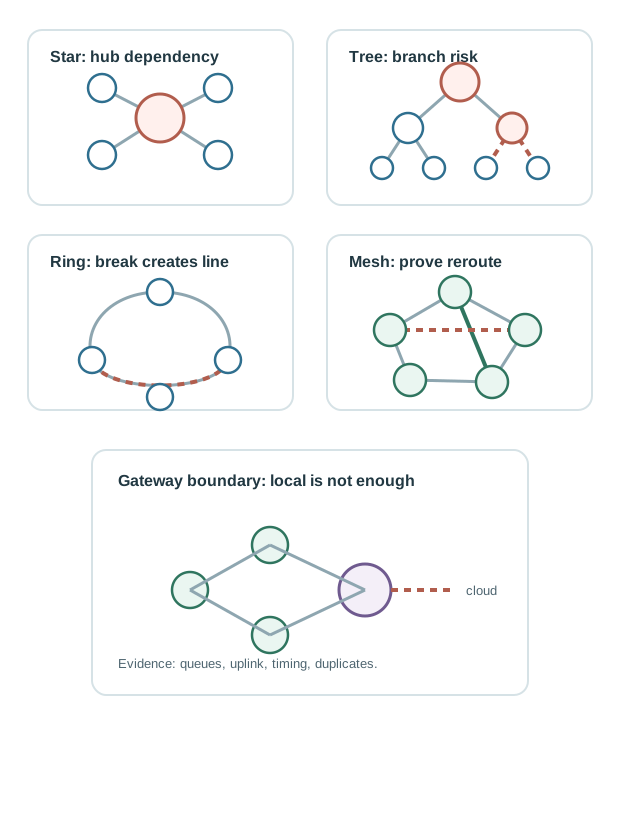
A star depends on its hub, and a tree on its parent branches; one shared role can isolate many leaves. A ring becomes a line after a break. A mesh needs an observed reroute before an alternate path can be treated as working. Local connectivity alone does not establish cloud service: check queues, uplink state, timing, and duplicates at the gateway. Describe which flow persists, which slows or buffers, and which still fails beyond a surviving local graph.
Articulation Node
One node removal separates otherwise healthy devices. It needs redundancy, monitoring, or a documented acceptance decision.
Bridge Link
One link removal partitions traffic. Bridge links are common in tree branches, gateway uplinks, and under-connected meshes.
Shared Dependency
Two paths can still share one channel, breaker, uplink, credential store, or operator handoff.
Graceful Degradation
The strongest designs state what changes after failure: longer paths, buffering, alarms, local isolation, or lower sample rate.
Keep the failure-test results together with the conditions they cover. Include assumptions, graph metrics, removed dependencies, operating measurements, limits, and changes that require another check.
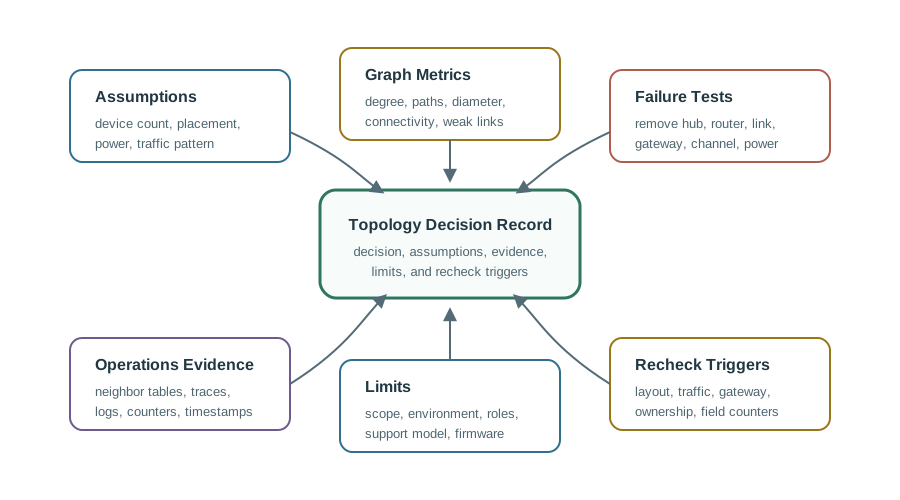
State the scope, environment, roles, and traffic assumed. Keep degree, paths, diameter, connectivity, and weak links alongside the hub, router, link, gateway, channel, or power source removed during each test. Add neighbour tables, traces, logs, counters, and timestamps. State limits so the observations are not treated as universal. Reconsider an accepted or constrained topology choice when placement, load, responsibilities, or firmware changes.
Under-the-Hood Knowledge Check
3.6 Summary
This section: Summary — Topology analysis makes a network design defensible by turning a diagram into a graph record.
Topology analysis makes a network design defensible by turning a diagram into a graph record. Count nodes and edges, measure degree, diameter, path length, and connectivity, then test what happens when a likely dependency fails.
The strongest topology records avoid topology-name shortcuts. They include weighted links, failure domains, routing overhead, operational evidence, limits, and a clear trigger for reopening the decision when device count, placement, traffic, ownership, or field counters change.
3.7 Key Takeaway
This section: Key Takeaway
Trust a topology decision only when the graph metrics, failure probe, operations evidence, known limits, and recheck trigger all support the deployment claim.
3.8 See Also
This section: See Also
Network Topologies: Basic Types
Review star, tree, ring, mesh, bus, and hybrid families before analyzing trade-offs.
Topology Selection
Turn analysis evidence into a bounded topology recommendation and recheck trigger.
Topology Failures
Study the failure modes that invalidate otherwise plausible topology diagrams.
Topology Management Techniques
Connect graph evidence to operational changes, rollback choices, and retest triggers.
Find help
3 reviewed answers.
Where should I start in a module?
Open the module page from the sidebar to see its chapters in order. Use the module map to return to a topic you need.
Modules and pathsReviewed
What can I try when a project does not work?
Check the symptom, then work through the diagnostic steps. Keep the error message and the smallest example that reproduces it.
When you are stuckReviewed
How do interactive examples work?
Use the interactive guide to check how examples and simulations work before changing your project.
Interactive examples guideReviewed