Device constraints
Power source, sleep behaviour, protocol capacity, placement limits, mobility, maintenance access, and ownership.
Progress saves as you read. Mark sections complete as you go; your progress appears in the sidebar.
A network design becomes real when cables, radios, power supplies, addresses, and maintenance access meet the site. Five readiness considerations keep a tidy diagram from skipping physical constraints. The release question is whether the built path supports the required devices and failures with traceable evidence.
A payload is the application data travelling on a link, and a protocol is the rule used to exchange it.
This section: Turn the Design Map Into a Readiness Decision — Read Figure 7.1 across its five labelled concerns.
Read Figure 7.1 across its five labelled concerns. Connect each one to the same deployment rather than treating them as independent checklist boxes. Coverage affects placement; capacity affects shared links; reliability exposes failure domains; security limits reachable paths; operations determine how faults and changes are handled.
Figure 7.3 captures the proposed nodes, links, roles, assumptions, and version. Follow that record into Figure 7.2, where measurements and tests support or challenge the proposal. Figure 7.4 ends the sequence with accept, correct, pilot again, or stop. The gate should cite evidence, not confidence in the drawing.
Consider 30 warehouse sensors sending one 120-byte payload every minute. Application data entering the gateway is (30\times120=3{,}600) bytes per minute before protocol overhead and retries. Capacity testing should include synchronized reporting, because thirty devices transmitting at the minute boundary can create a short burst even when the average rate is small.
Coverage evidence names the farthest and most obstructed sensors. Reliability testing removes the gateway, a shared switch or relay, and power to one zone. Security testing attempts a route that policy should deny. Operations testing asks whether staff can identify a missing sensor, replace it, and confirm its identity without weakening credentials.
Traceability connects every hard need to a result. “All 30 sensors report within two minutes” maps to an observed burst test. “One sensor must not reach the office network” maps to an allowed-and-denied path test. “A relay loss may affect at most five sensors” maps to the topology record and a physical fault drill.
Predict the readiness review. Expect 30 unique identifiers after the synchronized burst, not merely 30 messages. Remove each shared component and list the exact expected losses before observing them. Attempt the forbidden office route and expect a logged denial. If a requirement has no test or a test has no limit, the design is not ready for release even when basic connectivity works.
This section: Start With the Story — Imagine planning sensors for a school building.
Imagine planning sensors for a school building. A line on a drawing does not show whether a battery can last, a message can arrive, or a broken device can be replaced. A protocol is a set of rules for exchanging messages. A gateway is a bridge between a local device network and a wider system.
Begin with five facts: device limits, message needs, site boundaries, device addresses, and the planned network shape. Use those facts to reject choices that cannot work. Then test a sleeping device, a burst of messages, a blocked path, and a failed gateway. Keep the result beside the drawing so a later change reopens the right decision.
Use one sheet for the five facts. For each device, write power, sleep, place, and owner. For each message, write size, direction, rate, and deadline. Draw where local systems meet outside systems. Give each device a stable address plan. Draw normal and backup paths. Mark every point whose loss stops the service. Add the test that supports each arrow. Add the person who keeps that test current.
Now change one fact. Add devices, remove a path, or shorten a deadline. If the design record cannot show what must be checked again, it is not ready for release.
This first review cannot predict every wall, radio, or maintenance event. The Practitioner section turns the five facts into a release record. Under the Hood follows scale, routing, and failure trade-offs.
Before a network design is ready, someone has to connect the drawing to the release evidence. The five considerations in this chapter keep that story together: device constraints, data behavior, infrastructure boundaries, addressing, and topology records. Each one answers a practical review question before the network is trusted in the field.
This section: Overview: Design Starts With Traceability — A good IoT network design is not a protocol shopping list.
A good IoT network design is not a protocol shopping list. It is a traceable design record that links device constraints, data behaviour, infrastructure boundaries, addressing, topology views, security zones, operations, and release checks. A choice is ready only when the team can trace it to a requirement and recheck it when the deployment changes.
The five considerations stay connected. Device limits shape data behaviour. Data behaviour shapes gateway and backhaul choices. Infrastructure boundaries shape addressing and naming. Topology records show how those choices appear in logical, physical, and operational views.
For example, a sleeping battery sensor, a line-powered gateway, and a cloud dashboard may all appear in one network diagram, but they need different evidence. The sensor record should explain power budget, reporting cadence, retry tolerance, and service access. The gateway record should explain buffering, translation, backhaul, update ownership, and local diagnostics. The dashboard path should explain freshness, access boundary, retained state, and alert handling. Once those records exist, a topology choice becomes reviewable: the team can say why a star, mesh, tree, or hybrid pattern fits this deployment instead of relying on the default pattern from a previous project. If any record is missing, the design response is not to guess a better protocol; it is to mark the missing evidence and delay the release decision that depends on it.
Start with requirements when designing a new network. Start with missing records when assessing an existing design.
Protocol choice is premature until the design inputs can be traced to a release claim. Figure 7.1 gathers those inputs so the rest of the chapter can treat them as one maintained record rather than five independent checklists.
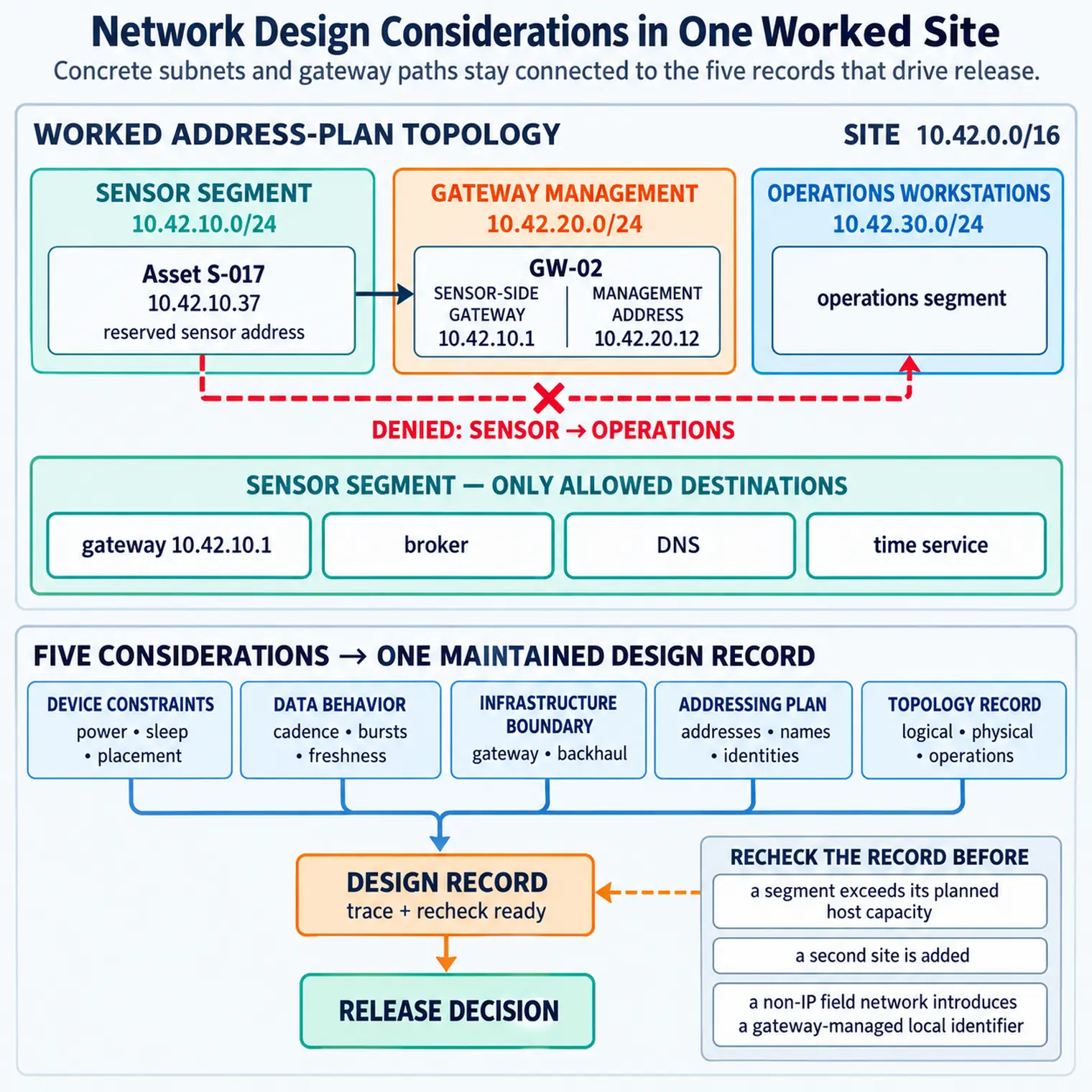
Around Figure 7.1, Device Constraints contributes power, sleep, and placement while Data Behavior contributes cadence, bursts, and freshness. Infrastructure Boundary, Addressing Plan, and Topology Record then converge on the central Design Record, which must be trace and recheck ready before it yields a Release Decision. That convergence is the chapter’s running narrative: every protocol, gateway, and address choice needs a visible requirement behind it and a trigger that says when its evidence has gone stale.
Power source, sleep behaviour, protocol capacity, placement limits, mobility, maintenance access, and ownership.
Cadence, bursts, freshness, direction, reliability tolerance, duplicate handling, and sensitivity.
Gateway, backhaul, segmentation, platform boundary, buffering, monitoring, and incident response ownership.
Address plans, names, identities, logical flows, physical placement, operations views, and recheck triggers.
This section: Practitioner: Build the Record Before the Diagram — The design record should produce consequences, not just inventory facts.
The design record should produce consequences, not just inventory facts. A battery sensor may need restrained reporting, local filtering, a sleepy receive policy, and gateway-assisted translation. A mains-powered gateway can support richer conversion and health reporting, but still needs placement, backhaul, recovery, and ownership evidence.
Data behaviour is the second pressure point. Average bandwidth is rarely enough. A network can look small on average and still fail during alarms, startup storms, gateway recovery, maintenance windows, retry loops, or synchronized reporting. Record representative bursts and recovery behaviour before accepting a topology or protocol.
Make the burst record concrete enough to test. A useful entry separates routine heartbeats, event messages, commands, diagnostics, and firmware or configuration traffic. It names which flows can be delayed, which must stay fresh, which may duplicate safely, and which require acknowledgement before the device sleeps again. It also states the retry limit and the recovery path after a gateway outage. Those details drive design choices: local buffering may matter more than peak radio speed, gateway placement may matter more than cloud features, and a simple addressing plan may reduce support risk more than a clever topology.
Protocol choice should also name the first physical and traffic questions explicitly: required distance, deployment area, payload volume, speed, message frequency, freshness need, power source, and whether the device can remain on continuously. A short-range deliberate tap may point toward NFC, a wide-area small-payload sensor may point toward LoRaWAN or cellular IoT, and a powered high-volume device near managed infrastructure may point toward Wi-Fi or 4G. Those names are only candidates until the record proves the device, link, service, and operations boundaries.
Small case studies make the record concrete. A dairy-farm entry tag read at a controlled gate within a few metres may justify passive UHF RFID evidence; kilometre-scale coverage requires a different active or wide-area radio system. A foot-drop wearable may be closer to PAN or Bluetooth evidence. A mobile bus path may combine wired links, LTE or 4G, GPS, RF, and Wi-Fi. A bridge monitoring site may justify fibre or Ethernet. A campus project with limited data and range may fit LoRaWAN, while rotating-machine monitoring may compare Bluetooth LE, Wi-Fi, LoRa, or Zigbee depending on access and range. The point is not the label; the row records device class, range, power, payload, environment, and owner before accepting the media choice.
A small IP-capable sensor site receives 10.42.0.0/16. The designer assigns 10.42.10.0/24 to the sensor segment (gateway 10.42.10.1), 10.42.20.0/24 to gateway management, and 10.42.30.0/24 to operations workstations. Asset S-017 maps in inventory to its radio or MAC identity, its reserved sensor address 10.42.10.37, and gateway GW-02 at 10.42.20.12. The access rule allows the sensor segment to reach only its gateway, broker, DNS, and time service; it cannot initiate sessions to the operations segment. The record must be revised before a segment exceeds its planned host capacity, a second site is added, or a non-IP field network introduces a gateway-managed local identifier.
In an internet-connected tilt-maze style prototype, the tablet command path, cellular or Wi-Fi access, cloud hop, Ethernet link to the controller, microcontroller-to-actuator interface, and camera return path exercise different layers. The review should name which layer owns each question: application message, transport reliability, IP route, network-access link, and local hardware interface. Non-IP or constrained links should terminate at a gateway that translates, buffers, and exposes diagnostics instead of pretending every endpoint speaks the same TCP/IP stack.
The worked address plan is credible only if its subnet and access choices remain connected to device and traffic evidence. Figure 7.2 shows where those choices enter the design chain and which supporting records keep them reviewable.
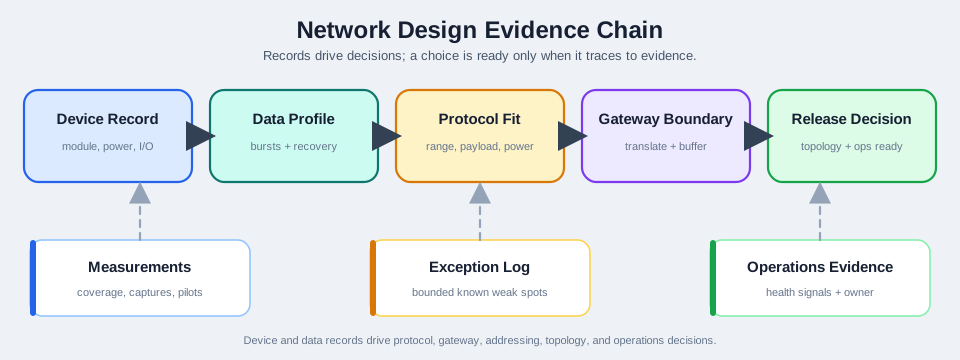
In Figure 7.2, Device Record names module, power, and I/O constraints while Data Profile contributes bursts and recovery behaviour. Those inputs narrow Protocol Fit and the Gateway Boundary, where translation and buffering occur, before the Release Decision asserts that topology and operations are ready. The dashed supports matter too: Measurements, Exception Log, and Operations Evidence supply coverage results, bounded weak spots, and named health owners. The 10.42.10.0/24 sensor segment above therefore belongs in this evidence chain, not in an isolated addressing table.
This section: Under the Hood: Release Gates Keep the Design Honest — Separate logical flows, physical placement, and operations notes.
Separate logical flows, physical placement, and operations notes. Logical views show data paths, control paths, protocol translation, access restrictions, and failure paths. Physical views show device locations, gateways, cable runs, power, obstacles, and service access. Operational views show responsibilities, monitoring points, expected alarms, fallback modes, reset procedures, and conditions requiring another check.
Before release, check for missing design details. Know which assumptions were measured, which exceptions have stated limits, who can diagnose missing data, which health signals separate device, gateway, network, and application failures, and which deployment change requires another check.
Ask for the measurement or pilot result behind the highest-risk assumptions, the exception log for known weak spots, and the operational handoff explaining who sees each health signal. If a floor gateway loses backhaul, operations should distinguish radio coverage, gateway queues, upstream network, and application ingestion problems. If these failure modes cannot be distinguished, pause release even when the diagram looks tidy. Specify which growth, site, firmware, or platform change would require the decision to be checked again.
A tidy topology diagram can hide physical service problems or missing support responsibilities. Check logical flow, physical placement, and operations readiness separately before release.
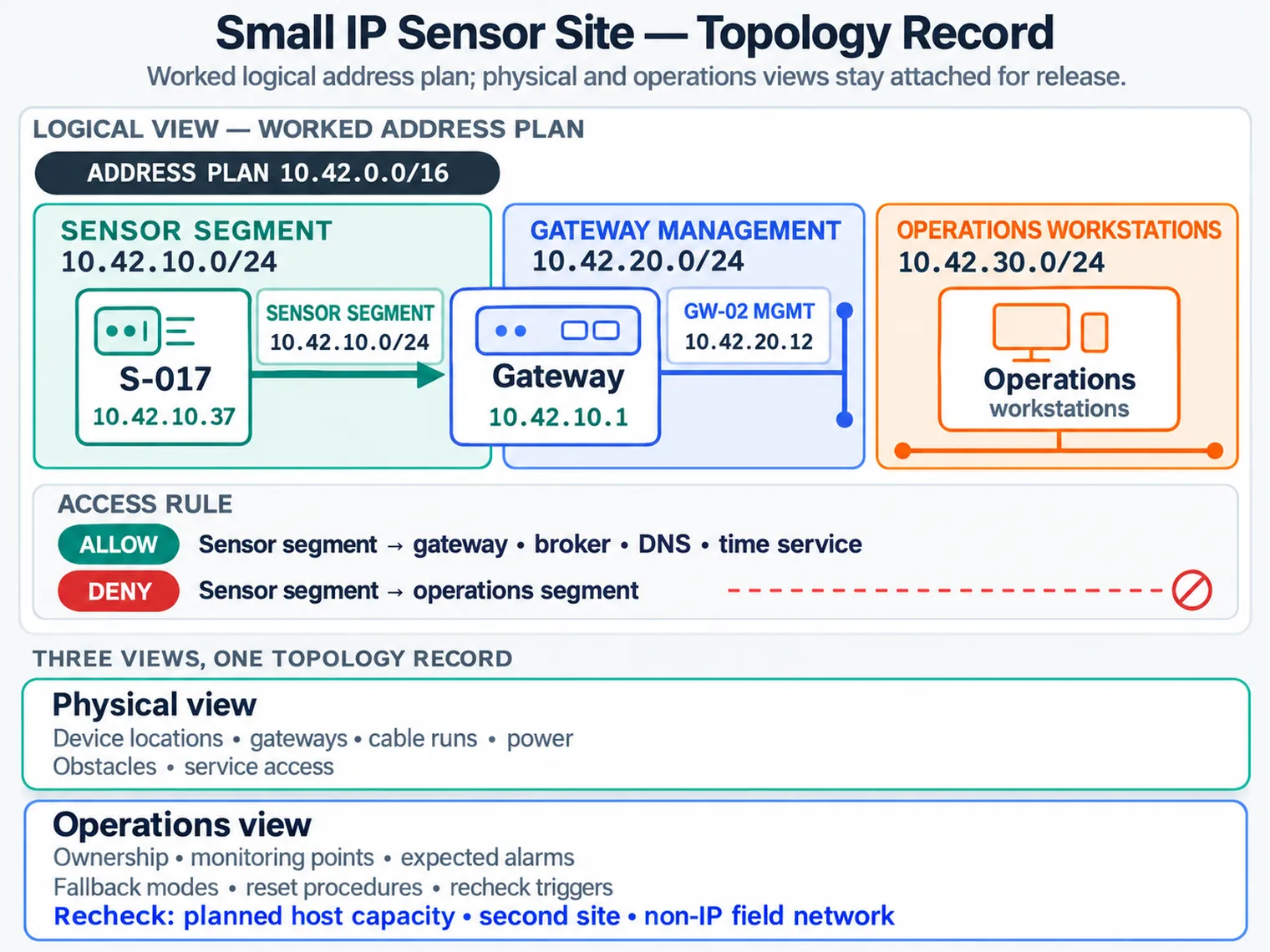
For logical flow, list data and control paths, protocol translation, access restrictions, and failure paths. For physical placement, list device and gateway sites, cable runs, power, obstacles, and service access. For operations readiness, name responsibilities, monitoring, expected alarms, fallback modes, resets, and changes that require another check. Keep all three views together so a sound logical route is not mistaken for a maintainable deployment.
With the three views assembled, check whether their test results support approval, a hold, or a narrower deployment.
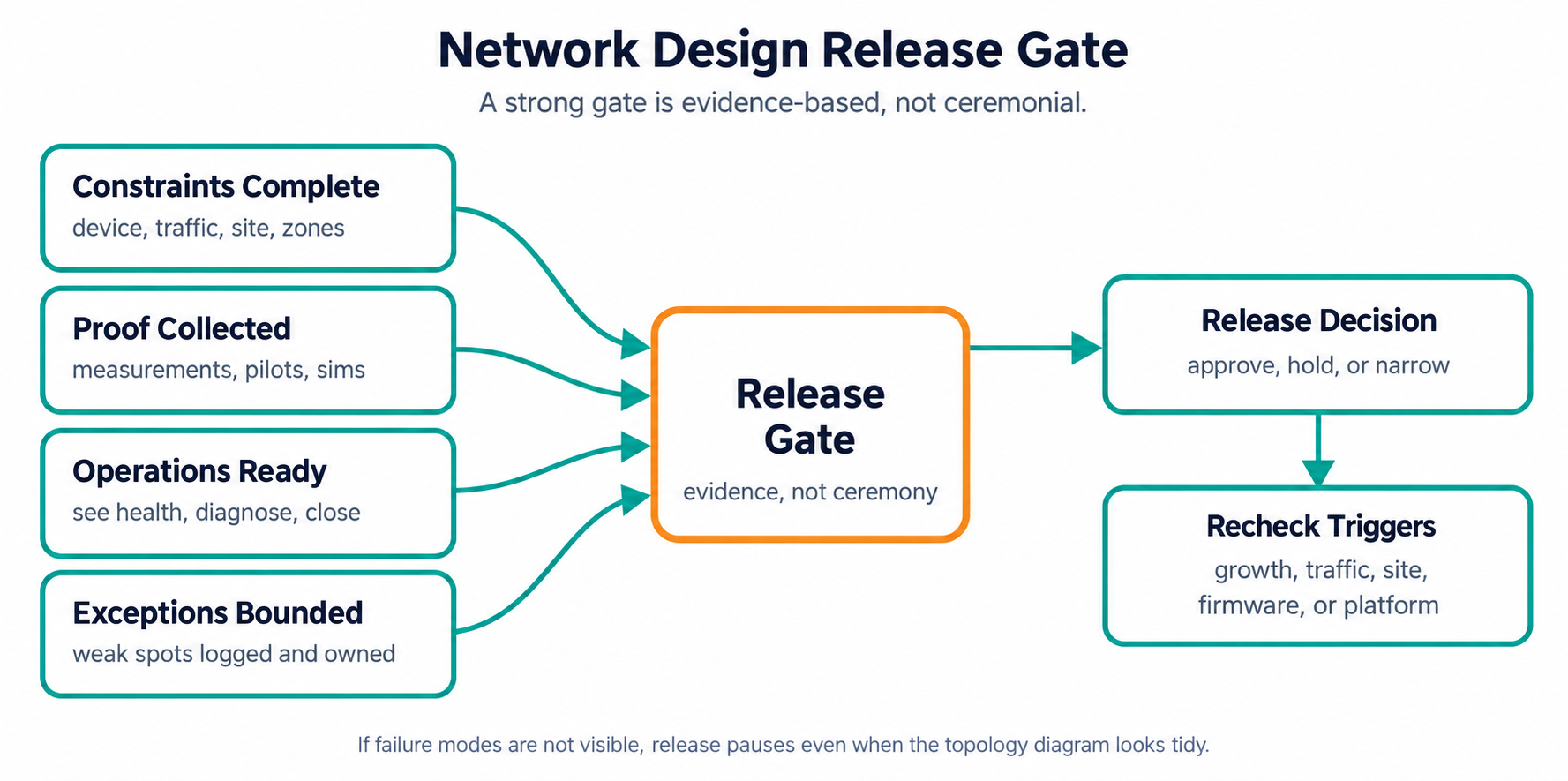
Before release, check four things: device, traffic, site, and zone constraints; measurements or pilots; visible health and diagnosis; and known weak spots with named responsible staff. Then approve, hold, or narrow the design. Specify when growth, traffic, site, firmware, or platform changes require another check, so approval does not persist after its tested conditions change.
Device classes, traffic classes, site limits, responsibilities, and security zones are documented.
Measurements, pilots, coverage checks, packet captures, or simulations cover the highest-risk assumptions.
Support can see health, diagnose missing data, replace devices, and close incidents with logs.
Growth, new traffic, changed site conditions, firmware changes, or platform migration force another recheck.

Wrong idea: a design must use the newest wireless method to be ready. It fails because release depends on field evidence and an operations plan, not novelty.
The packet-size and reliability gates meet at the reassembly buffer. Use the missing-and-timeout preset below to dispatch four fragments while fragment 3 is absent, then advance the receiver clock to the 60-second discard time. The byte-offset map shows why arrival order is recoverable but missing coverage is not.
Document the held bytes, missing range, and responsibility for the timeout in the network design. This makes the maximum transmission unit (MTU), the largest unit a link can carry without fragmentation, operational: one lost fragment can retain receiver state for the entire datagram and force upper-layer recovery.
This section: Summary — Network design considerations are useful only when they create traceable records.
Network design considerations are useful only when they create traceable records. Start with device constraints and data behaviour, define infrastructure and addressing boundaries, document logical, physical, and operational topology separately, and finish with a release gate that names operations readiness and recheck triggers. This keeps the design decision meaningful even when a protocol, vendor, platform, or site detail changes.
This section: Key Takeaway
An IoT network design is ready when its protocol, topology, addressing, operations, and release choices can all be traced back to device and data records.
This section: See Also
Compare star, mesh, tree, bus, and hybrid patterns before applying design records.
Turn scenario facts into bounded topology choices, pilot checks, and selection records.
Compare route length, failure domains, density, and maintenance records.
Practice applying the design record to lab-style topology decisions.
3 reviewed answers.
Open the module page from the sidebar to see its chapters in order. Use the module map to return to a topic you need.
Modules and pathsReviewed
Check the symptom, then work through the diagnostic steps. Keep the error message and the smallest example that reproduces it.
When you are stuckReviewed
Use the interactive guide to check how examples and simulations work before changing your project.
Interactive examples guideReviewed