Industrial IoT
Learn about Industrial IoT (IIoT), Industry 4.0 architectures, SCADA/PLC integration, predictive maintenance, and the convergence of IT and OT in modern manufacturing.
Industrial IoT
Learning Objectives
By the end of this chapter, you will be able to:
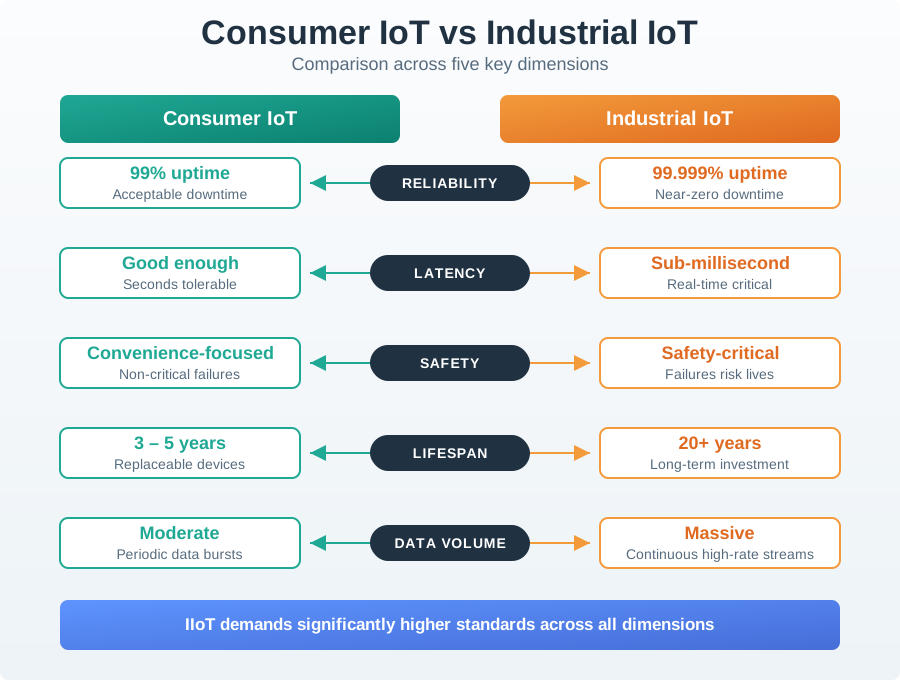
- Define IIoT: Explain how the Industrial Internet of Things differs from consumer IoT in terms of reliability, latency, and safety requirements
- Map Industry 4.0 Maturity: Identify the four industrial revolutions and position IIoT within the Industry 4.0 framework
- Understand IT/OT Convergence: Describe how Information Technology and Operational Technology systems integrate in modern factories
- Apply Predictive Maintenance: Explain the difference between reactive, preventive, and predictive maintenance strategies
- Evaluate IIoT Architectures: Compare SCADA, PLC, and DCS systems and their roles in industrial automation
If you take away only three things from this chapter:
- IIoT connects industrial equipment to data systems — unlike consumer IoT (smart speakers, fitness trackers), IIoT operates in environments where failures can cost millions of dollars per hour or endanger human lives. This demands deterministic latency (often under 10 ms), 99.999% uptime, and safety-certified hardware.
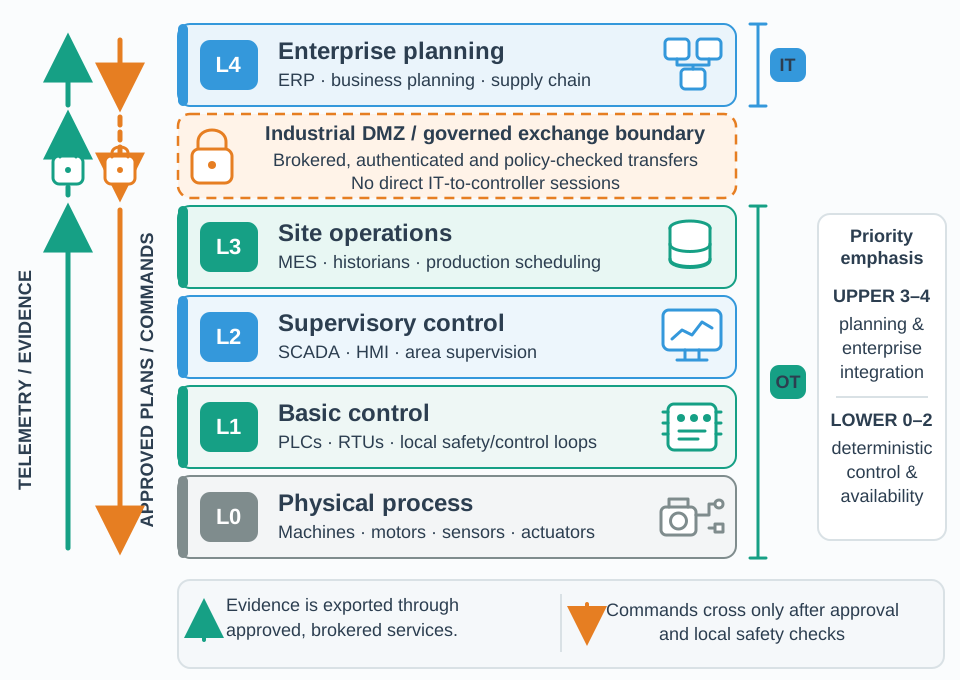
- Industry 4.0 is the convergence of IT and OT — traditionally, factory-floor Operational Technology (PLCs, SCADA, HMIs) was isolated from office Information Technology (ERP, databases, cloud). IIoT bridges this gap, enabling real-time production data to flow into business analytics and AI-driven decision making.
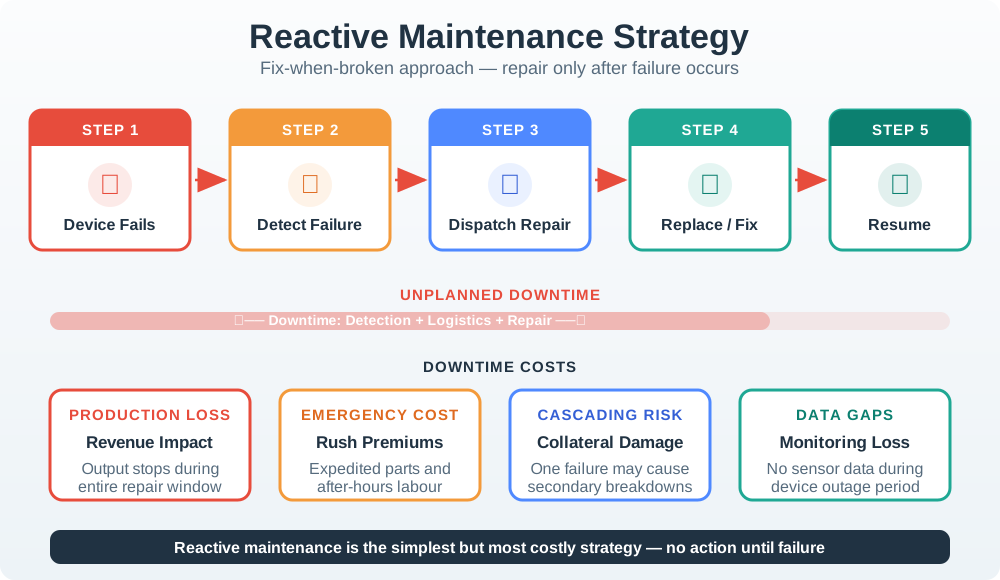
- Predictive maintenance is the killer application — by analyzing vibration, temperature, and current draw patterns, IIoT can predict equipment failures 2-4 weeks before they occur. This shifts maintenance from “fix when broken” (reactive) or “fix on schedule” (preventive) to “fix when data says it is needed” (predictive), reducing downtime by 30-50% and maintenance costs by 25-30%.
Hey Sensor Squad! Imagine our four friends get to visit a chocolate factory:
Temperature Terry is placed on the big chocolate mixing machine. Every second, Sammy checks the temperature — chocolate must stay at exactly 31 degrees Celsius. Too hot? It gets grainy. Too cold? It will not pour right. “I am the quality guardian!” Sammy beeps proudly.
Lila the Lightbulb is installed above the conveyor belt. She does not just light things up — she uses her special camera eye to check EVERY chocolate bar that passes by. Cracked? Too small? Missing a nut? Lila spots problems faster than any human inspector — 500 chocolates per minute!
the microcontroller is the brain of the wrapping machine. He counts how many chocolates get wrapped each hour and sends the number to the factory manager’s tablet. “We are 200 ahead of target!” Max reports. If the wrapping paper runs low, Max sends an alert BEFORE the machine has to stop.
the battery powers the wireless vibration sensor on the big motor. She listens to the motor’s hum all day long. One morning, the hum sounds different — a tiny wobble that humans cannot hear. Bella sends an alert: “Motor bearing wearing out! Replace within two weeks.” The factory fixes it on Saturday, avoiding a breakdown that would have ruined Monday’s 10,000-bar order!
The Big Idea: In a smart factory, sensors are like a team of tireless helpers:
- Sammy guards quality (temperature, humidity, pressure)
- Lila inspects products (vision, color, shape detection)
- Max tracks production (counting, timing, efficiency)
- Bella predicts problems (vibration, sound, power monitoring)
Together, they make the factory run better, safer, and with less waste — that is Industrial IoT!
The simple version: Industrial IoT (IIoT) is about connecting factory machines, robots, and production equipment to the internet so they can share data and be monitored or controlled remotely. Think of it as giving every machine in a factory a voice to say how it is feeling.
A real-world analogy: Imagine you are a doctor responsible for 500 patients. Without IIoT, you visit each patient once a day and hope nothing goes wrong between visits. With IIoT, every patient wears a smartwatch that continuously reports heart rate, temperature, and blood oxygen. You get instant alerts if anything looks wrong. Now replace “patients” with “machines” and “smartwatch” with “industrial sensors” — that is IIoT.
Key vocabulary explained:
| Term | What It Means | Everyday Analogy |
|---|---|---|
| SCADA | System that monitors and controls industrial processes | Like a security camera system for an entire factory |
| PLC | Small computer that controls one machine | Like the thermostat that controls your home heating |
| OT | Operational Technology — the machines and controllers on the factory floor | The kitchen in a restaurant |
| IT | Information Technology — servers, databases, cloud | The accounting office in a restaurant |
| HMI | Human-Machine Interface — the screen operators use | The touchscreen on a modern oven |
| DCS | Distributed Control System — multiple PLCs working together | A team of thermostats coordinating across rooms |
Why is IIoT different from regular IoT?
- A smart speaker failing means no music for a few minutes. A factory controller failing means a $50,000/hour production line stops.
- Your fitness tracker can be 5 minutes late sending data. A safety sensor on a chemical reactor needs sub-millisecond response.
- Consumer IoT needs to be cheap and easy. Industrial IoT needs to be reliable and certified for hazardous environments.
Overview
Key Concepts: factory automation, SCADA, PLC, predictive maintenance, IT/OT convergence, Industry 4.0, OPC UA, ISA-95, digital twin
The Industrial Internet of Things (IIoT) represents the application of IoT technologies to manufacturing, energy, transportation, and other industrial sectors. Unlike consumer IoT, where convenience is the primary driver, IIoT is motivated by operational efficiency, safety, and cost reduction. A single percentage point improvement in equipment effectiveness at a large factory can translate to millions of dollars in annual savings.
The Four Industrial Revolutions
Industry 4.0 — the fourth industrial revolution — is built on IIoT as its foundational technology layer. Understanding this historical context helps explain why IIoT is not merely “adding sensors to machines” but represents a fundamental shift in how industrial systems are designed and operated.
Key Industry 4.0 Technologies
| Technology | Role in Industry 4.0 | Example |
|---|---|---|
| IIoT Sensors | Real-time data collection from equipment | Vibration sensor on CNC machine spindle |
| Digital Twins | Virtual replica of physical assets | Simulating production line changes before implementation |
| Edge Computing | Local processing for latency-critical tasks | Running anomaly detection at the machine, not in the cloud |
| AI/ML | Pattern recognition and prediction | Predicting bearing failure from vibration frequency shifts |
| 5G/TSN | Deterministic low-latency communication | Coordinating robot arms with 1 ms synchronization |
| Augmented Reality | Worker guidance and remote expert support | Overlaying repair instructions on a technician’s view |
IIoT Architecture: The ISA-95 / Purdue Model
Industrial networks are organized into hierarchical levels defined by the ISA-95 standard (also known as the Purdue Model). This layered architecture ensures that safety-critical systems at the bottom are isolated from business systems at the top, while IIoT enables controlled data flow between them.
IT/OT Convergence Challenges
The convergence of IT and OT is one of the most significant — and difficult — aspects of IIoT deployment:
- Different lifecycles: IT systems refresh every 3-5 years; OT systems run for 15-30 years
- Different priorities: IT prioritizes confidentiality (data breaches); OT prioritizes availability (production uptime)
- Different protocols: IT uses TCP/IP and HTTP; OT uses Modbus, PROFINET, EtherNet/IP
- Different teams: IT reports to the CIO; OT reports to the plant manager or VP of Operations
- Different patch cycles: IT patches weekly; OT may go years without patching to avoid production risk
Predictive Maintenance: The IIoT Killer Application
Predictive maintenance uses IIoT sensor data and machine learning to predict equipment failures before they occur. It represents the most mature and highest-ROI application of IIoT.
Maintenance Strategy Comparison
| Metric | Reactive | Preventive | Predictive (IIoT) |
|---|---|---|---|
| Cost per event | Very high (emergency) | Medium (scheduled) | Low (planned) |
| Downtime | Unplanned, hours-days | Planned, but frequent | Minimal, data-driven |
| Parts usage | Replace when broken | Replace on schedule (wasteful) | Replace when needed |
| Failure rate | High | Medium | Low |
| Implementation cost | None | Low | High (sensors + ML) |
| ROI timeline | N/A | Immediate | 12-18 months |
| Downtime reduction | Baseline | 10-20% | 30-50% |
Key Sensor Types for Predictive Maintenance
- Vibration sensors (accelerometers): Detect bearing wear, imbalance, misalignment. Most common IIoT predictive sensor.
- Temperature sensors (thermocouples, RTDs): Detect overheating in motors, bearings, electrical connections.
- Current/power sensors: Detect electrical anomalies indicating mechanical stress.
- Acoustic emission sensors: Detect high-frequency sounds from cracks, leaks, and electrical discharge.
- Oil analysis sensors: Detect metal particles indicating internal wear in gearboxes and hydraulic systems.
IIoT Communication Protocols
Industrial environments demand specialized communication protocols that prioritize determinism, reliability, and sometimes safety certification over throughput:
| Protocol | Use Case | Latency | Key Feature |
|---|---|---|---|
| OPC UA | IT/OT integration standard | 10-100 ms | Platform-independent, secure, semantic data model |
| MQTT | Cloud connectivity | 50-500 ms | Lightweight pub/sub, ideal for telemetry |
| Modbus | Legacy PLC communication | 5-50 ms | Simple, widespread, but no security built in |
| PROFINET | Real-time machine control | <1 ms | Deterministic Ethernet, Siemens ecosystem |
| EtherNet/IP | Real-time machine control | 1-10 ms | CIP over Ethernet, Rockwell ecosystem |
| TSN | Next-gen deterministic networking | <1 ms | IEEE 802.1 standard, vendor-neutral |
1. Treating IIoT like consumer IoT Industrial environments have explosive atmospheres, extreme temperatures, and electromagnetic interference. Consumer-grade sensors and Wi-Fi will fail within weeks. Always specify industrial-rated hardware (IP67+, ATEX/IECEx for hazardous areas) and industrial wireless (WirelessHART, ISA100.11a, or private 5G).
2. Ignoring OT cybersecurity Connecting previously air-gapped OT systems to IT networks creates attack surfaces. The 2017 NotPetya attack cost Maersk $300M and Merck $870M by spreading from IT to OT. Always implement a proper IT/OT DMZ with data diodes, network segmentation, and IEC 62443 compliance.
3. Starting with analytics before fixing data quality Many IIoT projects jump to AI and dashboards before ensuring sensors are calibrated, data is timestamped consistently, and asset naming conventions are standardized. Garbage in, garbage out — invest in data engineering first.
4. Underestimating brownfield complexity Most factories are brownfield (existing equipment, some 20-40 years old). Retrofitting IIoT sensors to legacy machines without serial ports, Ethernet, or even electrical outlets requires creative solutions: clamp-on current sensors, external vibration sensors with adhesive mounts, and battery-powered wireless gateways.
5. No clear ROI target before deployment IIoT pilots that monitor “everything” without a specific business problem to solve generate data nobody uses. Start with the most expensive problem (e.g., the one machine that causes the most unplanned downtime) and prove ROI before scaling.
Worked Example: IIoT Predictive Maintenance ROI Calculation
Scenario: A bottling plant has a critical pump that fails approximately 4 times per year. Each failure causes 6 hours of unplanned downtime. The production line generates $5,000 of revenue per hour. Emergency repairs cost $8,000 each (parts + emergency labor + overnight shipping). The plant is considering an IIoT predictive maintenance system for this pump.
Step 1 — Calculate current annual cost of failures
- Downtime cost: 4 failures x 6 hours x $5,000/hour = $120,000
- Emergency repair cost: 4 failures x $8,000 = $32,000
- Total annual reactive maintenance cost: $152,000
Step 2 — Estimate IIoT system cost
- Vibration sensor (industrial, ATEX-rated): $800
- Temperature sensor (RTD, 4-20mA): $200
- Current transformer (clamp-on): $150
- IIoT gateway (edge compute, Modbus + MQTT): $2,500
- Cloud platform subscription (first year): $3,600
- Installation and commissioning: $2,000
- ML model development and training (consultant): $5,000
- Total first-year investment: $14,250
Step 3 — Estimate predictive maintenance savings
- Predictive maintenance typically detects 70-90% of failures 2-4 weeks in advance
- Assuming 80% detection rate: 4 failures x 80% = 3.2 failures predicted
- Predicted failures: planned repair during scheduled downtime (1 hour instead of 6), standard parts cost ($3,000 instead of $8,000 emergency)
- Remaining unpredicted failures: 0.8 failures x ($30,000 + $8,000) = $30,400
- Predicted failure cost: 3.2 x (1 hour x $5,000 + $3,000) = $25,600
- Unpredicted failure cost: 0.8 x (6 hours x $5,000 + $8,000) = $30,400
- New annual maintenance cost: $56,000
Step 4 — Calculate ROI
- Annual savings: $152,000 - $56,000 = $96,000
- First-year ROI: ($96,000 - $14,250) / $14,250 = 574%
- Payback period: $14,250 / $96,000 = 0.15 years (less than 2 months)
- Ongoing annual ROI (year 2+): $96,000 / $3,600 (platform only) = 2,567%
Key insight: Even with conservative assumptions (80% detection rate, only one pump), the IIoT system pays for itself in under two months. In practice, the same gateway and platform can monitor dozens of assets, further improving the economics. This is why predictive maintenance is the most common IIoT starting point.
Knowledge Check
Test your understanding of Industrial IoT concepts:
Learning Resources
Interactive Animations
Industry 4.0 Maturity Assessor
Topics: applications, cases, industry40
Summary
Industrial IoT represents a transformative force in manufacturing and industrial operations, but it demands fundamentally different approaches from consumer IoT:
| Dimension | Key Takeaway |
|---|---|
| Architecture | ISA-95/Purdue Model provides hierarchical security. IIoT bridges the IT/OT boundary through DMZ gateways. |
| Maintenance | Predictive maintenance using vibration, temperature, and current sensors delivers 30-50% downtime reduction and ROI payback in months. |
| Protocols | OPC UA is emerging as the IT/OT integration standard. Legacy Modbus and proprietary fieldbus protocols require edge gateways for translation. |
| Security | IT/OT convergence creates new attack surfaces. IEC 62443 and network segmentation are essential. Never connect OT directly to the internet. |
| Deployment | Start with one high-value asset and a specific business problem. Prove ROI before scaling. Brownfield retrofitting is harder than greenfield design. |
| Industry 4.0 | IIoT is the foundation layer. Digital twins, edge AI, and 5G/TSN build on top of connected, data-generating industrial assets. |
Where to go next: Explore Predictive Maintenance for deeper technical detail, or Smart Manufacturing for specific use cases in production environments.