Healthcare IoT
Learn about Healthcare IoT in IoT systems
Healthcare IoT
If you remember only 3 things from this topic guide:
-
Clinical vs. Consumer Accuracy Gap — Healthcare IoT devices must achieve less than 2% measurement error (clinical-grade), while consumer fitness trackers tolerate 10—15% error. This fundamental gap means consumer devices cannot simply be “upgraded” to medical use; they require complete sensor redesign with FDA 510(k) clearance (6—18 months, $50K—$500K).
-
Alert Fatigue Is the Silent Killer — False positive rates above 5% cause clinicians to ignore warnings entirely. A NICU nurse receiving 350 alerts per shift cannot meaningfully respond to any of them, so healthcare IoT must be designed with explicit alert fatigue budgets and multi-stage filtering (adaptive thresholds, sensor fusion, ML prediction).
-
Integration Beats Innovation — A simple device that sends data directly to Electronic Health Records (EHR) delivers more clinical value than a sophisticated standalone device that creates another data silo. The “integration-first” mindset separates successful healthcare IoT from expensive gadgets.
Sammy, Lila, Max, and Bella visit Sunshine Hospital to learn how IoT sensors protect patients around the clock!
Sammy the Signal Sensor was stuck gently to baby Maya’s tiny foot in the nursery. “Maya’s temperature just went up from 98.6 to 99.8 degrees! That might mean she’s getting a cold. I measure her temperature every single second — something even the best nurse couldn’t do for 20 babies at once! I’ll tell the nurse right away so she can check.”
Light Lucy sat on Grandpa Joe’s fingertip, glowing with a tiny red light. “I’m a pulse oximeter! I shine red and infrared light through the finger and measure how much bounces back. That tells me how much oxygen is in the blood. Right now it’s 97% — that’s great! But if it drops below 90%, I’ll sound the alarm because Grandpa Joe would need help breathing.”
Motion Marley was placed in Grandma Rose’s hallway at home. “I watch for two important things,” Max explained. “First, I make sure Grandma is moving around during the day — that’s healthy! But I also watch for falls. If someone falls and doesn’t get up within 30 seconds, I send an emergency alert. I even learned Grandma’s normal walking pattern, so if she starts walking differently — which might mean she’s feeling dizzy — I let the family know before she falls!”
Bella the Bluetooth Beacon was inside a smart pill bottle on the kitchen counter. “Grandma needs to take her heart medicine at 8 AM and 8 PM,” Bella said. “Every time she opens the bottle, I record the exact time and send it to her phone. If she forgets, I glow blue, play a gentle chime, and even text her grandson: ‘Hey, can you remind Grandma about her medicine?’ Fifty percent of patients forget their pills — but not on my watch!”
At 6 AM, Nurse Sarah checked her tablet and smiled. “The Sensor Squad watched over every patient all night and only woke me up twice — both times for real problems. Before we had smart sensors, alarms went off 50 times a night, and most were false alarms. Now I can actually rest between rounds and take better care of everyone!”
Key Words for Kids
| Word | What It Means |
|---|---|
| Pulse Oximeter | A clip on your finger that uses light to measure oxygen in your blood |
| Fall Detection | A sensor that can tell if someone has fallen and sends for help in seconds |
| Medication Adherence | Making sure patients take their medicine at the right time every day |
| False Alarm | When a machine says something is wrong but everything is actually fine |
| Clinical-Grade | Super accurate — good enough for doctors to trust for real medical decisions |
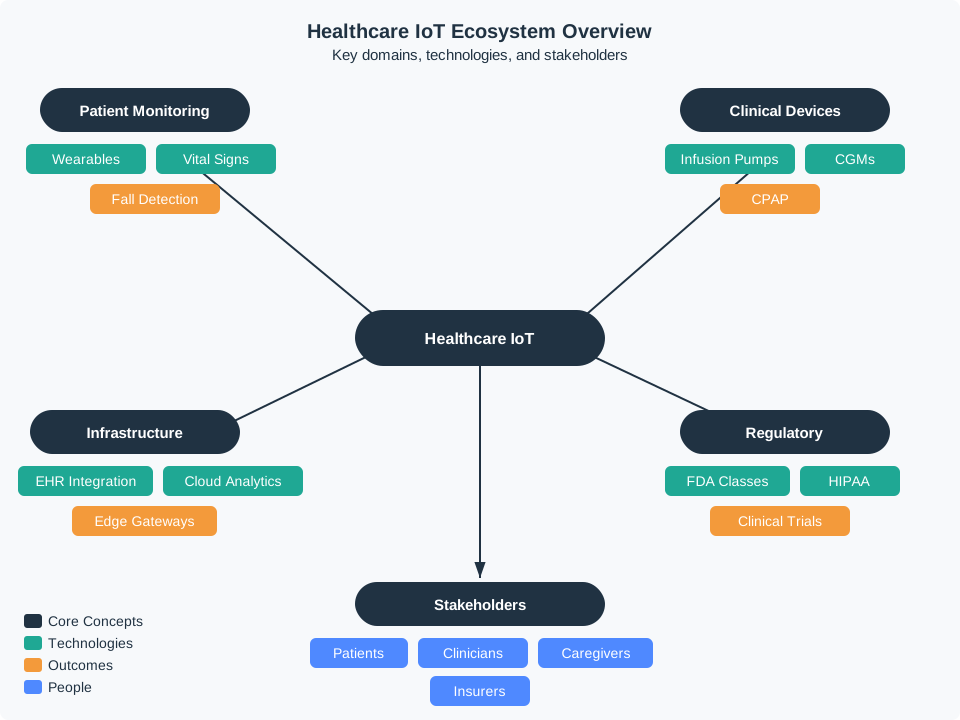
Healthcare IoT (also called the Internet of Medical Things, or IoMT) refers to connected devices and sensors used in hospitals, clinics, and homes to monitor patient health, track medical equipment, and improve clinical outcomes.
Why does it matter? Traditional healthcare relies on periodic checkups — you visit a doctor once a year and hope nothing goes wrong in between. Healthcare IoT enables continuous passive monitoring: sensors watch your vital signs 24/7 and alert doctors only when something needs attention. This is like having a nurse who never sleeps, never gets tired, and never misses a reading.
Three things that make healthcare IoT special compared to other IoT domains:
-
Regulatory requirements are much higher — Medical devices must pass FDA approval (Class I, II, or III), comply with HIPAA privacy rules, and meet strict accuracy standards. A smart thermostat can be off by a few degrees; a medical thermometer cannot.
-
The stakes are life and death — If a smart light bulb fails, you sit in the dark. If a cardiac monitor fails, a patient could die. This means healthcare IoT demands higher reliability (99.9%+ uptime), redundancy, and fail-safe designs.
-
Privacy is paramount — Health data is the most sensitive personal information. HIPAA violations carry fines up to $1.5 million per incident, and health records are worth 10—50x more than credit card numbers on the black market.
Common examples you might already know:
- Smartwatches with heart rate and SpO2 sensors (consumer-grade)
- Continuous Glucose Monitors (CGMs) that track blood sugar every 5 minutes
- Connected CPAP machines that monitor sleep apnea treatment (8 million+ units worldwide)
- Smart pill bottles that track when patients take medication
- Hospital bed sensors that detect if a patient is about to fall
Key vocabulary:
| Term | Meaning |
|---|---|
| EHR | Electronic Health Record — the digital version of a patient’s medical chart |
| HIPAA | Health Insurance Portability and Accountability Act — US law protecting patient data |
| FDA 510(k) | The regulatory pathway for most medical devices to get US market clearance |
| RPM | Remote Patient Monitoring — watching patients’ health from a distance using IoT |
| SpO2 | Blood oxygen saturation level, measured with a pulse oximeter |
Overview
Healthcare IoT encompasses connected medical devices, wearable biosensors, ambient monitoring systems, and clinical analytics platforms that together enable continuous patient monitoring, early disease detection, and data-driven clinical decision-making. The domain represents a $350+ billion addressable market spanning elderly fall detection ($50B), medication adherence ($100—300B), and chronic disease monitoring (84% of total healthcare spending).
Key Concepts: patient monitoring, clinical-grade accuracy, FDA regulatory pathways, HIPAA compliance, alert fatigue management, EHR integration, remote patient monitoring, ingestible sensors, medication adherence, sensor fusion for reliability.
Healthcare IoT Architecture
Healthcare IoT systems follow a layered architecture that moves data from bedside sensors through edge processing and cloud analytics to clinical decision support. Each layer adds filtering, context, and intelligence.

Consumer vs. Clinical-Grade Devices
One of the most important distinctions in healthcare IoT is the gap between consumer health devices and clinical-grade medical devices. This gap affects accuracy, regulation, cost, and liability.
| Aspect | Consumer Fitness Tracker | Clinical Medical Device |
|---|---|---|
| Heart Rate Accuracy | +/- 10—15 BPM | +/- 2 BPM |
| Regulatory Approval | FCC only | FDA Class II (510k) |
| Privacy Compliance | Company policy | HIPAA mandatory |
| Uptime Requirement | Best effort | 99.9%+ |
| Liability | Consumer product | Medical malpractice |
| Development Cost | $500K — $2M | $2M — $10M |
| Time to Market | 6—12 months | 18—36 months |
| Typical Price | $50—200 | $500—2,000+ |
Alert Fatigue: The Silent Killer in Healthcare IoT
Alert fatigue is the single biggest threat to healthcare IoT adoption. When clinicians are overwhelmed with false-positive alerts, they begin to ignore all alerts — including genuine emergencies.
Key statistics:
- A typical NICU nurse receives 350 alerts per 12-hour shift
- 82% of alerts are false positives or clinically insignificant
- Multi-stage filtering can reduce this to under 50 actionable alerts while improving clinical outcomes
- Sepsis detection can occur 12 hours earlier with ML-based prediction
Healthcare IoT Latency Tiers
Different healthcare data types require different processing speeds. Matching the latency tier to clinical urgency is critical for both safety and cost efficiency.
Common Pitfalls in Healthcare IoT
1. Treating consumer wearables as medical devices. A smartwatch heart rate sensor with +/- 12 BPM accuracy cannot replace a clinical ECG patch with +/- 2 BPM accuracy. Consumer devices are suitable for wellness monitoring and screening, but treatment decisions require FDA-cleared, clinically validated accuracy. Never assume a firmware update can bridge this gap — the hardware itself must be redesigned.
2. Ignoring alert fatigue budgets. Deploying sensors without a clear strategy for filtering false positives leads to clinicians ignoring all alerts. A NICU nurse receiving 350 alerts per shift will “alarm silence” critical warnings. Always design with an explicit alert budget (target: under 50 actionable alerts per shift) and implement multi-stage filtering: adaptive thresholds, multi-parameter fusion, and ML-based prediction.
3. Building innovation-first instead of integration-first. Startups frequently build sophisticated standalone devices that don’t connect to EHR systems (Electronic Health Records). A simple device that sends data directly into a hospital’s Epic or Cerner system delivers far more clinical value than a cutting-edge device that creates another data silo. Always confirm EHR integration capability (HL7 FHIR, Epic API) before finalizing device architecture.
4. Underestimating regulatory timelines and costs. FDA 510(k) clearance takes 6—18 months and costs $50K—$500K. Many startups plan 6-month consumer IoT timelines for what is actually a 2—3 year medical device development cycle. Budget at least 2—3x the time and cost of a consumer IoT equivalent.
5. Neglecting edge processing for life-critical events. Sending all data to the cloud introduces network latency (200—500 ms), which is unacceptable for life-threatening events like cardiac arrhythmia or fall detection that require sub-second response. Use edge processing for critical alerts and cloud processing for trend analysis and population health insights.
6. Overlooking data privacy at every layer. Health data is the most valuable on the black market (10—50x more than credit card data). HIPAA violations carry fines up to $1.5M per incident. Ensure end-to-end encryption (TLS 1.3), edge processing to minimize data in transit, and granular patient consent mechanisms.
Worked Example: Remote Patient Monitoring System Design
Scenario: A hospital wants to deploy a Remote Patient Monitoring (RPM) system for 200 heart failure patients discharged after surgery. The goal is to reduce 30-day readmission rates (currently 25%) by detecting clinical deterioration before patients need emergency readmission.
Given:
- Patient population: 200 heart failure patients at home
- Monitored parameters: Weight (daily), blood pressure (2x/day), heart rate (continuous), SpO2 (continuous), symptom questionnaire (daily)
- Clinical target: Reduce 30-day readmission rate from 25% to under 15%
- Budget: $1,500 per patient for devices + 90 days of cloud service
- Staff: 2 RPM nurses monitoring the full cohort during business hours
Step 1: Device Selection and Cost Allocation
| Device | Type | Cost | Rationale |
|---|---|---|---|
| Connected scale | FDA Class I | $120 | Daily weight gain of 2+ lbs in 24h indicates fluid retention |
| BP cuff (Bluetooth) | FDA Class II | $80 | Twice-daily readings for hypertension management |
| Wearable patch (ECG + SpO2) | FDA Class II | $600 | Continuous cardiac and oxygen monitoring |
| Home gateway (tablet) | Consumer | $200 | Data aggregation, questionnaire, video visits |
| Cloud platform (90 days) | SaaS | $500 | Analytics, dashboards, alerting |
| Total per patient | $1,500 | Within budget |
Step 2: Alert Tier Design
| Tier | Trigger | Response | Latency |
|---|---|---|---|
| Critical | SpO2 < 88% or HR > 150 BPM for > 2 min | Auto-call patient + notify on-call physician | < 5 minutes |
| Warning | Weight gain > 3 lbs in 48h or BP > 180/110 | RPM nurse calls patient within 2 hours | < 2 hours |
| Advisory | Missed readings or mild symptom changes | Automated text reminder + next-day nurse review | < 24 hours |
Step 3: Data Flow Architecture
- Edge (wearable patch): Continuous ECG analysis for arrhythmia; SpO2 threshold alerting. Processes locally, transmits summary every 5 minutes and immediate alerts for critical events.
- Gateway (tablet): Aggregates data from scale, BP cuff, and patch. Runs daily symptom questionnaire. Transmits to cloud via home Wi-Fi.
- Cloud (analytics platform): Applies ML model trained on historical readmission data. Generates risk scores combining all parameters. Powers nurse dashboard showing patients ranked by deterioration risk.
Step 4: Calculate Expected Outcomes
- Current readmissions: 200 x 25% = 50 patients readmitted within 30 days
- Target readmissions: 200 x 15% = 30 patients readmitted
- Readmissions prevented: 20 patients
- Average heart failure readmission cost: $15,000
- Cost savings: 20 x $15,000 = $300,000
- RPM investment: 200 x $1,500 = $300,000
- ROI: Break-even in Year 1, with continued savings as device costs amortize over subsequent patient cohorts
Step 5: Regulatory and Compliance Checklist
- All devices FDA-cleared for intended use (Class I scale, Class II BP and patch)
- Cloud platform HIPAA-compliant with BAA (Business Associate Agreement)
- Patient consent forms covering data collection, sharing with care team, and retention
- Medicare RPM billing codes (CPT 99453—99458) applied for reimbursement
Key Insight: The system pays for itself through readmission reduction alone, before counting improved patient outcomes, Medicare RPM reimbursement ($120—$180/patient/month), or reduced ER visits. The critical design decision was the three-tier alert system that prevents nurse alert fatigue while ensuring no critical event is missed.
Knowledge Check: Healthcare IoT
Learning Resources
Interactive Animations
Healthcare IoT Compliance Checker
Topics: applications, cases, healthcare, HIPAA, FDA regulatory pathways
Summary
Healthcare IoT is one of the highest-impact and most demanding domains in the Internet of Things. It transforms healthcare from periodic checkups to continuous, data-driven monitoring — but uniquely requires navigating stringent regulatory, accuracy, and privacy requirements that no other IoT domain faces.
Core Architecture: Healthcare IoT systems follow a four-layer model (Device, Edge Gateway, Cloud Platform, Clinical) with HIPAA encryption between every layer. Edge processing handles life-critical alerts in sub-second timeframes, while cloud analytics provides population-level insights and trend detection.
Critical Design Principles:
| Principle | What It Means | Why It Matters |
|---|---|---|
| Clinical vs. Consumer Gap | Clinical devices require under 2% error; consumer devices tolerate 10—15% | Cannot upgrade consumer to clinical — requires full redesign + FDA clearance |
| Alert Fatigue Budgets | Target under 50 actionable alerts per nurse per shift | 82% false positive rates cause clinicians to ignore all alerts, including real emergencies |
| Integration-First | EHR connectivity (HL7 FHIR, Epic API) before device features | Standalone devices create data silos; integrated devices transform clinical workflows |
| Latency Tier Matching | Edge for critical (sub-second), cloud for trending (minutes), batch for wellness (hours) | Wrong tier = either dangerous delays or wasted resources |
| Privacy-by-Design | End-to-end TLS 1.3, edge processing to minimize data in transit, patient consent | HIPAA fines up to $1.5M per incident; health data worth 10—50x credit cards on black market |
| Regulatory Planning | FDA 510(k): 6—18 months, $50K—$500K; budget 2—3x consumer IoT timelines | Underestimating regulatory cost/time is the number one cause of healthcare IoT startup failure |
The $350 Billion Opportunity: Healthcare IoT addresses elderly falls ($50B), medication non-adherence ($100—300B), and chronic disease monitoring (84% of healthcare spending). The RPM worked example demonstrates break-even ROI in Year 1 through readmission reduction alone — before counting Medicare reimbursement or improved outcomes.
Bottom Line: Healthcare IoT success requires designing for clinical workflows and outcomes first, with technology innovation as a means to that end — not the other way around.
What’s Next
With an understanding of healthcare IoT, explore related domains and deeper topics:
- Wearables — Consumer health devices, biosensors, and design principles
- Sensors — Sensor types, calibration, and signal processing fundamentals
- Edge Computing — Processing health data locally for sub-second critical alerts
- Encryption — HIPAA-compliant data protection and TLS 1.3
- Machine Learning — ML models for alert filtering, sepsis prediction, and clinical analytics