5 IoT Glossary: A-F
Essential IoT Terms from ACL to Frame
capstone
glossary
a
f
5.1 In 60 Seconds
This glossary section covers IoT terminology from A through F. Use the filter below or browser search to jump to a term, then read the definition, common confusions, related terms, and synonyms together. The most frequently reused terms in this range include API, BLE, CoAP, DTLS, Edge Computing, Authentication, Authorization, and Frame.
5.2 Start With The Boundary
When a new IoT term appears in a report, first ask what boundary it names. Authentication sits at the boundary between an unknown actor and a known identity. Authorization sits at the boundary between identity and permission. A frame sits at a local link boundary, while an API call sits at an application boundary. That boundary tells you which evidence to inspect.
This habit keeps glossary lookup practical. Instead of memorizing “BLE,” “CoAP,” “DTLS,” or “edge computing” as isolated phrases, attach each one to the artifact that proves it: a GATT characteristic, a confirmable message trace, a certificate chain, or a gateway placement decision. The definition becomes useful only when it helps a learner find the right piece of the system.
Use this A-F section as a boundary map. If two terms sound similar, compare the boundary each one owns and the failure it does not prevent.
5.3 Learning Objectives
After reviewing this section, you should be able to:
- Define key IoT terms from A to F with technical precision.
- Differentiate commonly confused concepts such as ACL vs. RBAC, authentication vs. authorization, edge vs. fog computing, and frame vs. packet.
- Apply appropriate terminology when discussing IoT protocols, architectures, hardware interfaces, data formats, and security.
- Use cross-references to move from a quick definition to deeper system-level understanding.
5.4 A-F Terms Name Boundaries
A glossary page is not only a vocabulary list. In IoT, the term usually names a boundary where responsibility changes. ACL, authentication, authorization, certificate, DTLS, encryption, and firewall name security boundaries. ACK, AMQP, at-least-once, at-most-once, exactly-once, BLE, CoAP, and frame name protocol or delivery boundaries. API, broker, cloud, digital twin, edge computing, and fog computing name architecture boundaries.
Read each term by asking what it lets you prove. Authentication proves identity, but it does not prove permission. Authorization limits actions, but it does not prove the device is genuine. Encryption protects bytes in transit or at rest, but it does not prove the endpoint certificate was validated. A frame is visible at a local link boundary, while an MQTT message or CoAP request is visible at an application boundary.
The A-F range is especially dense because it spans hardware, protocols, data representation, and security. ADC and DAC name conversion at a device pin. BLE and CoAP name communication models with different roles and reliability assumptions. CBOR, compression, aggregation, ETL, and data lake name different transformations of telemetry. Edge computing, fog computing, and cloud name operational placement, not just where software happens to run.
| Term Family | Boundary Question | Evidence To Inspect | Common Misread |
|---|---|---|---|
| Security | Who is the actor, and what may it do? | Certificate, token, ACL, role, topic permission, firewall rule | Identity is treated as permission |
| Delivery | Which layer acknowledged what state? | ACK, QoS setting, broker log, CoAP response, retry record | Receipt is treated as application processing |
| Data | Did the payload change form or meaning? | CBOR or JSON payload, schema version, ETL step, aggregation window | Encoding is treated as validation |
| Placement | Where is state processed and owned? | Edge node, fog gateway, cloud service, API contract, digital twin update | Location is treated as ownership |
5.5 Attach Every Term To An Artifact
When a glossary term appears in a lab report, design review, or capstone submission, attach it to an artifact. For API, inspect the endpoint contract, request method, status code, authentication requirement, and error behavior. For BLE, inspect the advertiser role, connection interval, GATT service, characteristic UUID, permissions, and phone or gateway role. For CoAP, inspect the method, confirmable or non-confirmable message type, response code, token, retransmission behavior, and whether DTLS is required.
Do the same for security terms. Authentication evidence might be a device certificate, pre-shared key exchange, login trace, signed token, or mutual TLS handshake. Authorization evidence might be an ACL entry, IAM policy, OAuth scope, topic permission, role mapping, or denied-action log. A firewall rule is useful only when the report names the address, port, protocol, owner, and reason the rule exists.
Data terms need a different artifact trail. CBOR, JSON, compression, aggregation, ETL, filter, and data lake should be tied to a payload sample, schema, transform step, retention policy, and query that proves the interpretation still matches the original measurement. If a gateway aggregates one-minute readings into hourly averages, the report should say which outliers disappear and whether alerting uses raw or aggregated data.
The practical method is four fields: term, artifact, boundary, next check. The artifact is what the learner can inspect. The boundary states what the term proves and what it does not. The next check points to the chapter, packet capture, dashboard query, datasheet, standard, or bench test that can settle the design question. That turns the glossary from memorization into engineering review.
Use the same four fields when reviewing someone else’s wording. If a teammate writes “the edge filters the data,” ask which edge node, which filter rule, which input fields, which output record, and which fallback exists when the node is offline. If the answer cannot be shown in a log, configuration file, capture, or test record, the term is still too abstract for a project claim.
5.6 Words Hide Protocol Scope
Under the hood, many A-F terms look similar because they are often described with short textbook phrases. The implementation scope is what separates them. An ACK can mean a TCP segment arrived, a CoAP confirmable message was received, an AMQP broker accepted a delivery, or an application command was processed. Those events sit at different layers and give different guarantees. A report that only says “the ACK was received” has not yet named the contract.
Exactly-once is another scope-sensitive term. It may describe stream-processing state inside a broker, idempotent application writes, deduplicated storage commits, or a transaction boundary. It rarely means that every physical sensor event is acted on exactly once across device resets, retries, network partitions, and dashboard refreshes. At-least-once and at-most-once also need a boundary: packet delivery, broker acceptance, database row, command execution, or user-visible state.
Security terms hide similar scope. DTLS protects UDP traffic, but endpoint validation, key rotation, certificate expiry, authorization, logging, and recovery remain separate design decisions. Encryption can protect bytes while metadata, topic names, timestamps, or access policies still leak operational meaning. A certificate can establish a trust chain while a misconfigured ACL still grants the wrong device action.
Architecture terms hide ownership. Edge computing may reduce latency and bandwidth, but it also moves update, observability, and failure-recovery responsibilities closer to the device. Fog computing may coordinate several local nodes, but it still needs a contract for cloud sync and local fallback. Cloud may simplify storage and dashboards, but it introduces dependency on identity, quota, retention, network reachability, and service-owner response.
Data representation terms hide one more layer of scope. CBOR can reduce payload size, but it does not define units, calibration, retention, or semantic validity. Compression can shrink a signal while making local inspection harder. Aggregation can stabilize dashboards while erasing spikes that matter for safety or maintenance. The technical term is therefore only complete when the report names what evidence survived the transformation.
5.7 Deep Dive: A-F Terms Mark System Boundaries
A glossary entry is useful when it helps you name the right boundary. Terms in A-F cover security boundaries such as ACL, authentication, authorization, certificate, DTLS, encryption, and firewall; protocol boundaries such as ACK, AMQP, BLE, CoAP, at-most-once, at-least-once, and exactly-once; and architecture boundaries such as API, broker, cloud, digital twin, edge computing, fog computing, and frame.
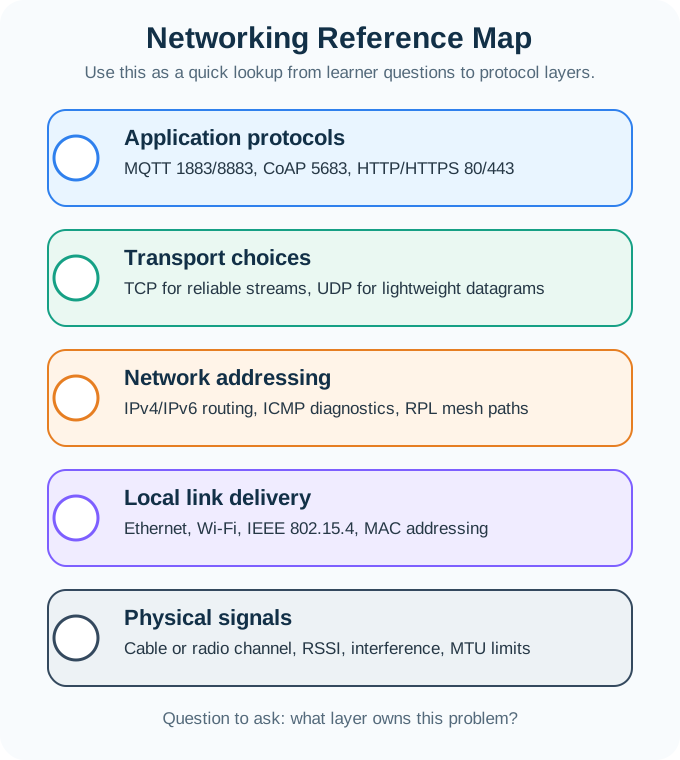
Use the definition to recognize the term, then use the common-confusion notes to avoid treating nearby concepts as interchangeable. Authentication is not authorization. A frame is not necessarily the same analysis unit as a packet. Edge computing is not the same operational placement as cloud computing.
The reference map shows one recurring pattern: a term is not just a word, it points to a layer of responsibility. MQTT, CoAP, and HTTP sit in the application-protocol layer; TCP and UDP are transport choices; IPv4, IPv6, ICMP, and RPL belong to network addressing; Ethernet, Wi-Fi, IEEE 802.15.4, and MAC addresses sit at local-link delivery; RSSI, interference, MTU limits, cable, and radio channel quality are physical or link constraints. That ownership question keeps a glossary lookup from becoming a vague label.
Use the same habit for terms outside the stack diagram. ACL and RBAC name different authorization models. A certificate supports identity and trust, but it does not automatically prove an account has the right permission. Cloud, edge, and fog name placement and operational ownership, not just where code happens to run. Broker, API, and digital twin name different contracts in the system. If a term changes who owns a fault, who validates data, or where state is stored, treat it as a design boundary.
| Check | Question to Ask |
|---|---|
| Definition | What does the term mean in an IoT architecture, protocol, hardware, or security context? |
| Boundary | What does the term not mean, and which adjacent term is it often confused with? |
| Next action | Which cross-reference, lab, quiz, or project decision changes if this term is interpreted correctly? |
5.7.1 Check the Term Against a Real Artifact
Do not memorize a glossary term in isolation. Tie it to an artifact: an MQTT QoS setting, a CoAP message type, a BLE GATT characteristic, a REST API endpoint, an ACL rule, an OAuth scope, a DTLS handshake, a frame capture, an edge deployment diagram, or a data-pipeline step. The term becomes useful when it helps explain what the artifact is doing.
For delivery terms, name the operational consequence. At-most-once can lose messages. At-least-once can duplicate messages and needs idempotent handling. Exactly-once usually depends on coordination, deduplication, transactions, or stream-processing semantics, and the contract often applies only inside a defined boundary.
When a term appears in a project report, attach it to evidence. For authentication, show the login flow, device certificate, pre-shared key, or token exchange that proves identity. For authorization, show the ACL, IAM policy, OAuth scope, topic permission, or role mapping that limits action. For BLE, show the GATT service, characteristic UUID, advertising interval, connection interval, and phone or gateway role. For CoAP, show whether the message is confirmable, what method and response code appear, and whether DTLS is used. For frame, show the capture layer, header fields, payload length, checksum, and whether a gateway converts that local frame into a routed packet or application record.
A useful glossary note therefore has four fields: term, artifact, boundary, and next check. The artifact is the object being inspected. The boundary says what the term promises and what it does not. The next check sends the learner to the chapter, standard, datasheet, packet capture, or bench test that can settle the claim. That pattern is especially important for A-F terms because many of them look simple in a list but become risky when they control security, delivery guarantees, device placement, or data meaning.
- Pick the artifact. Example: a broker log, packet trace, IAM policy, board pinout, or cloud API response.
- Name the term. Example: authorization, ACK, CBOR, dead letter queue, duty cycle, or frame.
- State the boundary. Example: what changes if the protocol, device role, trust model, or processing location changes?
5.7.2 Glossary Precision Prevents Design Errors
Small vocabulary errors become implementation errors. Confusing authentication with authorization can produce accounts that prove identity but receive the wrong permissions. Confusing encryption with certificate validation can protect data in transit while still accepting the wrong endpoint. Confusing aggregation with raw telemetry can hide outliers that a device-health workflow needs.
The same is true for protocol semantics. MQTT QoS 1, AMQP acknowledgements, CoAP confirmable messages, and stream-processing exactly-once claims do not all mean the same thing. Each defines a scope: packet receipt, broker acceptance, application processing, storage commit, or downstream consumer state. Read glossary terms with that scope in mind.
Underneath the vocabulary, every term is tied to a state transition or contract. An ACK may confirm that a TCP segment arrived, that a CoAP confirmable message was received, that an AMQP broker accepted a delivery, or that application code processed a command. Those are different guarantees. Encryption may protect bytes on the wire, while certificate validation decides whether the endpoint is trusted. A firewall may filter at an address, port, or protocol boundary, while an application authorization rule may decide whether a device can write to a specific topic or API route.
Data terms have the same hidden scope. CBOR, JSON, compression, aggregation, ETL, and data lake are not interchangeable labels for “data handling.” They describe representation, size trade-offs, transformation, storage, retention, and later interpretation. A frame may include link-layer headers and checksums, while an application record may include stable field names, units, timestamps, schema version, and device identity. If the report says “the broker received the frame,” the wording is probably mixing layers; the gateway or radio stack sees the frame, while the broker sees a message or application payload.
A good capstone explanation should use these terms to identify responsibility: which device, broker, gateway, cloud service, dashboard, or human operator owns the next state transition.
5.8 Key Concepts
- API (Application Programming Interface): A defined contract that lets software components communicate. In IoT, REST APIs expose device data to applications, while device APIs let firmware interact with hardware peripherals.
- Actuator: A hardware component that converts electrical signals to physical action such as motor rotation, valve opening, or LED illumination.
- BLE (Bluetooth Low Energy): A short-range wireless protocol optimized for periodic low-power data transmission.
- CoAP (Constrained Application Protocol): A lightweight REST-like protocol for constrained devices, using UDP with optional reliability and compact encoding.
- DTLS (Datagram TLS): A security protocol that brings TLS-like authentication and encryption to UDP traffic.
- Edge Computing: Processing data near the source device to reduce latency, bandwidth use, cloud cost, and dependence on continuous connectivity.
5.9 How It Works: Turn a Term into a Design Choice
A glossary lookup should end with a better design choice, not just a remembered definition.
- Start with the artifact. Name the thing you are inspecting: an ACL rule, a BLE GATT characteristic, a CoAP confirmable message, an ADC reading, a broker topic, a DTLS handshake, an edge gateway, or a frame capture.
- Check the boundary. Read the definition, then read the common confusion. The boundary tells you what the term does not promise: authentication is not authorization, encryption is not certificate validation, and a frame is not a routed packet.
- Choose the next action. Follow the related terms and course links when the term changes implementation work, such as adding idempotency for at-least-once delivery, moving filtering to the edge, or separating cloud access from local gateway access.
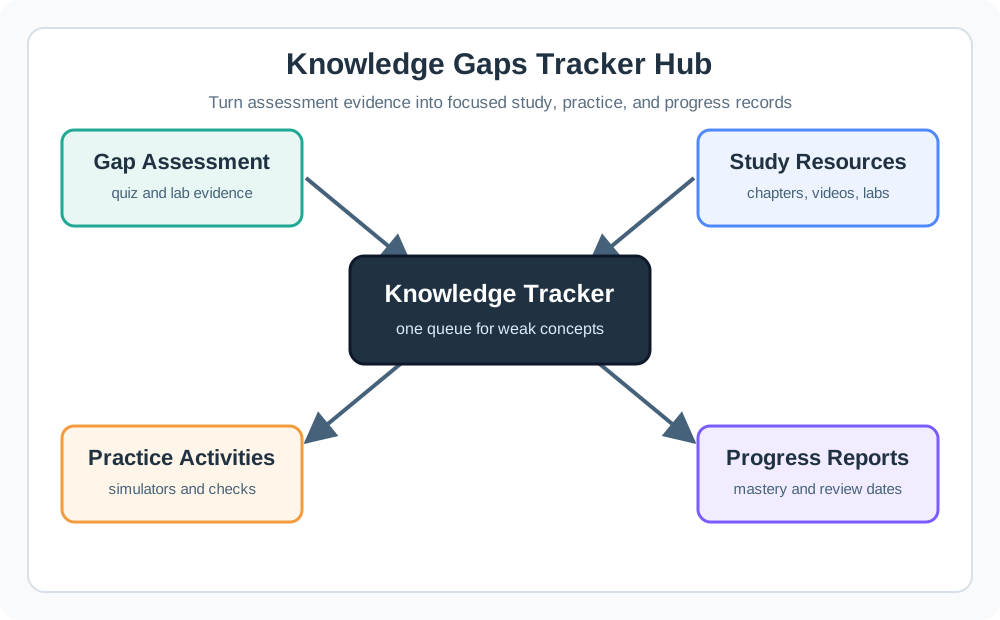
Use Figure 5.2 to anchor terms such as actuator, cloud, edge computing, broker, and API to system locations.
Use Figure 5.3 when a term depends on layer boundaries, especially frame, channel, bandwidth, CoAP, DTLS, and AMQP.
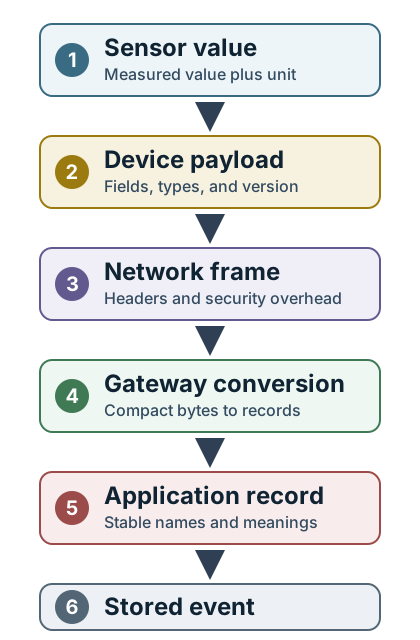
Use Figure 5.4 when terms such as aggregation, CBOR, compression, data lake, ETL, and filter affect how telemetry changes form.
5.10 For Beginners: IoT Glossary A-F
A glossary is a focused dictionary for course vocabulary. When you meet a term such as “CoAP” or “edge computing,” use this page to get the short definition, the plain-language explanation, and the common mistakes to avoid.
Navigation
This is part 1 of the IoT Glossary, covering terms A-F. See also:
- Glossary A-F - start of the glossary sequence and quick navigation
- Glossary G-P - Gateway through Publisher
- Glossary Q-Z - QoS through 6LoWPAN
5.11 Quick Lookup
Reference Use Metric
Reference usability can be estimated by lookup coverage:
\[ U = \frac{N_{\text{resolved-lookups}}}{N_{\text{total-lookups}}} \]
Worked example: If learners perform 220 glossary lookups and 198 are resolved without leaving the section, usability is \(198/220=90\%\). Improving cross-references and examples should push this ratio higher.
5.12 A
5.12.1 ACL (Access Control List)
Definition: A security mechanism that specifies which users, devices, or systems are granted or denied access to particular resources, and what operations they can perform.
In simple terms: A list that says who can do what - like a VIP list for a club that specifies which guests can enter which rooms.
Common confusions:
- ACL vs. RBAC (Role-Based Access Control) - ACLs are resource-centric while RBAC is role-centric
- ACLs define permissions per resource, not per user globally
Related terms: Authentication, Authorization, OAuth
Synonyms: access list, permission list
5.12.2 Acknowledgment (ACK)
Definition: A signal or message sent by a receiving device to confirm successful receipt of data, enabling the sender to know transmission was successful.
In simple terms: A “message received” confirmation - like texting “got it” when someone sends you important information.
Common confusions:
- ACK vs. response - ACK confirms receipt, response contains actual reply data
- Different protocols implement ACKs differently (TCP vs. UDP)
Related terms: QoS, At-least-once, Retry
Synonyms: ACK, confirmation
5.12.3 Actuator
Definition: A device that converts electrical signals or energy into physical action, enabling IoT systems to affect the physical world through motion, heat, light, or other outputs.
In simple terms: The “muscles” of an IoT system - while sensors are the eyes and ears, actuators are the hands that actually do things like turn on lights or open valves.
Common confusions:
- Actuator vs. sensor - sensors read data, actuators perform actions
- Not all output devices are actuators (displays show data but don’t perform physical actions)
Related terms: Sensor, GPIO, DAC
Synonyms: effector, output device
5.12.4 ADC (Analog-to-Digital Converter)
Definition: An electronic circuit that converts continuous analog signals (like voltage from a sensor) into discrete digital values that can be processed by a microcontroller.
In simple terms: A translator that converts real-world measurements (like temperature as voltage) into numbers a computer can understand.
Common confusions:
- ADC resolution (bits) determines precision, not accuracy
- Sampling rate and resolution are independent specifications
Related terms: DAC, Sensor, GPIO, Sampling
Synonyms: A/D converter, analog-digital converter
5.12.5 Aggregation
Definition: The process of combining multiple data points into summary statistics (sum, average, min, max, count) to reduce data volume while preserving meaningful information.
In simple terms: Summarizing lots of small measurements into useful totals - like calculating your average daily steps from thousands of individual step counts.
Common confusions:
- Aggregation loses individual data points (cannot recover original values)
- Different aggregation functions suit different use cases (average vs. sum vs. max)
Related terms: Time Series, Sampling, Telemetry
Synonyms: summarization, rollup
5.12.6 AMQP (Advanced Message Queuing Protocol)
Definition: An open standard application layer protocol for message-oriented middleware, providing reliable queuing, topic-based publish-subscribe, flexible routing, and transactions.
In simple terms: A sophisticated postal system for software - it ensures messages get delivered reliably with options for different delivery patterns and confirmations.
Common confusions:
- AMQP vs. MQTT - AMQP is more feature-rich but heavier; MQTT is simpler and lighter
- AMQP 0.9.1 (RabbitMQ) vs. AMQP 1.0 are quite different protocols
Related terms: MQTT, Broker, Publisher, Subscriber
Synonyms: none common
5.12.7 API (Application Programming Interface)
Definition: A set of defined rules, protocols, and tools that specify how software components should interact, enabling different applications to communicate and share data.
In simple terms: A menu at a restaurant - it tells you what you can order (available functions) and how to order it (required format), without needing to know how the kitchen works.
Common confusions:
- API vs. SDK - API defines the interface, SDK provides tools to use it
- REST API vs. API - REST is one style of API, not all APIs are RESTful
Related terms: REST, HTTP, Microservices
Synonyms: interface, service endpoint
5.12.8 At-least-once
Definition: A message delivery contract where the sender retries until an acknowledgement boundary is reached, reducing loss within that boundary but potentially causing duplicates that receivers must handle.
In simple terms: “Better safe than sorry” delivery - the system keeps trying until it’s sure you got the message, even if that means sending it twice.
Common confusions:
- At-least-once requires idempotent receivers to handle duplicates properly
- More reliable than at-most-once but less than exactly-once
Related terms: QoS, At-most-once, Exactly-once, Idempotency
Synonyms: QoS 1 (in MQTT)
5.12.9 At-most-once
Definition: A message delivery contract where messages are sent zero or one time, providing best-effort delivery without retries, which may result in message loss.
In simple terms: “Fire and forget” delivery - send the message once and hope it arrives, like shouting across a noisy room.
Common confusions:
- At-most-once is not unreliable by design - it’s appropriate for frequent, non-critical data
- Often used for high-frequency sensor data where occasional loss is acceptable
Related terms: QoS, At-least-once, Exactly-once
Synonyms: QoS 0 (in MQTT), best-effort delivery
5.12.10 Authentication
Definition: The process of verifying the identity of a user, device, or system, typically through credentials like passwords, certificates, tokens, or biometrics.
In simple terms: Proving who you are - like showing your ID at a security checkpoint before being allowed in.
Common confusions:
- Authentication vs. authorization - authentication proves identity, authorization grants permissions
- Strong authentication often requires multiple factors (MFA)
Related terms: Authorization, Certificate, Token, OAuth
Synonyms: identity verification, login
5.13 B
5.13.1 Backoff
Definition: A strategy for handling failed operations by waiting increasingly longer periods before retrying, typically using exponential growth to reduce system load during failures.
In simple terms: Being patient when something fails - instead of repeatedly hammering a locked door, wait longer between each attempt to give the system time to recover.
Common confusions:
- Exponential backoff vs. linear backoff - exponential grows faster (1s, 2s, 4s, 8s)
- Jitter (randomization) is often added to prevent thundering herd problems
Related terms: Retry, Circuit Breaker
Synonyms: exponential backoff, retry delay
5.13.2 Bandwidth
Definition: The maximum rate of data transfer across a network path, measured in bits per second (bps), kilobits (kbps), megabits (Mbps), or gigabits (Gbps).
In simple terms: The width of a pipe - a wider pipe (more bandwidth) lets more water (data) flow through at once.
Common confusions:
- Bandwidth vs. throughput - bandwidth is capacity, throughput is actual achieved rate
- Bandwidth vs. latency - bandwidth is how much, latency is how fast
Related terms: Latency, Throughput, Jitter
Synonyms: data rate, capacity, speed
5.13.3 BLE (Bluetooth Low Energy)
Definition: A wireless personal area network technology designed for short-range communication with minimal power consumption, operating in the 2.4 GHz ISM band with range up to 100m.
In simple terms: Energy-efficient Bluetooth - designed so small devices like fitness trackers can communicate wirelessly while running on tiny batteries for months or years.
Common confusions:
- BLE vs. Bluetooth Classic - BLE is optimized for low power, Classic for continuous streaming
- BLE is not backward compatible with Bluetooth Classic
Related terms: Zigbee, Thread, Mesh
Synonyms: Bluetooth Smart, Bluetooth 4.0+
5.13.4 Broker
Definition: A middleware server that receives messages from publishers and routes them to appropriate subscribers based on topics or other criteria in publish-subscribe messaging systems.
In simple terms: A post office for IoT messages - it receives mail (messages) from senders and delivers it to everyone who signed up to receive that type of mail (subscribers).
Common confusions:
- Broker vs. queue - broker routes messages, queues store them
- Brokers can cluster for high availability and scalability
Related terms: MQTT, Publisher, Subscriber, Topic
Synonyms: message broker, MQTT broker
5.14 C
5.14.1 CBOR (Concise Binary Object Representation)
Definition: A binary data serialization format designed to be extremely compact and efficient, based on JSON’s data model but optimized for constrained environments and IoT devices.
In simple terms: Compressed JSON - takes the same information as JSON but packs it into a smaller, faster-to-process binary format perfect for devices with limited resources.
Common confusions:
- CBOR vs. JSON - CBOR is binary (smaller, faster), JSON is text (human-readable)
- CBOR is used with CoAP, while JSON is typically used with HTTP
Related terms: JSON, Protobuf, Serialization, CoAP
Synonyms: none common
5.14.2 Certificate
Definition: A digital document that uses cryptographic signatures to bind a public key to an identity, enabling secure authentication and encrypted communication in TLS/SSL.
In simple terms: A digital ID card - like a passport that proves your identity, issued by a trusted authority (Certificate Authority) that vouches for who you are.
Common confusions:
- Certificate vs. private key - certificate is public, private key must stay secret
- Self-signed vs. CA-signed certificates - self-signed aren’t trusted by default
Related terms: TLS, Authentication, Encryption
Synonyms: X.509 certificate, digital certificate, SSL certificate
5.14.3 Channel
Definition: A logical or physical pathway for communication between devices, which may refer to radio frequency channels, communication ports, or logical message streams.
In simple terms: A TV channel for data - different channels carry different information, and devices tune to specific channels to send or receive data.
Common confusions:
- Physical channel (radio frequency) vs. logical channel (message stream)
- Channel overlap in Wi-Fi can cause interference
Related terms: Topic, Bandwidth, Frequency
Synonyms: communication channel, frequency band
5.14.4 Circuit Breaker
Definition: A design pattern that prevents cascading failures by monitoring for failures and temporarily stopping requests to failing services, allowing them time to recover.
In simple terms: A safety switch for software - like an electrical breaker that trips when there’s too much load, it stops sending requests to overwhelmed services to prevent total system collapse.
Common confusions:
- Circuit breaker vs. retry - circuit breaker prevents retries during known failures
- States: closed (normal), open (failing), half-open (testing recovery)
Related terms: Retry, Backoff, Dead Letter Queue
Synonyms: failure circuit, stability pattern
5.14.5 Cloud
Definition: Remote computing infrastructure accessed over the internet that provides on-demand computing resources, storage, and services without direct management by the user.
In simple terms: Someone else’s computer that you rent - instead of buying servers, you use shared computing resources over the internet and pay for what you use.
Common confusions:
- Cloud vs. edge - cloud is remote/centralized, edge is local/distributed
- Public cloud vs. private cloud vs. hybrid cloud architectures
Related terms: Edge Computing, Fog Computing, Platform
Synonyms: cloud computing, cloud services
5.14.6 CoAP (Constrained Application Protocol)
Definition: A specialized web transfer protocol designed for constrained devices and networks, using UDP for lightweight request/response communication with built-in discovery and multicast support.
In simple terms: HTTP’s smaller sibling - does similar things (GET, PUT, POST) but is designed to work on tiny devices with limited memory and battery over unreliable networks.
Common confusions:
- CoAP uses UDP (not TCP like HTTP), making it lighter but requiring application-level reliability
- CoAP is request/response while MQTT is publish/subscribe
Related terms: HTTP, MQTT, 6LoWPAN, DTLS
Synonyms: none common
5.14.7 Compression
Definition: The process of encoding data to reduce its size for storage or transmission, using algorithms that eliminate redundancy while allowing recovery of original data.
In simple terms: Packing a suitcase efficiently - arranging data to take up less space, like vacuum-sealing clothes so you can fit more in your luggage.
Common confusions:
- Lossless vs. lossy compression - lossless recovers exact data, lossy discards some
- Compression adds CPU overhead - trade-off between bandwidth and processing
Related terms: Payload, CBOR, Serialization
Synonyms: data compression, encoding
5.15 D
5.15.1 DAC (Digital-to-Analog Converter)
Definition: An electronic circuit that converts digital values from a microcontroller into continuous analog signals, enabling digital systems to control analog devices.
In simple terms: The reverse of ADC - converts computer numbers back into real-world signals, like turning a volume number into actual sound levels.
Common confusions:
- DAC vs. PWM - DAC produces true analog, PWM simulates analog through fast switching
- DAC resolution affects output precision
Related terms: ADC, Actuator, GPIO
Synonyms: D/A converter, digital-analog converter
5.15.2 Data Lake
Definition: A centralized repository that stores vast amounts of raw data in native format until needed, supporting diverse data types and enabling flexible analysis without predefined schemas.
In simple terms: A massive storage pool - dump all your data in its original form, figure out how to use it later, like keeping everything in a warehouse rather than organizing it into specific shelves.
Common confusions:
- Data lake vs. data warehouse - lakes store raw data, warehouses store processed/structured data
- Data lakes can become “data swamps” without proper governance
Related terms: ETL, TSDB, Telemetry
Synonyms: raw data repository
5.15.3 DDS (Data Distribution Service)
Definition: A middleware protocol and API standard for real-time publish-subscribe communication, providing fine-grained QoS policies and designed for mission-critical systems.
In simple terms: Industrial-strength messaging - designed for systems where milliseconds matter and failures aren’t an option, like autonomous vehicles or medical devices.
Common confusions:
- DDS vs. MQTT - DDS offers more QoS options and is broker-optional
- DDS is peer-to-peer capable, MQTT requires a broker
Related terms: MQTT, AMQP, QoS, Publisher
Synonyms: OMG DDS
5.15.4 Dead Letter Queue
Definition: A service queue that stores messages that cannot be delivered or processed successfully, allowing later analysis, reprocessing, or manual intervention for failed messages.
In simple terms: A “lost and found” for messages - when a message can’t be delivered, it goes here instead of disappearing, so you can investigate what went wrong.
Common confusions:
- DLQ vs. retry queue - DLQ holds permanently failed messages, retry queue holds temporary failures
- Messages in DLQ need manual intervention or automated remediation
Related terms: Retry, Circuit Breaker, Broker
Synonyms: DLQ, poison queue, error queue
5.15.5 Digital Twin
Definition: A virtual representation of a physical device, system, or process that mirrors real-world behavior through synchronized sensor data, enabling simulation, analysis, and optimization.
In simple terms: A virtual clone - a digital copy of a real thing that updates in real-time, letting you test changes or predict problems without touching the actual device.
Common confusions:
- Digital twin vs. simulation - twins sync with real data, simulations use models
- Digital twins require continuous data connection to their physical counterpart
Related terms: Telemetry, Platform, Edge Computing
Synonyms: virtual twin, device shadow (AWS)
5.15.6 DTLS (Datagram Transport Layer Security)
Definition: A security protocol providing TLS-equivalent encryption and authentication for datagram protocols like UDP, designed to protect CoAP and other UDP-based IoT communications.
In simple terms: Security for UDP - since TLS only works with TCP, DTLS was created to provide the same protection for connectionless protocols used by many IoT devices.
Common confusions:
- DTLS vs. TLS - DTLS works with UDP, TLS requires TCP
- DTLS handles packet loss and reordering that UDP doesn’t prevent
Related terms: TLS, CoAP, Encryption, Certificate
Synonyms: none common
5.15.7 Duty Cycle
Definition: The fraction of time a device, radio, or workload is active during a repeated operating period.
In simple terms: How often something is awake and working instead of sleeping. A sensor that transmits for 1 second every 100 seconds has a 1% duty cycle.
Common confusions:
- Duty cycle vs. battery life - duty cycle is one input to battery life, not the full calculation
- Radio duty cycle vs. firmware duty cycle - radios, sensors, processors, and actuators may each have different active windows
Related terms: LPWAN, Telemetry, Low-Power Strategies
Synonyms: active-time ratio
5.16 E
5.16.1 Edge Computing
Definition: A distributed computing paradigm that processes data near the source of generation rather than in a centralized data center, reducing latency and bandwidth requirements.
In simple terms: Computing at the source - instead of sending all data to a distant cloud, process it locally where it’s created, like having a smart assistant in each room rather than one in a faraway call center.
Common confusions:
- Edge vs. fog - edge is at devices, fog is between edge and cloud
- Edge doesn’t eliminate cloud, it complements it
Related terms: Fog Computing, Cloud, Gateway, Latency
Synonyms: edge processing, local computing
5.16.2 Encryption
Definition: The process of encoding data using cryptographic algorithms so that only authorized parties with the correct decryption key can access the original information.
In simple terms: A secret code - scrambles your message so only someone with the right key can read it, like a lockbox that only opens with your key.
Common confusions:
- Encryption at rest vs. in transit - different protection for stored vs. moving data
- Symmetric vs. asymmetric encryption serve different purposes
Related terms: TLS, DTLS, Certificate, Authentication
Synonyms: encoding, ciphering
5.16.3 ETL (Extract, Transform, Load)
Definition: A data integration process that extracts data from sources, transforms it to fit operational needs (cleaning, formatting, aggregating), and loads it into a destination database.
In simple terms: Data processing pipeline - grab raw data, clean it up and reshape it, then store it where it’s needed, like sorting mail, organizing it by category, and delivering to the right mailboxes.
Common confusions:
- ETL vs. ELT - ETL transforms before loading, ELT loads raw then transforms
- ETL is batch-oriented, streaming alternatives exist for real-time needs
Related terms: Data Lake, TSDB, Aggregation
Synonyms: data pipeline, data integration
5.16.4 Exactly-once
Definition: A message-processing contract that aims to apply each message effect once within a defined system boundary, usually requiring sophisticated coordination between systems.
In simple terms: “Apply it once” delivery - the system tries to prevent both loss and duplicate effects inside the part of the pipeline it controls.
Common confusions:
- True exactly-once is extremely difficult and often impossible across distributed systems
- Most “exactly-once” implementations are actually at-least-once with deduplication
Related terms: QoS, At-least-once, At-most-once, Idempotency
Synonyms: QoS 2 (in MQTT), exactly-once semantics
5.17 F
5.17.1 Filter
Definition: A mechanism that selectively passes or blocks messages based on specified criteria such as topic patterns, content attributes, or metadata properties.
In simple terms: A message sieve - only lets through messages you care about, like email filters that sort important messages from spam.
Common confusions:
- Topic filters vs. content filters - topic filters match message routing, content filters inspect payload
- Filter syntax varies by protocol (MQTT wildcards vs. AMQP routing keys)
Related terms: Topic, Subscription, Wildcard
Synonyms: message filter, selector
5.17.2 Firewall
Definition: A network security system that monitors and controls incoming and outgoing network traffic based on predetermined security rules, creating a barrier between trusted and untrusted networks.
In simple terms: A security guard for your network - checks everyone trying to enter or leave and only allows those who meet the rules to pass through.
Common confusions:
- Firewall vs. NAT - firewall filters traffic, NAT translates addresses (though often combined)
- Hardware vs. software firewalls serve different deployment needs
Related terms: ACL, Encryption, TLS
Synonyms: network firewall, packet filter
5.17.3 Fog Computing
Definition: A decentralized computing infrastructure extending cloud capabilities to the network edge, providing intermediate processing, storage, and networking between IoT devices and centralized cloud.
In simple terms: A middle layer between devices and cloud - like regional distribution centers between factories and central warehouses, processing some things locally without going all the way to headquarters.
Common confusions:
- Fog vs. edge - fog is in network infrastructure (routers, gateways), edge is at end devices
- Fog computing was coined by Cisco, edge computing is more general
Related terms: Edge Computing, Cloud, Gateway
Synonyms: fog networking, edge-cloud continuum
5.17.4 Frame
Definition: A data unit at the data link layer (Layer 2) containing header information, payload data, and error-checking trailer used for transmitting packets across physical network segments.
In simple terms: An envelope for network data - wraps the actual message (packet) with addressing and error-checking information needed for local network delivery.
Common confusions:
- Frame vs. packet - frames are Layer 2 (local network), packets are Layer 3 (routed network)
- Frame size limits (MTU) affect how packets are fragmented
Related terms: Packet, Payload, MTU
Synonyms: data frame, Layer 2 PDU
Incremental Examples
5.17.5 Beginner Example: Actuator, ADC, and DAC in a Greenhouse Prototype
Scenario: A student describes a greenhouse prototype as “the sensor opens the vent when temperature is high.”
Glossary lookup:
- Sensor is not in this A-F section, but the related A-F terms clarify the boundary.
- ADC converts an analog thermistor voltage into a digital value that firmware can read.
- Actuator is the vent motor or servo that changes the physical world.
- DAC is only needed if the controller must output an analog voltage, not when it drives a digital relay or PWM-controlled servo.
Design choice: Rewrite the explanation as: “The temperature sensor is read through an ADC; firmware compares the digital value with the threshold; the controller drives an actuator to open the vent.” That wording separates measurement, computation, and physical action.
5.17.6 Intermediate Example: Glossary-Driven Troubleshooting of “At-least-once” Duplicate Messages
Scenario: Your MQTT sensor publishes temperature readings, but cloud dashboard shows occasional duplicates (same reading, same timestamp, received twice).
Glossary lookup (At-least-once): > “A message delivery guarantee where messages are delivered one or more times… potentially causing duplicates that receivers must handle.”
Aha moment: MQTT QoS 1 (at-least-once) is working correctly - duplicates are expected, not a bug!
Follow cross-reference: Idempotency: > “A property of operations where performing them multiple times produces the same result… enabling safe retries without unintended side effects.”
Solution: Add idempotency key to messages:
{
  "device_id": "sensor-001",
  "timestamp": "2026-02-15T10:30:00Z",
  "temperature": 23.5,
  "message_id": "a3b2c1"  // <-- Deduplication key
}
Dashboard code checks message_id - if already received, skip duplicate.
Key insight: The glossary’s cross-references led from “at-least-once” to “idempotency” to a practical deduplication fix. Understanding related concepts revealed the solution.
5.17.7 Advanced Example: BLE Cold-Room Gateway with Security and Delivery Boundaries
Scenario: A cold-room gateway reads BLE temperature sensors, filters noisy readings locally, and sends exceptions to a cloud service. The team says the system is “secure and reliable” because the gateway encrypts traffic.
Glossary lookup:
- BLE describes the short-range radio link from sensor to gateway, often through GATT services and characteristics.
- Edge Computing explains why filtering happens on the gateway before cloud upload.
- CoAP and DTLS may describe a constrained UDP path from gateway to cloud, while AMQP may describe a brokered enterprise path for exception handling.
- Authentication proves device or user identity; authorization, ACL, and firewall rules control allowed actions and network paths.
- At-least-once, dead letter queue, and circuit breaker describe what happens when delivery, processing, or downstream services fail.
Design choice: Replace the broad claim with specific boundaries: BLE readings are accepted only from enrolled device ids, noisy samples are filtered at the edge, gateway-to-cloud traffic uses DTLS with certificate validation, cloud APIs enforce authorization separately from authentication, firewall rules limit inbound paths, AMQP exceptions use idempotency keys, and a dead letter queue holds events that still fail processing.
Decision Framework: Using Glossary Cross-References to Deepen Understanding
When you look up a term, follow this strategy:
| Your Goal | Strategy | Example |
|---|---|---|
| Quick definition | Read definition, move on | “What does ADC mean?” Read, done |
| Design decision | Read definition, related terms, and common confusions | “ADC vs. DAC for my actuator?” Follow links |
| Troubleshooting | Read definition, common confusions, and cross-references | “Why QoS not working?” Explore related concepts |
| Learning | Read definition, cross-references, and related chapters | “I want to understand MQTT deeply.” Follow every link |
Effective glossary usage pattern:
- Look up primary term (e.g., “MQTT”)
- Read “Common confusions” (reveals frequent mistakes)
- Follow “Related terms” links (Broker, Publisher, Subscriber, QoS)
- Check synonyms (helps with literature searches)
- Jump to detailed chapter for implementation guidance
Key insight: Glossary entries are connected concepts, not isolated definitions. Following cross-references builds systems-level understanding.
Common Mistake: Skipping “Common Confusions” Section
The Mistake: Reading just the definition, skipping “Common confusions,” then making exactly that mistake in your project.
Example:
Term looked up: At-least-once - Read definition: “Messages delivered one or more times” - Skipped common confusion: “At-least-once requires idempotent receivers” - Result: Built system assuming no duplicates, then saw duplicate records in production
Another example:
Term looked up: ADC - Read definition: “Converts analog to digital” - Skipped common confusion: “ADC resolution determines precision, not accuracy” - Result: Bought a 16-bit ADC expecting 0.001°C accuracy, then measured only about 0.5°C accuracy because sensor noise dominated
The fix: Read the “Common confusions” section before using a term in a design choice. It captures the distinctions that most often lead to wrong design choices.
Key insight: The “Common confusions” section is often the most valuable part of each entry because it connects the definition to realistic failure modes.
5.18 Try It Now: Map One Term to an Artifact
Choose one term from A-F and fill in the table before using it in a project explanation.
| Field | Your answer |
|---|---|
| Term | ACL, ACK, ADC, AMQP, API, authentication, authorization, BLE, broker, CoAP, DTLS, edge computing, or frame |
| Artifact | Rule, message, packet capture, gateway setting, API endpoint, certificate, code path, diagram, or log line |
| Boundary | What this term does not mean |
| Common confusion | Nearby term that could be mixed up with it |
| Next action | Link to a related term, course chapter, test case, or implementation change |
5.19 Micro-Exercise: Identify the Confusion
For each statement, name the glossary distinction that fixes it.
- “The user logged in, so the app can open every shared lock.”
- “QoS 1 means the cloud will process each temperature reading exactly once.”
- “The sensor is accurate because the ADC has 16-bit resolution.”
- “A frame capture proves how the packet was routed across the internet.”
Concept Relationships
Glossary terms cluster into functional groups:
- Security chain: ACL, authentication, authorization, certificate, and encryption
- Messaging reliability: ACK, at-most-once, at-least-once, exactly-once, and QoS
- Hardware interfaces: ADC for sensor data, DAC for actuator control, and GPIO for both
- Architecture continuum: cloud, fog, and edge as processing moves closer to the source
Terms reference across chapters: Understanding “Broker” (here) requires context from MQTT chapter. “Edge Computing” glossary entry points to detailed Edge Computing chapter.
Common confusions prevent mistakes: Each entry’s “Common confusions” section highlights traps such as treating ADC resolution as the same thing as sensor accuracy.
See Also
Glossary navigation:
- Glossary G-P - Gateway through Publisher
- Glossary Q-Z - QoS through 6LoWPAN
Referenced chapters (examples from terms covered): - MQTT Protocol - Detailed broker, QoS, pub/sub - Security Fundamentals - Authentication, authorization, encryption - Edge Computing - Edge vs. fog vs. cloud
External resources:
- RFC Index - Official protocol specifications
- IEEE Xplore - Standards documentation
- IoT Glossaries Compared - Industry terminology
Common Pitfalls
1. Looking up terms without reading the ‘Common confusions’ sections
Many IoT terms are easily confused (edge vs fog, authentication vs authorization, QoS 0 vs QoS 1). The ‘Common confusions’ subsections within each glossary entry specifically address these distinctions. Skipping them leads to persistent misunderstandings that propagate into design decisions – for example, confusing QoS levels leads to over-engineering reliability in systems that don’t require it.
2. Memorizing definitions without understanding application context
Knowing that BLE stands for Bluetooth Low Energy is less useful than knowing when to use BLE versus Zigbee versus LoRaWAN. Use each entry’s definition, common confusions, related terms, and linked chapters to understand the application context. IoT engineering is about choosing the right tool for each constraint, not just reciting acronym expansions.
3. Treating glossary as a substitute for chapter content
Glossary definitions are intentionally brief to serve as quick references. A 2-sentence glossary entry on MQTT cannot substitute for the MQTT chapter’s coverage of QoS levels, retained messages, last will and testament, and broker architecture. Use glossary for term lookup; use chapters for conceptual understanding.
5.20 Summary
This section covered 36 essential IoT terms from A through F:
| Category | Terms | Examples |
|---|---|---|
| Security | 7 | ACL, Authentication, Authorization, Certificate, DTLS, Encryption, Firewall |
| Protocols | 4 | AMQP, BLE, CoAP, DDS |
| Architecture | 6 | API, Broker, Cloud, Digital Twin, Edge Computing, Fog Computing |
| Data | 5 | Aggregation, CBOR, Compression, Data Lake, ETL |
| Reliability | 7 | ACK, At-least-once, At-most-once, Backoff, Circuit Breaker, Dead Letter Queue, Exactly-once |
| Hardware | 3 | Actuator, ADC, DAC |
| Networking | 4 | Bandwidth, Channel, Filter, Frame |
5.22 What’s Next
| If you want to… | Read this |
|---|---|
| Look up IoT terms from G through P | Glossary G-P |
| Look up IoT terms from Q through Z | Glossary Q-Z |
| Review the glossary from the first range | Glossary A-F |
| Apply these terms in capstone project work | Capstone Projects |
| Study mathematical foundations for IoT calculations | Mathematical Foundations |
5.23 Key Takeaway
Use glossary entries as design vocabulary, not memorization targets. When terms such as authentication, bandwidth, broker, or encryption appear in a design review, connect the definition to the system behavior it controls.